SNOWDROPS IN THE CITY AND OTHER STORIES

LOOKING FOR SPRING IN LONDON GALLERIES AND GARDENS
garden museum against blackUnspeakable February storms and not being able to drive for a couple of weeks has meant that apart from being chauffeured to see this extraordinarily transformed – because so rarely flooded – water meadow in Suffolk:IMG_0695

there has been a slightly feverish need to get a horticultural fix in the city wherever it can be found.

The weather app on my iPhone last Tuesday foretold that despite black skies and continuous sheets of rain all morning – it would be sunny in the afternoon.  By 1pm I could sense there might be some truth in this. I slammed the front door behind me and headed speedily for the Chelsea Physic Garden, lured by the idea of witnessing a snowdrop theatre and the knowledge that this beautiful walled garden in which grapefruit and pomegranates ripen to full size -outdoors! – would be the most sheltered place I could find if the weather suddenly turned on its head.

snowdrop theatreThe snowdrop theatre was sweetly enchanting in its perfection and an intelligent, uncluttered way of comparing the different cultivars.  You enter a dangerous world, of course, and it was swiftly done to lose my heart to the gorgeous, lantern shaped, seersucker-petalled Galanthus plicatus ‘Diggory’:
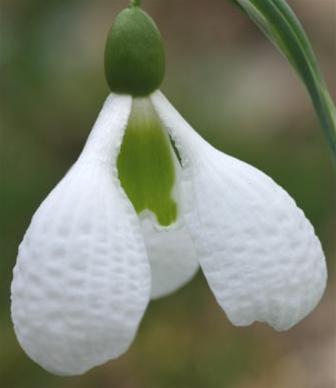
Image.aspxDespite its glamorous appearance, ‘Diggory’ is a vigorous snow drop, if fairly slow to increase,  and would work perfectly happily in a semi-shaded garden situation.

But I soon fell, even more seriously, for another, quieter, utterly lovely snowdrop, Galanthus plicatus ‘Wendy’s Gold’ :another wendy's gold close up wendys goldI love the slight glow of its rich yellow markings and the slim bell-like simplicity of its petals.  ‘Wendy’s Gold’ is the favourite snowdrop of botanical artist, Helga Crouch http:/www.wildlybotanical.co.uk  whose storybook garden in Essex I have written about for the December 2014 edition of Gardens Illustrated Magazine. Helga has a reliable eye for the exquisite and it was brilliant to see ‘Wendy’s Gold’ for myself, better still to learn that it is again an easy garden snowdrop and best of all to be able to buy some there and then at the Physic Garden.

But it was also riveting, within the perfectly groomed context of the snowdrop theatre, to see that the darting elegance of the common snowdrop, Galanthus nivalis holding up so extremely well against its less well known – and more expensive – rivals.

nivalis

There was a great, very simple idea at the Physic Garden for using Galanthus nivalis in large pots – mass planting the snow drops in a mound of soil and using moss to cover the bare earth:

big pot nivalis sunpot shade

Naomi Slade was giving a talk at the garden when I visited and spoke about the different approaches to planting snowdrops in pots.  There is also really helpful practical advice on the website http://www.galanthus.co.uk.

The main reason that collections of snowdrops are kept, preciously and expertly, in alpine houses is to get the watering regime right.  Potted snowdrops need watering throughout their full growth cycle, not just when they are in flower. If they are allowed to get dry and badly wilted, ‘even once’ says Galanthus, (this is where gardening can feel seriously intimidating), the bulbs are likely go dormant prematurely and may take a couple of years to flower well again. The pot should never be allowed to freeze either  – snowdrops are fine, of course, when the ground is frozen but they become vulnerable when in freezing temperatures above ground.

But most gardeners agree that it is still worth a try. The best chance of success is to use a large container and fill it with a thoughtful compost mix – Naomi’s recipe is for John Innes, leaf mould, bonemeal and grit – which, snow drops being greedier than you might think both in pots and in the ground – you replenish every year. In a shady, city garden Naomi proposed a large pot with snowdrops for the early spring and a handsome hosta for summer.  I recommend snow drops planted at the base of the compact, reddish-green Hydrangea preziosa which work brilliantly well in a container and are, of course, bare stemmed at this time of year.

IMG_9148

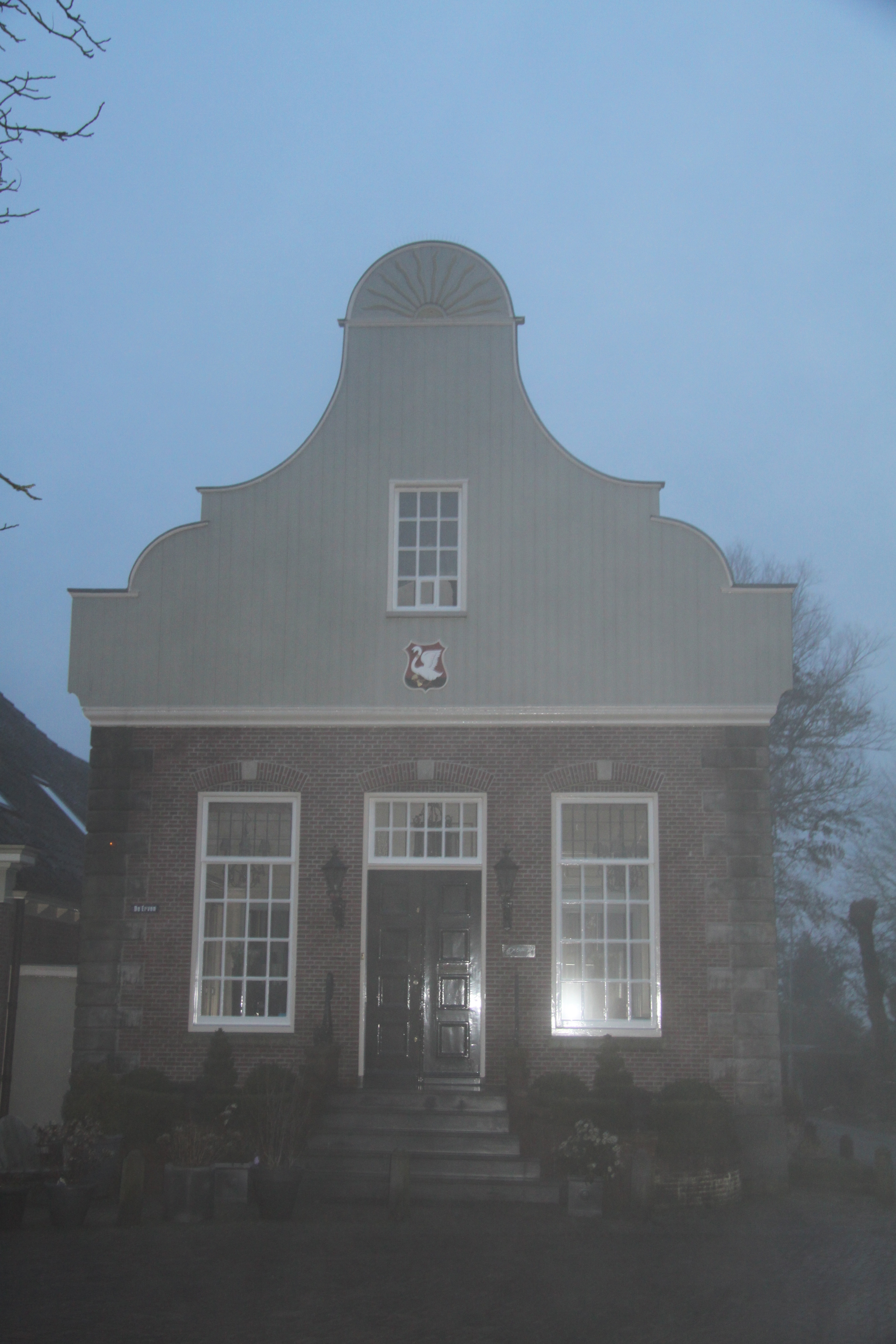
One of the most effective use of snow drops I have seen in a small garden is in the front gardens of the beautiful painted 17th Century wooden lakeside houses in Broek in Waterland just outside Amsterdam – a cosy and atmospheric place to stay if you are visiting the city.broek misty house broek in waterland lakeIn the garden below, the design is clean and spare – a row of glossy topiaried trees densely underplanted with snowdrops, smart and pretty against the deep gloss of the cool grey and white paintwork of the house.
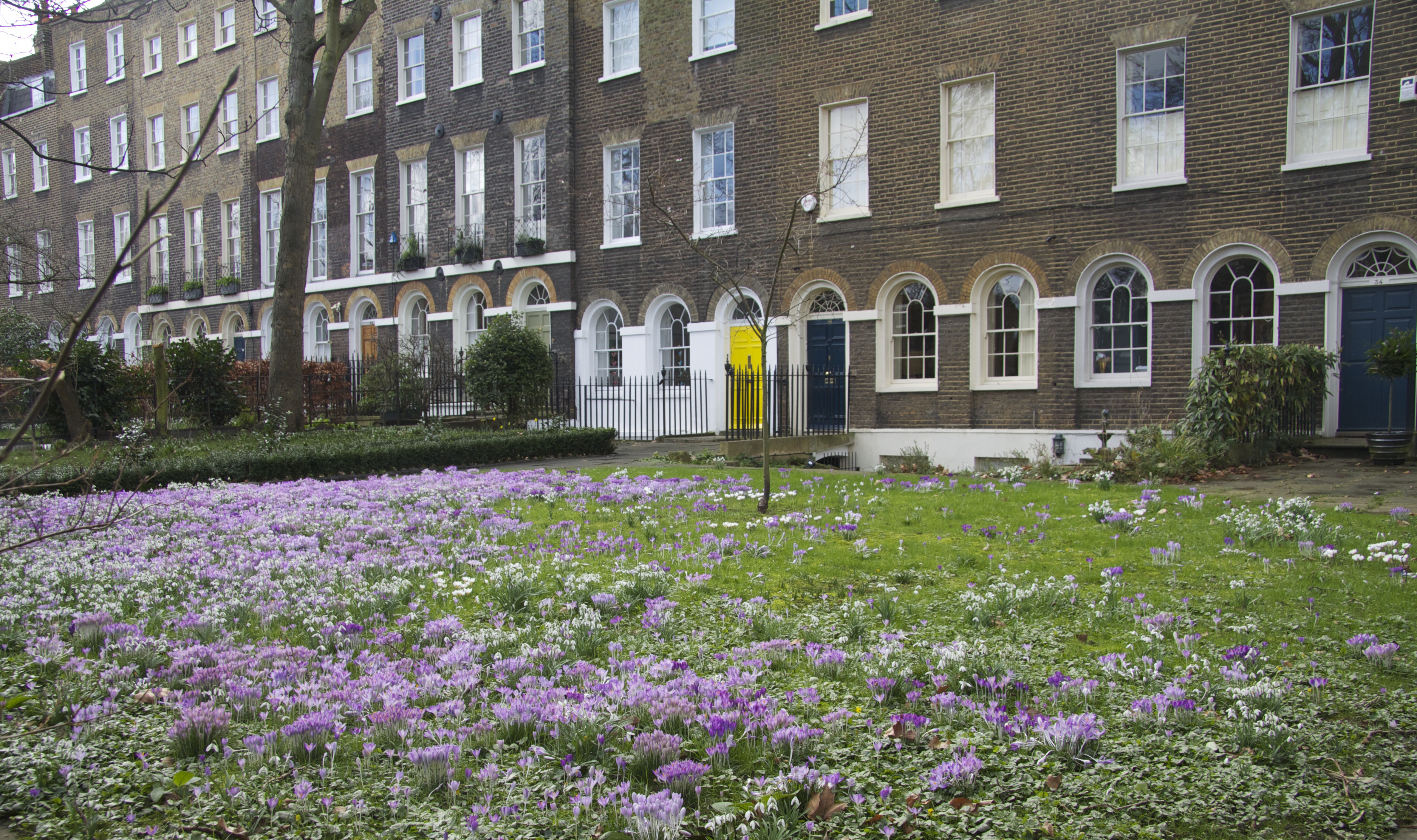
broek snowdrops broek snowdrops closeupBack in Camberwell, my friend, the artist Charlotte Verity  http:/www.charlotteverity.co.uk urged me to walk down the hill to see ‘one of the great London sights of spring’.  camberwell front garden close up massed flowersIt was indeed brilliant to see such a wild sea of white snow drops and mauve Crocus tommasinianus in a world of quiet front lawns and too many recycling bins.
At the top of the hill, Crocus tommasinianus is planted in a more restrained semi circle around a single multi stemmed Magnolia:

closed crocus circle closed crocus close up

The difference in colour intensity after half an hour of February sunshine never fails to amaze me:purple crocus circle purple crocous close up

The great thing about this semi circle of purple is that everyone stops to smile at it for a few weeks and then the lawn returns obediently to green as the year progresses.  I love the idea of secret plantings of crocus. I have a friend who stealthily planted his wife’s initial in the lawn one September so that she would see a silvery-mauve letter ‘O’ suddenly emerge the following Spring.  And I remember seeing a great photograph of long herbaceous borders in the garden at Petersham Nurseries – in a scheme designed, I think, by Mary Keen  – in which the grass path between the borders was planted with crocus creating a playful, chequerboard effect for early spring.

But enough of gorgeous spring days.  When the weather, even in London, was truly atrocious in the middle of the week, the only solution was to go flower hunting inside.

The feisty floral artist, Rebecca Louise Law (www.rebeccalouiselaw.com) was having a solo exhibition at the Coningsby Gallery.GalleryInviteCAROUSEL-1080x580Entering the space you are drawn immediately to the sunnily-lit main installation, ‘The Hated Flowers’:

the hated flowers

hated flowers close upIt is an absolute pleasure to come close to the pink, yellow and red flowers dancing deliciously and plentifully form the sky light on their spun frame of glistening copper wires.  Daughter of a Head Gardener at Anglesey Abbey, Rebecca trained in Fine Art at Newcastle University and has been working in ambitious and original ways with flowers for seventeen years.

I wondered why the title  “The Hated Flowers”?  Rebecca explains that it is a “piece I have wanted to do ever since I experienced the ‘Floristry’ world.  Coming from Art and using flowers as my material, I found it fascinating listening to Florist’s opinions and trends on what flowers to use.  The first rule of high class Floristry is to never buy Chrysanthemums or Carnations, not even to stock them.  I suppose I just wanted to make a statement about this’

We have a very good conversation about the powerful tyranny of fashion in everything including flowers.  Rebecca also tells me more about some of her other works in the exhibition which explore her constant struggle with the ephemeral nature of cut flowers.

There were some wonderful smaller installations: glass cases filled with an alluring complexity of papery dried flowers, butterflies and other treasures.

Also some seductive still life photographs – in collaboration with the photographer Tom Hartford:

pair still life

I really liked these: wonderful homages to Dutch Still Life painting with the Rebecca Louise Law twist of introducing tiny plastic figures into the scene – a Busby Berkeley capped lady swimmer with towel ready for a bathe, a few suited executives ploughing their way through the jungly foliage, a little family group of horses neatly trotting along a leaf.

On the other side of the River, I was blown away later that day by the scale, billowing shape and gorgeous subtlety of her installation in the main body of Garden Museum to celebrate the Museum’s current exhibition, ‘Fashion & Gardens’:

garden museumMy friend, Alice Burroughes and I could not wipe the smiles from our faces.  Museum Director, Christopher Woodward emerged to say hello.  He revealed that the best thing currently about his job was lying on the floor at the end of the day to look upwards: garden museum ceiling

Alice suggested they provide bean bags to encourage people to lie down or that they copy the mirrored trolley idea at Norwich Cathedral which lets you admire the ceiling without strain.

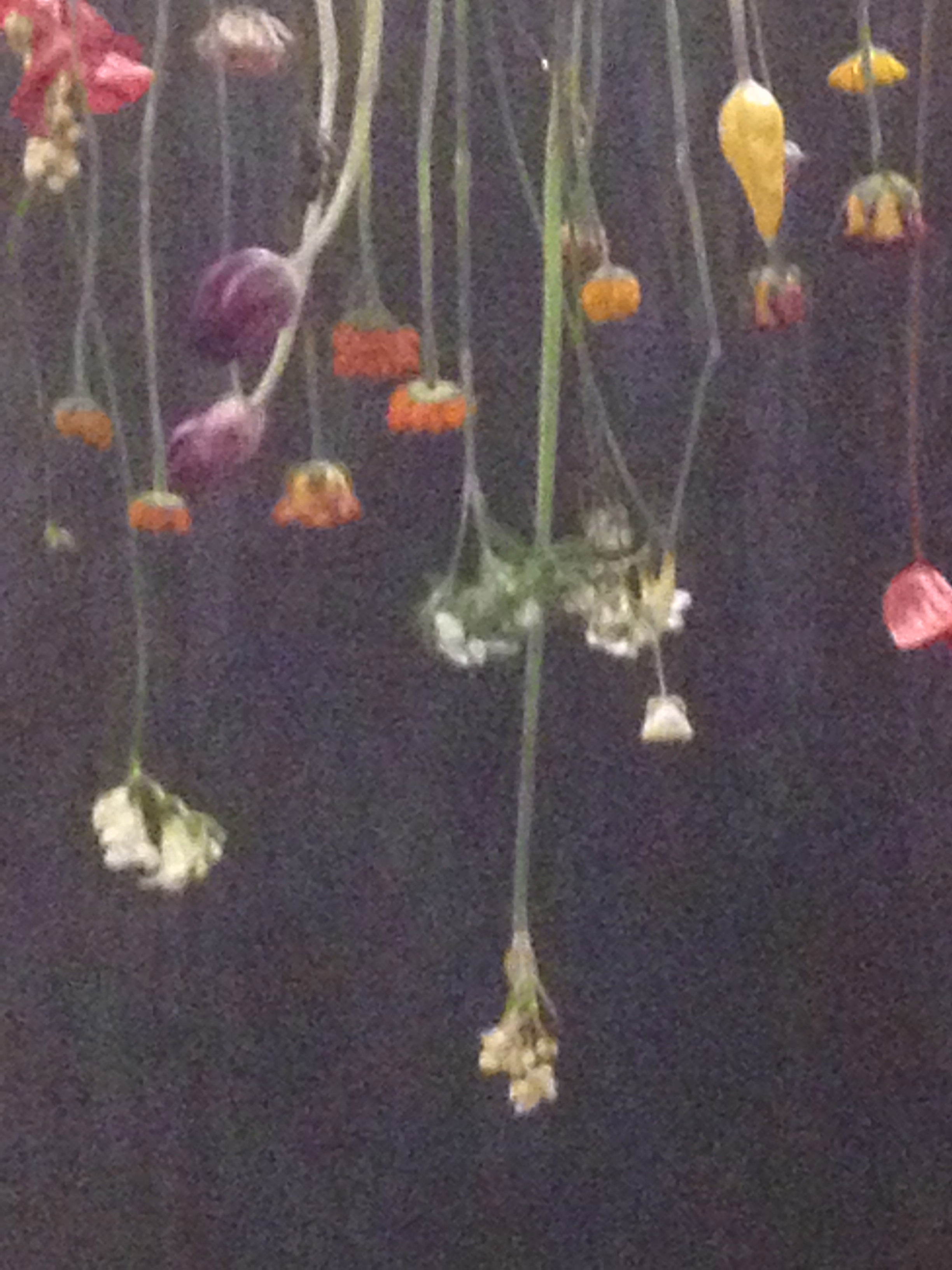
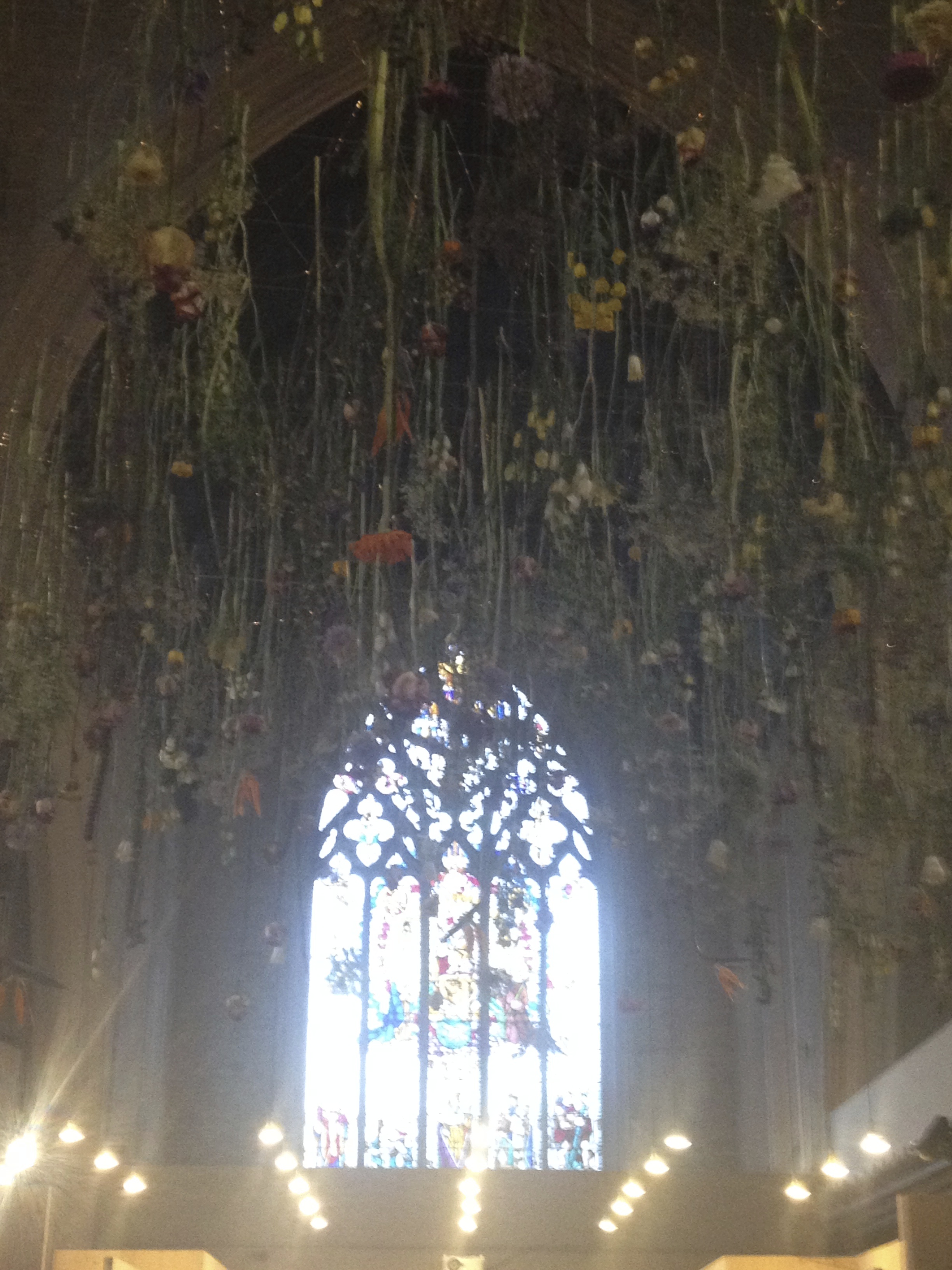
But actually it was fine just noticing the difference in the flowers from different viewpoints. Wonderful and peaceful against black:garden museum against black

hazy and fragmented against the stained glass:
IMG_0680

Alice and I could not resist one last plant fix and walked back to the Courtauld Gallery at Somerset House to see ‘A Dialogue with Nature, Romantic Landscapes from Britain and Germany’.

One particularly luminous watercolour to recommend: Caspar David Friedrich’s ‘Moonlit Landscape’ thought to have been painted around 1808:

Caspar_David_Fried_2807602bA fantastic, ethereal painting in which a full moon floats brightly and symbolically (representing Christ) above a shadowy lakeside scene.  The painting is unusual because it is a ‘transparent’ – the moon’s almost halo-like clarity is achieved by inserting a piece of plain paper behind a hole cut in the painting.  The idea was for transparents to be viewed in a darkened room, lit from behind by a candle, accompanied by music. An unsurpassably civilised solution to a wet and windy night.

Tonight, however, I confess that I will be spending the evening with 7 boys and one girlfriend watching Wales v. France, Six Nations Rugby, on the telly.

My name, Non, is the name of the mother of St David and I am 100% Welsh. One final toast to Rebecca Louise Law who created this supremely cheerful trailing and fluttering column of daffodils for the London Welsh Centre on St David’s Day – March 1st 2011! St-Davids-Flagr-360x480

A SCENTED SWEETSHOP OF COLOUR FOR EARLY SPRING

A JANUARY VISIT TO ASHWOOD NURSERIES

IMG_2112This gorgeous, spirit-lifting image is of a bowl of floating Auricula flowers at the entrance to a small ‘Alpine plant sales’ glasshouse at Ashwood Nurseries which I visited this week, (www.ashwoodnurseries.com).  The nursery is completely worth a pilgrimage even if the round trip from home – London to Wolverhampton and back – is over 250 miles and even if the weather forecast during this wettest January on record is simply not be borne.

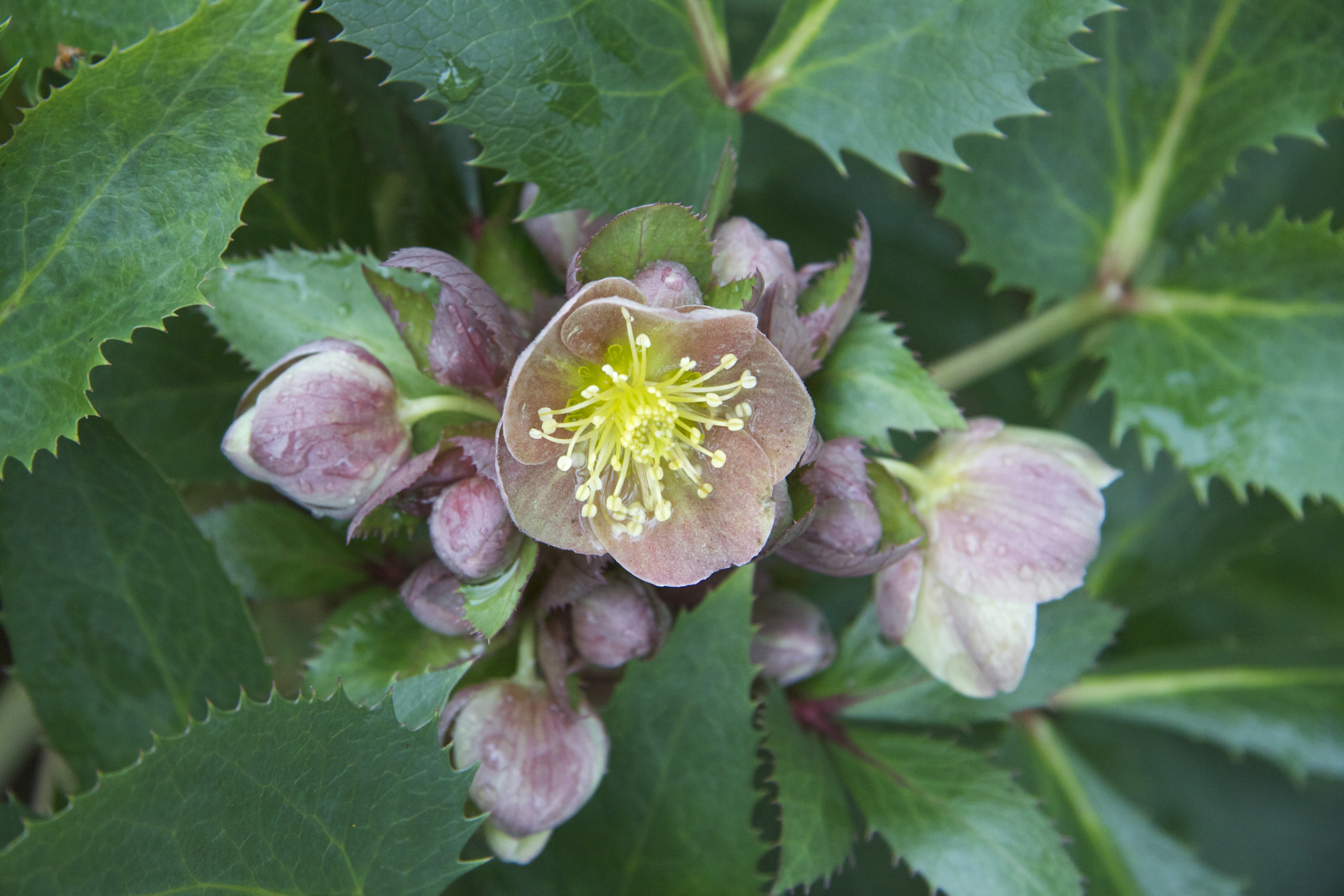
We have come – my friend and garden design partner, Helen Fraser and I – lured by the promise of a rare talk by Witch hazel authority, Chris Lane.  Infuriatingly, we end up arriving late for the morning session but this is Ashwood, a nursery with an extensive and covetable plant collection much of which is for sale – so we are swiftly distracted.  Within moments I am beginning a small love affair with a recently named species Hellebore Helleborus liguricus:

IMG_2024We discover that it is a tall, strong, easy garden plant, with palest green flowers held elegantly well above the foliage and the most extraordinary sweet and powerful scent.  Apparently, people try to compare the scent to that of Mahonia or lemons or even cucumber.  I would say it is definitely citrus-y but I like the idea of cucumber too – it begins to communicate its alluring freshness.  I buy several plants for my partly shaded but very sheltered London terrace. I will use them in combination with Euphorbia mellifera and Polystichum setiferum:

IMG_9153

Nandina domestica:

IMG_9150and Japanese anemone ‘Honorine Jobert’ (for later in the year!):

IMG_0062 I will love to have the graceful, bobbing saucers of intoxicatingly scented pale green just outside my back door.

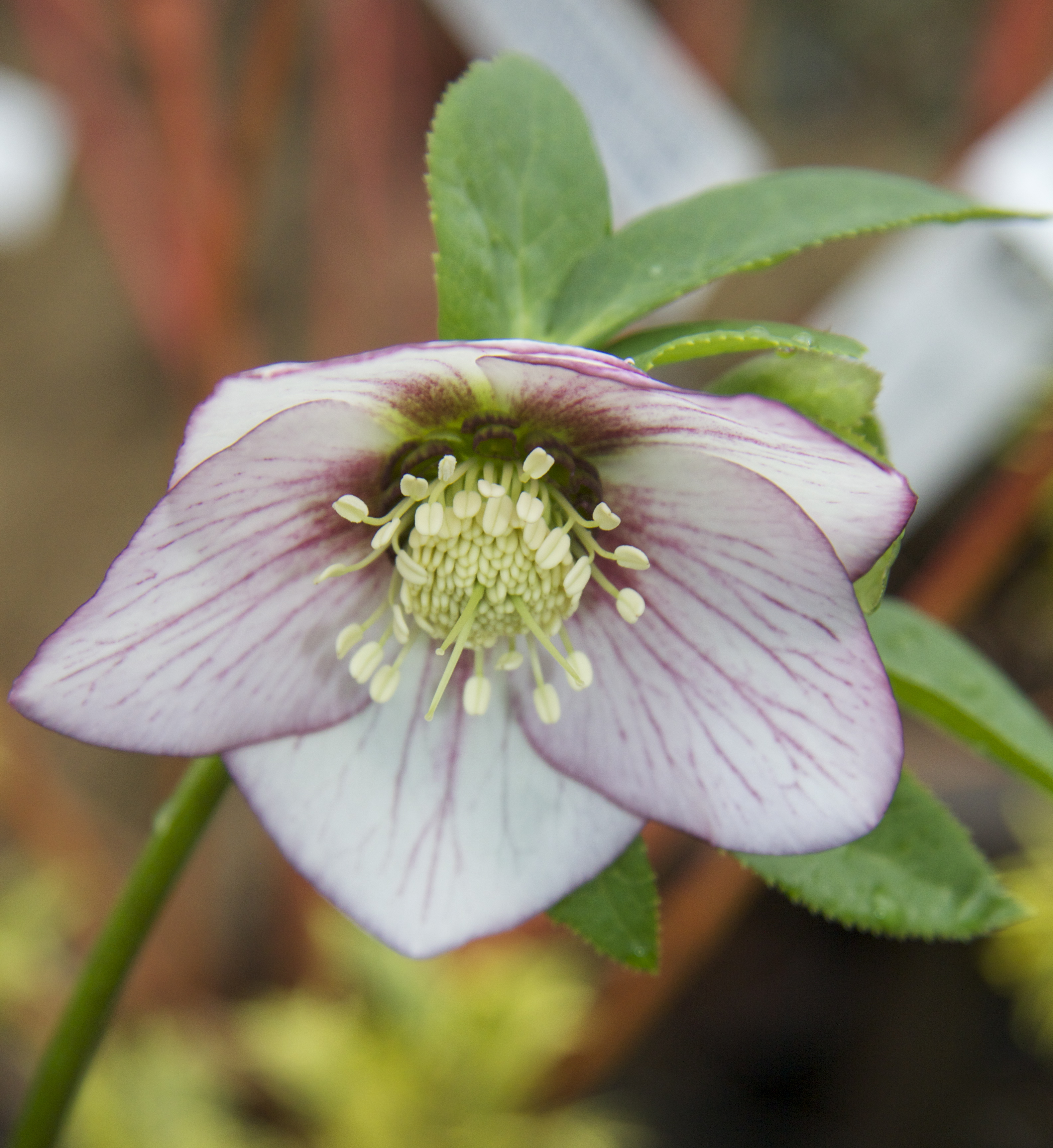
Back at Ashwood Nurseries, we stop to admire the finely etched lines of deep pink on white of this lovely Hellebore:

IMG_2027

– a perfect example of Helleborus x hybridus ‘Ashwood Garden Hybrid’ – hellebores selected for their purity of colour, beautiful markings, quality of their flower form and shape with a reputation for retaining their intensity of colour over a long  period.  We start talking about hellebores to Phillip Burden, an Ashwood nurseryman – whose specialities are in fact Cyclamen, Auricula and Lewisia.  Phillip has the patient, generous-spirited, knowledgeable calm which seems to characterise the approach to plants here.  He invites us to the Hellebore glass house – reserved really for the renowned ‘Hellebore Tours’ where visitors can buy from an exhilerating range of unique plants (you are not too late, there is one further Hellebore day on February 15th). This is the glasshouse – we were feeling pretty excited at this point …

IMG_2031-And here are some of my favourites:

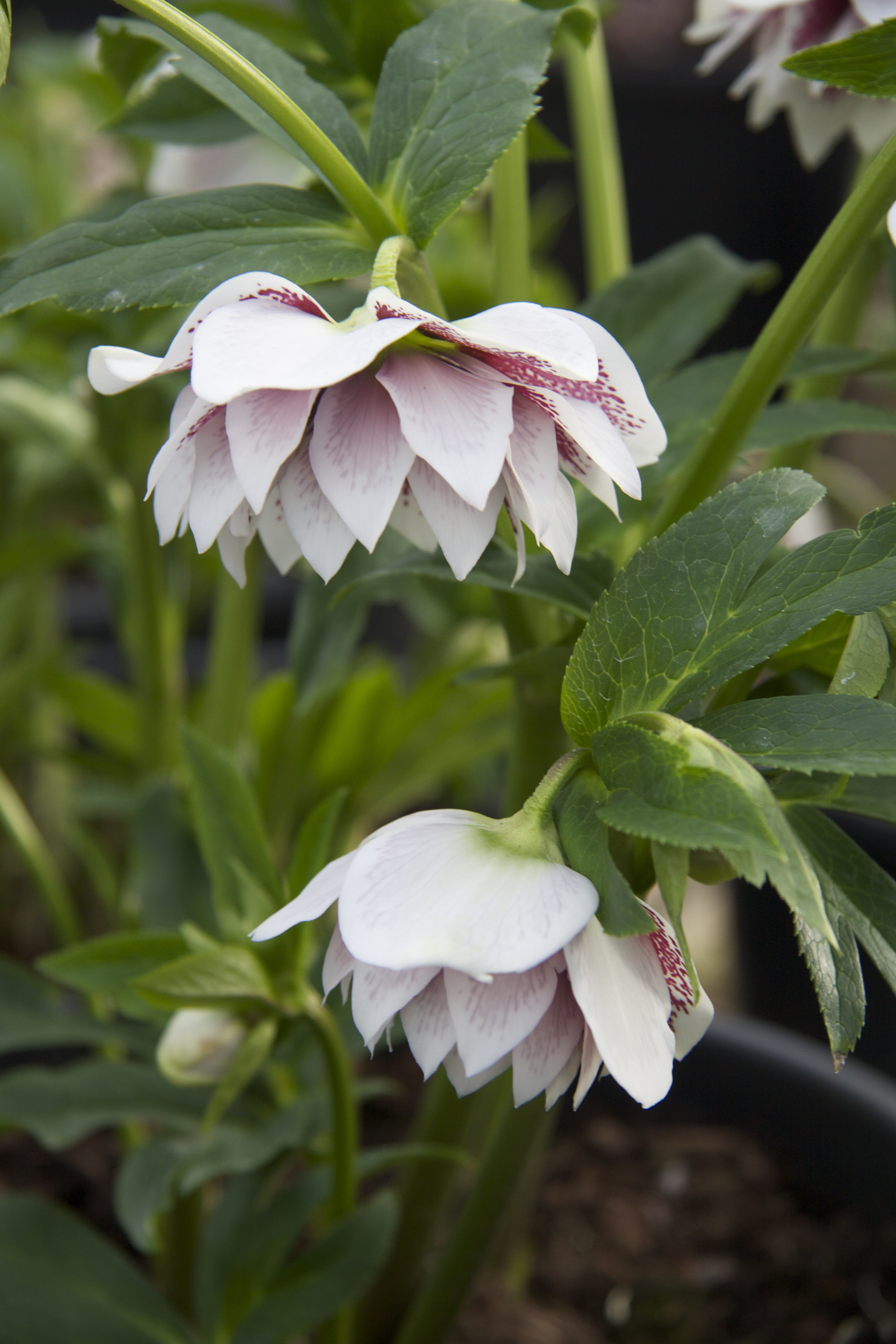
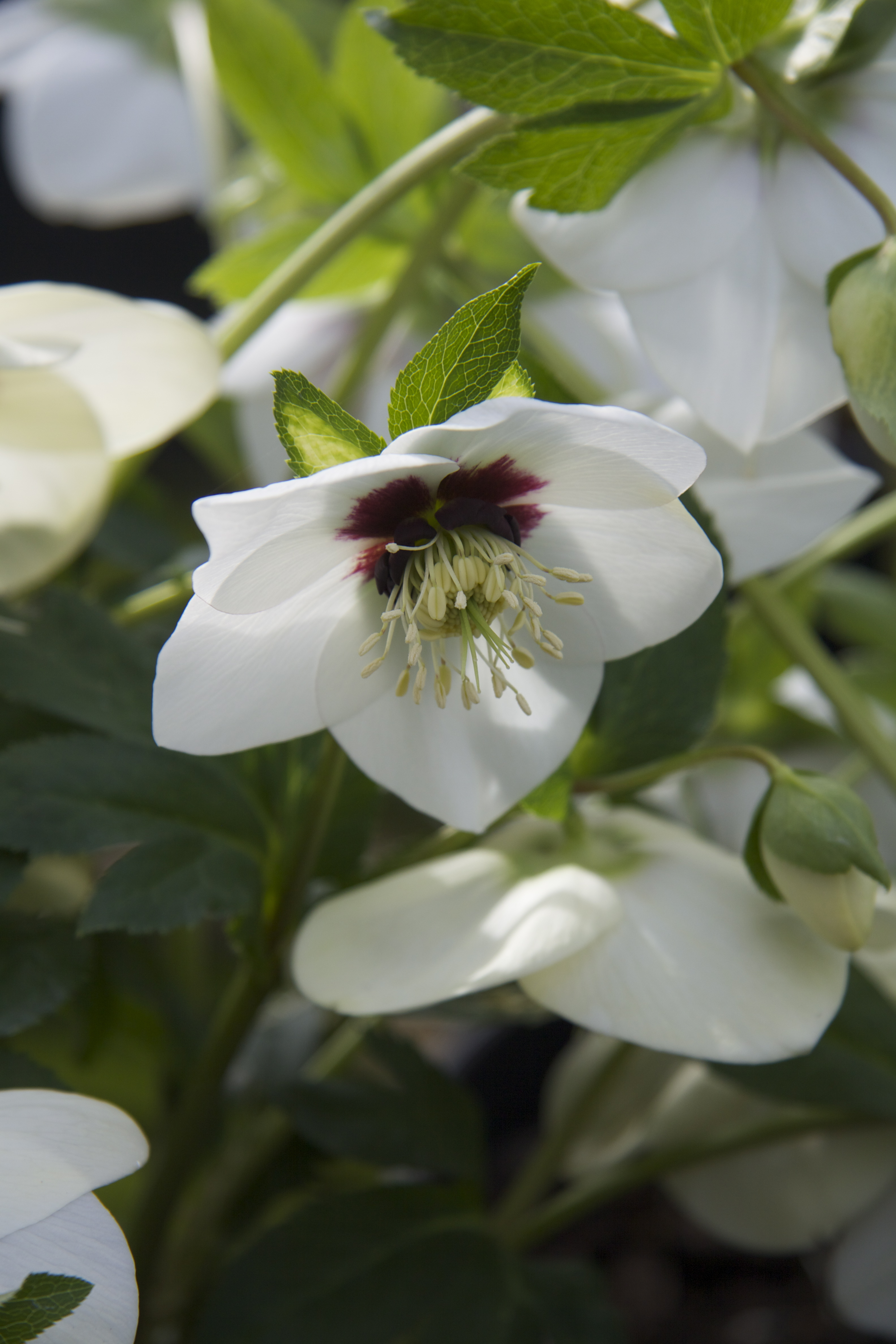
IMG_2040 IMG_2052 IMG_2053 IMG_2036 IMG_2037

A few of the  Ashwood hybrids have slightly extreme, decorative qualities which are perhaps for specialist collectors only but most of them are subtle and gorgeous, super-healthy plants which would be wonderful additions to soft and natural spring gardens.

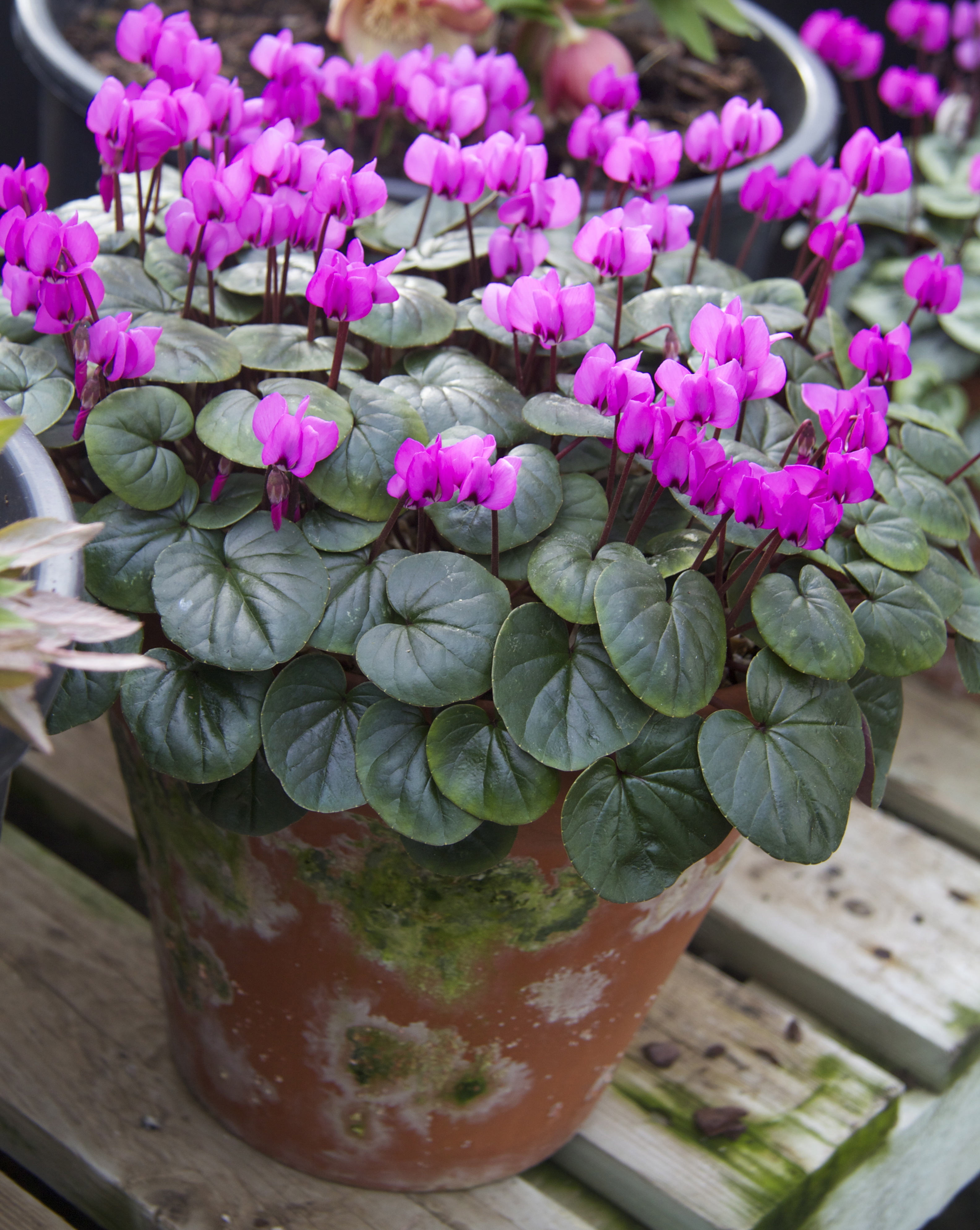
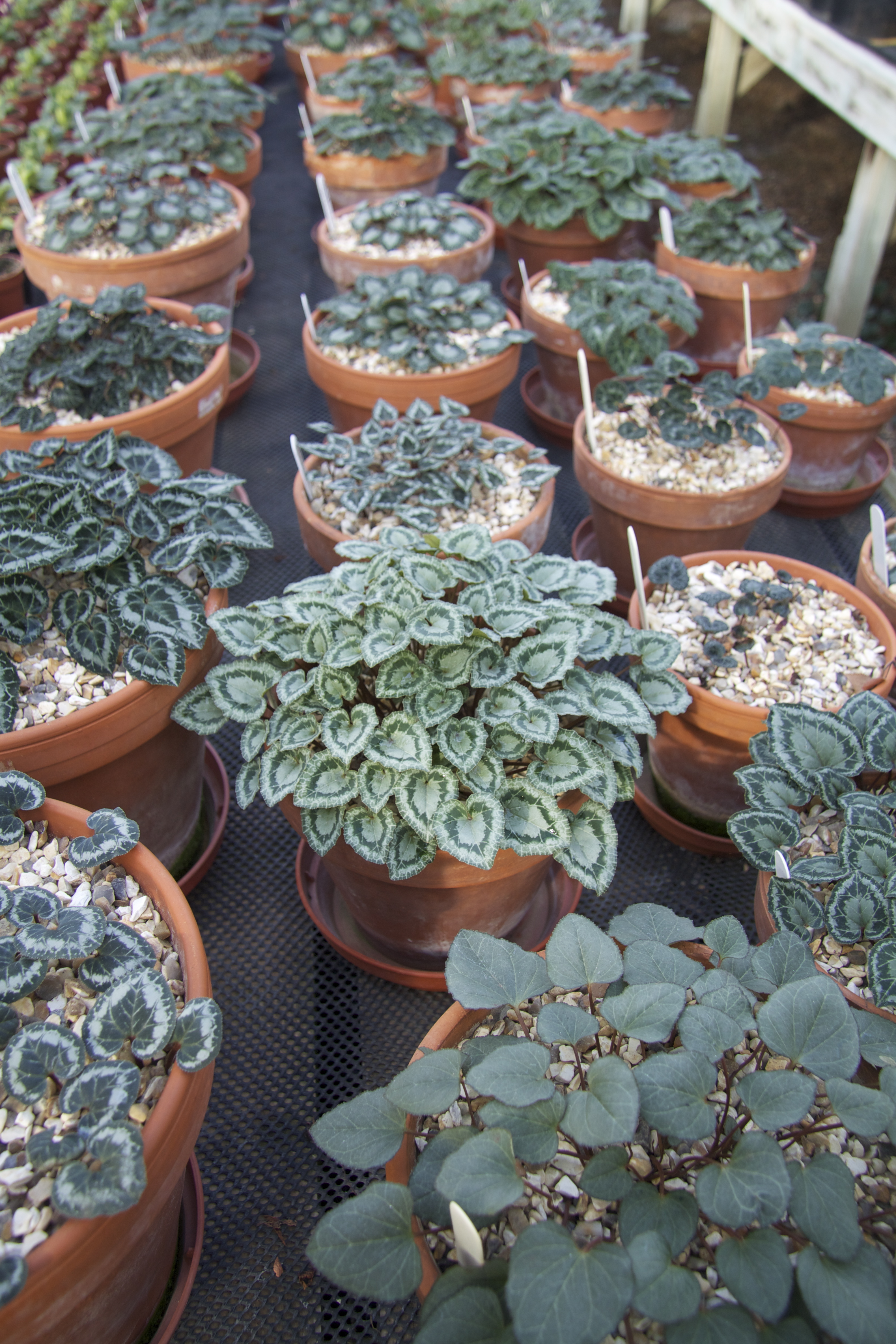
Dizzy with hellebores, we move onto Cyclamen.  Phillip shows us fantastic fat pots of Cyclamen coum.cyclamen coum1cyclamen coum 2 We are struck by the tremendous success of the seemingly simple idea of taking one 9cm pot of Cyclamen coum, potting it up with plenty of drainage “perlite rather than grit”, says Phillip, and just transferring it to a slightly larger pot each year.  The plants he shows us are satisfyingly dense and offer a brilliant injection of colour – they are ten years old. I buy a tiny pot and pledge to keep it going for at least a decade.

We move onto more rarified treasures such as the delicate windmill-flowered Cyclamen alpinum:IMG_2065Dangerously tempting, but these are jewels for a glass house or alpine house and not for outside.

We are bowled over by the quietly dazzling subtleties of the Cyclamen creticum foliage:

IMG_2058and smile at the rarest of all with its excellent label:

IMG_2062And then we are outside again and have the chance to see nursery owner, John Massey’s private garden.

The Cyclamen coum is looking as vibrant outside as it does under glass – and looks great, gentler probably, with the ground covered with a mulch of fine gravel rather than just bare earth:

IMG_2109Not surprisingly, my favourite moments here on this bitter day are small ones.  I love to see the tiny buds of the small spreading tree, Cornus mas just on the verge of opening – ten days more and it will be a haze of bright yellow:

cornus mas

After admiring  the fine princesses of the Hellebore world, it is a pleasure to see the distinctly muscly, Helleborus x sternii with soft pink-grey flowers take on the role of a small architecutural shrub:

Helleborus x sterniiclose up sterniiAnd I love the dense mat of Cyclamen hederifolium, Ajuga and the bright green Euphorbia cyparissias – fantastic persian-carpet-like ground cover under mature trees.

ground coe=ver matBut what about the witch hazel?  There are Witch hazels in John Massey’s garden:

IMG_2099and although the day was too grim for us too find their scent they offered bursts of clear yellow and rich gold – especially effective as glimpsed in the denser planting in the private area  around his house.  Chris Lane – who breeds Hamamelis and has the national collection gave a wonderful and inspiring talk about Hamamelis x intermedia – a talk with human passion as the clear cornerstone to the wonderful range of Witch hazel available to us today.

But the next day my plan to visit Chris’s nursery in Kent (www.witchhazelnursery.com)  to photograph his incredible collection was just washed out by the non-stop rain. And so I have decided write about Witch hazel properly another time.

Eating away at me, however, is Chris’s dangerous suggestion that as well as fantastic mature specimens in the Savill and Valley Gardens near Windsor, the place to see Witch Hazels is the ‘Hamamelisfest’, (on until 23rd February), at the Kalmthout Arboretum near Antwerp in Belgium – the original home of many of the intermedia hybrid Hamamelis we grow today.

naamloos2_tcm7-164262The real celebration here is seeing Witch Hazels which have become glorious spreading trees in their own right.

I am becoming increasingly keen on letting a good plant have the space it really needs.  At Fullers Mill Garden in Suffolk (www.fullersmillgarden.org.uk) there is a single, prize witch hazel which lights up the woodland in winter – not least because it is has been given room to throw out its arms and be itself.

fullers mill sunfullers mill snow

CASA DE PILATOS, SEVILLE

BRILLIANT TILES, PAINTED WALLS AND FRAMED VIEWS IN A PERFECT COURTYARD GARDEN
IMG

It’s cold outside in London. Although I can sometimes enjoy a dreamy morning like this, as I set off  around my local park…

IMG_0632

…and sometimes foggy days in London town do indeed have the ability to turn into mornings like this…

IMG_0599

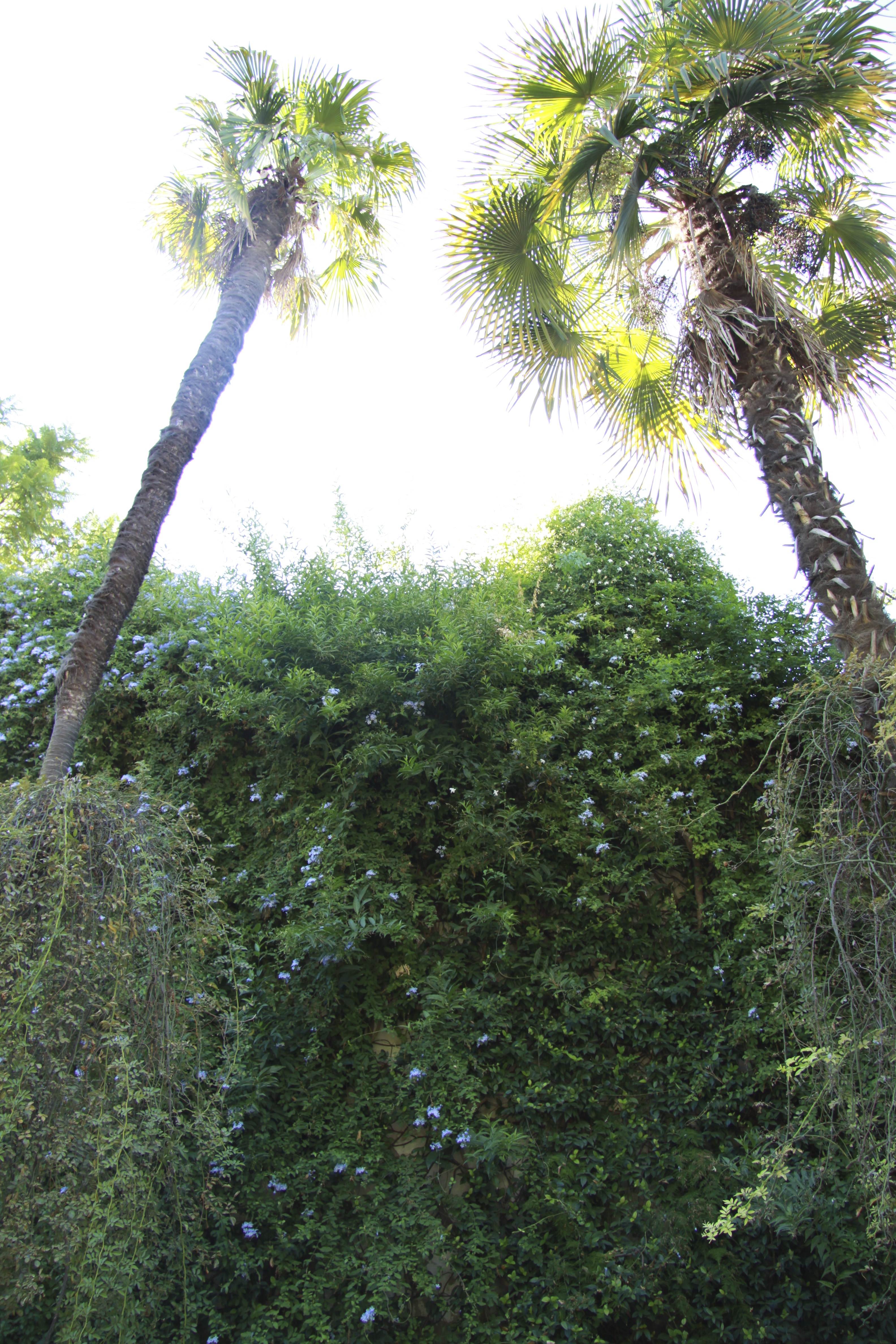
…what I am really dreaming of, as the rain begins again and every stretch of green turns into a murky expanse of brown, is THIS – soaring palm trees and walls heavily, exuberantly cloaked with billowing Plumbago, Bougainvillea and Jasmine:

palm trees

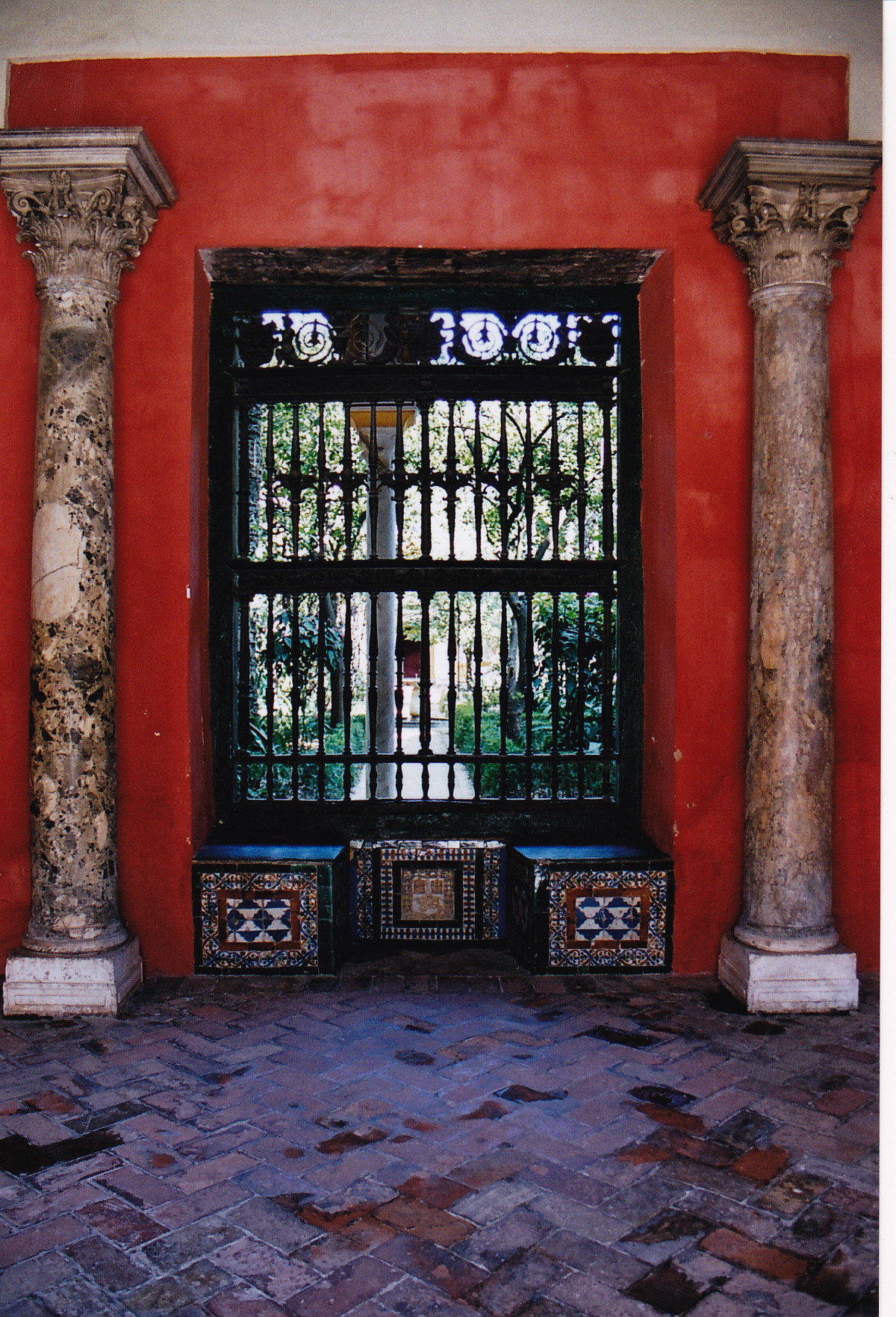
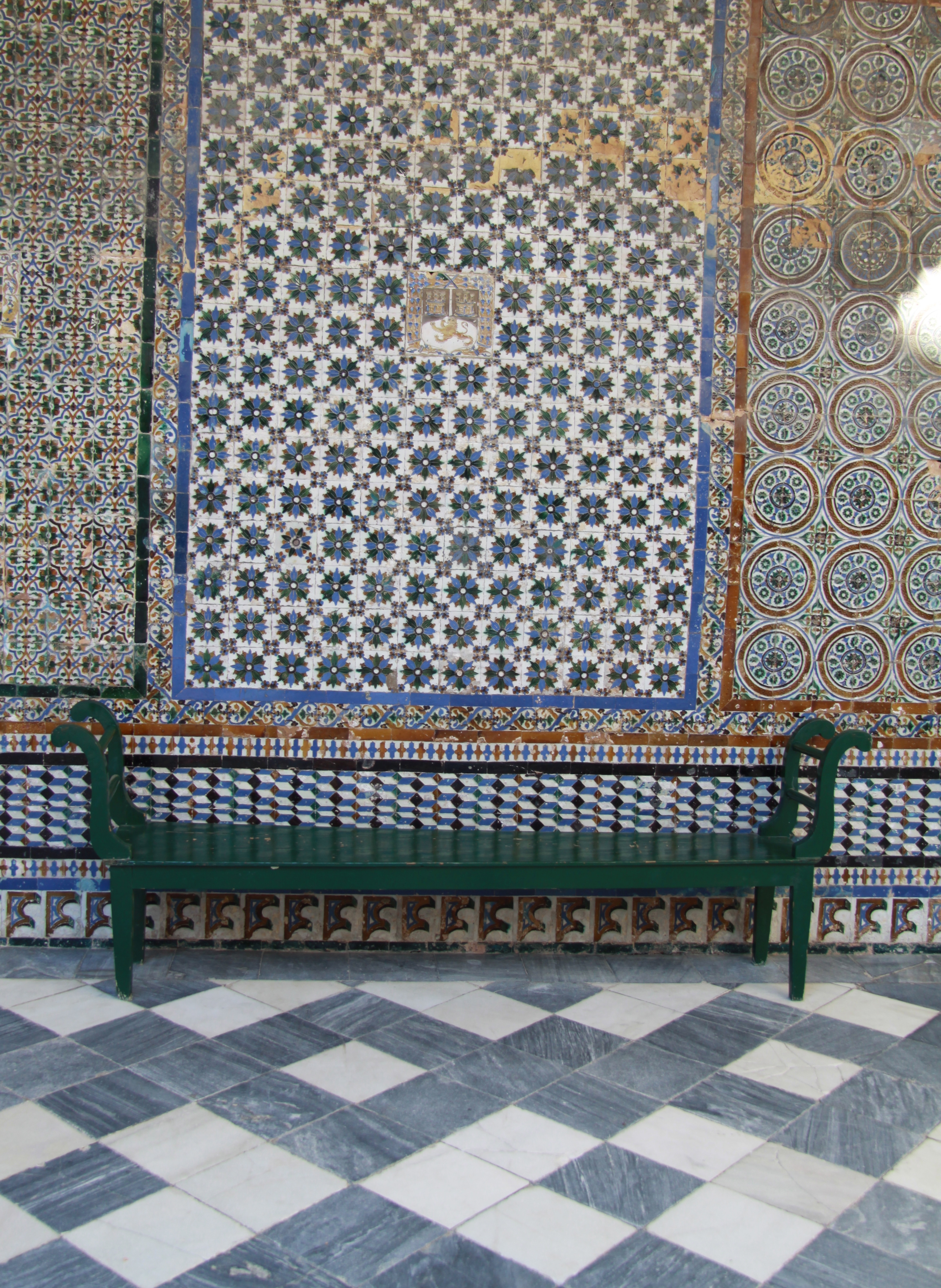
The Casa de Pilatos in Seville is one of my favourite gardens in the world. A wonderful series of elegant, slightly faded gardens, courtyards and loggias, exquisitely and abundantly decorated – with five hundred year old Cuenca tiles (Casa de Pilatos holds one of the largest collections in the world):

more tiling

detail tiling

and richly pigmented paint:IMG_0001

It is above all a masterclass in thinking about the garden from the interior of a building, with the different garden rooms, framing the view , luring the visitor from one part of the space to another.

entrance gate

yellow chamber doorgreen beyond the corridor

I could be lured there again anytime.  Seville in Southern Spain is a great place to visit in the cooler months of the year.  The last few days of January 2014 will apparently be sunny, with day time temperatures of between 15 – 20°C.

I start to smile when I am in a part of the world where the windows are bordered in yellow

entrance cleaner

and where you can stop for a moment to  enjoy the muscly elegance of its doors. Here is  a wonderful glossy green paint and brass door in the nearby hilltop town of Carmona:

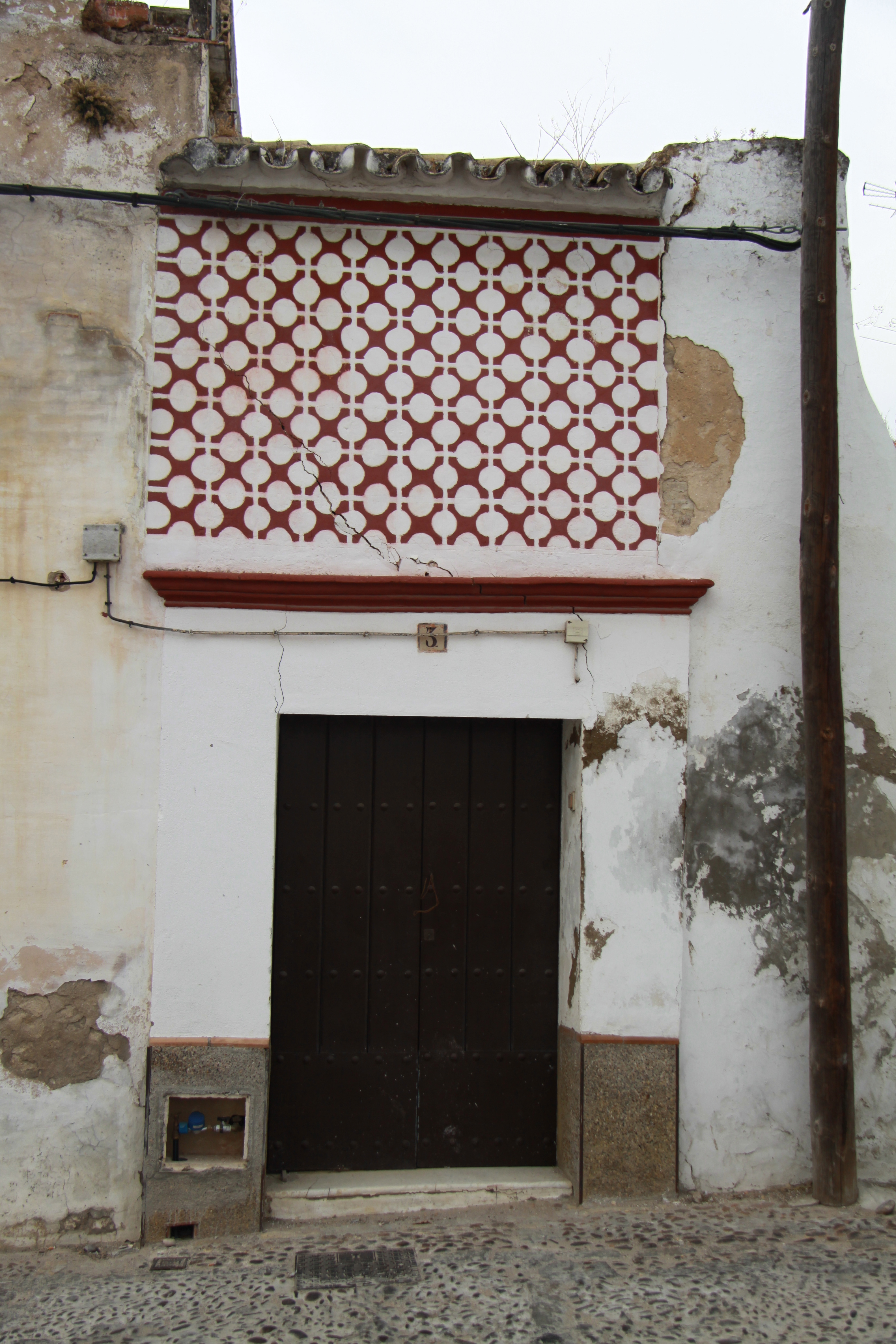
palace of justice door detail And here is the kind of soft geometric wall pattern that you find a burst of everywhere:

painted wall cordoba

It would be great to try something like this in a London garden:

close up painted wall

Cool, verdant courtyards are crucial here to provide somewhere to sit and calm the spirit when temperatures rise.  And there are lessons everywhere we could take away for urban back gardens anywhere.

The rusty orange awnings that can be drawn to completely enclose a courtyard

orange blind close up

are clean and elegant and cast a brilliant glow on the patio below.  IMG_0007

Casa de Pilatos itself, in the Santa Cruz district of Seville, is the ultimate courtyard garden.  Created within the exquisite walls of an innovative and influential Andalusian palace, it was built in several phases in the fifteenth and sixteenth centuries for a wealthy Aristocratic family.  The first ambitious phase built by the Chief Governor of Andalusia, Don Pedro Enriquez, and his hugely wealthy wife, Dona Catalina de Ribera in 1482.

Behind the simple, gothic facade (with excellently riveted double doors):

IMG_0005 IMG_0006is an elegant cloud- coloured mansion built around a spacious central patio in the lacy, Mudejar style :

IMG_0001

During the sixteenth century, successive generations of the family travelled to Italy and returned inspired by Renaissance ideas  – and loaded up with classical sculpture.   Remodelling – to include ideas found in Italian architecture – took place between 1526 and 1539 and again in 1568 when Neopolitan architect, Benvenuto Tortello was commissioned to build a ‘new palace’ within the gardens of the Casa, the main purpose of which was to house the now extensive collection of classical art.

In particular, Tortello adapted the Italian notion of the Loggia – traditionally an open-sided building with views over the countryside – to suit the Casa de Pilatos’ position amongst a dense urban network of Seville streets, and of course the Aristocratic desire to be screened from public view. Two loggias and an arcaded corridor were built opening instead onto the enclosed gardens – creating an intimate and yet monumental setting for the extraordinary family collection.

IMG_0003

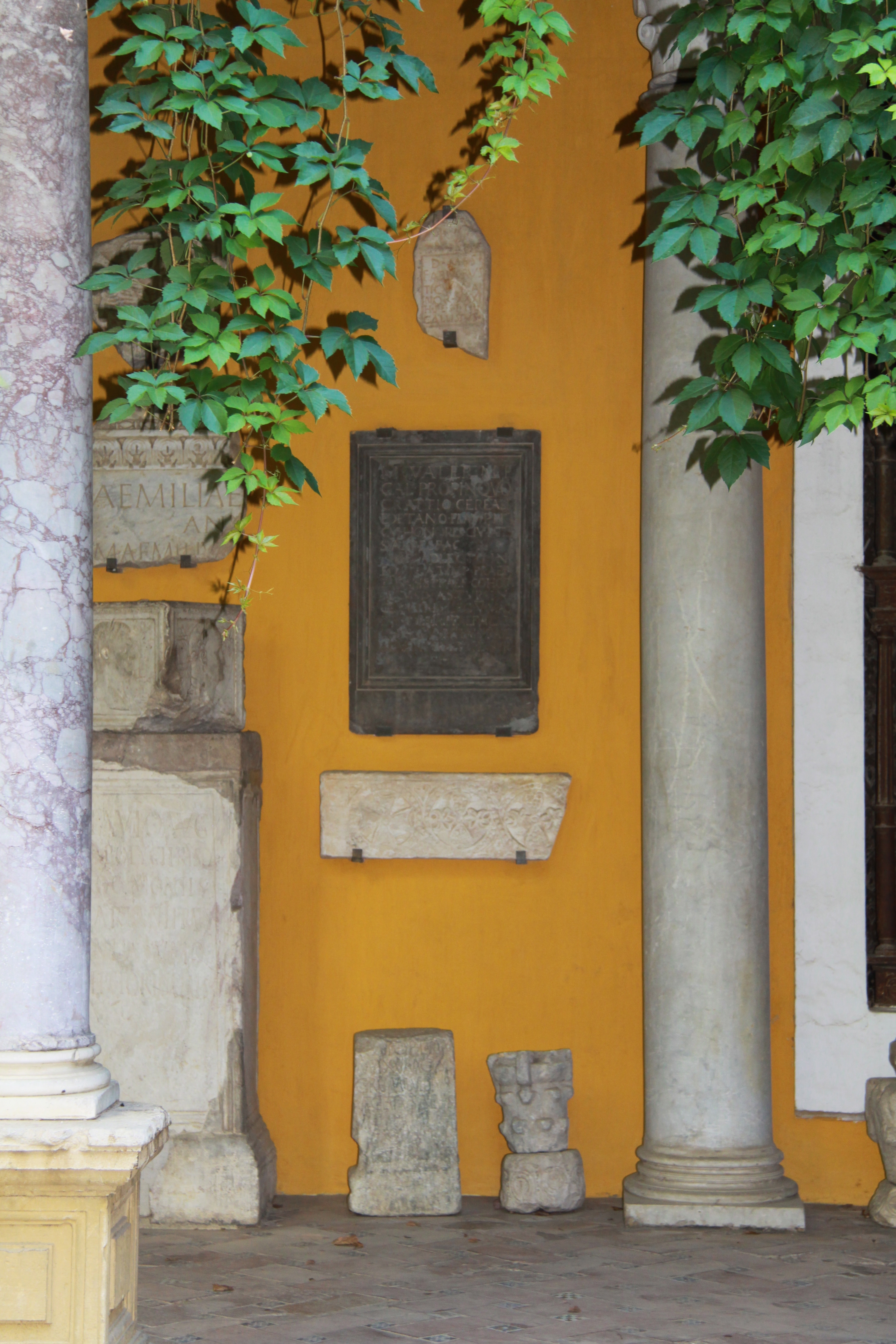
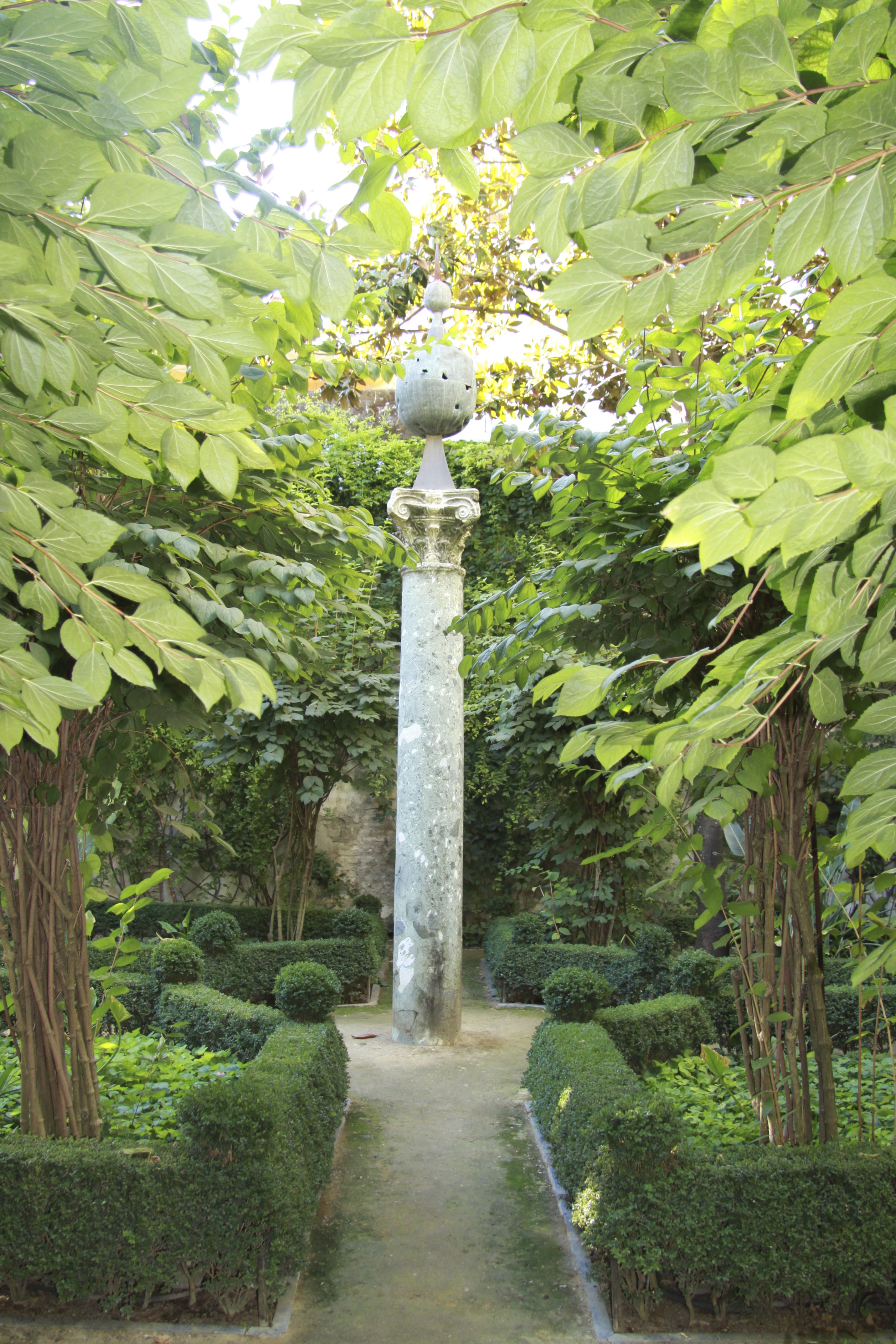
Here, the combination of deep ochre yellow walls, perfectly placed sculptures and fragments of classical architecture and a soft green fringe of lingering foliage is seductive and feels entirely personal.

tablets yellow wall green fringecentral stone

Everywhere, the extent of the detailing is breathtaking. If you look down, the chalky terracotta floor is embedded with jewel-like coats of arms:

detail floorIf you look up, an iron gate may be framed with a gorgeous corrugated roof of jade-coloured tiles:

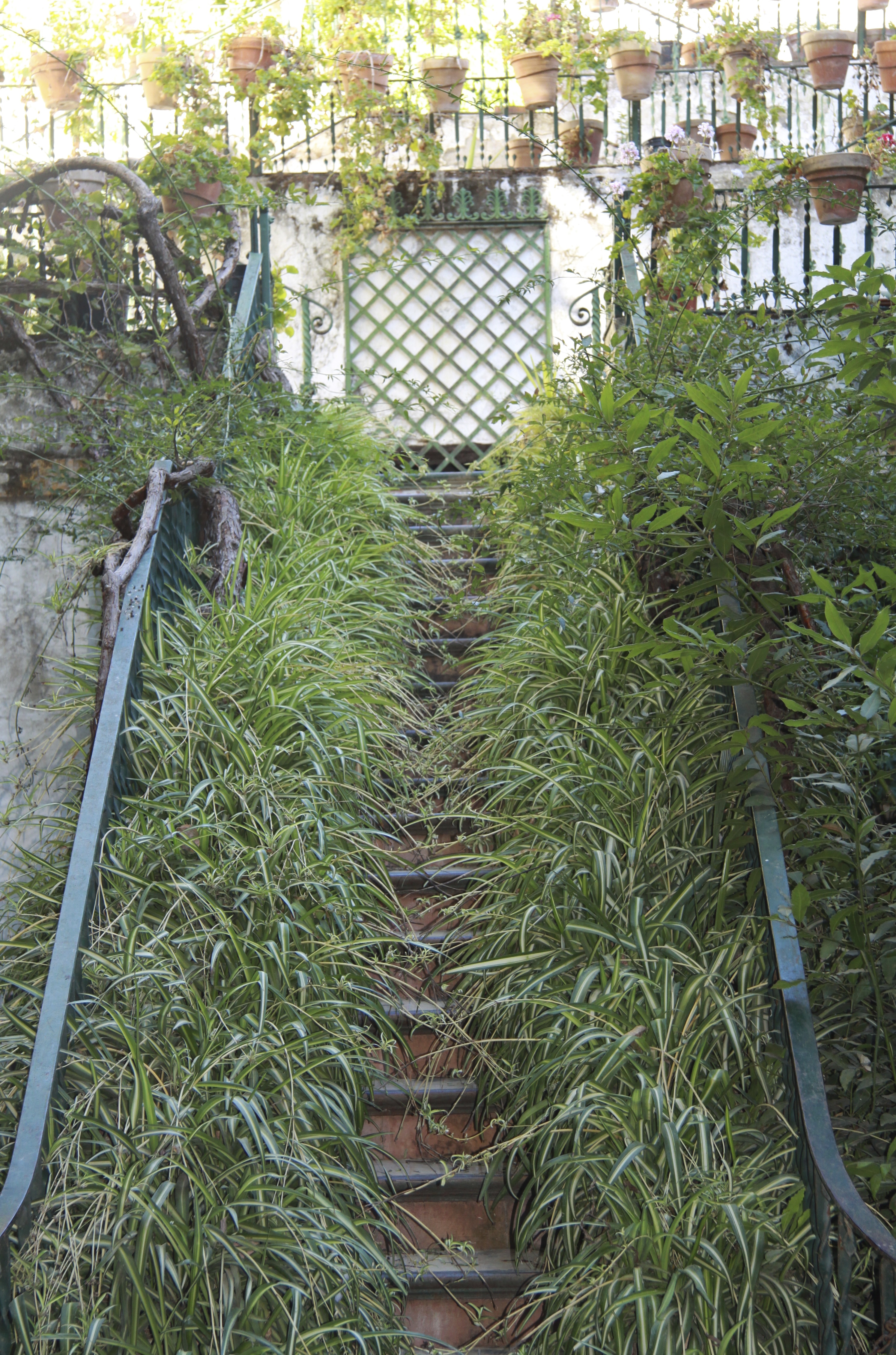
green roof tileEven the steps up to a working area of the palace are densely lined with pots of impressively lush spider plants IMG_3825

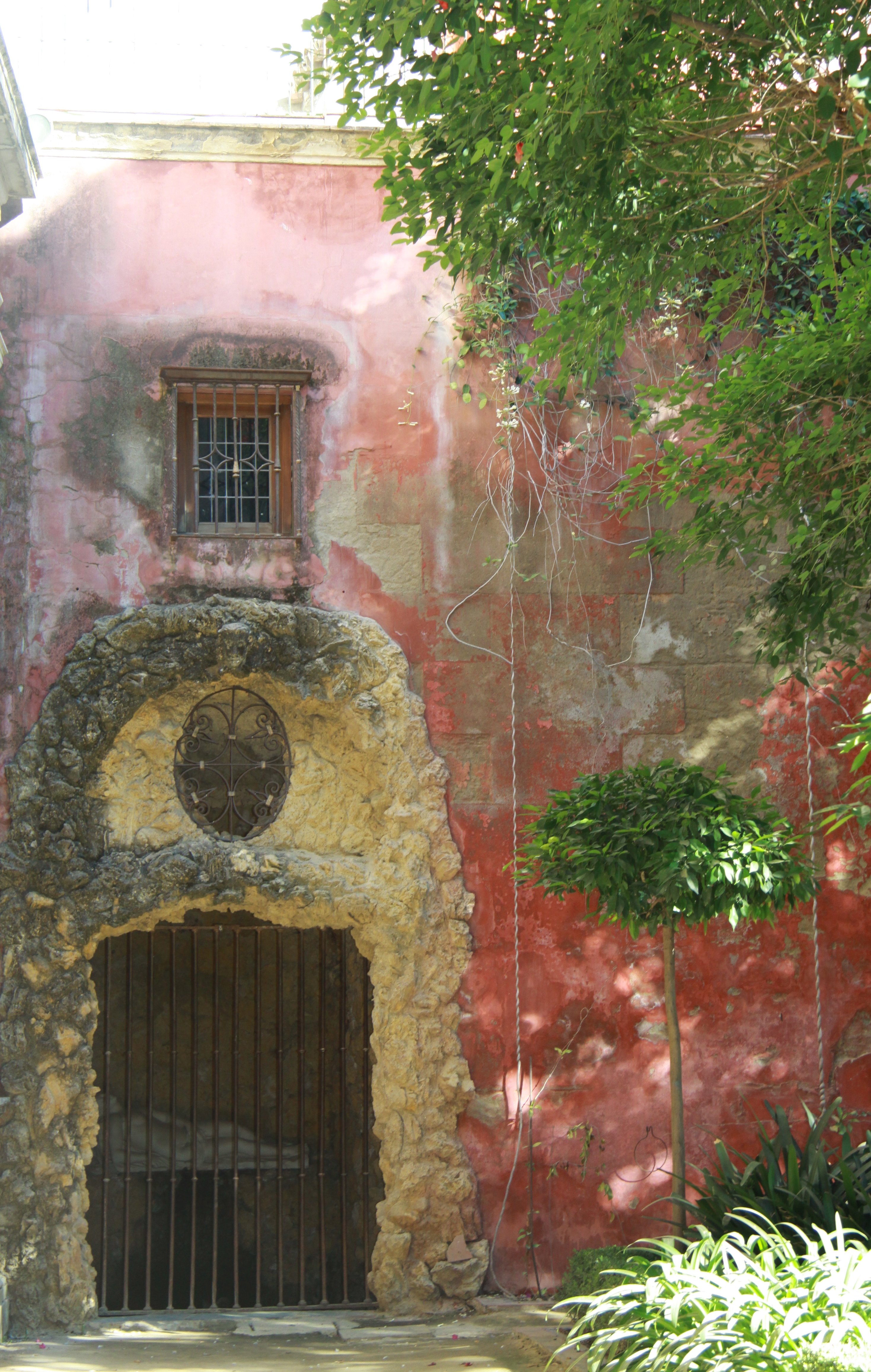
A tactile mannerist grotto – turbulant papier-mâché style pebble work against a crumbling Venetian red wall – houses a sixteenth century marble ‘Sleeping Venus’

pink grotto–  it is a delicious surprise after the cool, intricate elegance of the Mudejar plasterwork. lacy wall and tiles

The planting itself is a slightly ramshackle version of formal, with fading Acanthus casting laddered shadows against the walls,

IMG_0002mounds of suckering but sweetly scented Clerodendrum bungei,

IMG_0003and trees of rather mismatching scales amongst ranks of Aganpanthus.

IMG_3847

But it is this relaxed, comfortable imperfection, combined with the quality of the architecture and decorative elements that make it such a pleasure to visit.

I love the rugged, hairy  palm tree trunks and their stiff strings of fat pea-like seeds –IMG_0009

in such close proximity to the fine, Mudejar, marquetry doors and shutters:

IMG_0010

and the intense, sometimes incredibly freely-patterned, tiling.

IMG_0004I love the way the trees are allowed to close over sculptures to form a bright green canopy:

verdant towerand the way shadows form new patterns of their own against the rich backdrop of colour and tile.pot shadow tile

I love the way a bench can be merely another curving line of green against an intense, multicoloured tapestry of tiling:

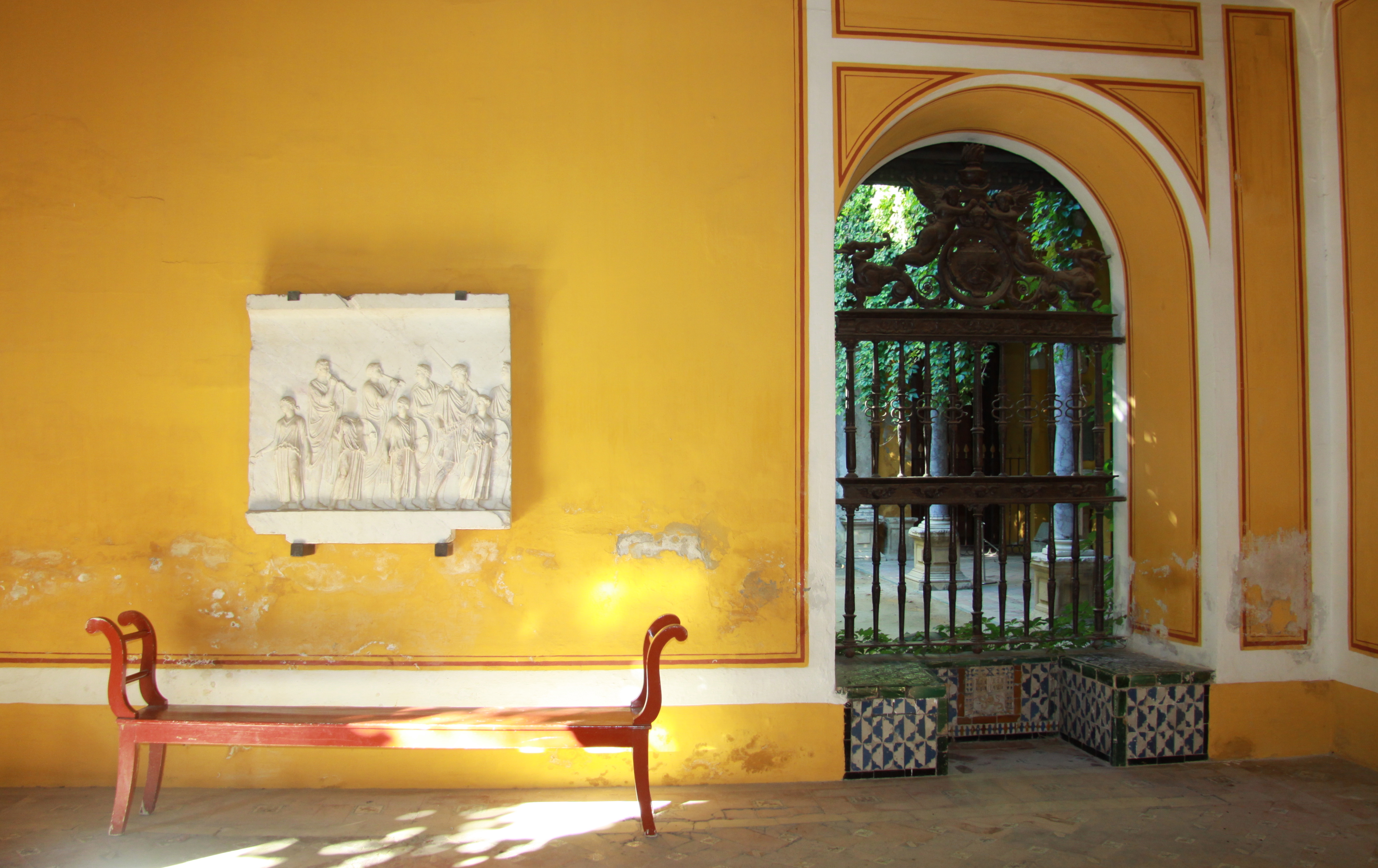
tile benchor it can provide a perfectly judged balance of red against yellow in a neighbouring room.

yellow chamber with benchCasa de Pilatos has the eclectic charm and multi-layered beauty of a house and garden which have been cherished and invested in by generations of passionate owners.  It has a romantic, timeless atmosphere that could perhaps be the starting point for lifting an interior or an exterior design simply by painting a wall in a rich yellow geometric pattern:

IMG_0002Or it could be the trigger to a hundred stories and daydreams.  It is not surprising to discover that David Lean used the Casa de Pilatos along with other locations in Seville to represent Cairo in his film, Lawrence of Arabia – Peter O’Toole’s Lawrence meets Jack Hawkins’ General Allenby in the main patio:

3620131502184552w lawrence-of-arabia-1962I am very tempted to jump on a plane …IMG_0008

RED GOLD GREEN AND WHITE FOR ADVENT

IVY, BERRIES AND THE FIRST SIGHT OF SNOW
0527533k6-Fichte1

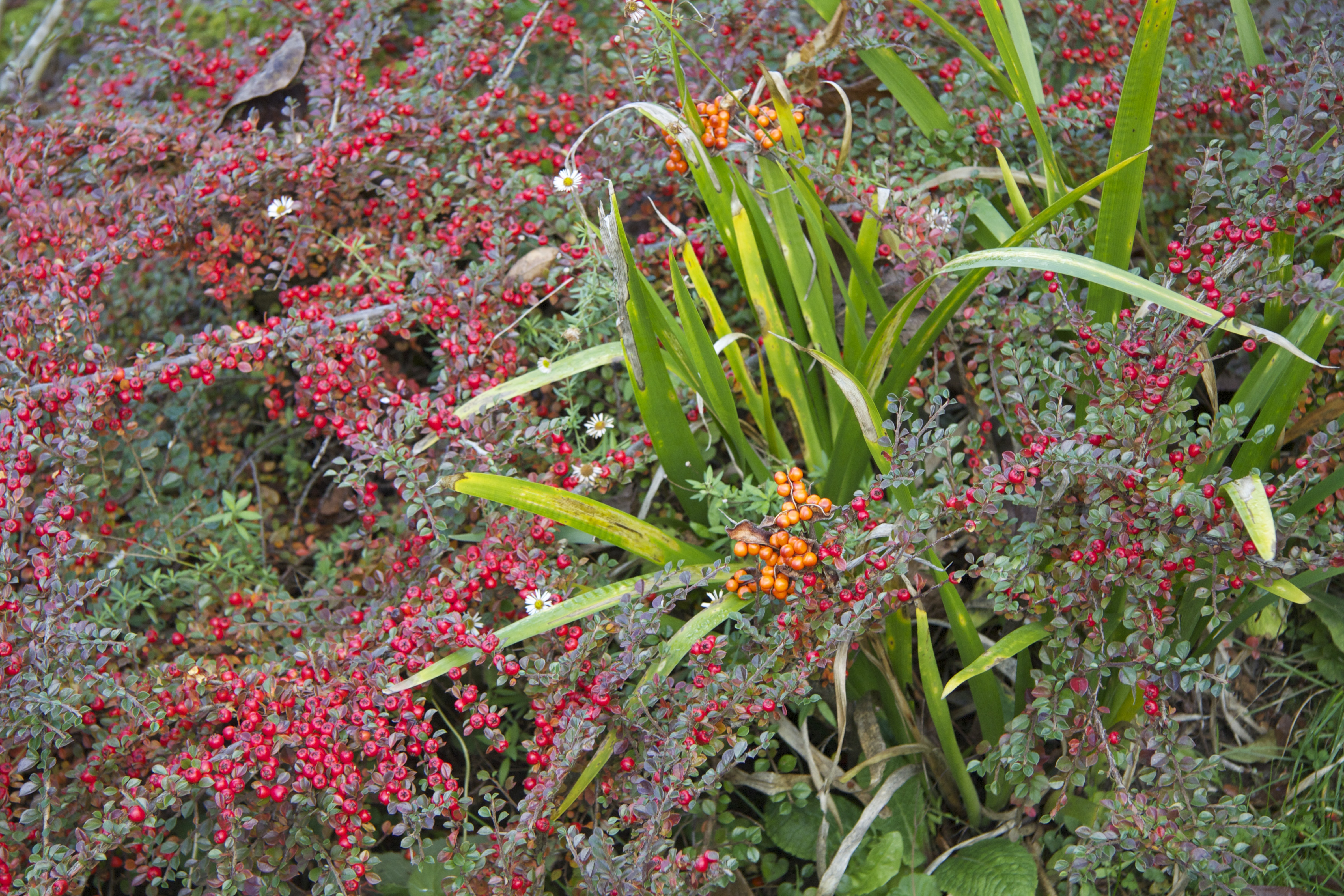
On the cusp of December, on a day of thin winter sunshine, I visit Great Dixter (http://wwwgreatdixter.com) for the last time this year.  The garden is still ablaze with the crimson berries of Cotoneaster horizontalis. In one celebratory combination the orange berries of Iris foetidus burst up brilliantly through its fan-shaped branches.

cotoneaster and irisRound the corner in the sunken Barn Garden, something completely magical and unexpected is waiting for us.

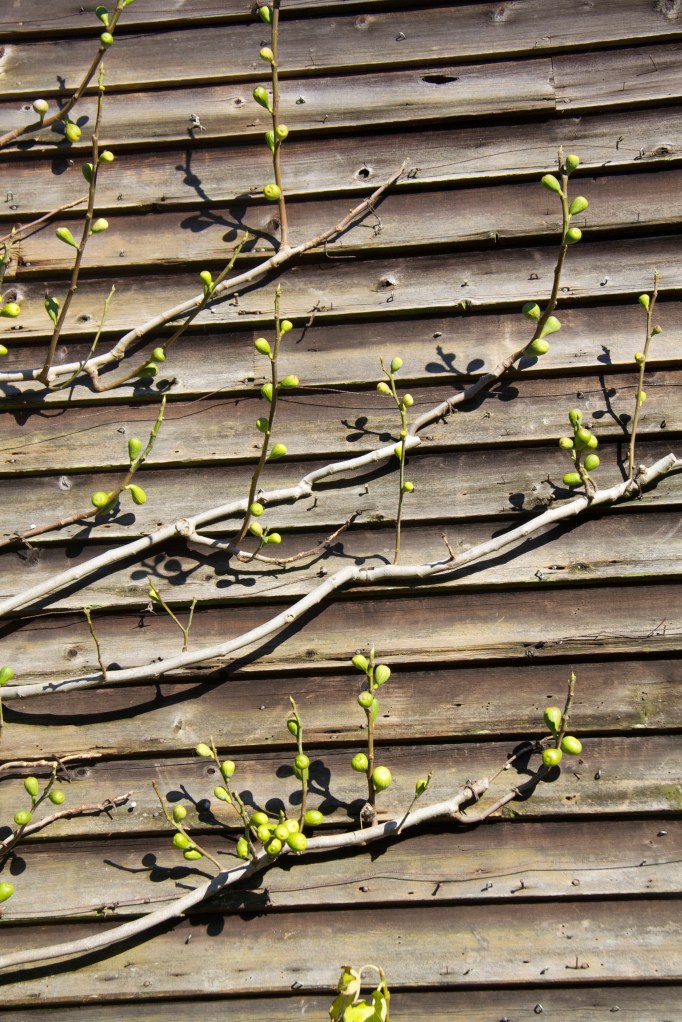
In the inky stillness of the hexagonal pond, floats an ethereal flame-red reflection of the cotoneaster on the steps above.  I have visited this garden at least once a month for a year but this dramatic reflection is new and takes my breath away.pool 4Looking up from its painterly centre, the whole garden seems to be playing out a great end- of-year finale – the naked branches of fan trained fig a dynamic firework at one corner, balanced by the solid, rounded green of the Osmanthus delavayi at the other.

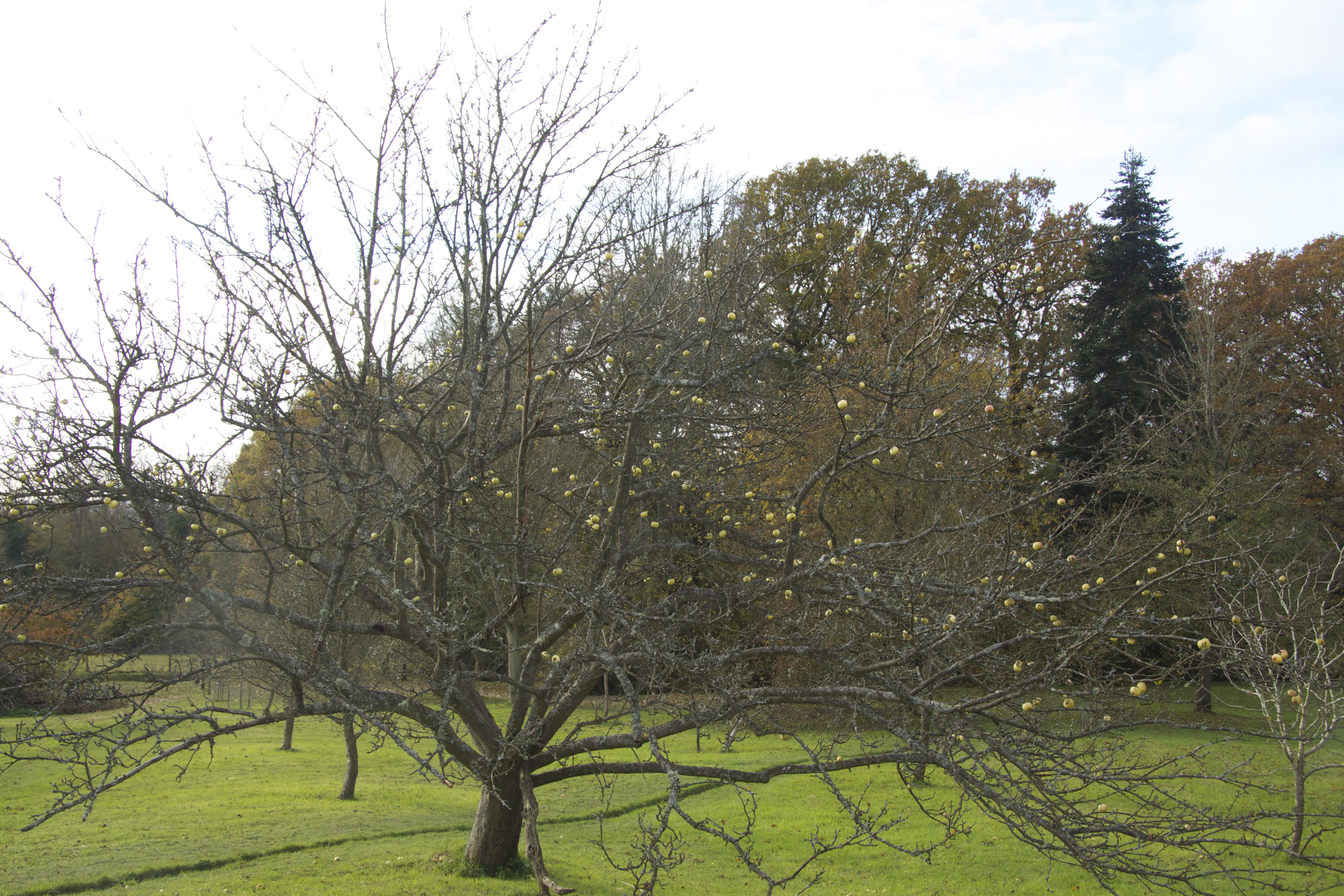
pool 1The mood is festive.  In the Orchard there is an apple tree as fine as any Christmas tree – a majestic spread of dark branches with pale yellow apples for baubles:

apple and christmas treeThere is a wonderful ivy nearby which I have admired all year – Hedera helix ‘Buttercup’.  The leaves of ‘Buttercup’ are lime green to dark green in shade, but a brilliant milky yellow-gold in full sun.  At Dixter it is grown as a fine, ordered garland over a barn roof:

butter ivy

Another brilliant ivy to recommend at this time of year is Hedera helix ‘Maple Leaf’ – with dark green, glossy, five lobed leaves.  It is a fast grower and at the Prieuré d’Orsan (see my post on this beautiful garden in December 2013) clads an entire shady wall with a smart coat of rich green.  Both ivies can be sourced at http://www.fibrex.co.uk .

ivyA few days later and the ancient oak trees at Ickworth Park in Suffolk make an elegant scene of dull hazy gold against green (http://www.nationaltrust.org.uk) .

GOlden Ickworth park

At the park entrance there is a cottage with the sort of fairy tale planting which makes you promise to plant yourself a small yew tree in 2014.  You may have to wait a while until you get such a gorgeous fat green, bulging creature on your doorstep – but it would surely be worth the wait?

plant a yewOf course, if you can also find a champion Copper Beech to tower brilliantly over your little house – even better.

A short drive away, the King’s Forest is glowing with horizontal tiers of yellow-gold and bronze:

kings forestWithin the forest there is a wonderful 7 acre treasure trove of a garden called Fuller’s Mill (http://fullersmillgarden.org.uk). Here the porcelain-white berries of Sorbus ursina hang with covetable elegance and clarity.

sorbus ursina

If you wanted to buy a similar Sorbus, choose a Sorbus cashmiriana – a very pretty small tree with soft pink flowers in late spring, and clusters of marble white fruits in autumn. The fruits  often well into winter.  Try either http://ashwoodnurseries.com or http://bluebellnursery.com – both wonderful nurseries.

Further on in the garden, the fruits of Euonymus elatus ‘Compactus’ are gorgeous tiny luminous bulbs in a delicious tangle of papery purple calyx and fine naked branches.
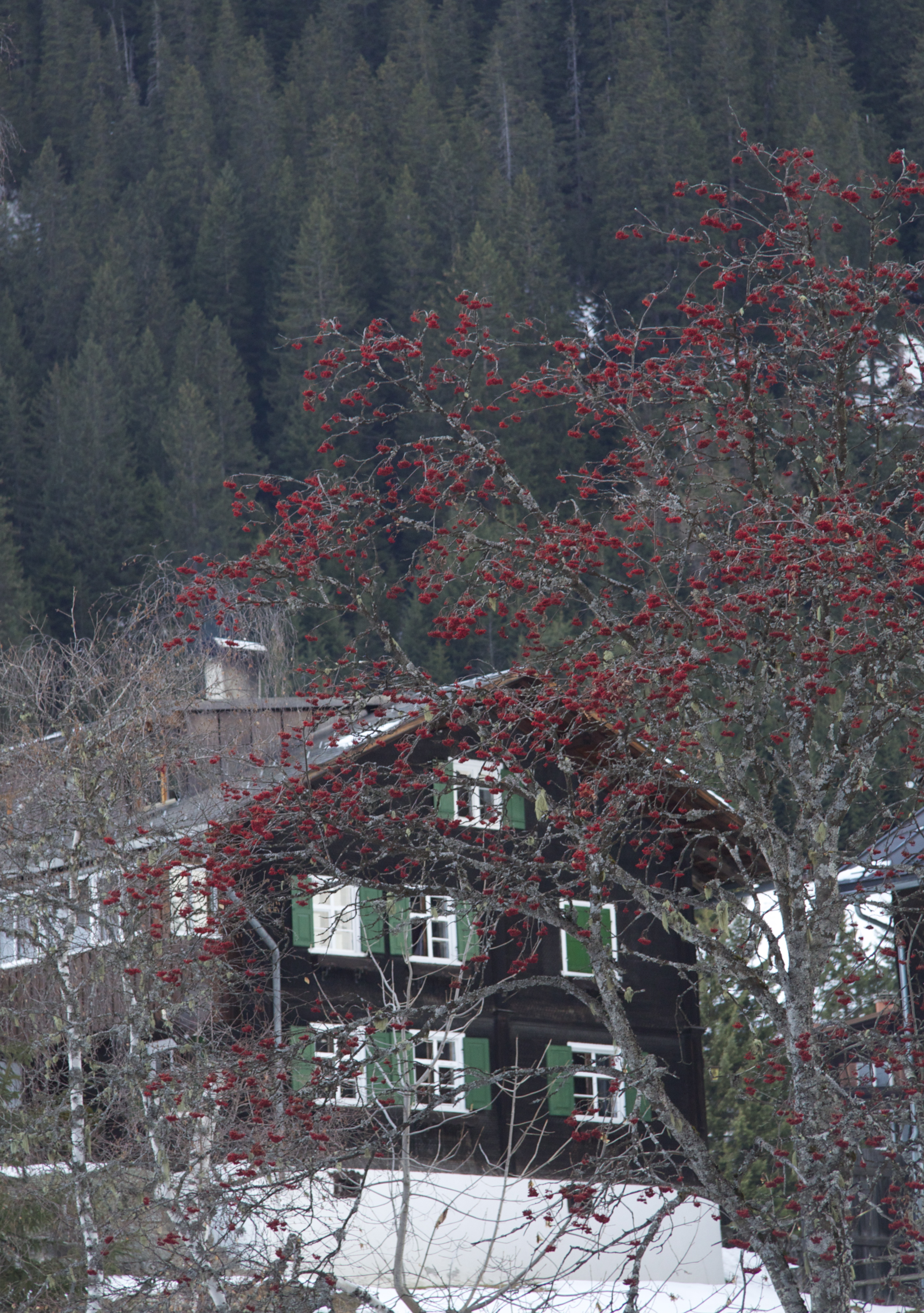
euonyous red cascadeAnd the week before Christmas I am in a tiny skiing village in Austria.  Here the houses are framed with dense ranks of deep green spruce and the lacy branches of red berried Mountain Ash.  It is wonderful to see native trees growing simply and plentifully where they are happiest on fertile well-drained soil on a mountain slope.

green shutter house plus rowan

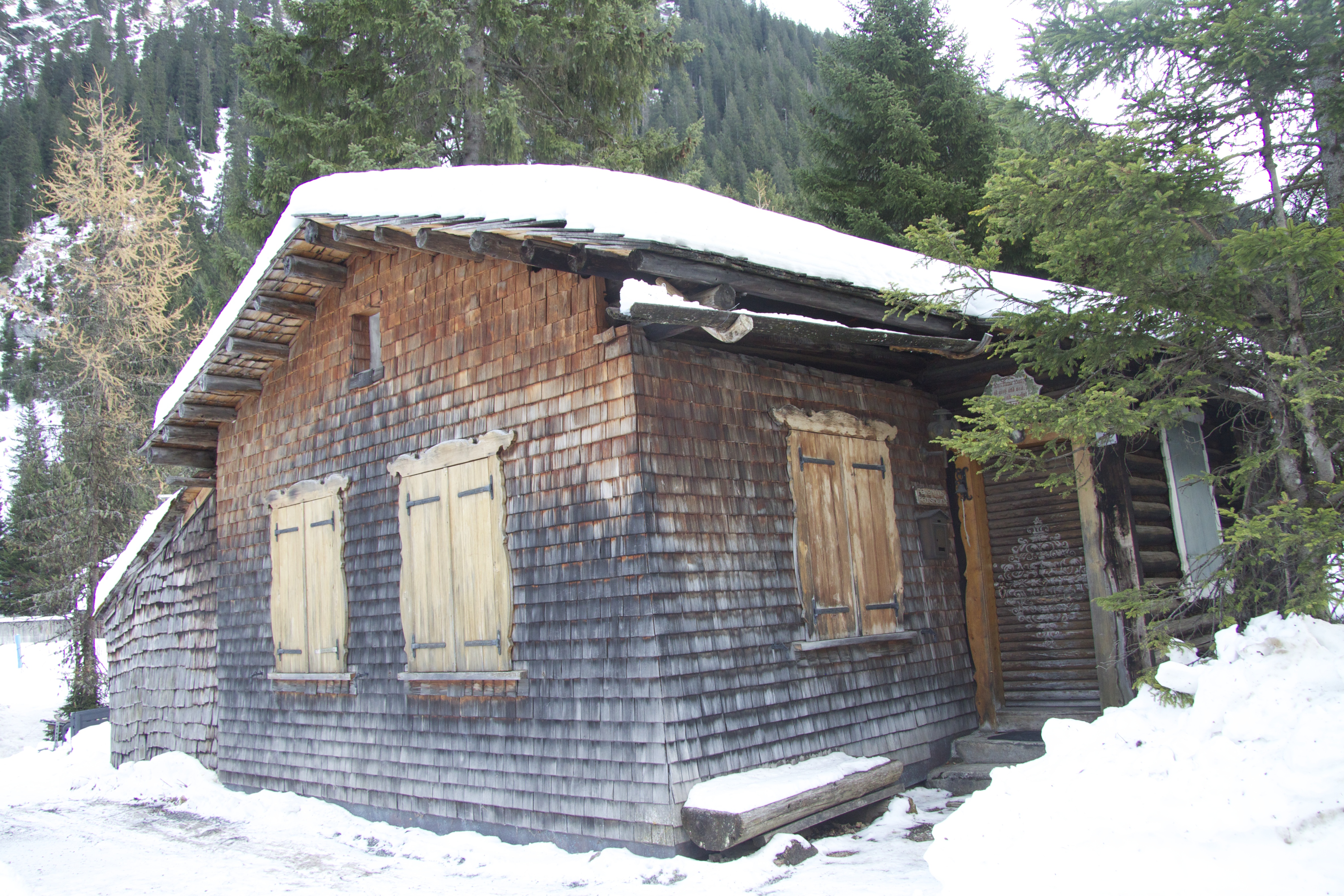
The Rowan berries  are shiny and festive in the winter sunlight. We ate two kinds of rowan berries last night for supper with pigeon paté,: they were almost bitter but rather good against the richness of the meat.rowan berries As the light fades at the end of the day, the clusters make elegant drooping patterns against the mountain sky:silhouette rowanI love the beautiful scalloped tiles – made of spruce – which clad entire buildings.  scalloped tiles

Cladding buildings like this is the work of farmers during the snowbound winter. The tiles last for about twenty years and age to a wonderful smokey darkness.

little chalet

Even the plain rectangular tiles are softly lovely:lean to tilesI like the idea of this handsome door – slim logs painted with a pale grey stencil:door made of logs And I have a soft spot for this painted shield with a message of welcome above the door.welcome sign But my real discovery this week is the larch. I have never really enjoyed it before, despite my attempts to appreciate an often slightly shabby specimen of Europe’s only deciduous conifer on a tour of an arboretum.  But here I am enchanted by its regal stature and elegance:grand single larch  by the soft gold of its needles against the cherry red of the rowan fruits:larch and rowanand by the ethereal way it catches the sun and lights up the valley bottom – a soft ghostly gold against velvety green against the white mountain.IMG_1739

THE PRIEURÉ D’ORSAN, FRANCE

MAGICAL GARDEN AND RENOVATED MEDIEVAL MONASTERY, BERRY, FRANCE

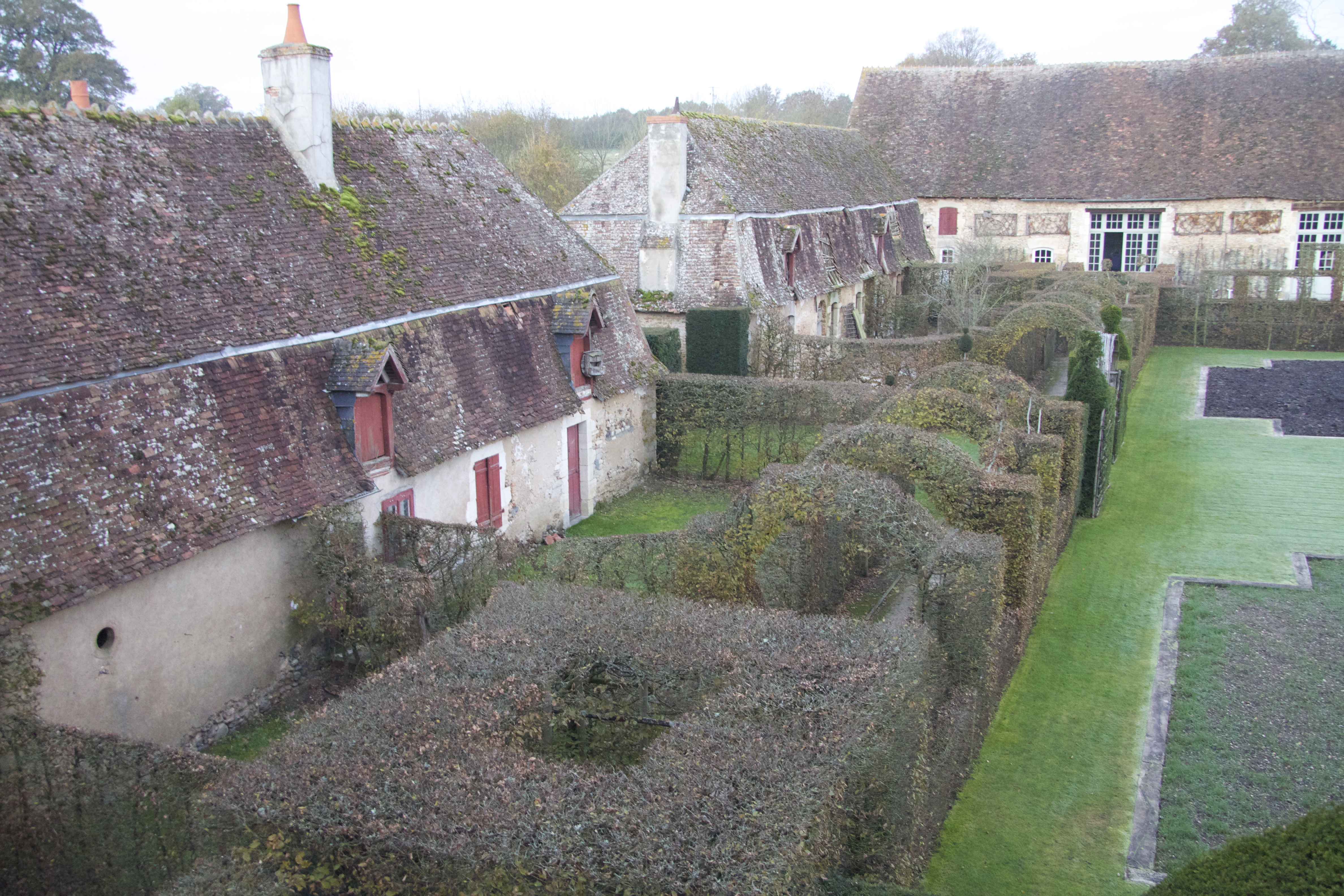
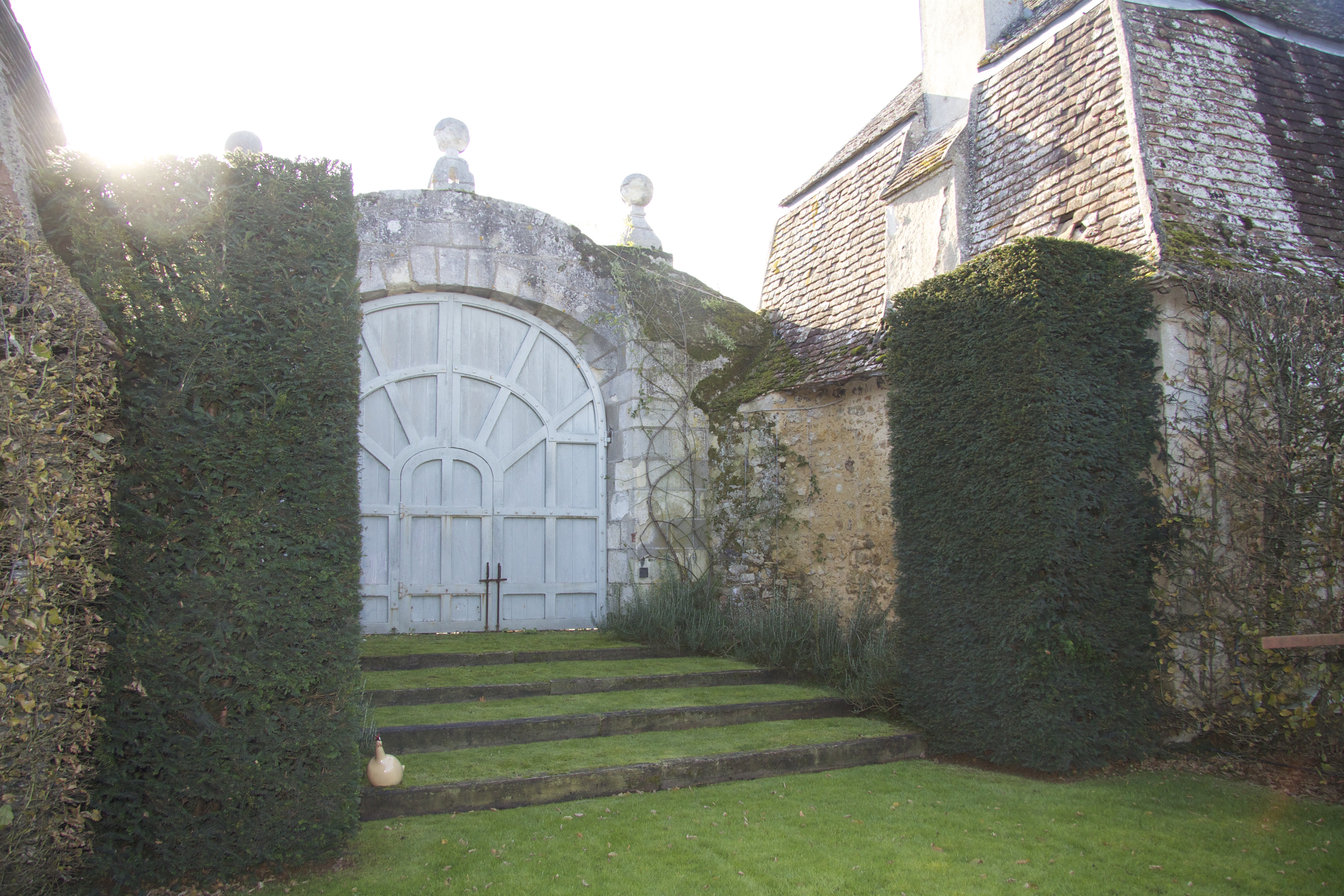
I have just returned, exhilarated, from a visit to a brilliant French garden, Le Prieuré d’Orsan  (http://www.prieuredorsan.com ), which happens to be made around an idyllic small hotel in the middle of the province of Berry, about 300km South of Paris. I was there to find out more about the garden for Gardens Illustrated (http://www.gardensillustrated.com). The garden was looking ethereal and very beautiful in the low winter light.view through arch entrance

The soft mottled roof tiles, quilted with lichen and moss have the same gentle, enduring rust-and-pale-grey softness as the ever leaner skeletons of the hornbeam cloister which architect and owner, Patrice Taravella has created as the heart of the garden.

roof tiles

general soft viewgeneral soft view rigth

I first visited Le Prieuré D’Orsan a year ago, at the height of summer. Only a garden as well structured as this can look as as elegant in late November

new soft screen

as it did in August.

IMG_6264

Here the approach to gardening is serious.  There is nothing that cannot be eaten or that does not serve a practical or symbolic purpose. But the energy, inventiveness and attention to detail that go into every aspect of its creation and its maintenance add a magical layer that is harder to define.

The immaculately clipped ivy around the storybook tower leading to the bedrooms is a perfect example of this.ivy tower

If you look down for a moment, even the cobbled path has been perfectly judged and beautifully laid.

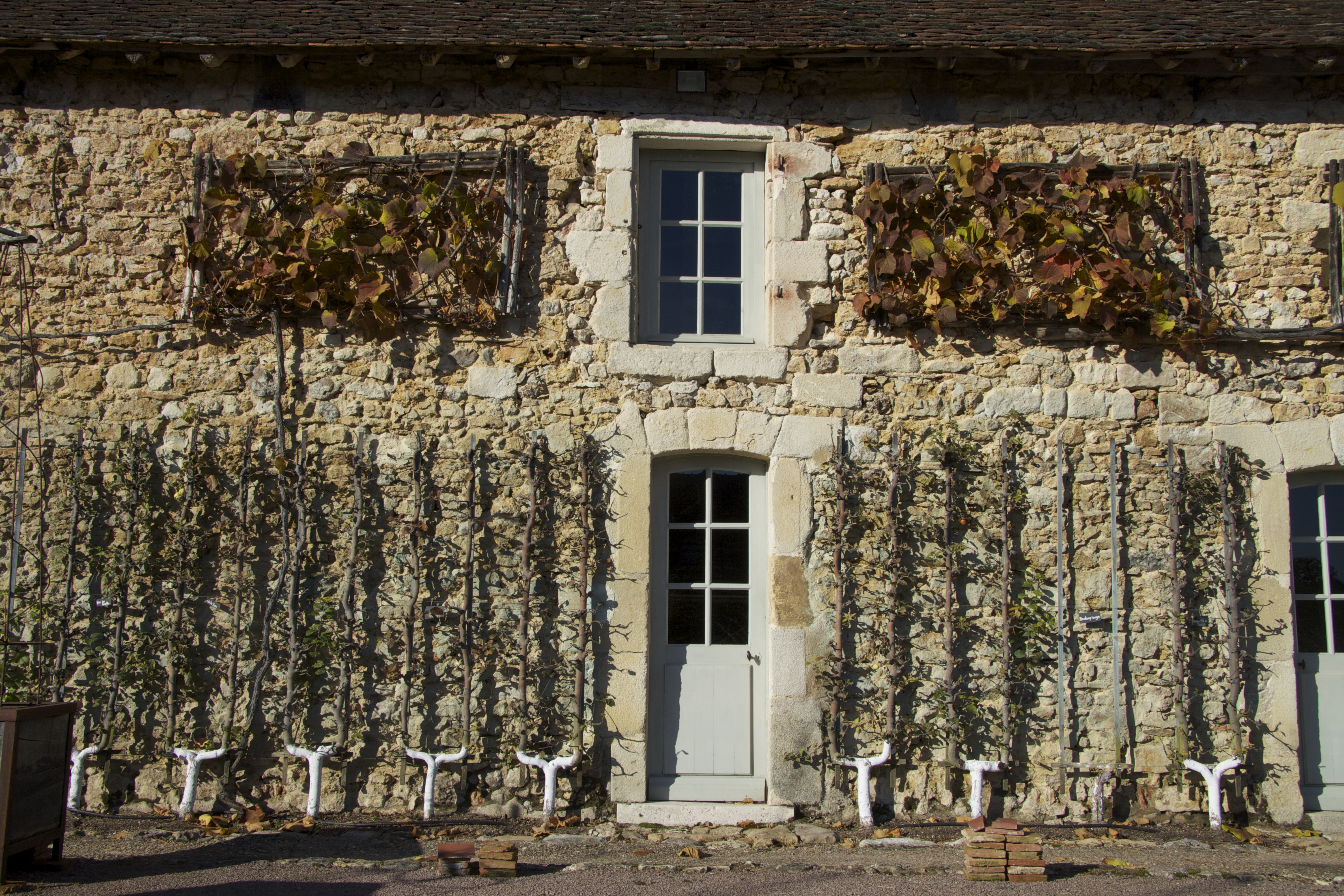
cobblesThere are some deliciously mad ideas – like training the vigorous ornamental vine, Vitis coignetiae, into particularly finite rectangular wall panels above a series of almost impossibly narrow-shouldered cordon pears.  But the mad idea works of course because the vine will always be perfectly trained and never left for a moment to get slightly out of hand. Vitis coignetaie is usually left to festoon itself rampantly into a huge tree. I have seen its’ extravagant leaves with their luminous autumn colour grow in perfect scalloped rows – almost like roof tiles – over a garden shed, but this is the first time I have seen anyone try to harness this contradictory neatness in such a high profile position in the garden.

vitis coignet

Again the composition looks as strong in winter as it does in its more lush summer form:
vitis summerIt is extraordinary to visit the new rose garden n a freezing November day before any of the roses has had a chance to flower, and find that the confidence and exuberance of the structure alone has the power takes your breath away.

IMG_1412IMG_1423rosarie windowAs with the garden’s many other structures, the towers and panels of the rose garden are built by Patrice’s  Head Gardener of twenty years,  Gilles Guillot.  Coppiced chestnut,  often cut in half lengthways –  intended for straps around wine barrels  – is used as the principal material. The working relationship between the two men is now so close that they find it hard to separate out whose idea was whose – one will take up the idea of the other and a trellis panel, arch or exuberant tree seat will find itself simply emerging.

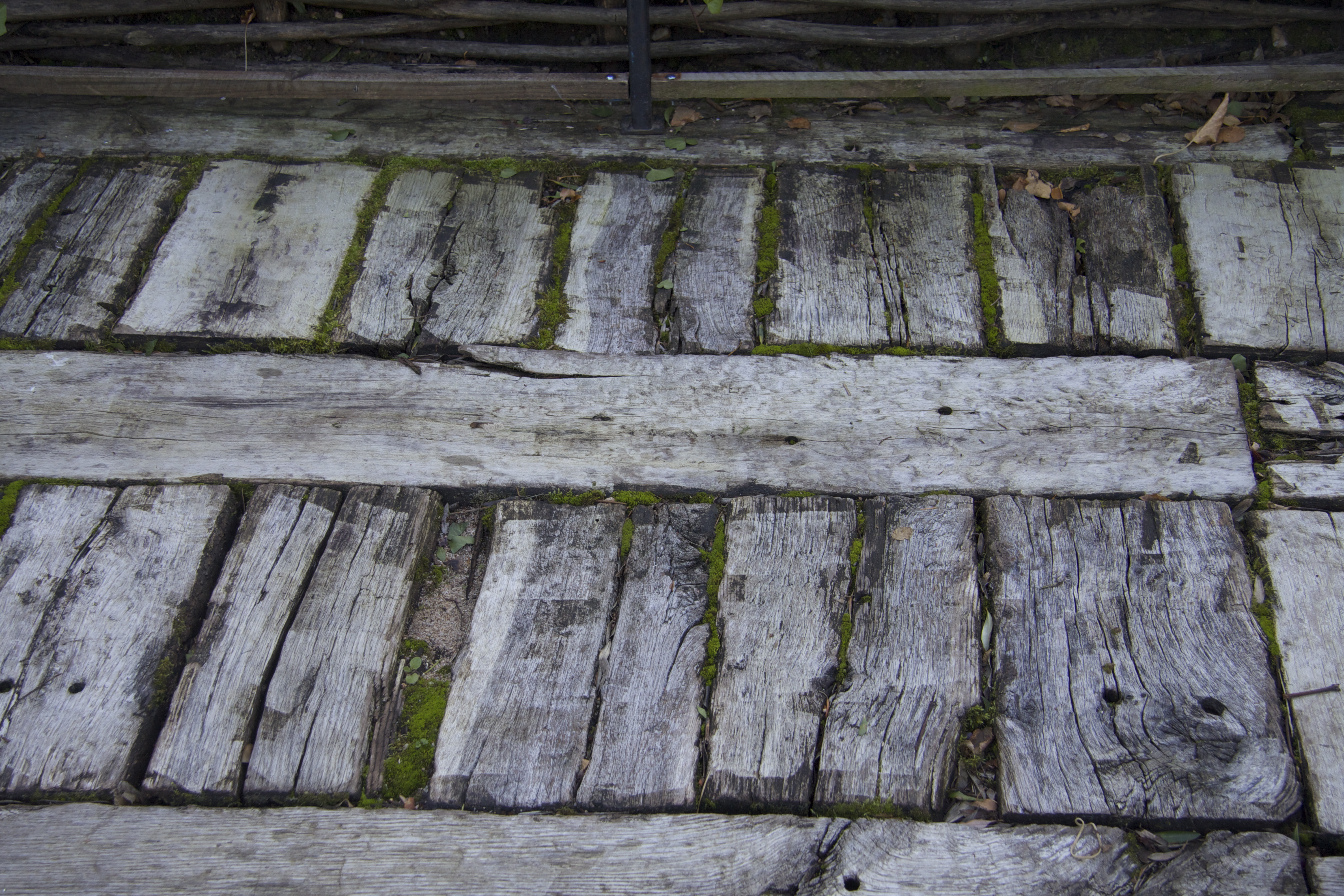
Railway sleepers are used particularly cleverly as a subtle, robust and often surprisingly elegant decking.  This is the central terrace of the ‘Rosarie’

rosarie parquet

This is an older path which has almost taken on the quality of stone as it has aged.old parquet

And here is one of the neat terraces of the ground floor bedrooms which have their own small garden:
new little wodden terraceI have seen sleepers used even more simply to make tactile and handsome decking at a vineyard in Bordeaux (below).  The sleeper paths and terraces are pressure washed in early spring and  work brilliantly as a gentle but elegant hard landscaping material.

IMG_5858

Elsewhere at Orsan the delicate chestnut structures are used to screen and partially reveal, always offering tantalising glimpses of the next section of the garden. I love the way the cool grey main gates are only revealed if you take the trouble to go and find them.

front gate arch screen

front gate summergate

Lacy tunnels of hornbeam filter the sunlight to create an atmosphere of secrecy and surprise.

lovely leafy arch

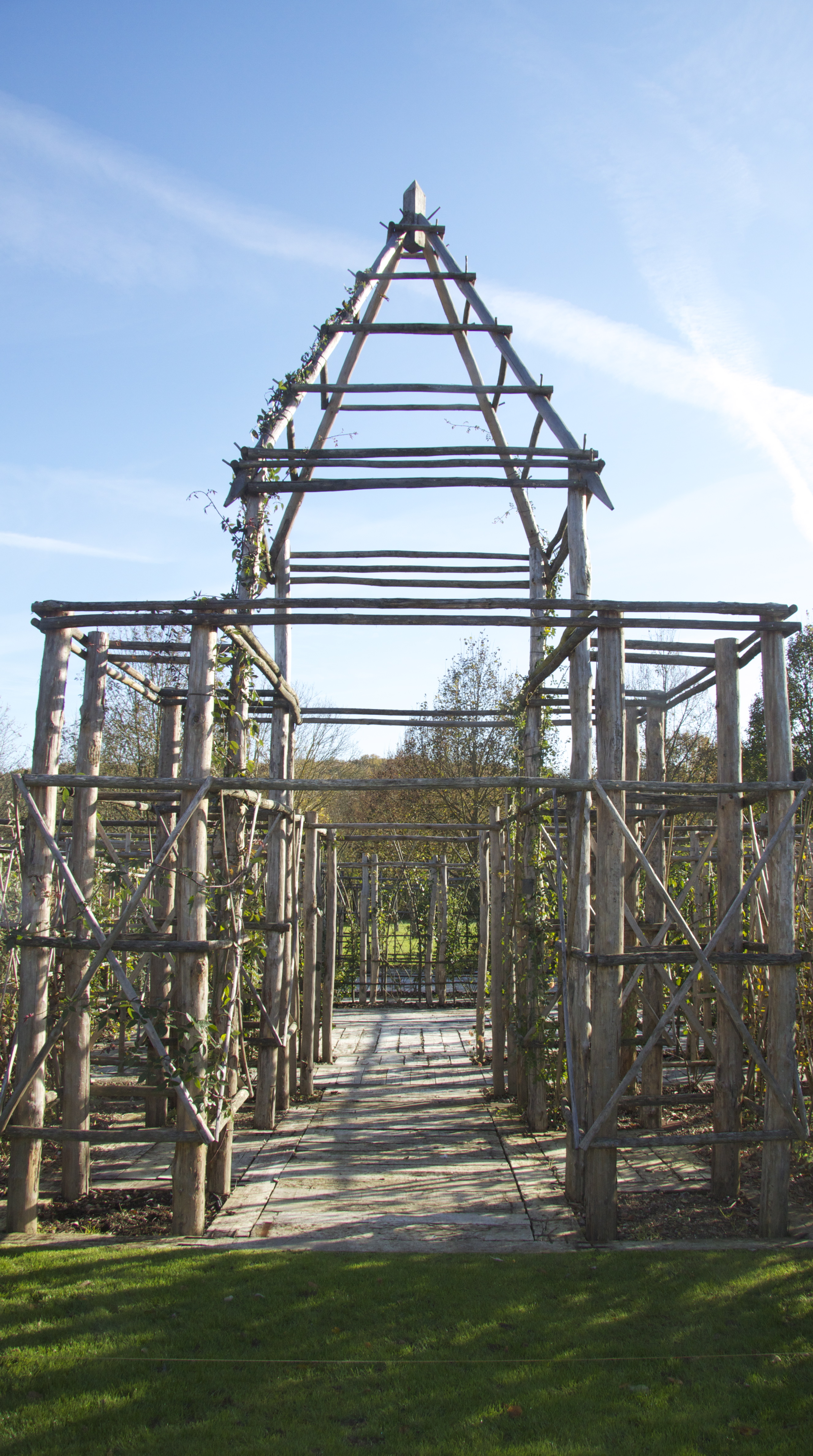
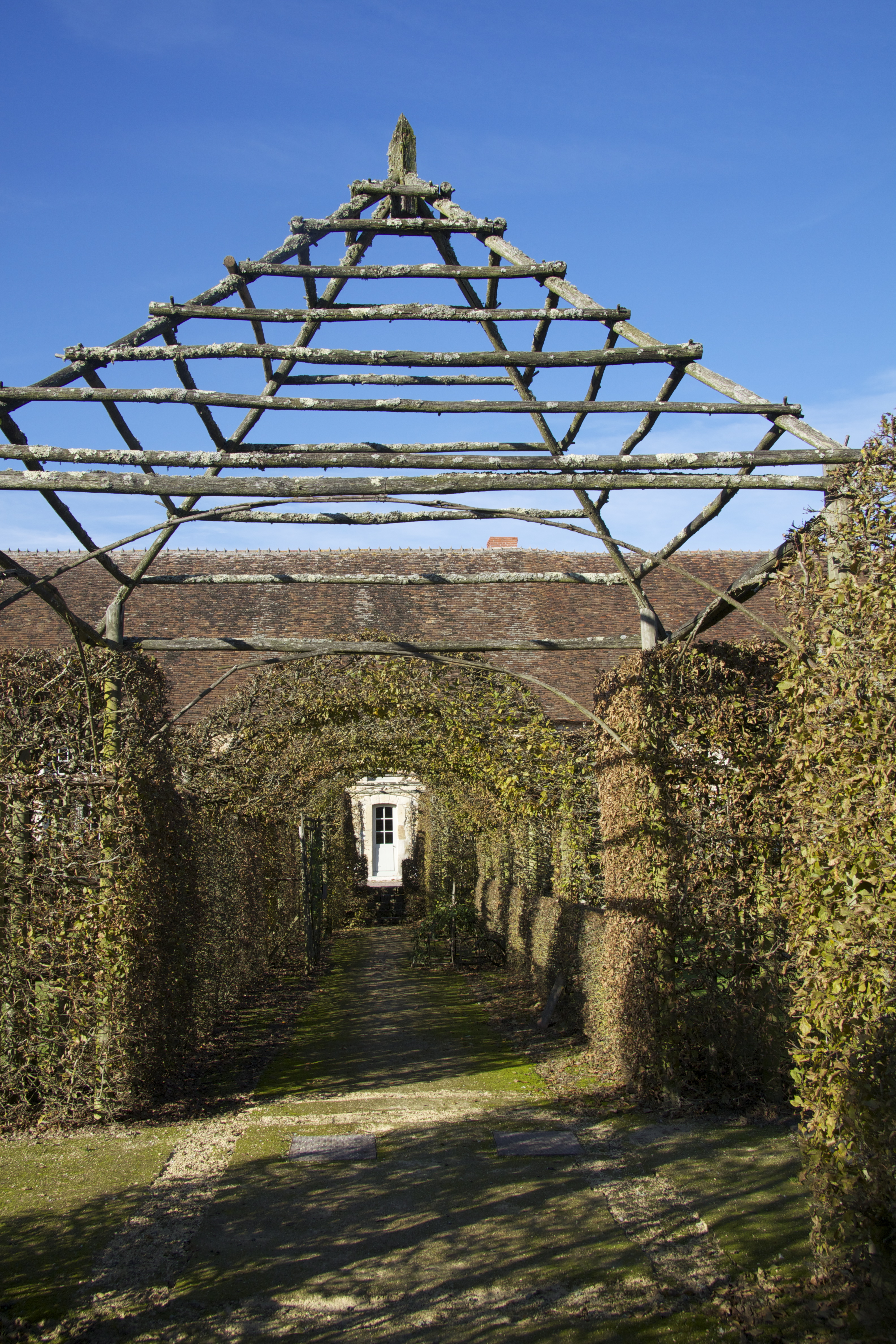
Hornbeam pillars support exuberant pyramid-shaped ‘gloriettes’ – or pergolas – which keep the levels playful and unexpected

gloriette

and mark out brilliant shapes against the sky.
gloriette skyWalking around the garden is a kind of game – even before you get to the espaliered fruit maze where Patrice put to use information culled from a job building a huge supermarket when he was a young architect (“I learned that on entering a supermarket, 95% of customers turn right – this is of course where I have put my dead ends …” ).

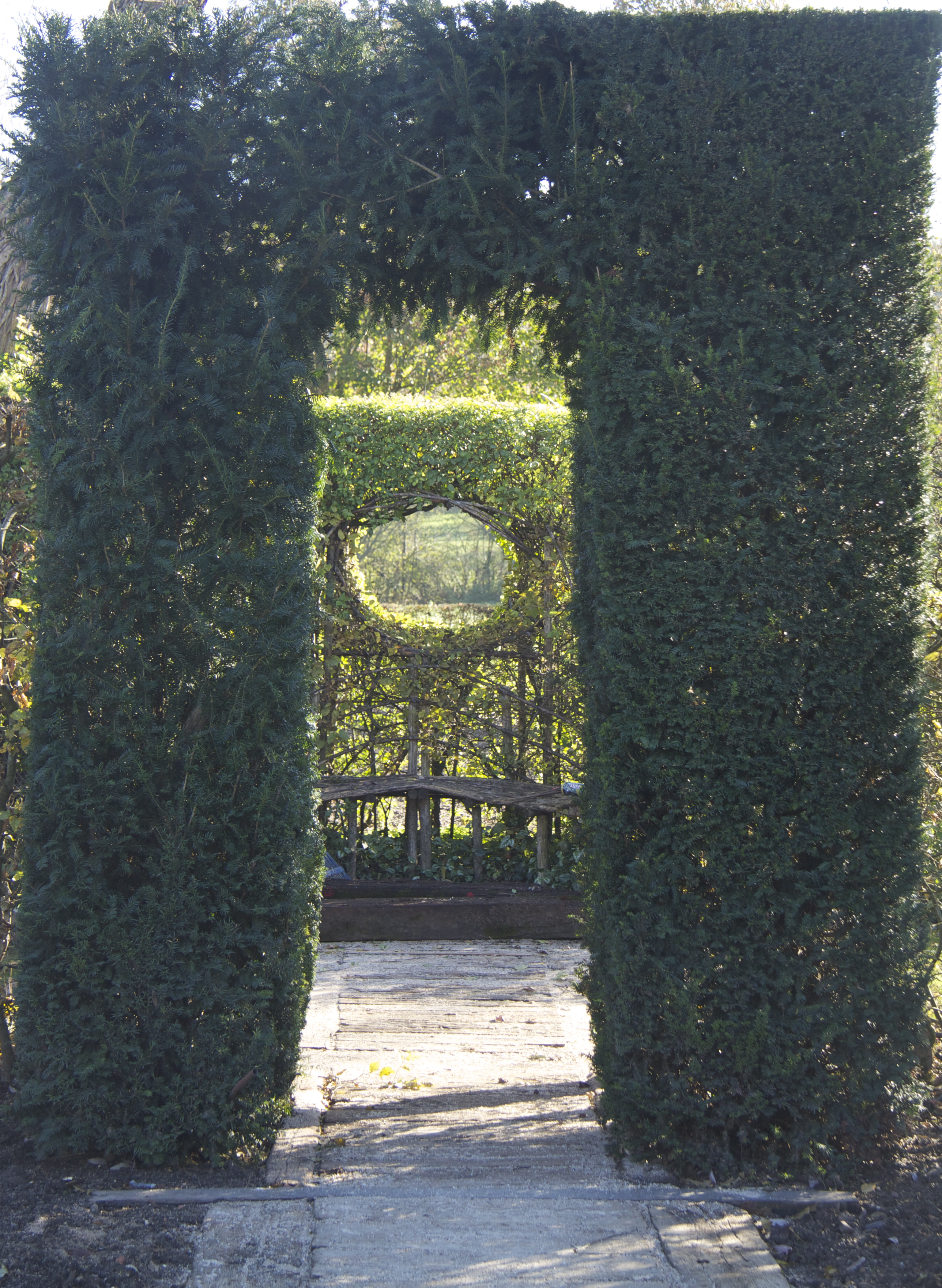
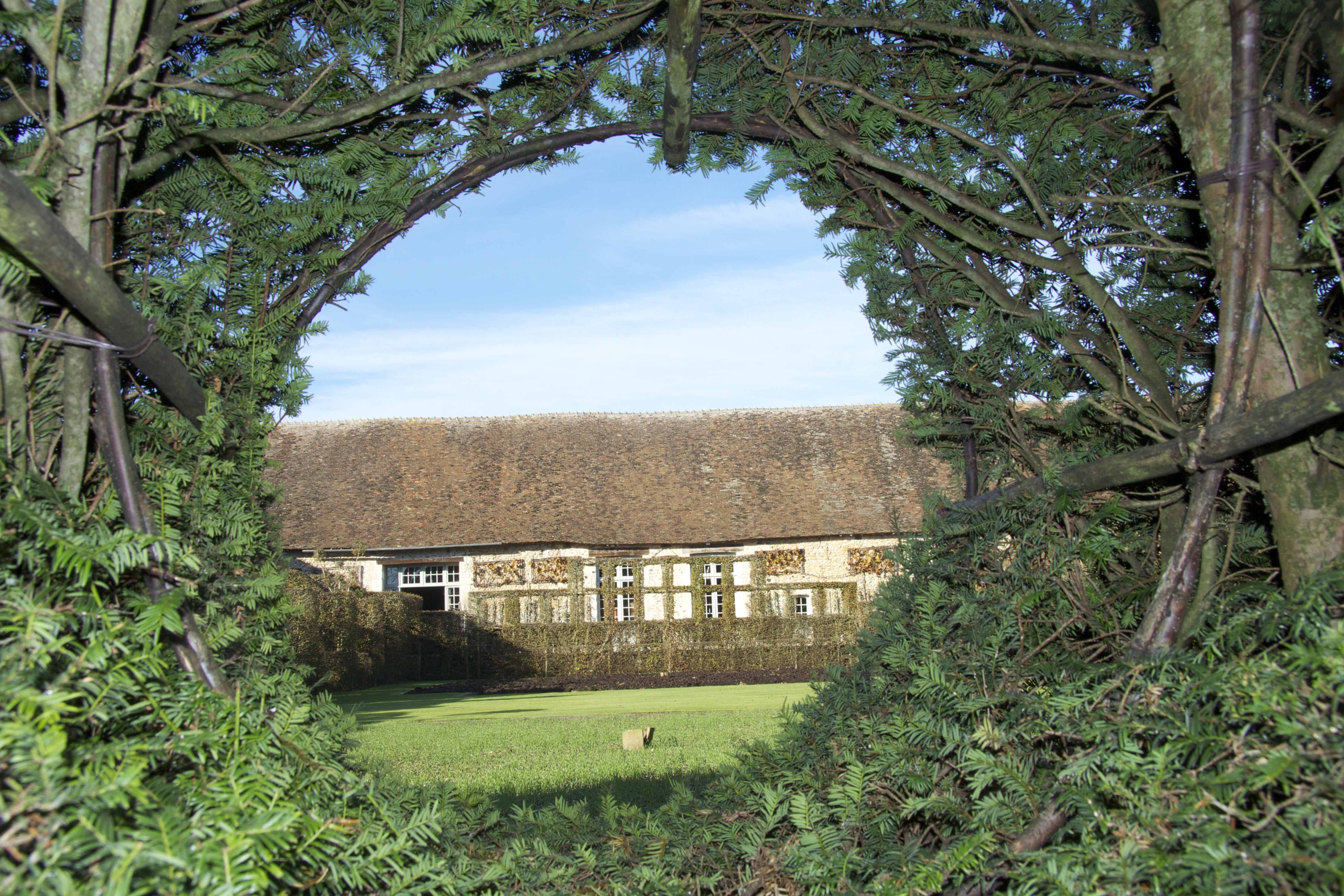
There are views through arches

IMG_1305

and through windows cut into hedgesround windowand there are dead ends so handsome and lush

yew panel

or so fine and delicate …
IMG_1420that you are happy to just enjoy the moment, knowing that there is another delight just around the corner.

Here in the potager the medlar fruit glow on their spreading branches against the sky.

IMG_1430The training of the soft fruit and fruit trees at Orsan is extraordinary and humbling in its perfection – I will be writing about this and about the structure of the garden in greater detail in the  February 2014 editon of http://gardensillustrated.com

Strictly following the mantra “we must always break the sap”,  every plant is immaculately trained to produce as much fruit as possible.  I am enchanted by the screen of arched panels glittering with golden gooseberry leaves catching the light.

IMG_1492

The idea with this ‘cradle’ for raspberries is to train one year’s canes up one side of the structure only leaving the opposite side for the following year’s growth.

raspberry cradle

Rhubarb is grown long and straight nurtured by handsome willow baskets.

IMG_1435This is a garden where it takes a week to built structures around the two olive trees to fill with fleece and protect them in the -20˚ temperatures to come.IMG_1279But it is also a garden of dreamily timeless abundance in summer.two climbers

A place that lifts the spirits whenever you visit.
having a lovely time The benches make me happyfab bench Even the outside taps make me smile.tapLast year we celebrated my husband’s birthday sitting under the vines on the terrace.
festoon lights

Patrice made the most delicious birthday cake – a strawberry mille feuille with a vase of chocolate filled with flowers from the cutting garden.

nick's birthday cake

Pretty perfect. Go there.

STARRY AUTUMN DAYS

LOW LIGHT, RAINBOW LEAVES AND JEWEL-LIKE BERRIES IN AN ENGLISH GARDEN
FIG 2

At Great Dixter (http://greatdixter.co.uk) clusters of tight, unripened figs glow like little light bulbs on naked branches against the timber barn.  A brilliant, self contained symbol of autumn on a November day.

There is an uncertain edge to the mix of fresh full-colour plants and the fading crispy hues of others.

Here clumps of Nerine bowdenii provide bursts of bright pink against a more subdued palette – they work because the clumps are repeated regularly along the length of the path.

nerine

More Nerines, at the base of the lower terrace, loving their place in the sun with garlands of Erigeron karvinskianus.  This is November!

GARLANDS

It is a classic and brilliantly reliable combination.   The Nerines take over easily from the richer red of Centranthus ruber which billows over walls and steps in the early summer.

centranthus erigeron

The real stars of the autumn show are plants which triumph when back lit by the early winter light.  The common teasel (Dispascus fullonum) is a perfect example of this – an architectural plant which will grow happily from seed – and which will self seed happily when established.  It catches the light brilliantly.

TEASEL TWO

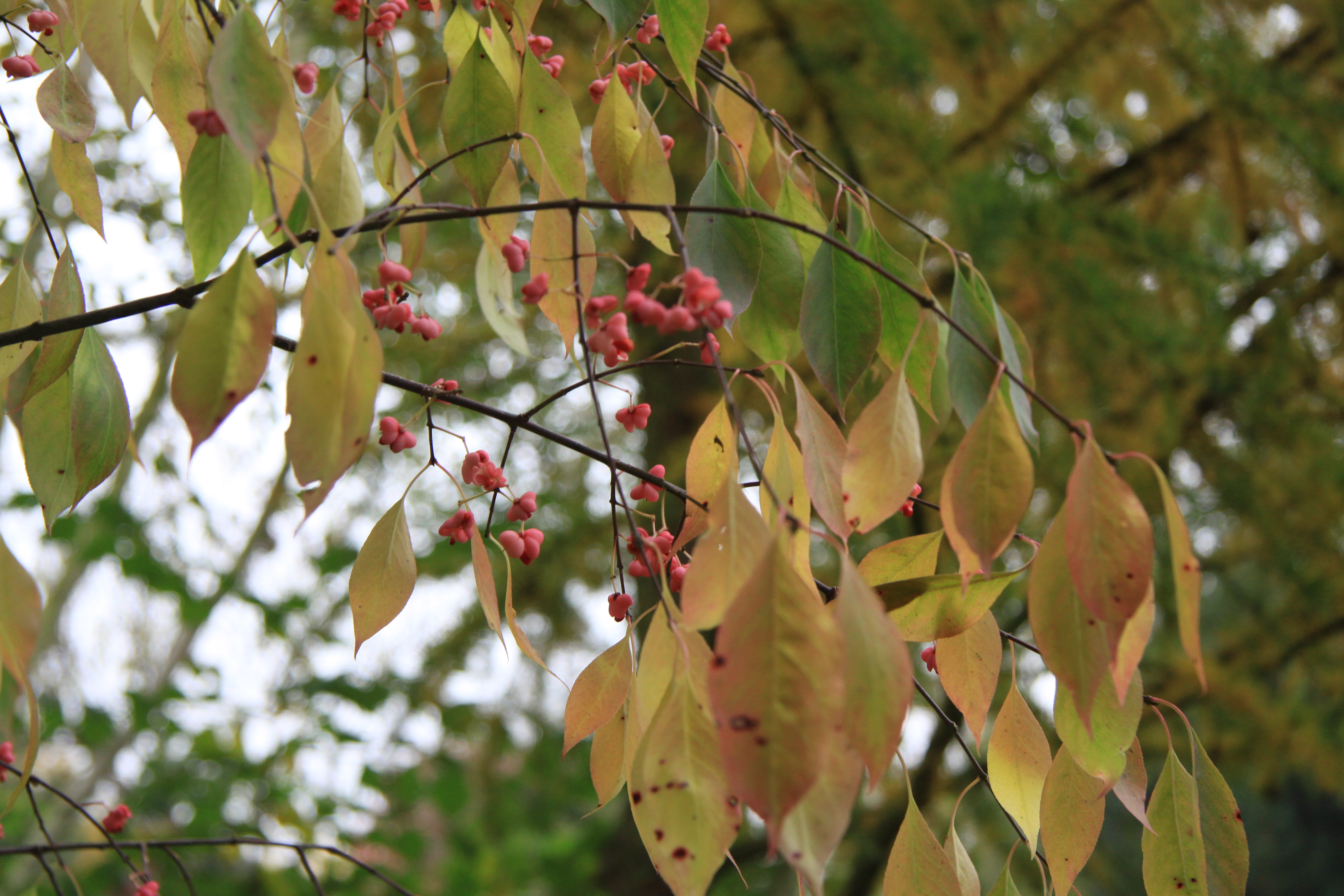
Here against the cherry-red seed capsules of the wonderful Euonymus europaeus, the teasels with their late afternoon haloes give the planting an intoxicating ethereal quality.

teasel and euonymys

And then there are the berries.  Worth taking note now and thinking of planting for hips or berries next year.

One of the greatest sources of wisdom on the best plant choices for autumn colour is John Massey of Ashwood Nurseries in the West Midlands (http://www.ashwoodnurseries.com). Massey is a self taught nurseryman who has been a plant collector, plant breeder and passionate gardener for forty years.  He gives specialist talks throughout the year – which include a visit to his private garden.  Absolutely a pilmrimage worth making

You know you are in the presence of the real thing when even his house is draped in a starry chain mail of yellow and orange foliage with the rainbow leaves of Liquidambar styraciflua ‘Worplesdon’ AGM falling so knowingly onto the deep green holly hedge.starry house

liquidamber on holly

And there is real golddust to come:  when John tells you that the best yellow crab apple is Malus ‘Comtesse de Paris’ -an elegant tree with pearl-like golden fruit which hang down from slender red stalks

comtesse yellow

and that the better known Malus ‘Golden Hornet’ is no contest because its fruits turn brown so fast, it is the sort of rare and generous advice that can transform a garden.  His other favourite crab apples are the long lasting ‘Red Sentinel’ and ‘Crittenden’, the larger red fruiting ‘Evereste’ – and ‘Sugar Time’ with really tiny berries.  Perhaps his favourite of all is ‘Indian Magic’ (below) which has dark pink blossom and deep red fruit on long stems which become brighter orange as the winter progresses.

indian magic

One of the prettiest crab apples we see in his garden is Malus ‘Toringo’ – the Japanese crab – a small, semi-weeping tree with fragrant flowers that are pink in bud but fade to white, and gorgeous butter yellow leaves in autumn and tiny blood red fruit.

malusAs we are guided round the garden the conversation dances from Parthenocissus quinquefolia ‘Red Wall’ – a Virginia Creeper with particularly shiny green leaves in summer which turn a sensational flaming red, Euonymus alata compacta – the most reliable spindle for bright crimson leaf colour in Autumn and Hydrangea paniculata ‘Great Star’ which he was originally given by the late Princess Sturdza of the Jardin du Vasterival (http://vasterival.fr ) in Normandy and for whose support he feels indebted.  ‘Great Star’ is the opposite of the worryingly, almost permanent, plumpness of one of the new super breed of hydrangeas such as  Hydrangea arborescens ‘Incrediball’  – a wonderfully graceful hydrangea with clusters of fresh, white star-shaped flowers from late summer to autumn.

greatstar                  Photo by Ashwood Nurseries

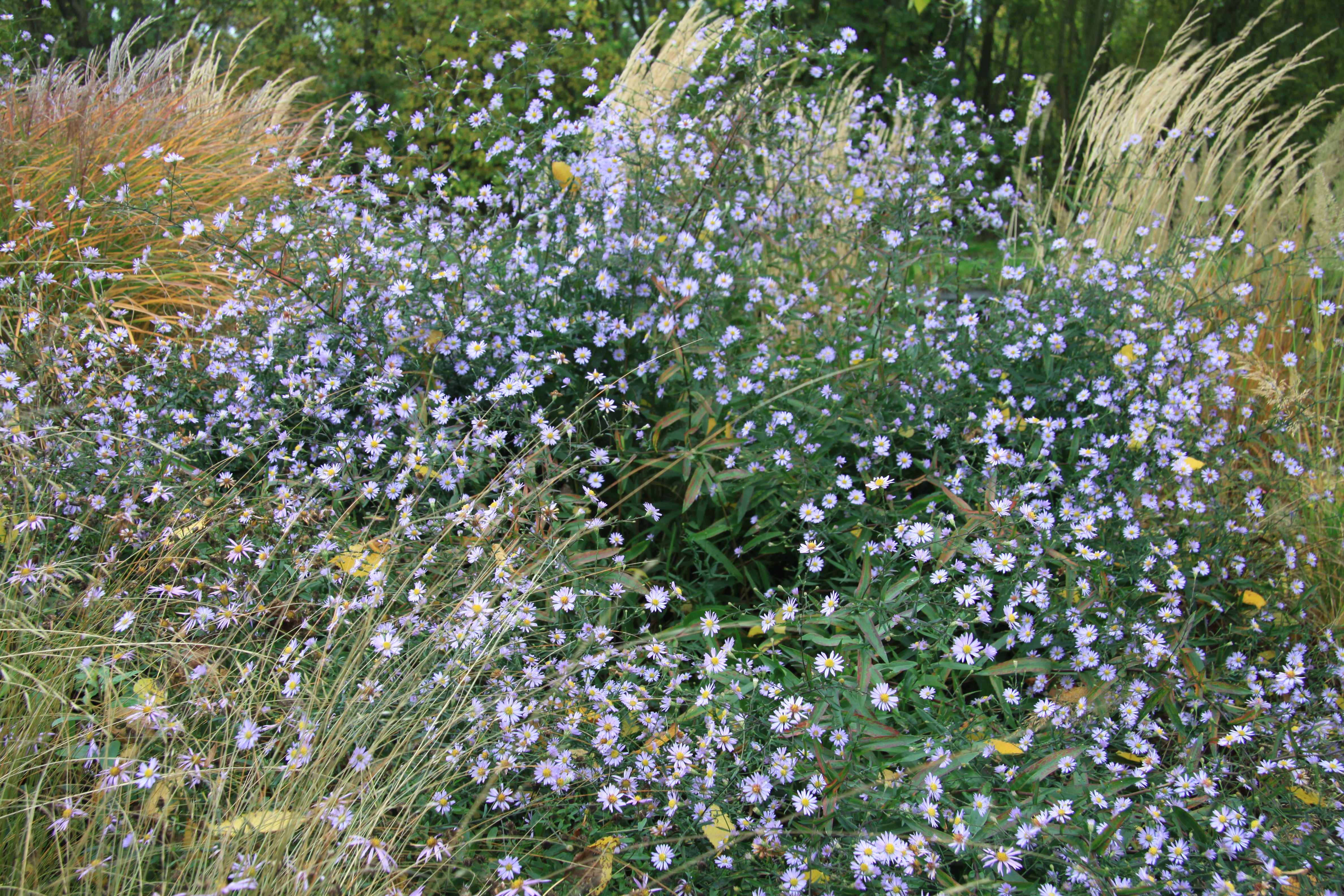
I am smitten by the violet-blue Aster ‘Little Carlow’ – which I have previously classified as just too brash and intense for the autumn garden – here looking airy and elegant amongst the bleached sketchy sheaves of grasses.

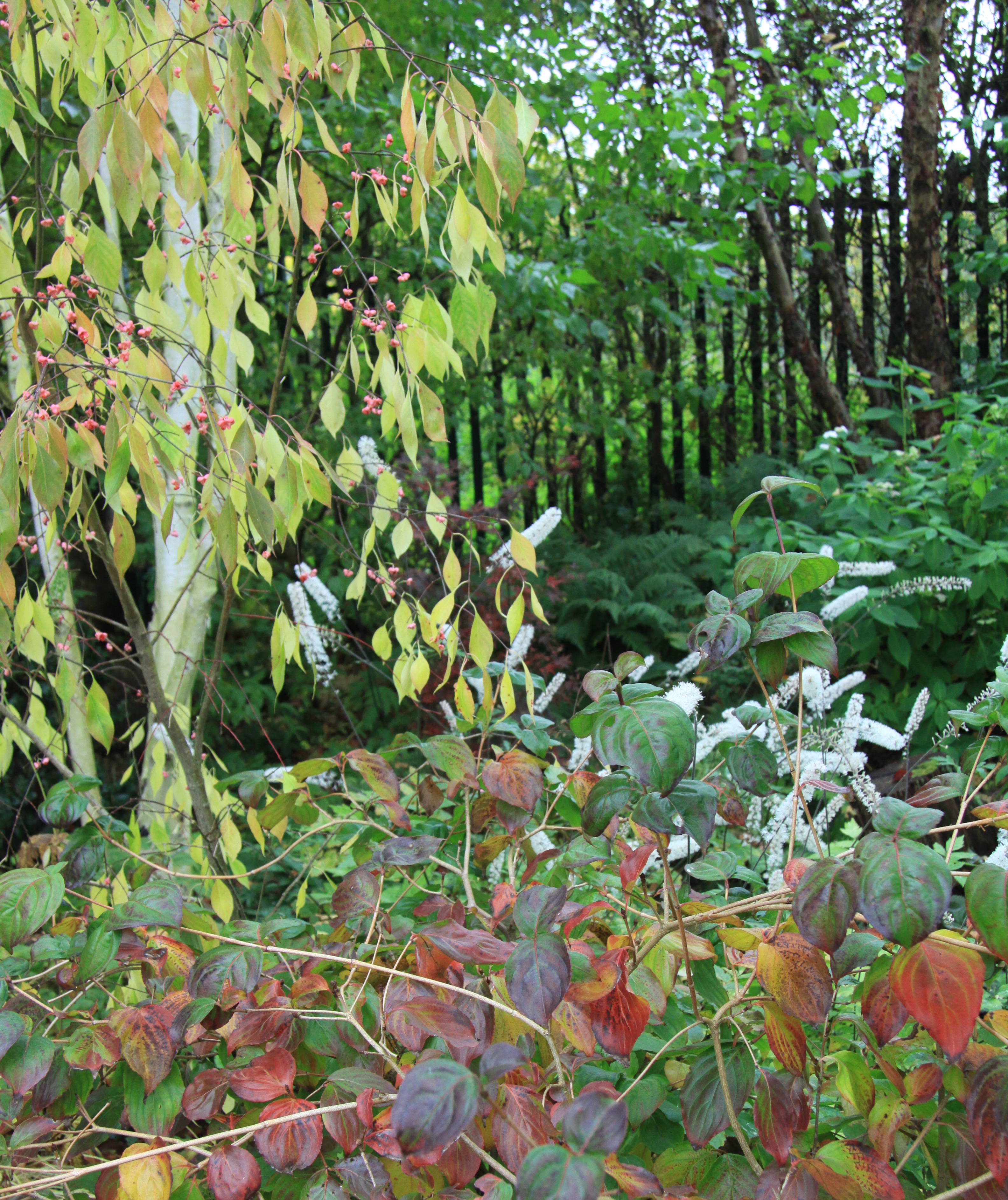
aster and grassMy favourite moment of all is when John stops to pick a tall, soft bottle-brush stem of Actaea matsumura ‘Elstead Variety’ from an elegant dancing group in full flower. We are all surprised and delighted by the intensity of its perfume.  actaea group cropThe Actaea are growing in brilliant combination alongside Euonymus bugneamus ‘Fireflame’ – which has a seductive limp quality to its milky green leaves and gorgeous perky apricot coloured seed heads –

salmon euonymus bungeaanus fireflame and the sculptural, ruby-polished foliage of Cornus kousa ‘Miss Satomi’ – one of the finest small dogwoods which will have rich pink flower bracts in early summerMISS SATOMI

Important to remember, of course,  that where acres of intricate planting are sadly not a possibility –   just a single source of brightly coloured berries or rich autumn leaf colour can spectacularly transform a space.

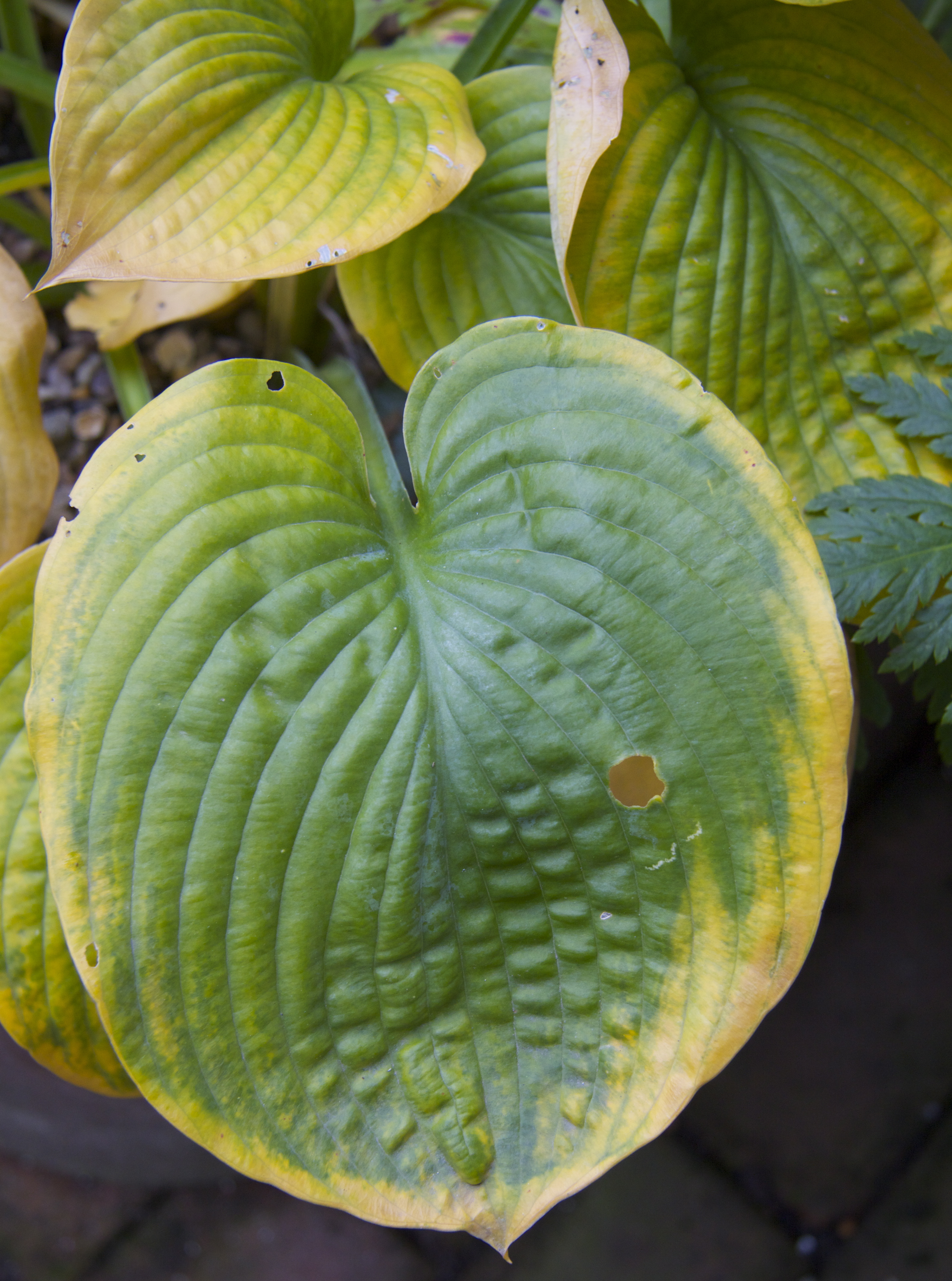
Here at the entrance to Gravetye Manor, (http://www.gravetyemanor.co.uk),  former home of eminent Victorian ‘wild’ gardener, William Robinson and now my favourite country house hotel – I love the rough simplicity of this planting of Rosa moyesii on either side of the entrance steps.rosa moyesii gravetyerosa moyesii close upBack in Camberwell a neighbour’s Cotinus ‘Grace’, has been pruned into a small tree which takes your breath away with the richness of its colour on a grey November day.cotinus camberwellclose up cotinus camberwellShifting down a scale, a Hosta sieboldiana var. elegans in a pot on my terrace suddenly hurtles – caramelises almost – into winter.  Don’t forget to stop and look.hosta 1hosta 2

HONEY BEE GARDEN, MURANO

VISIT TO AN ARTIST’S ORCHARD GARDEN ON MURANO AND A SCARPA GARDEN IN VENICE

beehive
Dinner in Vini da Arturo where I ate pasta with a very delicious sauce made from raddichio da Treviso which had been cooked for five hours (a clove of garlic, half an onion , half a cup of olive oil, basil and parsley and a kilo of raddichio – add water every ten minutes, add half a cup of cream and parmesan before serving, since you ask). We got talking to New York artist, Judi Harvest http://www.judiharvest.com , who invited us to meet her the next day at her Biennale show – Denatured – which takes the form of a honey bee garden on the island of Murano with beehives painted the colours of the fishermens’ houses on Buranohouse

image courtesy of ‘Denatured Honeybees+Murano’catalogue

and an exhibition of glass honey vessels and paintings at the elegant Scola die Batioro e Tiraoro – the eighteenth century building on the Grand Canal that was once the headquarters of the city’s goldworkers. scolaJudi worked with master glassblower Giorgio Giuman and his family at the Linea Arianna factory on Murano to create the beautiful abstracted glass vessels in gorgeous, glowing honey-inspired colours – from olive to deep amber to a clear lavender.  The vessels are a celebration of the sensuous, viscous quality  of both honey and molten glass and the use of found chicken wire as a framing device, with the blown glass bulging stickily through, perfectly echoes the rhythmical, hexagonal structure of honeycomb.

Untitled

image courtesy of ‘Denatured Honeybees+Murano’ 

At the heart of the exhibition, suspended from the ceiling with the grandeur and glittering allure of the finest Venetian chandelier, is ‘Monumental Hive’ – made from porcelain, beeswax, goldleaf and resin and which took six months to construct.

the hive

                       image courtesy of ‘Denatured honeybees + Murano’ cataloge.

As we ride in the water taxi over to the factory, Judi explains how the exhibition was conceived.  She had become increasingly aware of both the global environmental crisis in the dwindling honey bee population and the saddening local decline of handmade glassmaking in Murano – a seven hundred year old tradition being increasingly and aggressively replaced by cheap imports from China and Eastern Europe.

IMG

In New York, to find out more about bees, Judi set up beehives on her studio roof terrace (keeping bees has, amazingly, only been legal in New York City since 2010) and became involved with Bees Without Borders ( http://www.bestbees.com) a brilliant small charity whose aim is to reduce poverty by teaching beekeeping skills around the world.

In Venice, as she set about making her work in glass for her exhibition, she also took on the extraordinary – and pretty much single handed – task of making a real, durable bee friendly garden in the neglected grounds of the factory on Murano.

It was brilliant to visit the garden with her.  We spent time in the factory first – a wonderful place with the raw, ramshackle, treasure trove quality of the best studios and workshops –

journey 2festoon factory

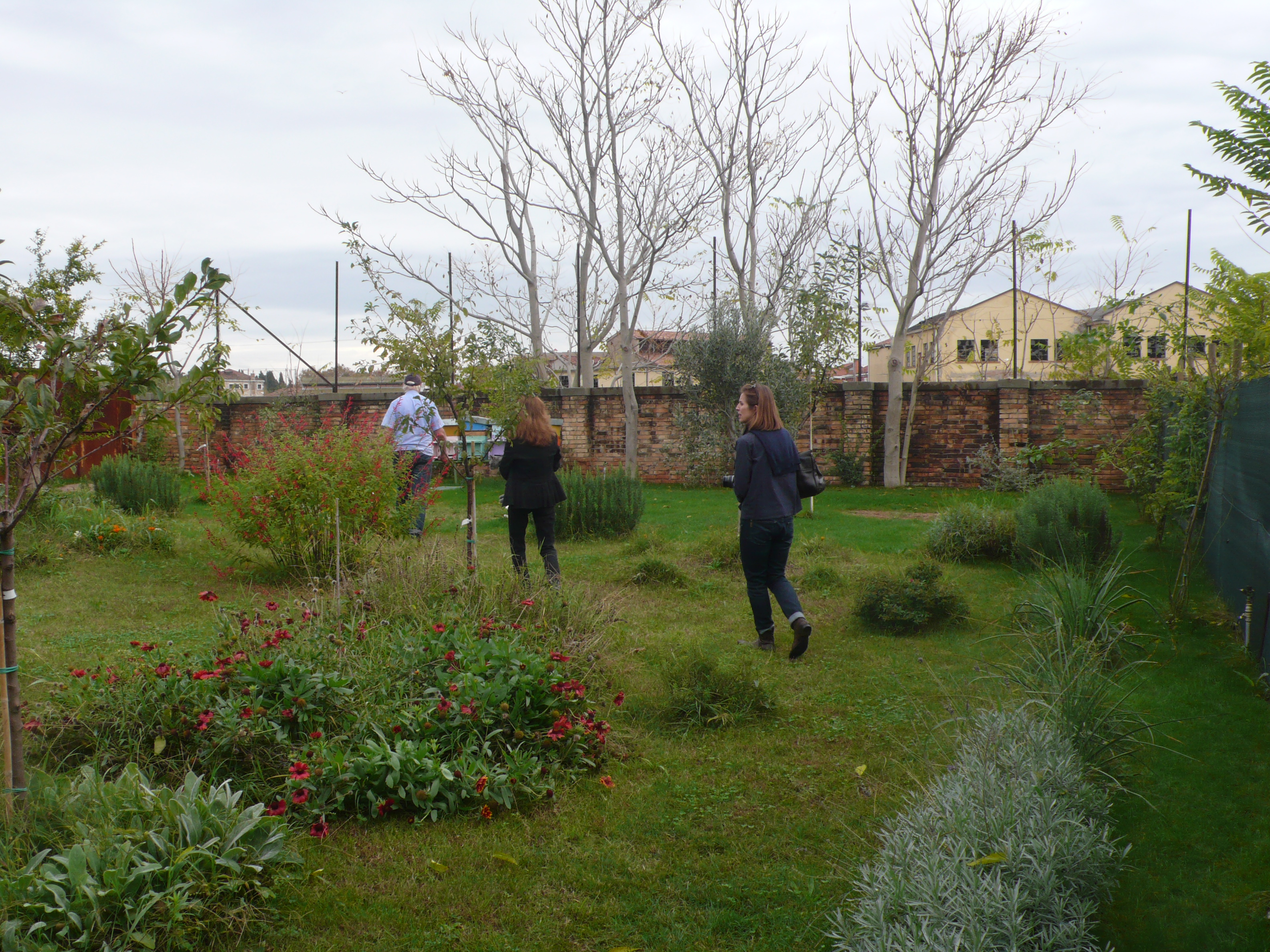
opaque orangecoloured glass windowand then we entered the almost story book world of the walled garden with the brightly painted beehives as the focal point and fruit trees – pomegranate, peach, pear, cherry, apple and quince – encircled with cushions of lavender and sage.
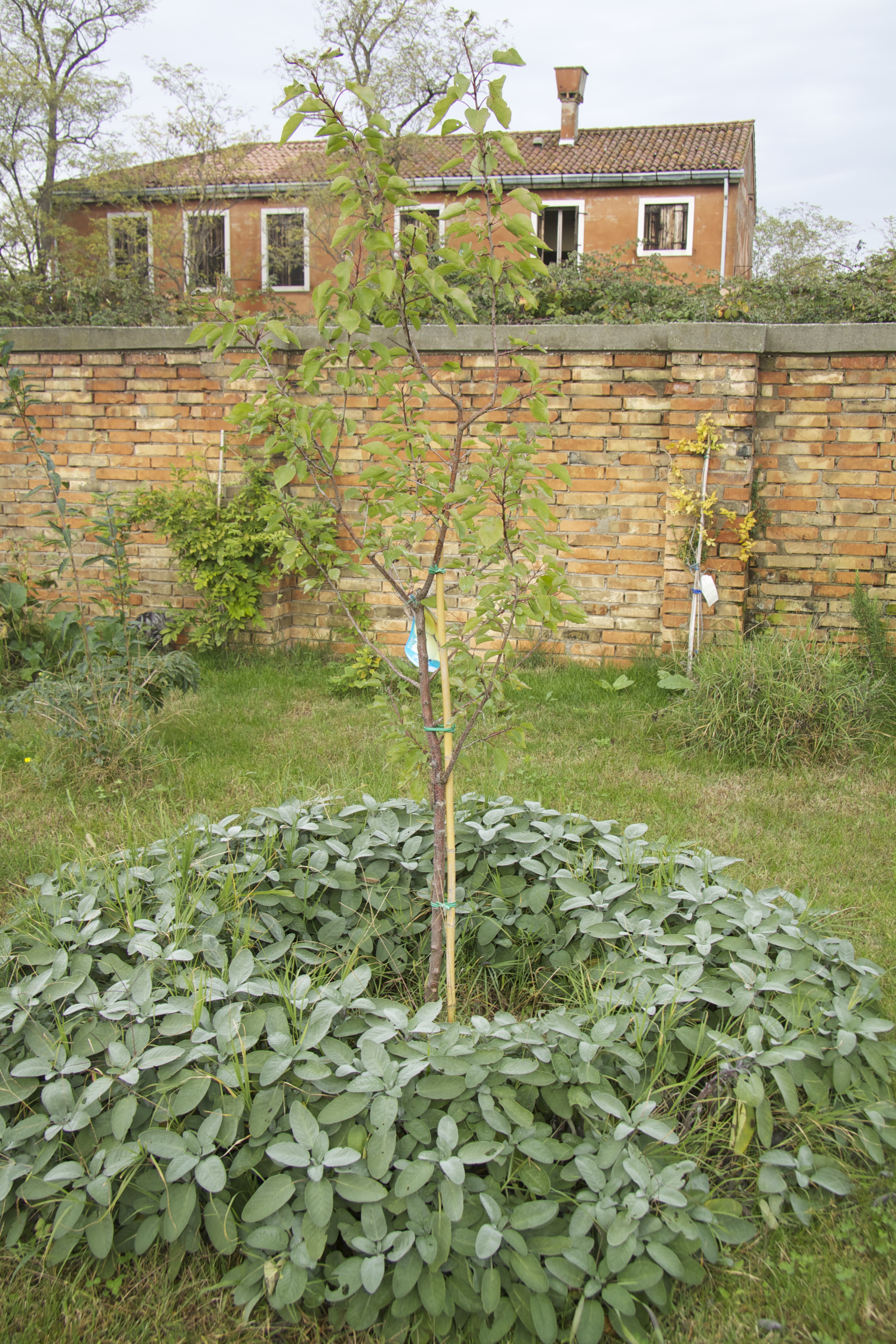
non  and judy tramping

salvia and beehivesage circlecoloured glass and ceratostigmaThis tranquil space does not betray the dogged hard graft it took to make it.  Once the ground was cleared of rubbish and broken glass, everything – soil, turf, trees, plants, bee hives – had to be sourced somehow from the nearest possible point, brought in by freight boat and installed in the heavy rains and aqua alta of early spring 2013.

But the impact of the garden has been significant beyond the scope of the exhibition – it has had a powerful effect of the pride and self esteem of the Giuman family – finally a place to go when there is a chance to take a break from the intense heat and dusty concentration of glass blowing.  Giorgio’s daughter made the sweet threshold sign ” il giardino delle api” out of glass beads. Already the history of the garden is taking off by itself – and honey and fruit will be harvested for years to come.threshold 2threshold 1

We have lunch in a great workers’ cafe/restaurant,  Trattoria Bar Serenella dal Coco just next door to both the glass factory and the Serenella vaporetto stop.  Surely the cheapest spaghetti vongole you will find in Venice?

serenella

In the afternoon we take the vaporetto to the island of Torcello to see the cathedral of Santa Maria Dell’ Assunta.  The cathedral was built in the Seventh Century and is most famous for its Byzantine mosaics.  Torcello_-_Santa_Maria_Assunta_-_mosaics_of_the_choirimage by Remi Mathis via Wikipedia Commons

As well as the gorgeous elongated simplicity of the Madonna and Child on a gold ground which fills the entire curve of the apse, I am captivated first by the pale zig zag marble of the walls and then the marble floor.

floor torcellofloor torcello 2

A bold, inventive, delicate patchwork of ochre, russet, black, green, grey and white.  A celebration of whatever could be sourced over the years.
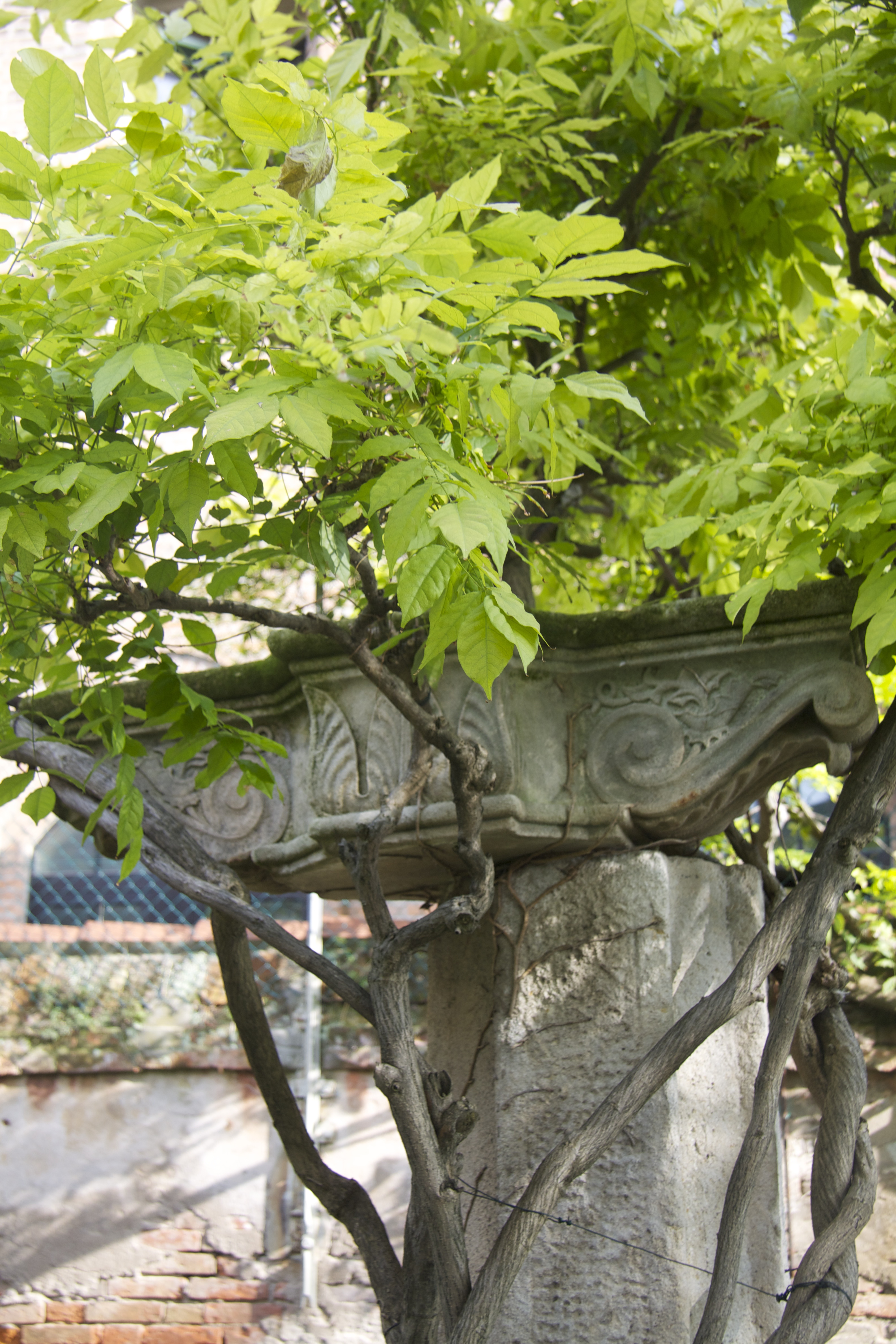
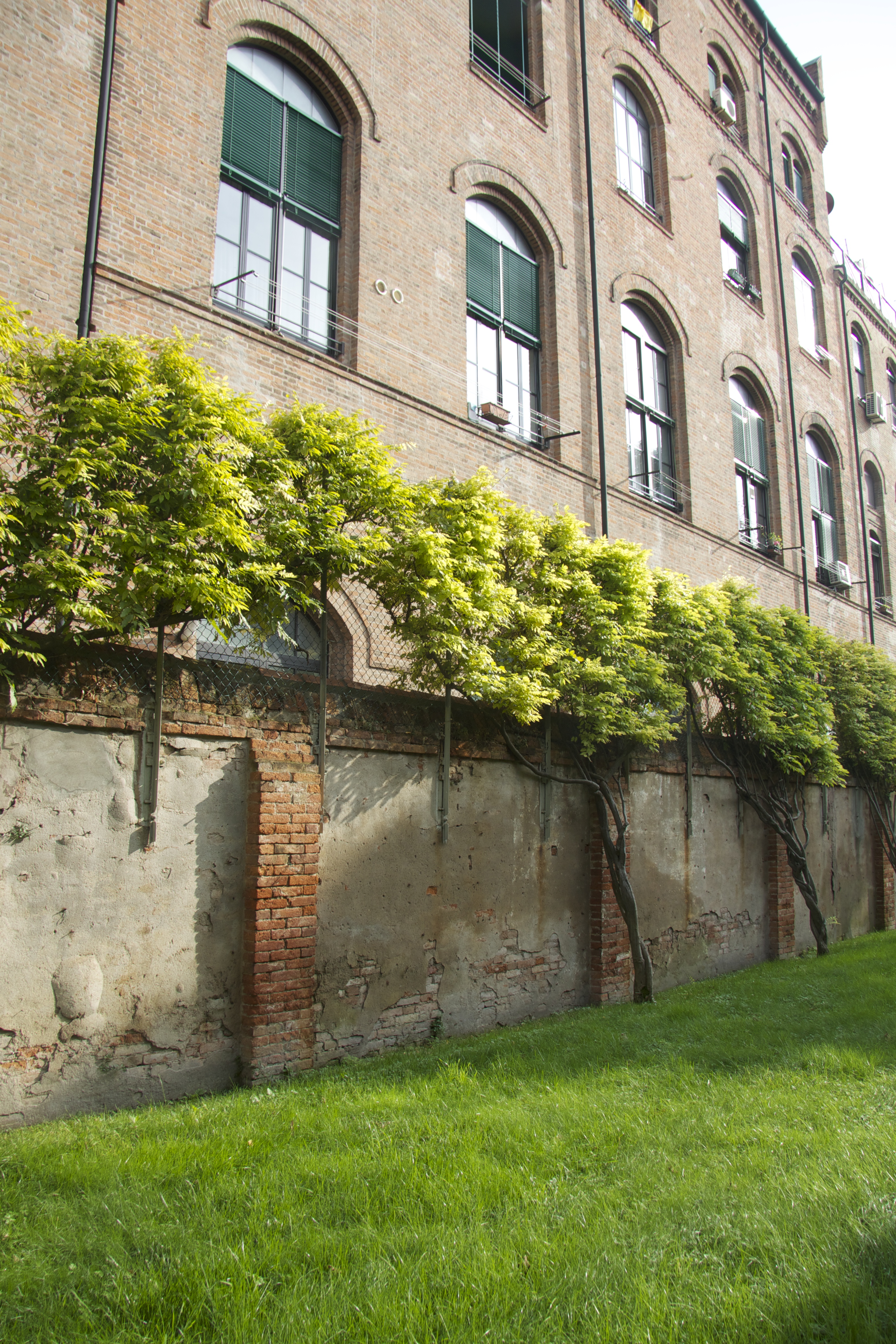
Later in the afternoon we enjoy an elegant, 20th Century interpretation of the same materials at the Fondazione Querini Stampalia.  The ground floor interior and garden of this sixteenth century palazzo now art gallery were brilliantly redesigned by Venetian Architect Carlo Stampa in the early sixties.

IMG_0174

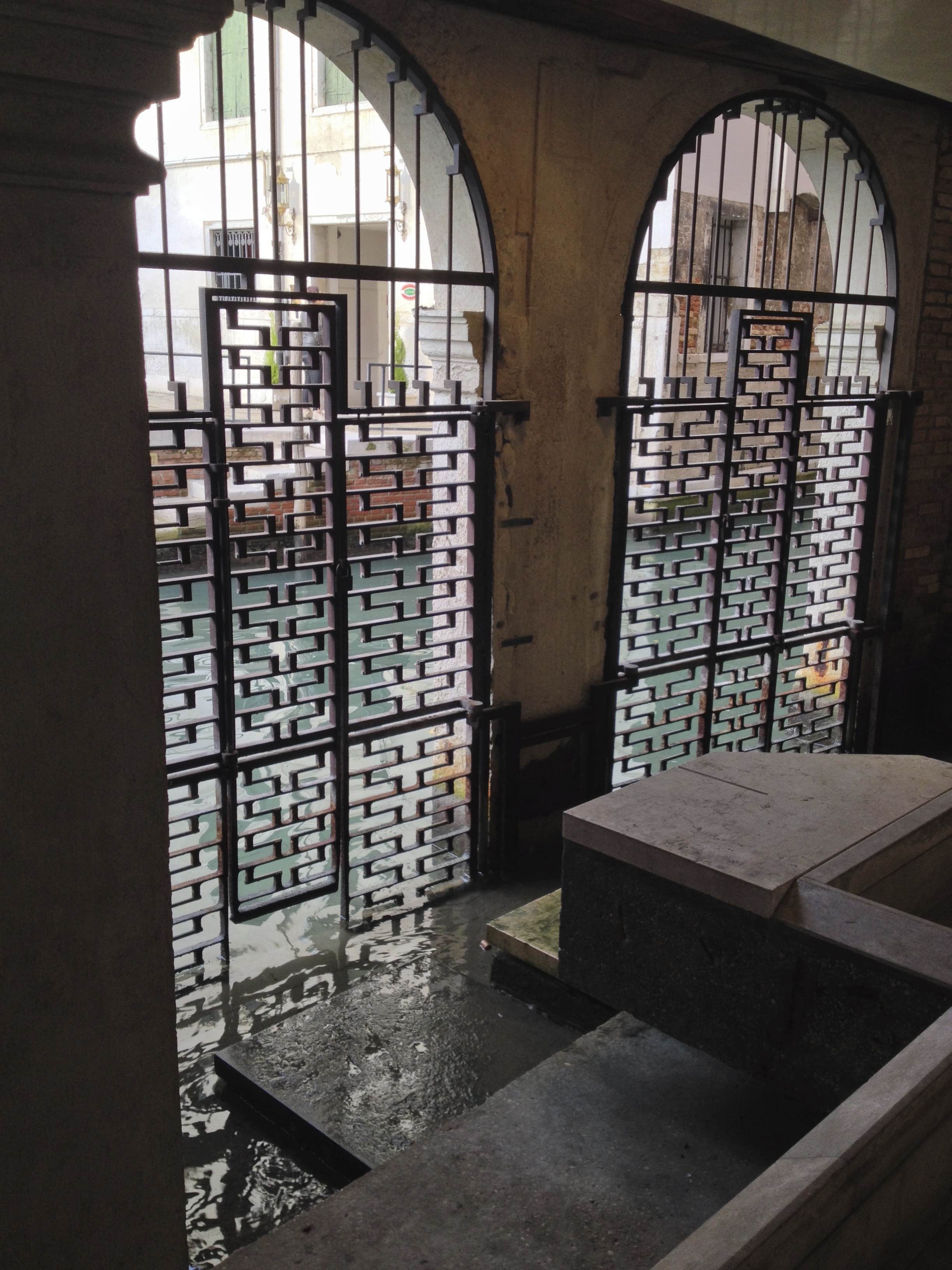
I am utterly charmed by the incredible quality and detail of his work here.  I love the spare geometric ironwork of the pair of gates which lead – tantalisingly – straight into the milky water of the canal,scarpa gatescarpa gates

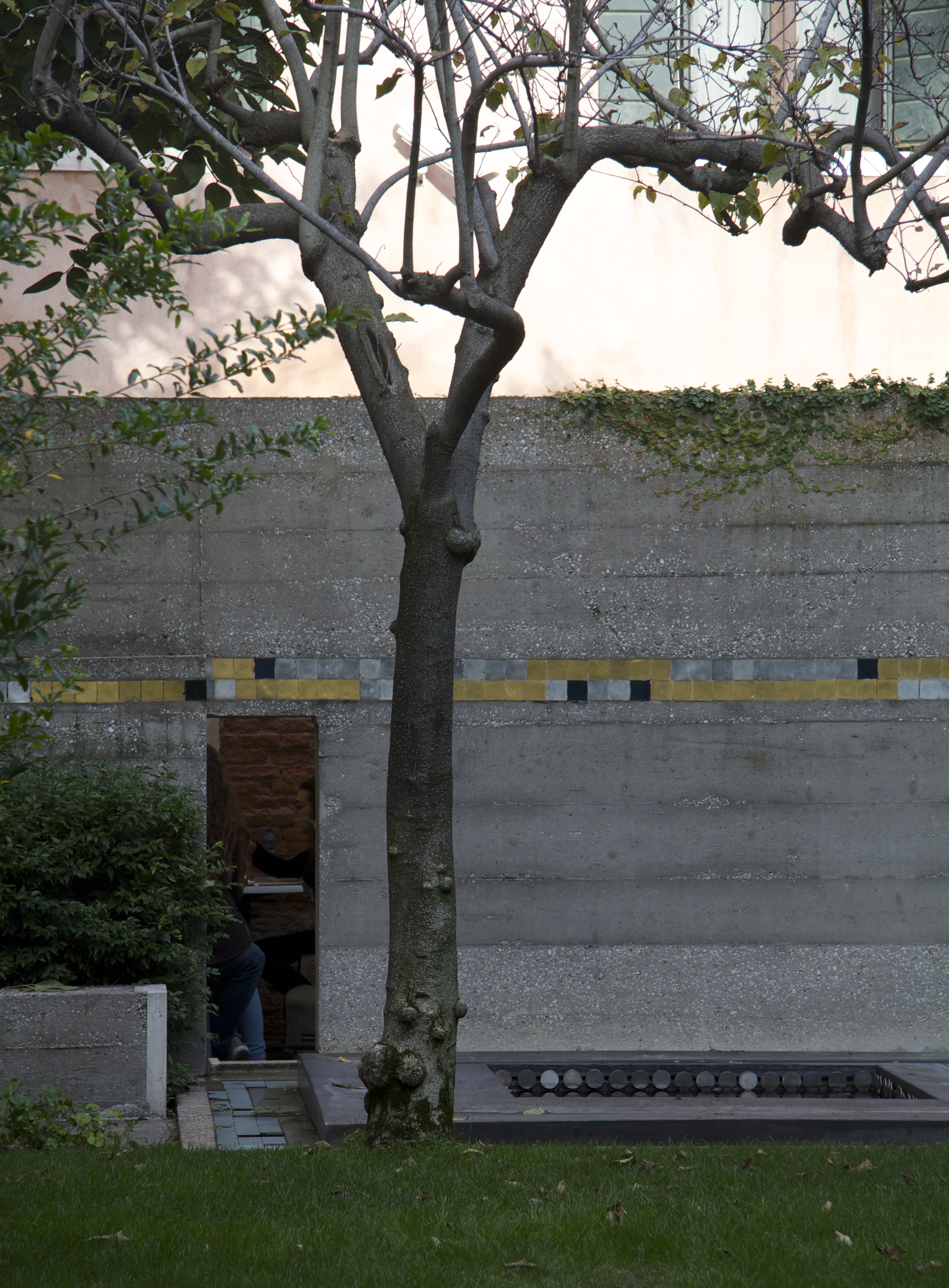
and the graceful double row of precious and semi precious tiles set into a speckled concrete wall.

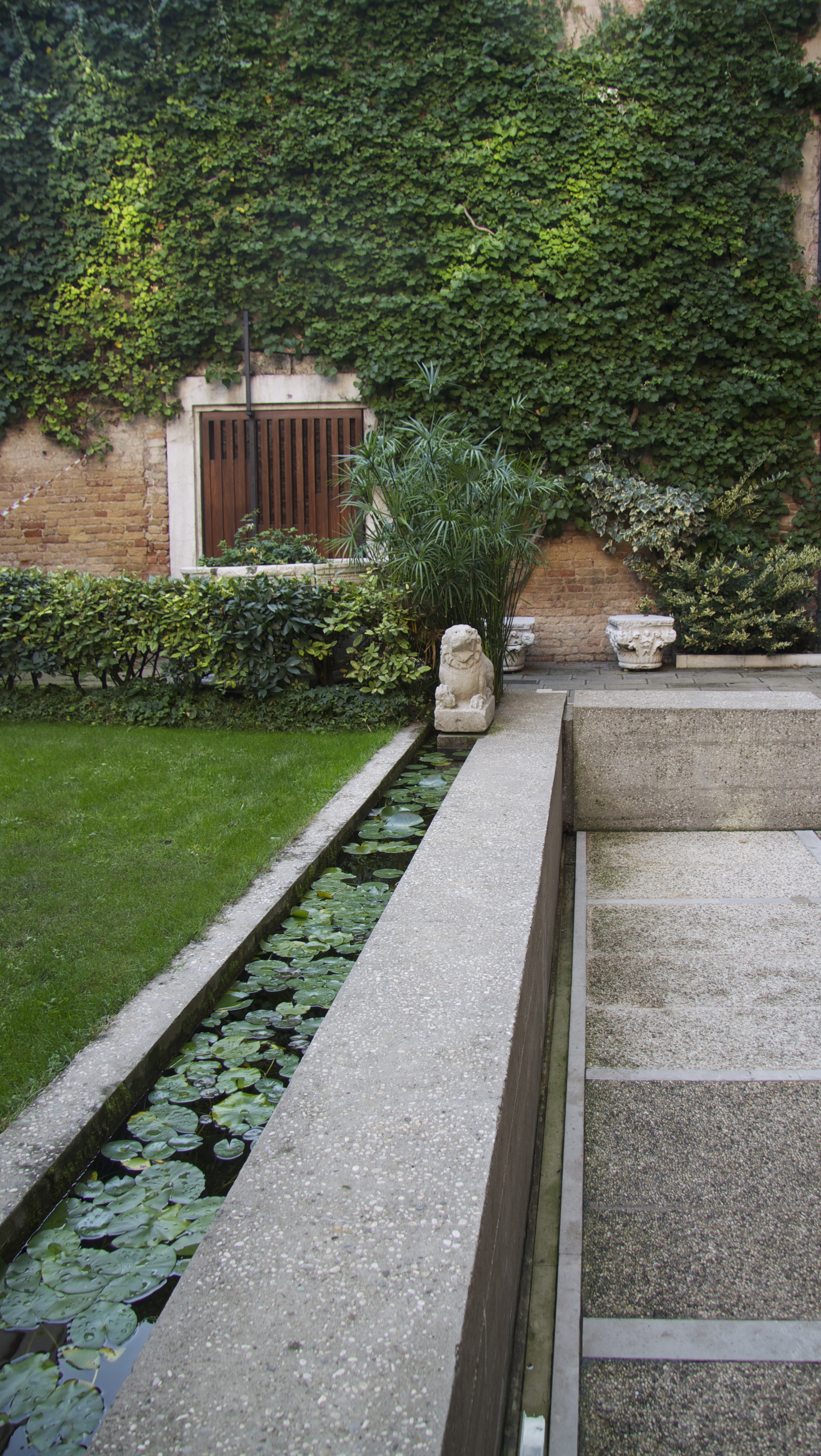
scarpascarpa tilingThe floating emerald discs of water lily leaves provide a glossy rhythm to the rill

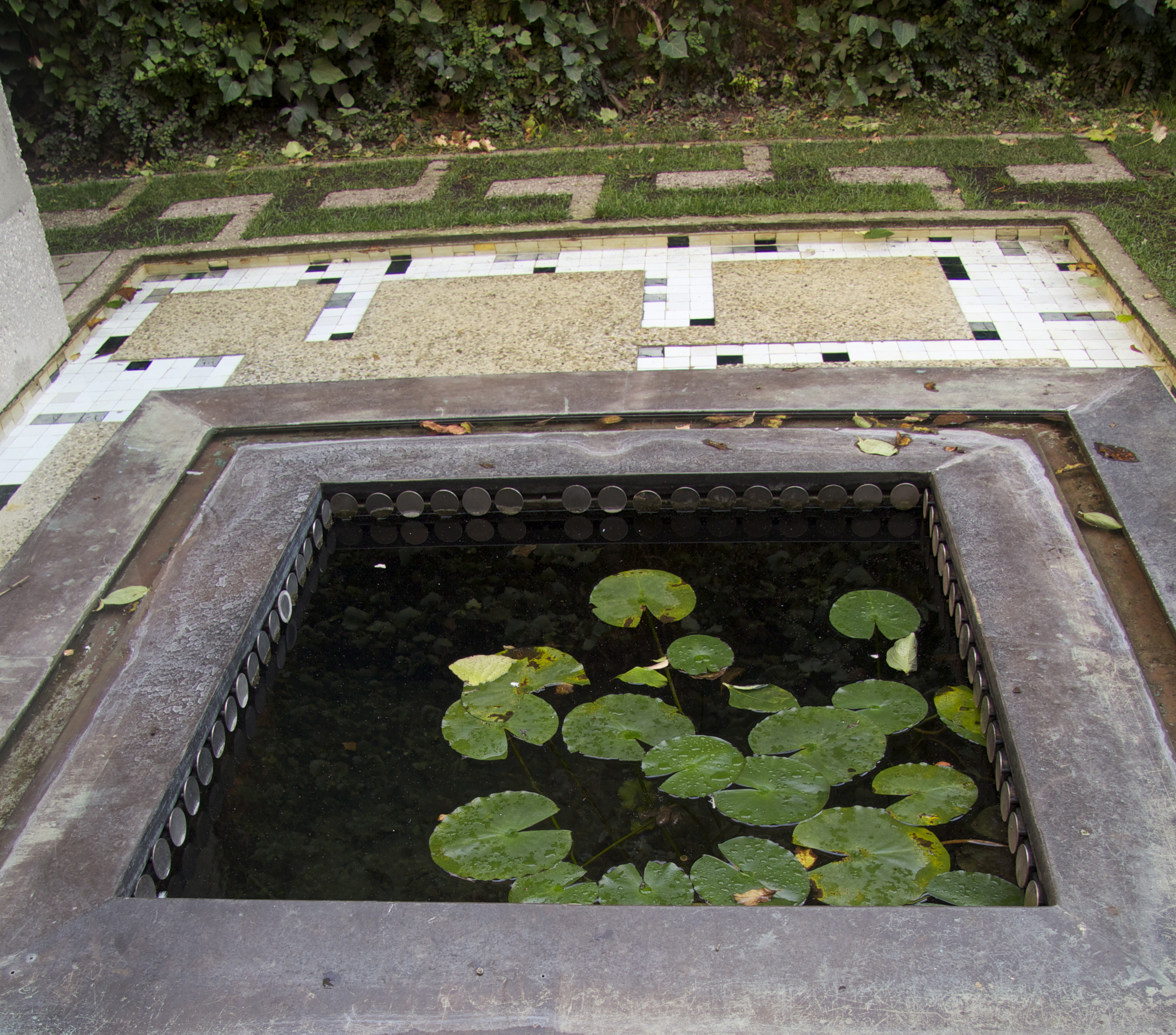
scarpa rilland the band of stainless steel circles which line the wooden frame of the pond and the patterns of tiles and stepping stones cut into the lawn add further delightful layers of texture.

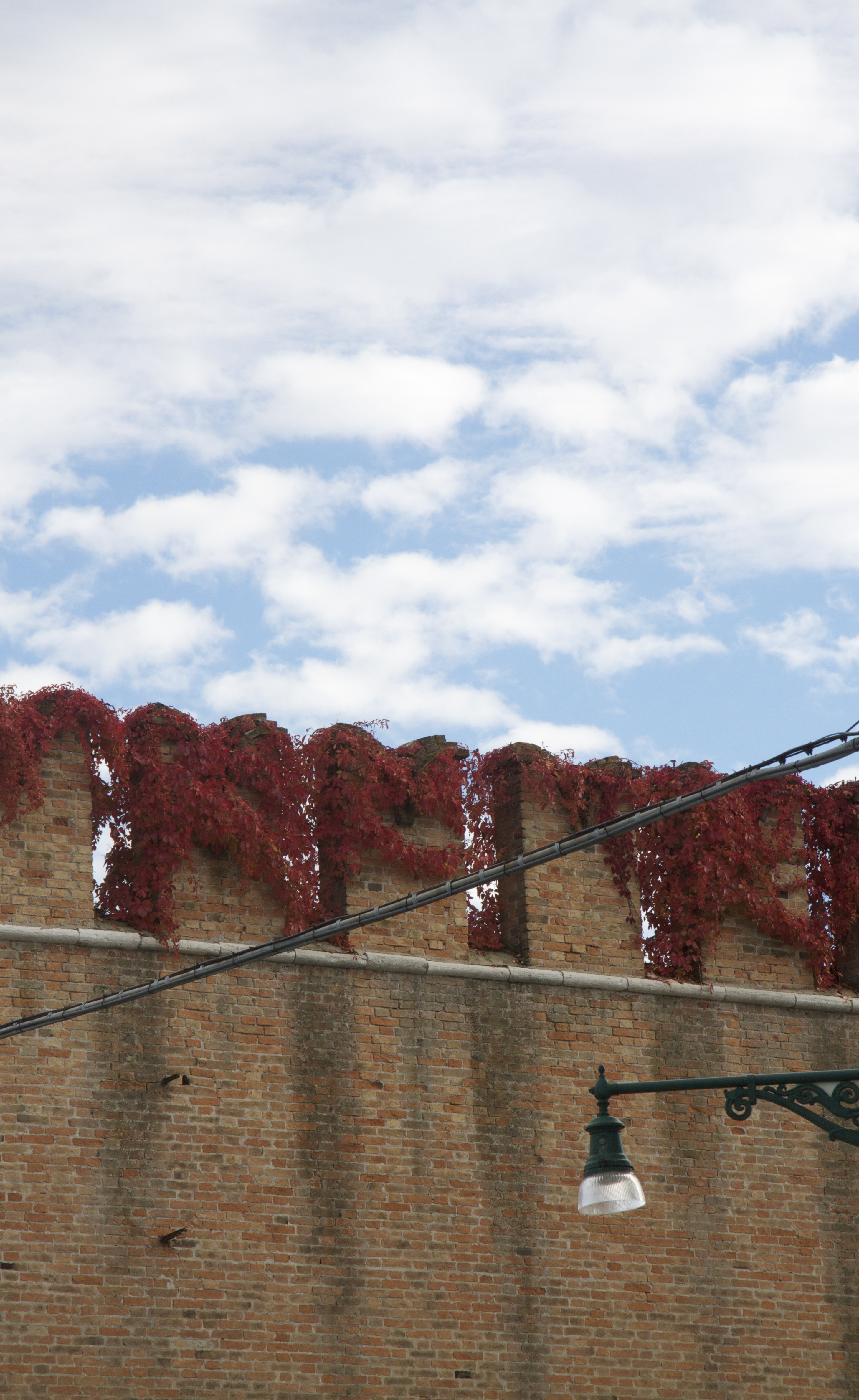
new pondWe are feeling the city’s charm badly.  Flashes of red everywhere.  Deep red Virginia creeper drapes itself knowingly over an austere castellated wall.

venetian sky

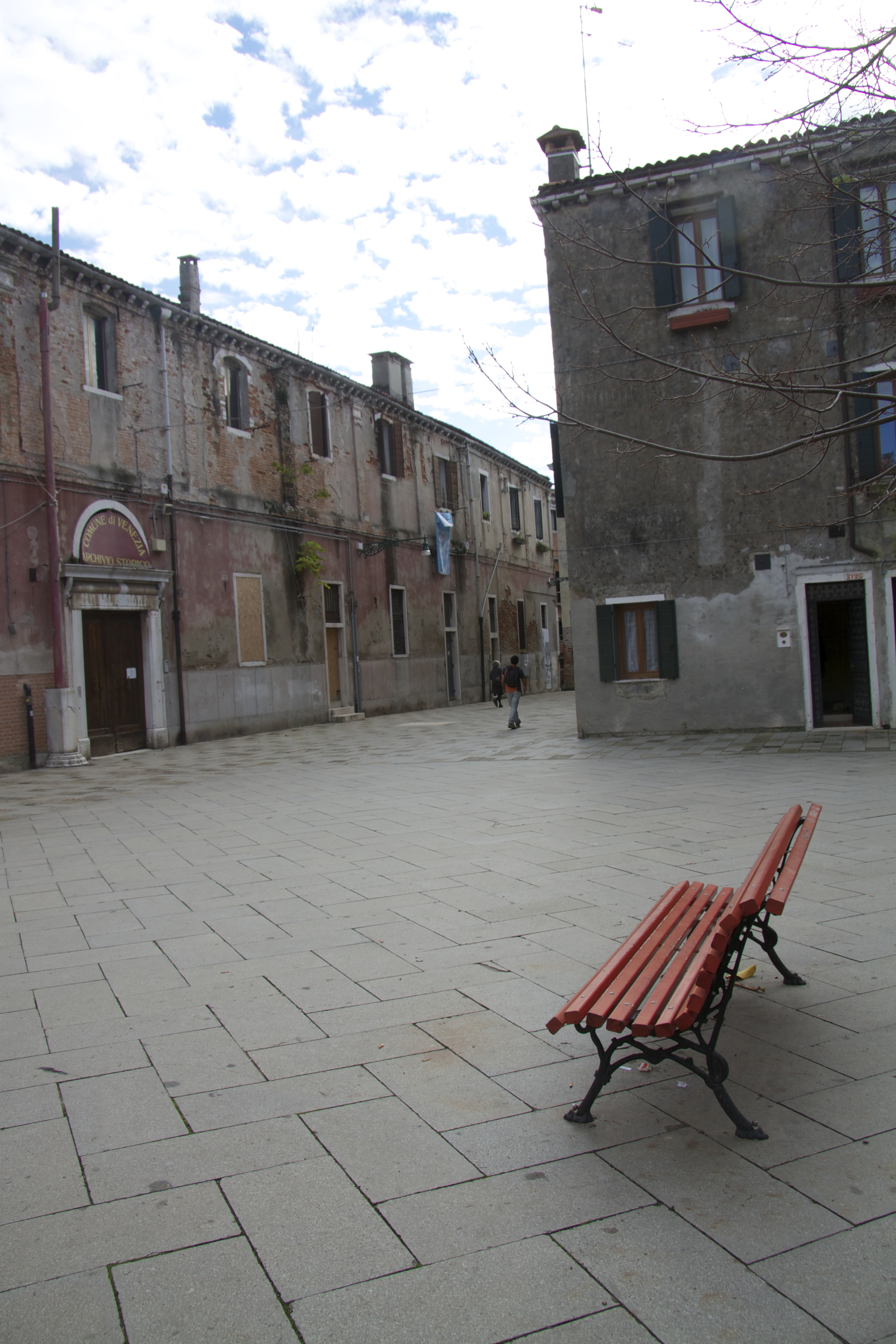
One of the city’s red painted benches waits confidently in a crumbling square.

red benchPartially lowered red canvas blinds provide a warming glow to the cool, shiny damp of the fishmarket.

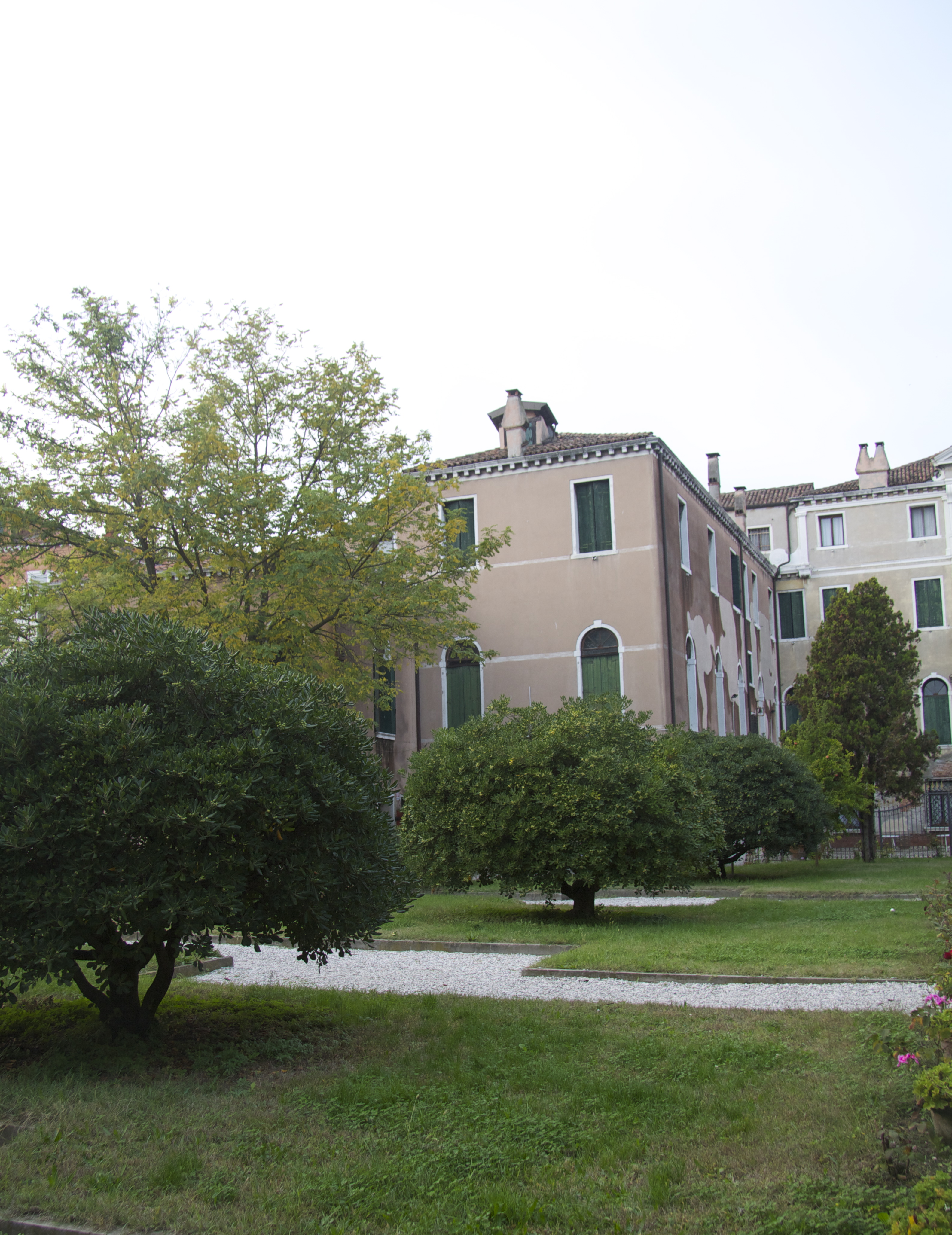
flashes red and greenAn avenue of eighty year old Pittospurum, shaped into lush and portly trees, anchors the garden of a crumbling private palazzo

IMG_0707

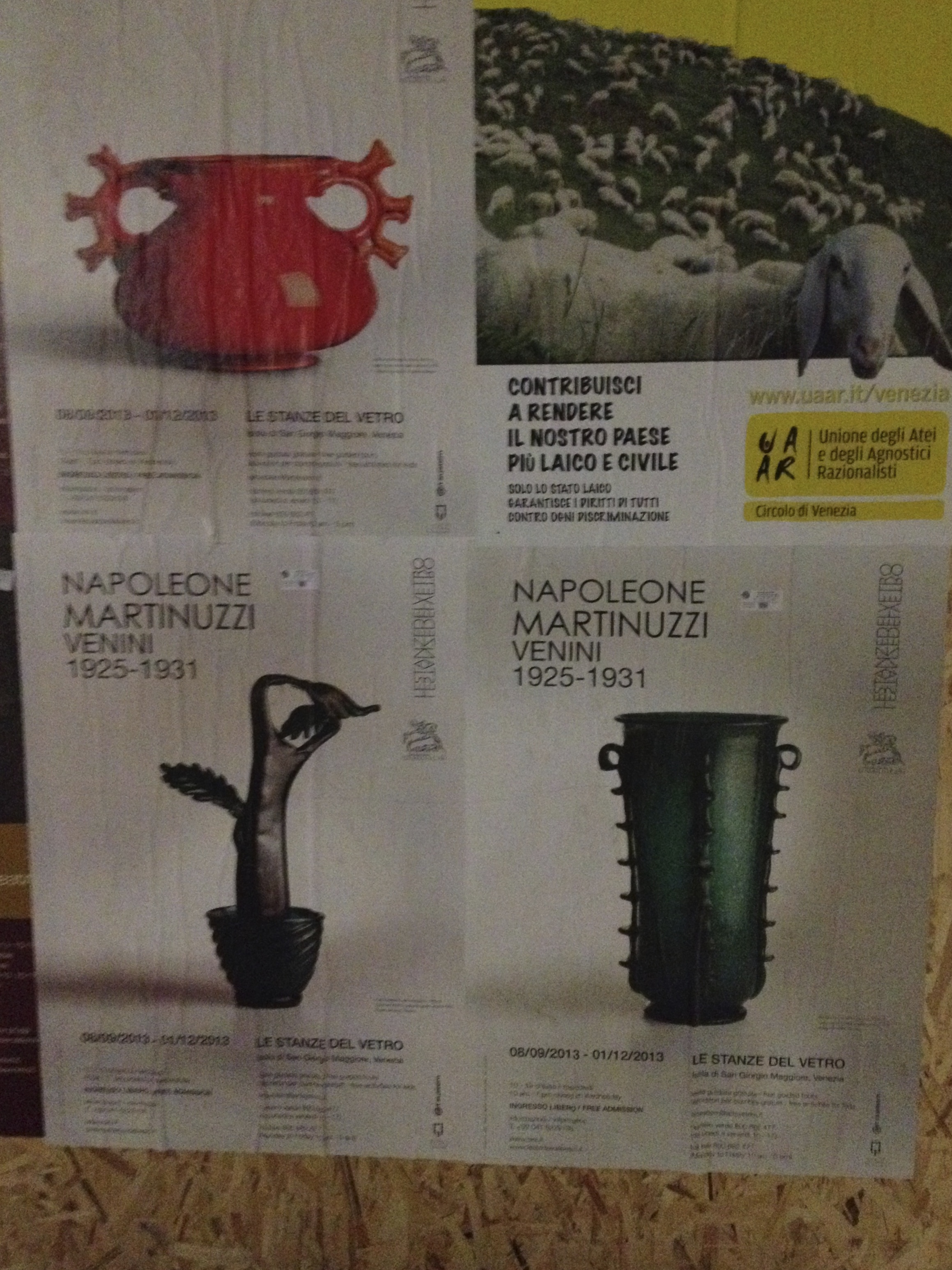
Even the museum posters plastered onto corrugated iron seem to be a symbol of the beautiful and endlessly creative city which is always the same but always slightly changing.

poster muranoposter tapies

FORTUNY FACTORY GARDEN VENICE

THE COLOURS RED AND THE RESTORATION OF A PRIVATE GARDEN IN VENICE

Venetian pink

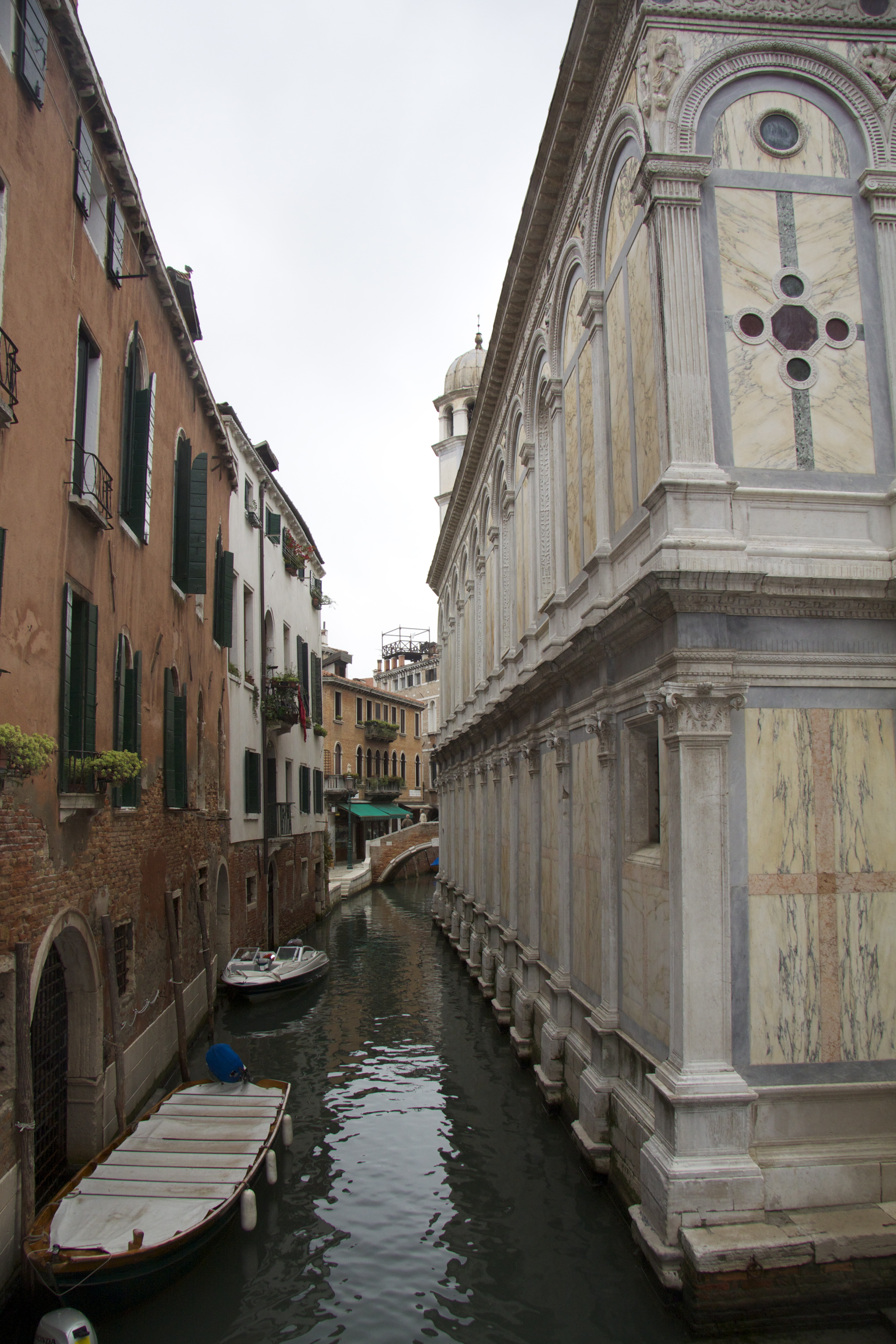
An October day in Venice. The morning glides softly by in a palette of diffused reds and milky greens.  The marble clad Church of Santa Maria dei Maracoli is the most exquisitely beautiful, calmly metered example of this, emerging matt and confident out of the petrol blue of the canal.

dei Miracolijourney a

The colours shift gently as we walk – somehow the richness of colour and texture is always perfectly balanced.

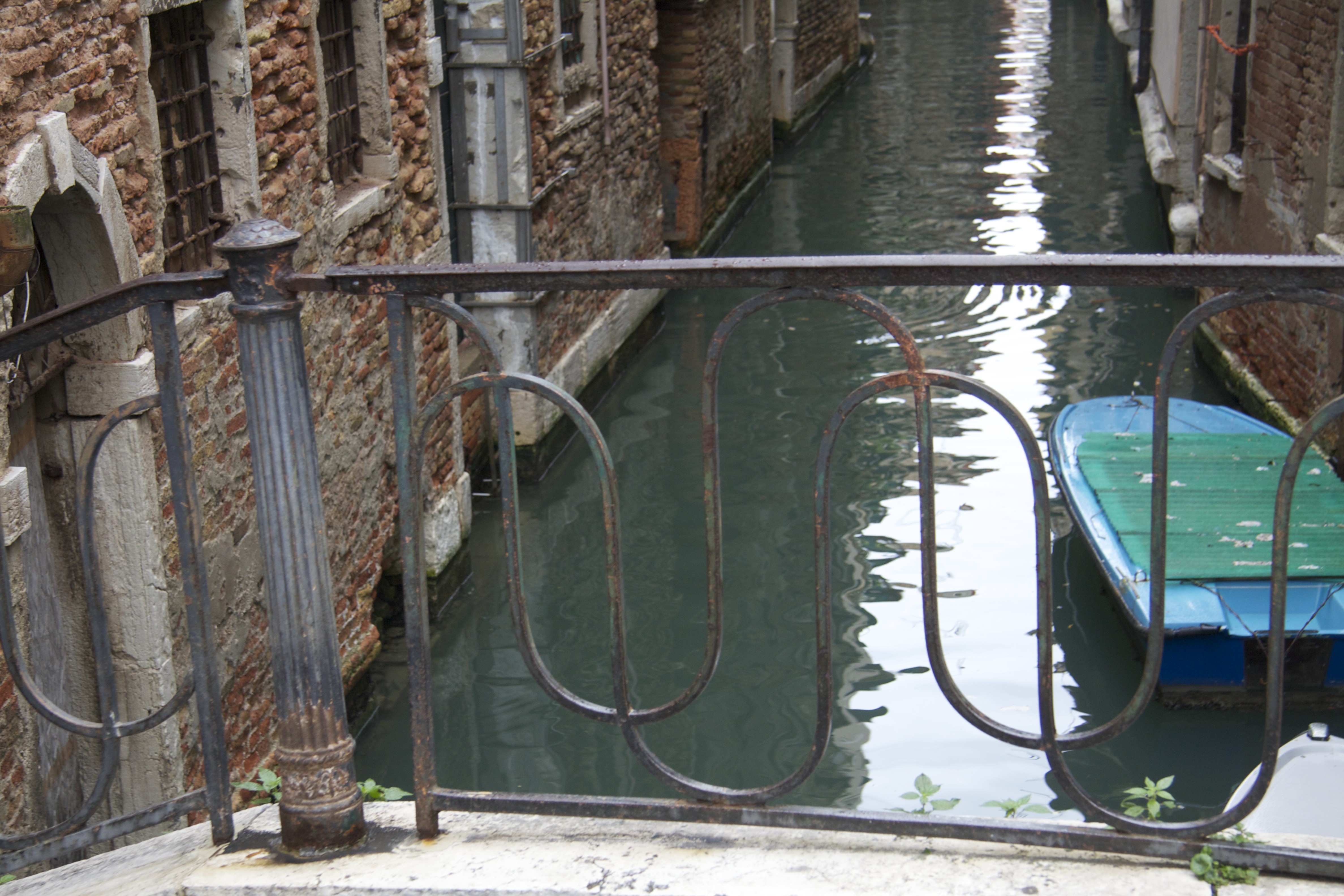
I am distracted by a detail – here the simple, overlapping curves of the metalwork on a bridge go into my sourcebook.

diversion 1

We climb up the tower of San Giorgio Maggiore. Look down one way and you have a dreamy view of the lagoon and its islands.

lagoon

Look down another way and you have the ordered topiary of the Fondazione Giorgio Cini Onlus. It is a heady mix.

look down

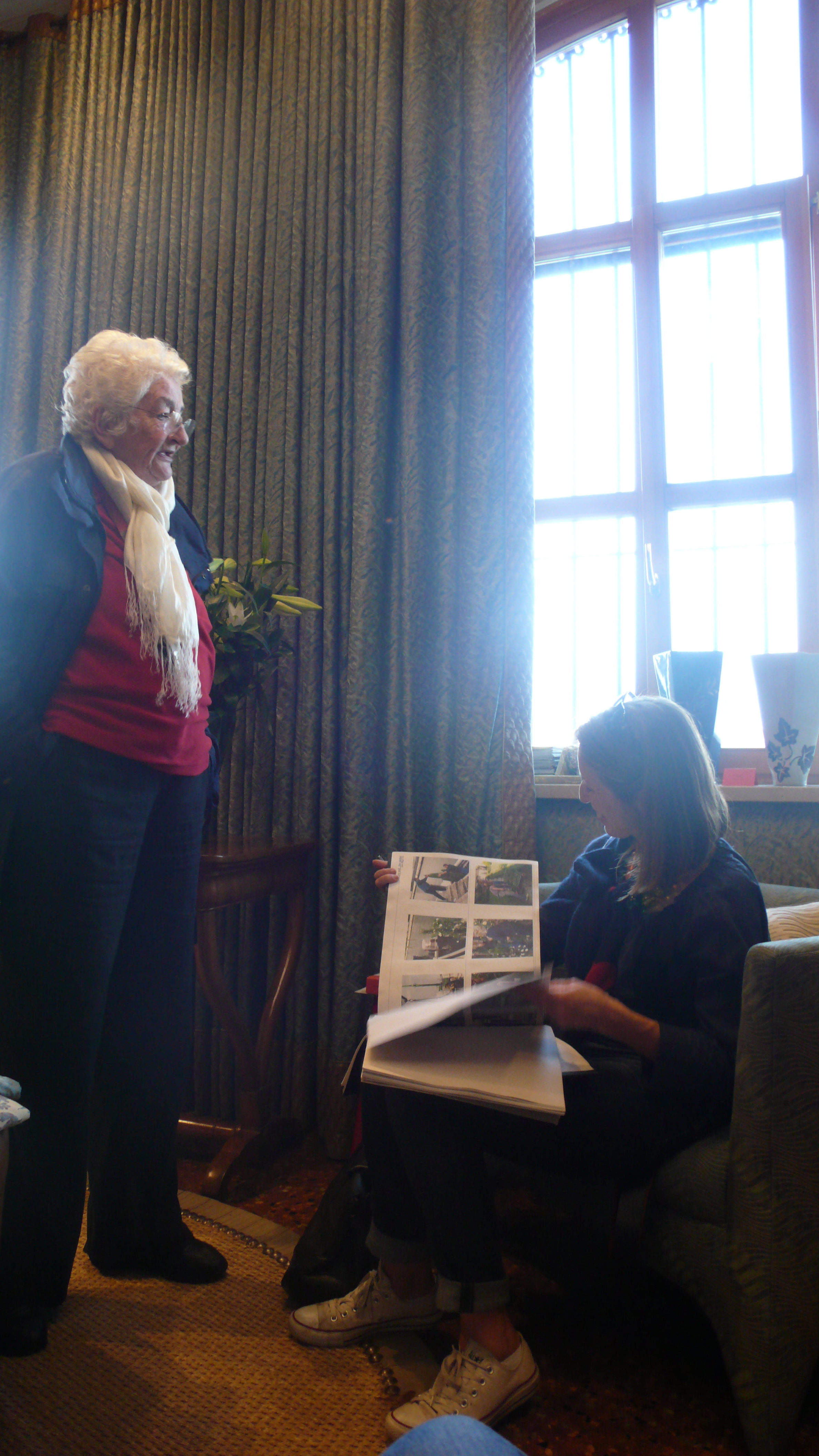
We have arranged to meet Tudy Sammartini – the grande dame of Venetian gardens, both as a writer (“Secret Gardens in Venice” and “Verdant Venice: Gardens in the City of Water”) and a designer. We meet her at the San Basilio stop. The fragile white haired eighty something figure sitting by the canal melts away as she gets up revealing her imposing height and commanding voice. She lights up as we step onto the vaporetto over to Guidecca and is greeted superstar style for the rest of the afternoon – “Ciao Signora Tudy!”.

L1020750

Tudy has been restoring the private garden behind the rich red industrial brickwork of the Fortuny factory with specialist architect, Ilaria Forti and will continue to work on the garden over the next few years.

view

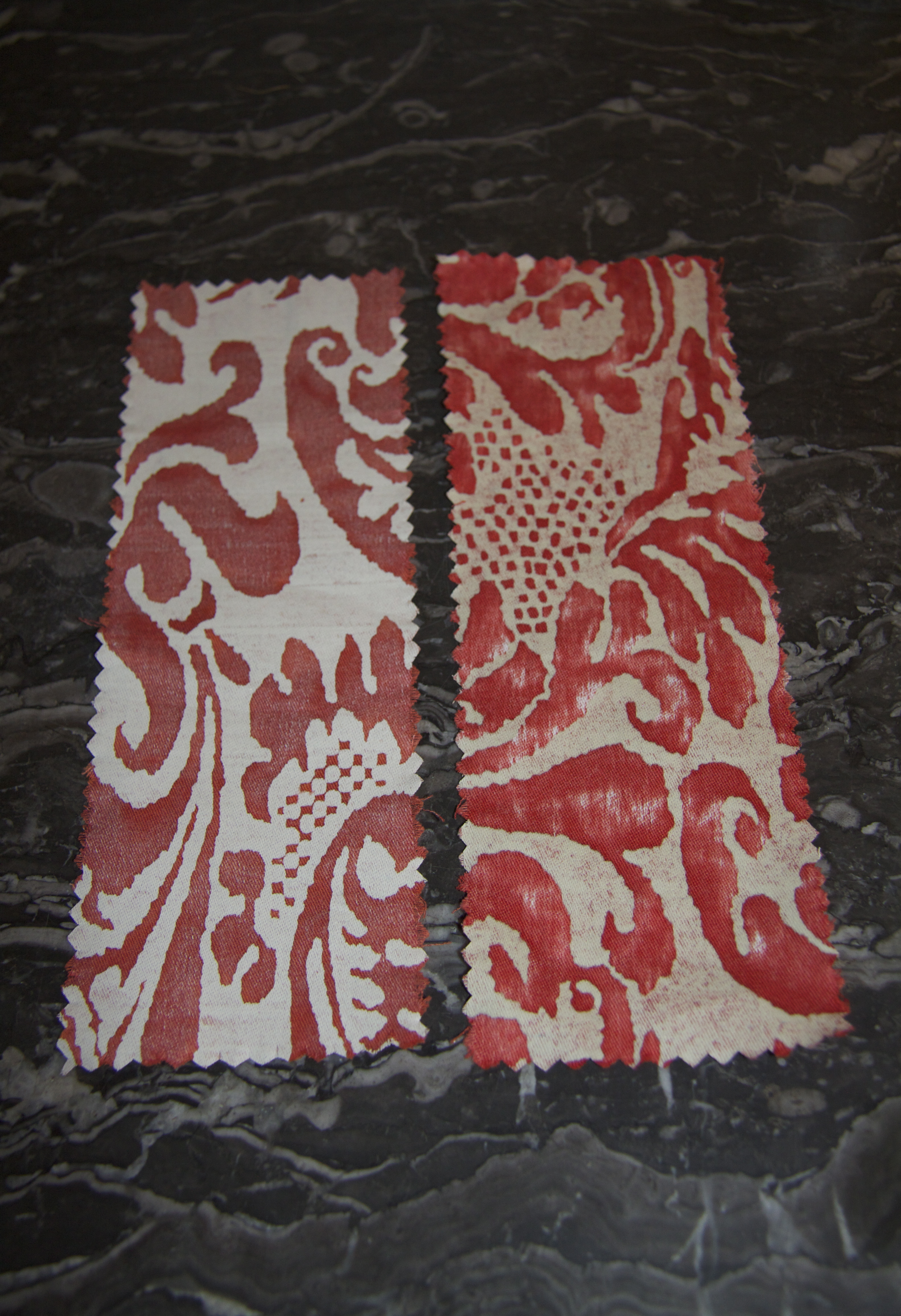
She has been in the business for a long time and tells us how she worked with ‘The Countess’ in the sixties on the original development of the garden. Countess Gozzi has an amazing story.  She was an American interior designer and business woman – Elsie McNeill Lee – who fell in love with Fortuny furnishing fabrics in 1927 when she saw them hanging in the Carnavalet Museum in Paris.

fortuny sampleMariano Fortuny had patented a way of processing cotton to have the sheen and subtlety of antique silk in 1910.  He was an extraordinary man – as well as establishing his textile business he was an innovative and exciting set designer and painter, a lighting designer (he invented the dimmer switch) and in 1907 started producing the gorgeous finely pleated silk “Delphos” gowns which are synonymous with his name.

McNeill Lee travelled to Venice to meet  Fortuny – and ended up introducing his furnishing fabrics to the US and becoming so closely involved that when Fortuny died in 1949 she took over the business.  When she died in 1994 – having married an Italian Count and become Countess Gozzi –  she left the business to her confidant, Maged Riad whose family are still in charge and who have commissioned the garden restoration.

One of Countess Gozzi’s most ambitious gestures in the garden was to adapt the ‘Cavana’ – or boat garage into a private swimming pool – still one of only four swimming pools in Venice.  But for me the ambition is in the painstaking research – each plant in the restored garden features as a design in the Fortuny archives  –

Non and Tudy in showroom

archive fortuny

and the passionate tenacity that are bringing a neglected garden and piles of stone back from this:

still undone

non tudy pile treasures

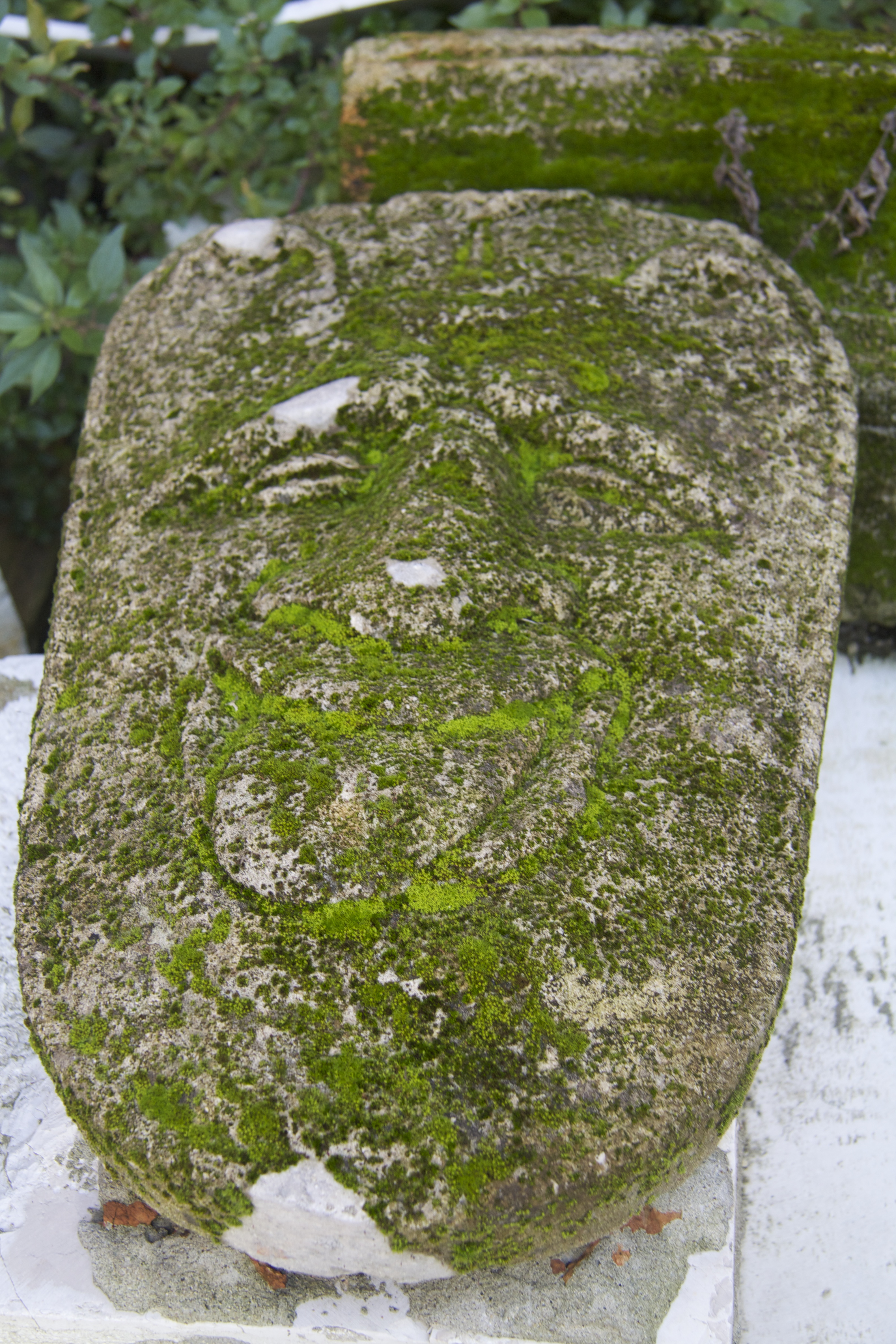
Tudy shows me her fiercely guarded “pile of treasures”

stone face

To this:

gates + recycling

wisteria colum 1IMG_0648arch with sky

‘These sculptures are not that great’ she declares  ‘but they will have red-orange coats, (Virginia Creeper),  they will look good when they have coats.’

naked man

There is a romance and particular vocabulary to this sort of European formal garden which excites the Anglo Saxon designer – it is a language of rusting pergolas, berceaux  (vaulted trellises) laden with fruiting vines, crumbling marble columns whose capitals have been replaced slightly off centre “to keep a sense of movement and rhythm”, walls waiting to be clothed in arches of Laburnum and rangy pomegranate trees with their globe-like fruit splitting and spilling out their jewel red flesh against a blue sky.

IMG_0675

Tudy has renovated the roses and the Wisteria herself ” I bring earth from the mountains …. I cut, cut, cut”.  But the first thing she insisted on was serious irrigation and she has used Dichondra to replace lawn as it only needs to be cut twice a year.  She will be planting bulbs – Iris, baroque tulips and narcissus – and shows me the meandering scented ‘snake’ she has created of lavander, box and myrtle.

A pragmatic scheme of white Camellia underplanted with blue and white Vinca is edged in the finely striped sepia and white stones used in the manufacturing process of Fortuny fabric.

fortuny stone

A celebration of soft red:

rust fabric paint and bricj

and rich green and soft red.

IMG_0634

This wall – with spare arching black iron window frames dressed in grey toile de jouy style fabric – is clothed in bright yellow roses all summer.  I bet it is a brilliant combination.

IMG_0643grey fabric iron

As we leave the garden Tudy points to some dandelion leaves lurking at the base of a still  lonely pergola – I should not, of course, have expected this gardening powerhouse to be remotely apologetic:  ” I come to collect it” she says “and then I eat it”.

GREAT DIXTER: LAST DAY OF SEPTEMBER

A CELEBRATION OF BRILLIANT PLANTING AT THE VERY END OF SUMMERdahlia

The last day of September and Great Dixter (http://www.greatdixter.co.uk) is still comfortably pumping out rushes of sheer happiness all over the garden. I am part of a monthly study group led by the tirelessly enthusiastic Kemal Mehdi – friend of the late Christopher Lloyd and Dixter Trustee. It is always the same – as we turn the corner from the Front Meadow and get the first dancing glimpse of the Barn Garden beyond the dark yew entrance – no one can help that moony Dixter smile wash over their faces. The rest of the world stops for a day as we get looking, hungrily.

salvia confertiflora

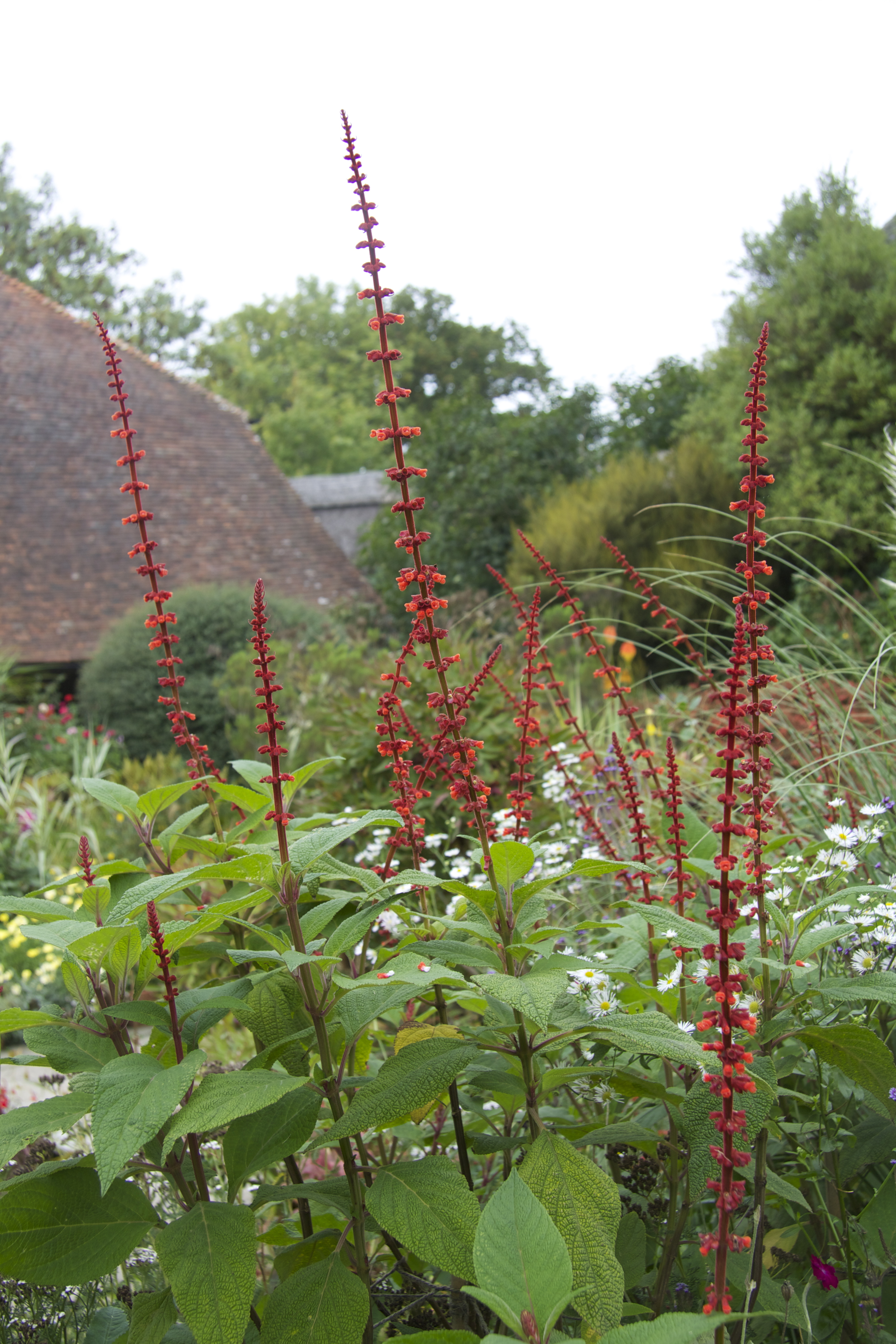
Salvia confertiflora

This wonderful – tender – sage has tall spires of glowing crimson flowers on soft, felted calyces with bold corrugated green leaves. It has the perfect common name – ‘red velvet sage’ – and is dangerously irrisistable here against the rich reddish brown of the wonderful barn roof tiles. The daisy in the background here is the tall Erigeron annuus which is one of the late summer leitmotiv plants at Dixter. It works especially well when used lightly as it can look a bit marooned and leggy when there is too much of it in one go. The elegant arching foliage belongs to the compact and surprisingly elegant pampass grass – Cortaderia selloana ‘Pumilla’. Time to throw out all prejudice about pampass grass perhaps and enjoy instead the elegant, slender evergreen foliage and soft white upright plumes?

cyperus 1

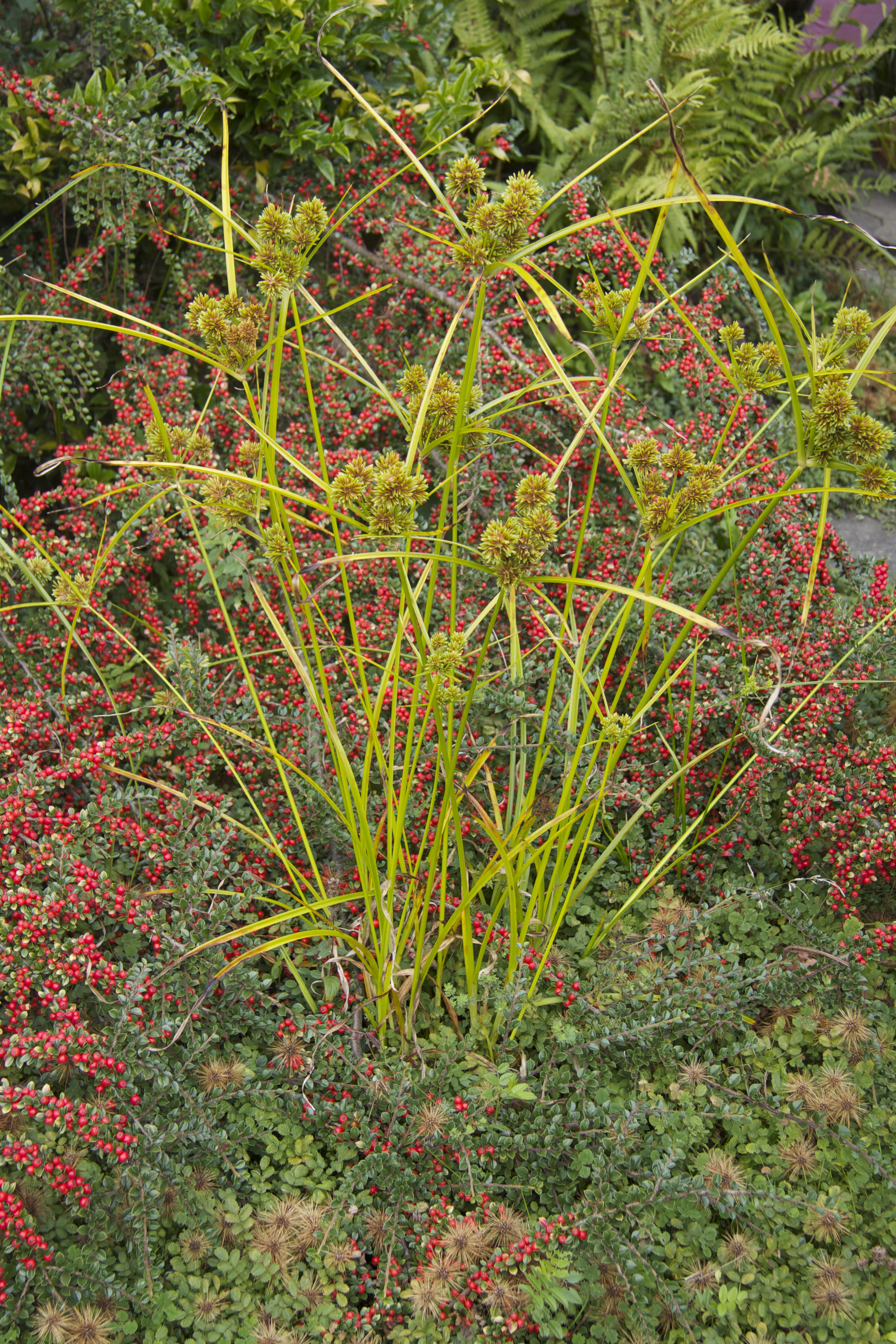
Cyperus eragrostis

Growing near the pond at the centre of the Barn Garden – but introducing itself with style up the steps and into the barn itself – the yellow greens and bronzes of this supposed bog sedge glow vividly against the brilliant red of Cotoneaster horizantalis behind it.

kniphofia rooperi

Kniphofia rooperi

At the top of the steps is a stand of fantastically robust and brilliantly coloured red hot pokers. Evergreen architectural foliage and a reliable offering of orange-red torches every October. All this against irridescent dashes of magenta – the incredibly long flowering Salvia microphylla ‘Cerro Potosi’, the rich purply blue of even longer flowering Geranium ‘Rozanne’ and the intense coral red of Hesperantha coccinea Major (Hesperantha the new name for Schizostylis). Every member of the happy club muttering quietly to themselves already.

For really trying to understand the impact of certain plants and how they work together there is nothing to compare with looking closely at any garden again and again throughout the year. At Dixter – famous for a density of successional planting that few other gardens could even begin to emulate – visiting and revisiting is relentlessly rewarding. What is even more energising is the tone of happy and constant experimentation that Head Gardener, Fergus Garrett now sets for his wonderful team. There are many moments at Dixter that are beyond the manpower and skill of most gardens but there are also plenty of ideas that will work really effectively elsewhere.

THE REALLY GREAT INDIVIDUAL PLANT

Taking the time to track down a particular variety and then giving it space and growing it well.

nb best white mophead

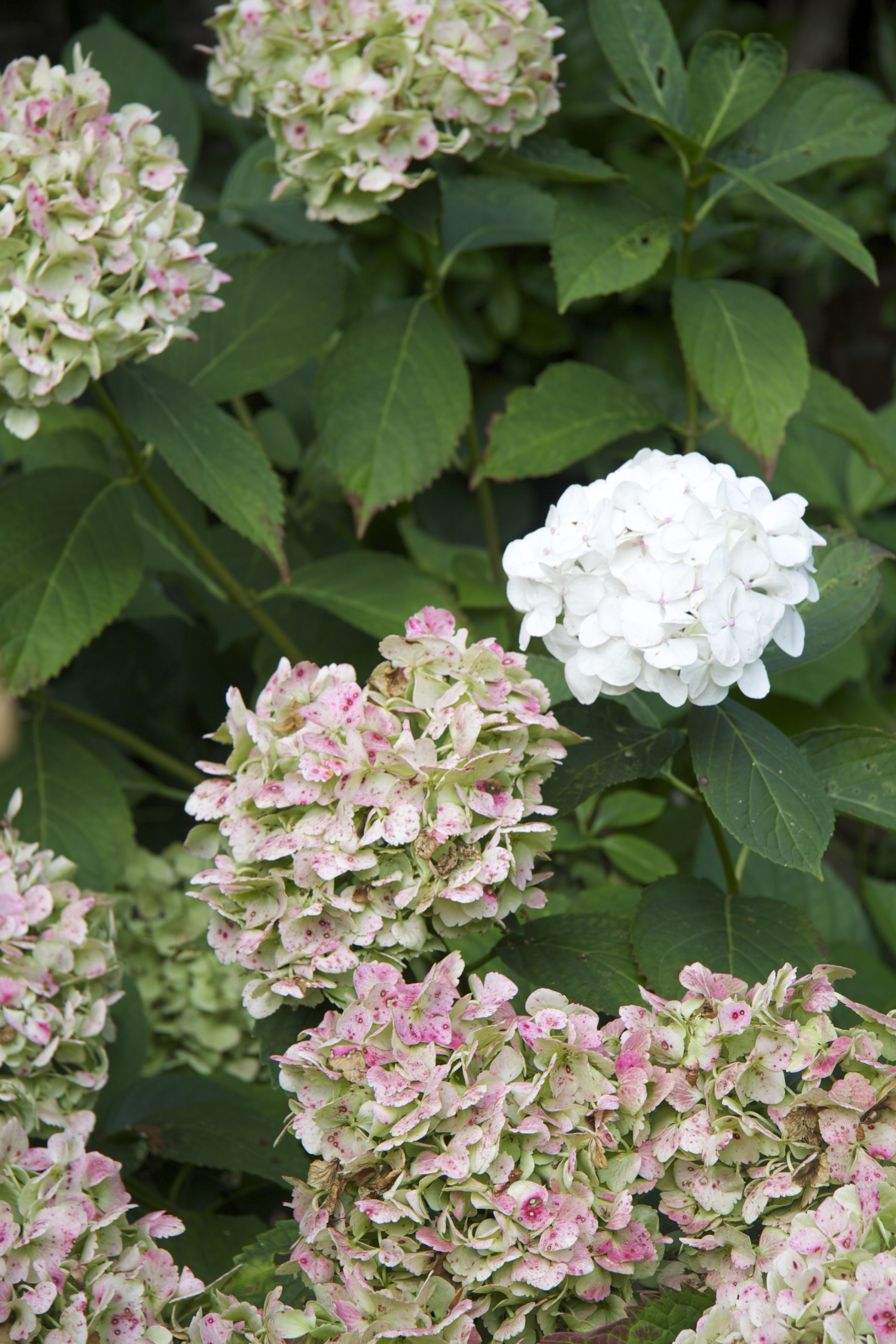
Hydrangea macrophylla ‘Mme Emile Mouillere’

Christopher Lloyd always declared this to be the best pure white mophead hydrangea – a clear white rounded flower head with faint pink markings which gradually fade to a soft speckled pale greeny- pink. It needs to be given space away from brighter more magenta toned pinks or it will appear to be almost salmony in colour which might irritate – well it would irritate me. On its own or amongst green foliage, this late summer colour is gorgeously subtle and happy to be occasionally illuminated by the occasional freshly emergent white flowerhead.

Actaea

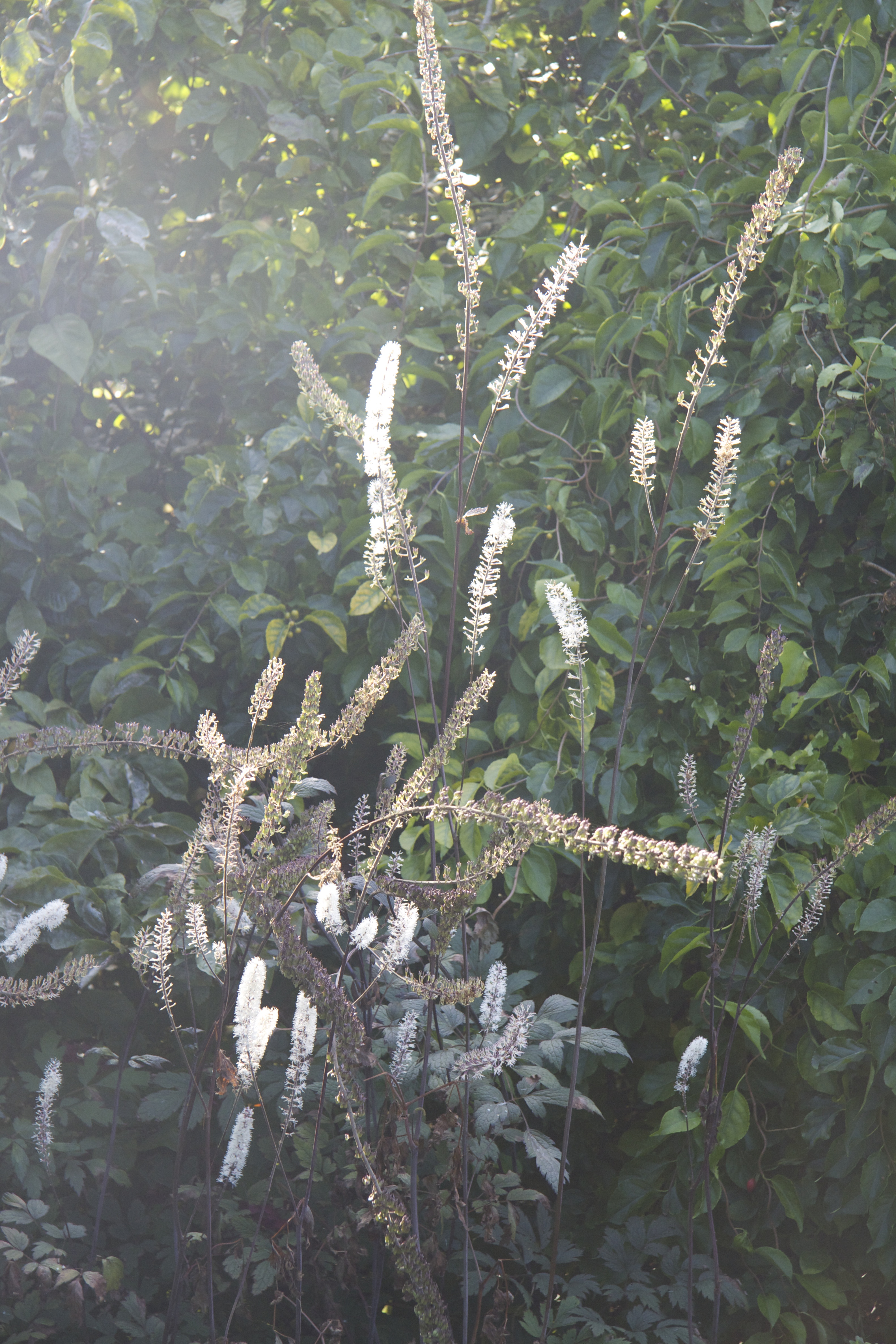
Actaea simplex Atropurpurpurea Group

Looking through a stepped yew arch from the High Garden down into the orchard garden a group of Actaea simplex are planted, brilliantly, by themselves. The slender white bottle brush flowerheads catch the early evening sun – dancing afternoon fireworks leaning and fizzing in every direction.

pandanifolium close up

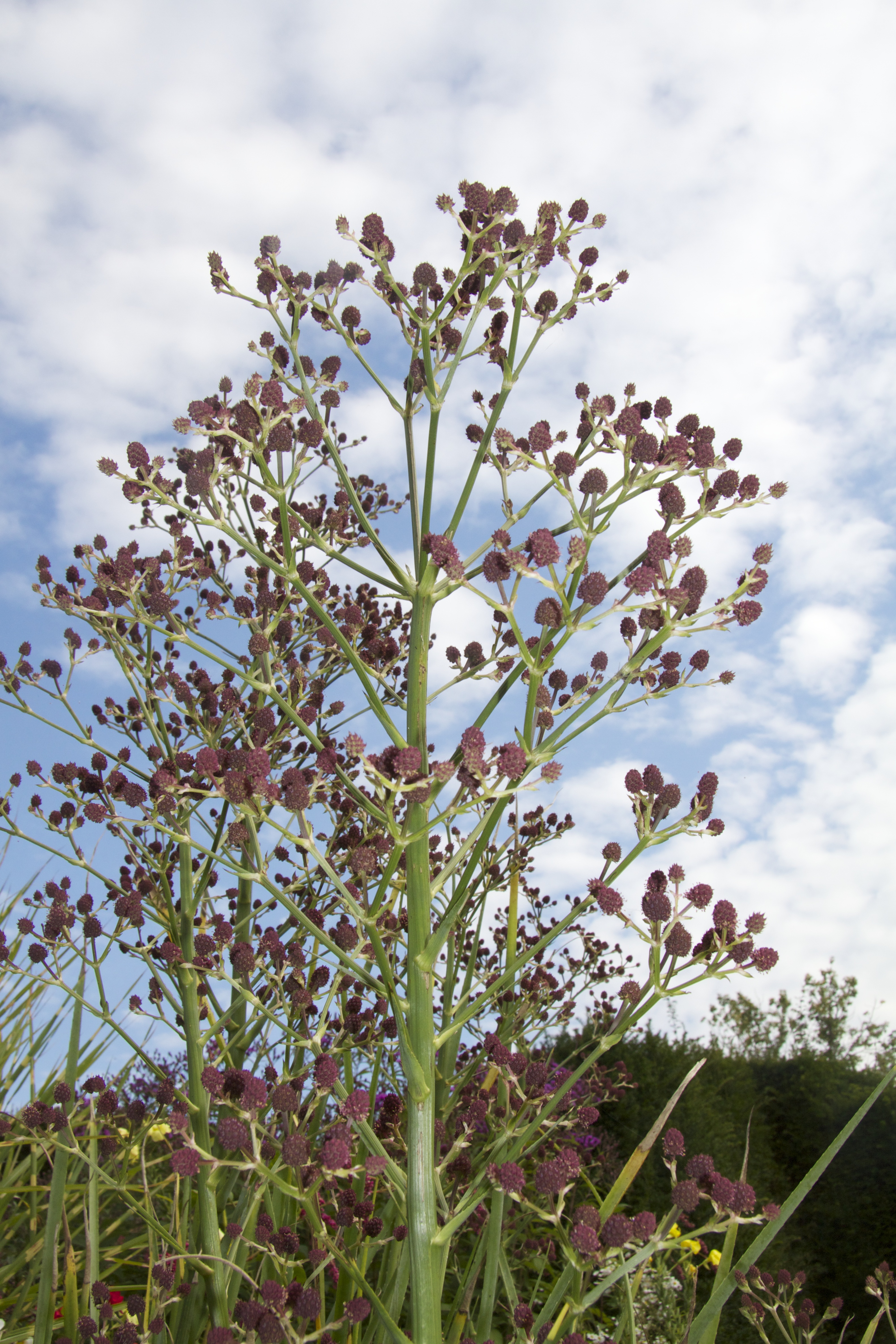
Eryngium pandanifolium ‘Physic Purple’

Well admittedly this monumental plant – situated at the bench end of the Long Border is hardly on its own – but it is a fantastic year round architectural presence with a rosette stiff grey green leaves and wonderful towering – 6 or 7 feet high – branched heads of tight wine coloured flowers from October to December. I am on a mission to find a place for this plant.

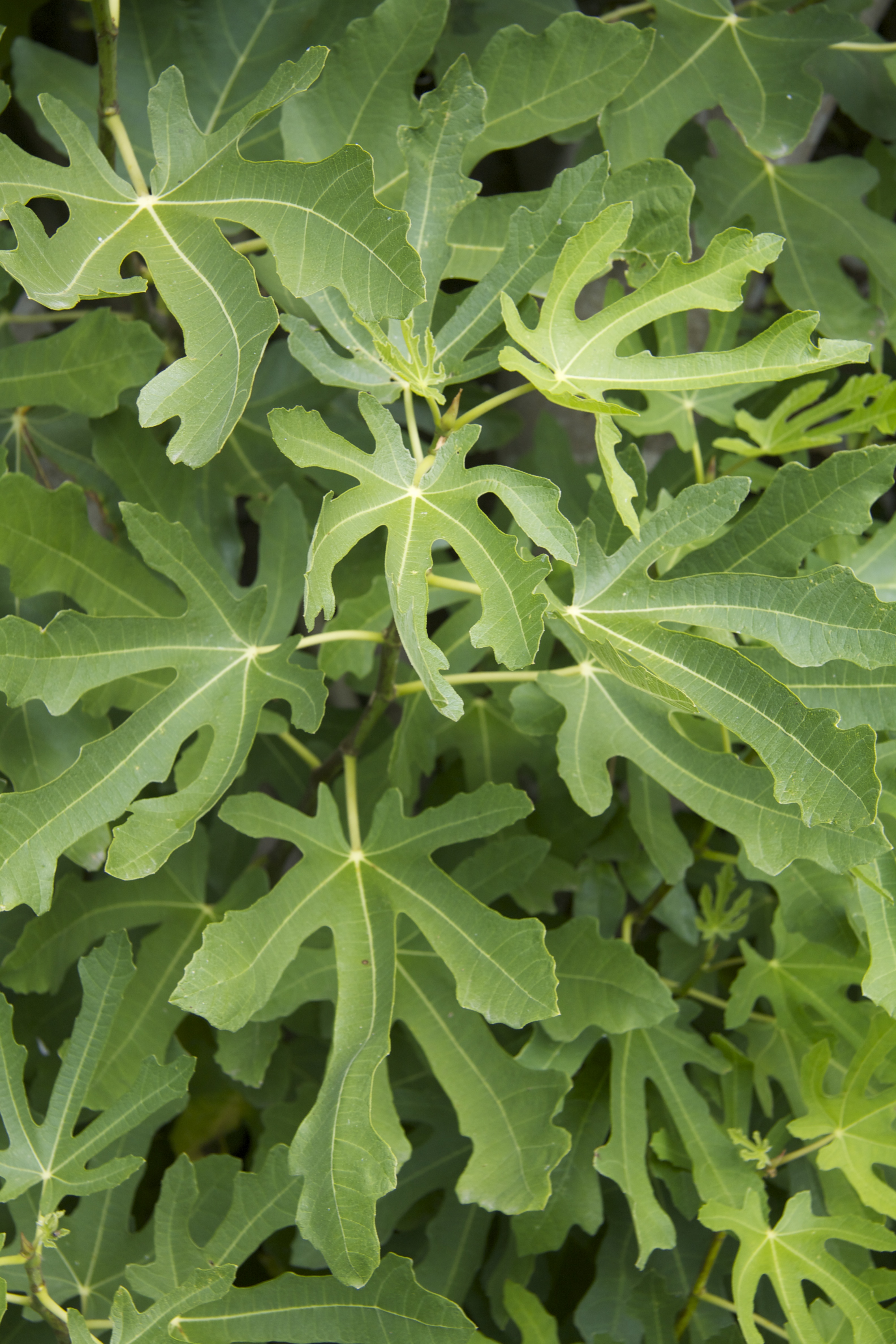
figs and figs

Ficus carica ‘Brunswick’

A wonderful fig grown against the South facing wall on the Lower Terrace. Worth stopping to admire the rhythmic patterns formed by the overlapping deeply cut leaves. Even better to discover it is a reliable and heavy fruiting fig in the UK with greeny-yellow skinned fruit with sweet tasting pink flesh.

AND THEN THERE ARE THE BRILLIANT PAIRS OF PLANTS:

cotoneaster horizontalis and Rubus cockburnianus 'Goldenvale'

Cotoneaster horizontalis and Rubus cockburnianus ‘Goldenvale’

Cotoneaster horizontalis is hardly a fashionable plant but is used brilliantly at Great Dixter – clothing the base of walls and flights of steps with its dynamic fans of branches, tiny glossy green leaves and at this time of the year generous beading of glossy red berries. Here in the Walled Garden, the combination with the lime green leaves and chalky white stems of the white stemmed bramble, Rubus cockburnianus ‘Goldenvale’ is exquisite.

simple achievable combo

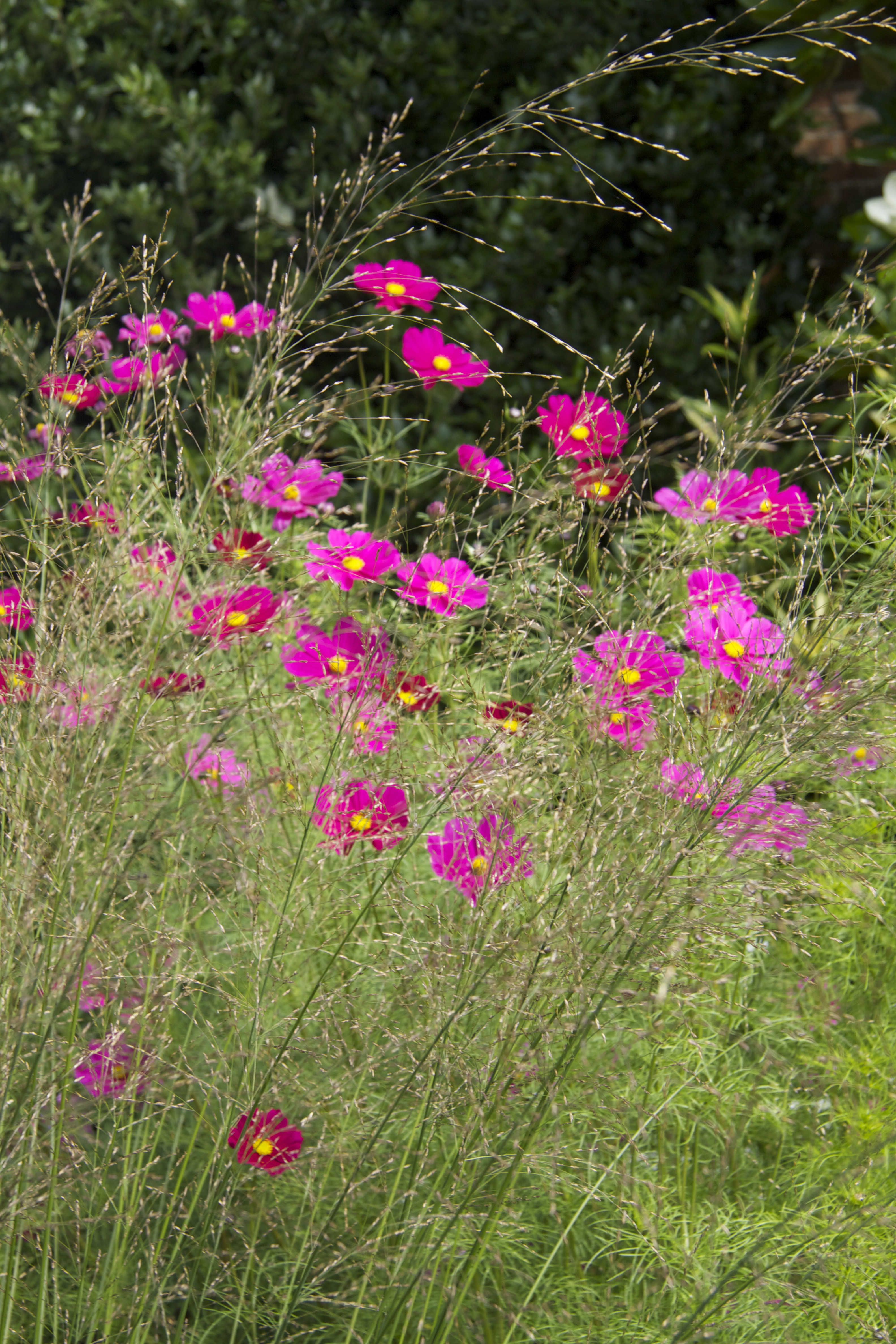
Cosmos bipinnatus ‘Dazzler’ and Molinia caerulea subsp. arundinacea ‘Transparent’

Not an earth shattering combination but easy to recreate – the rich colour of the Cosmos and the airy texture of the grass working so well together.

hydrangea macrophylla 'Sea Foam' Fuchsia magellanica 'Aurea'

Hydrangea macrophylla ‘Sea Foam’ and Fuchsia magellanica ‘Aurea’

An absolutely classic combination of Hydrangea and Fuchsia – one of my favourite pairings which lasts so well in late summer through to autumn. Great Dixter is brilliant at bringing a person round to certain types of plant. I have always been slightly reluctant to pick golden leaved forms of any plant, but as with the Rubus this Fuchsia is the best of its kind with yellow green leaves veined in beetroot with dark red stems and fantastically desirable glowing pink pendant flowers.

heuchera a nd paris

Paris polyphylla and Heuchera villosa

The comparatively rare Himalayan woodland perennial, Paris polyphylla has elegant layers of leaves and fine whiskery petals on upright stems. Even before the arrival of the wonderful surprise of the bright orange seed heads that is yet to come, this combination with the graceful Heuchara with its spires of tiny greenish white is graceful and covetable.

A DIFFERENT SORT OF PAIRING – WHEN ONE PLANT IS REPEATED IN THE GARDEN WITH DIFFERENT COMPANIONS:

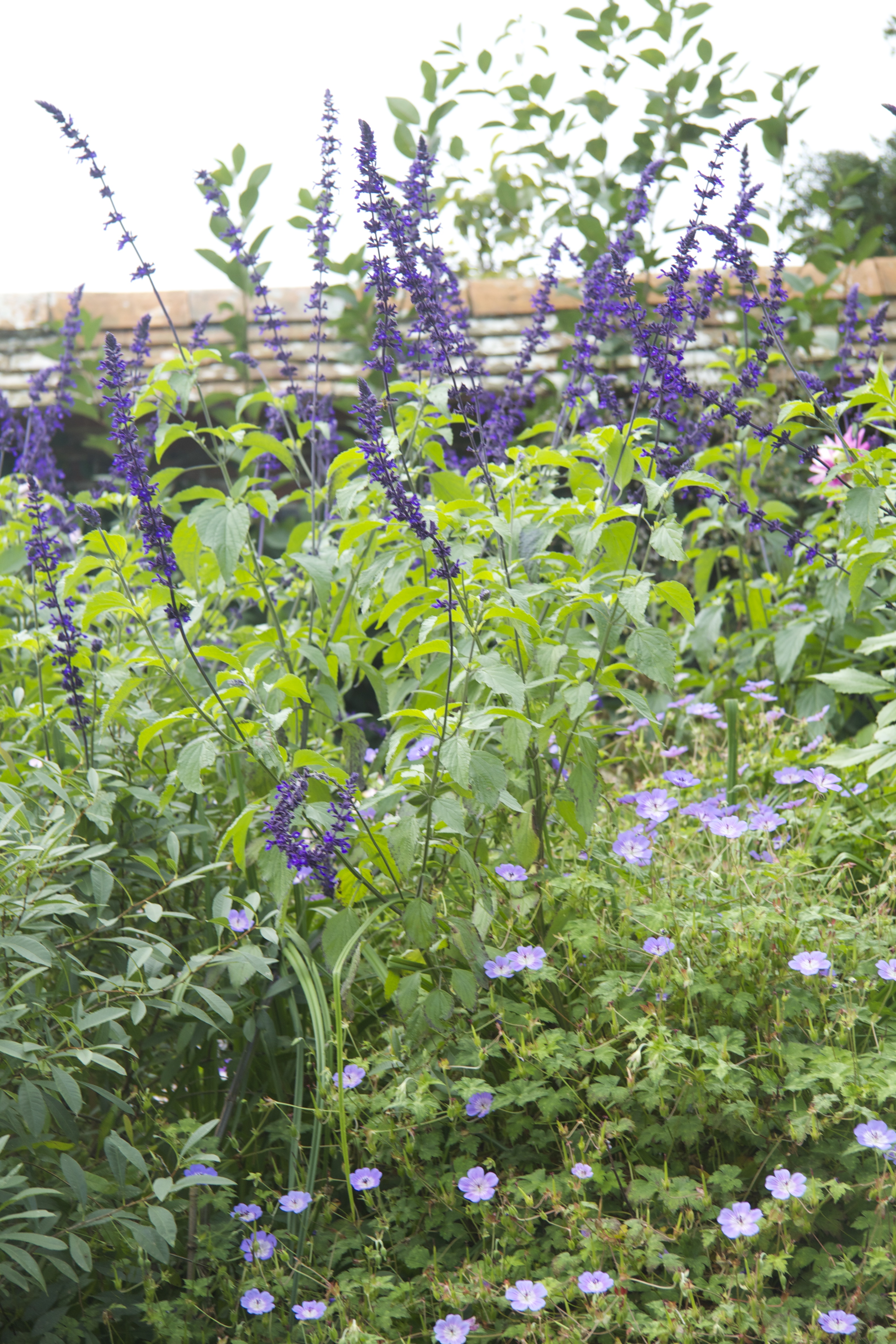
salvia indigo spires plus buxton

Salvia ‘Indigo Spires and Geranium wallichianum ‘Buxton’s Variety’

The elegant violet blue spires of the Salvia in a gentle combination with the paler blue of the Geranium billowing beneath.

indigo spores and mexican black

Salvia ‘Indigo Spires’ and Cosmos x Dahlia ‘Mexican Black’

The depth of red in the Cosmos x Dahlia ‘Mexican Black’ brings out the richness of the the Salvia – a very different, velvety effect.
salvia indigo spires and dahlia 'Hillcrest Candy'

Salvia ‘Indigo Spires’ and Dahlia ‘Hillcrest Candy’

Suddenly a more playful, sweet shop effect with the clear pink and white of the Dahlia energising the colour of the darker Salvia.

AND FINALLY THERE ARE THE ALMOST PSYCHEDELIC DIXTER MOMENTS WHICH MAKE VISITING THE GARDEN SO UNSTOPPABLY JOYFUL.

pyschadelic salvia and mexican black

Salvia ‘Amistad’ with Cosmos X Dahlia ‘Mexican Black’ and Hydrangea aspera Villosa Group

I am finding this Salvia dangerously enticing. There is something about the glowing purple of the flower, the black-purple of the calyces and the horizontal spread of the bright green leaves that creates a particularly tantalising, slightly drunken, fluttering tapestry. The rich red of the Dahlia x Cosmos and the way the flower heads pop up and look out in every direction like dainty periscopes adds to the dancing mood and then the laid back softness of the Hydrangea adds a smokey haze which deepens the mood.

psychadalia 3

Persicaria orientalis, Amaranthus ‘Autumn Palette’, Aster thompsonii Canna ‘Phasion’, Aster laterifolius var. horizontalis – plus a white Cosmos and an orange Crocosmia.

This is an amazing combination. The Amaranthus is completely wild – outrageous cinnamon suede flower heads and completely mismatching jack-and- the-beanstalk fresh green leaves. The bright pink arcs of the Persicaria orientalis – which are repeated wonderfully all over the garden – frame the scene which is enriched with the soft mauve of the aster, the crazy stripiness of the Canna (the RHS description of the Canna reads “bronze-purple leaves striped with pink, ageing to shades of pink and orange and large deep orange flowers in summer) and dashes of white cosmos and orange crocosmia complete this utterly celebratory planting.
psychadelic photo 2

Crataegus persimilis ‘Prunifolia’, Yew, Persicaria orientalis, Aconitum carmichaelii ‘Kelmscott’ and Tagetes ‘Cinnabar’

Crateagus persimilis ‘Prunifolia’is a wonderful hawthorn with glossy leaves, white flowers and deep red fruits. Known for its dramatic autumn colour it is worth noting just how early and how vivd this colour is. The Aconitum is vivid and compelling (at Dixter apparently Aconitum is divided pretty much every year to maintain this kind of flower power) and the stripy red and gold of the marigold keeps the energy going – as ever the broad stretch of flat green provided by the yew pulls everything together.

just do it (now and then?

Zinnia ‘Aztec Sunset’

At the beginning of the Lower Terrace there is a stone trough which always has something pretty seductive going on. At the end of September the trough is bursting with these neatly kaleidoscopic Zinnia – so cheerily stripy and circular that you can only smile and persuade yourself that every additional moment like this is worth going for.

ZAKYNTHOS, AUGUST 2013

TEN PERFECT DAYS WITH MY OWN WILD GREEK GARDEN

garden 3

I have just returned from the Greek island of Zakinthos. We stayed in a small house with a wooden deck nestled amongst prickly pears and scented maritime pines. The house has its own rocky cove and chalky white steps down to the sea. Ten days with our own, wild, greek island garden – my kind of holiday.

After a pre-breakfast swim, I sit on the warm canvas chair and look up. Shaggy-toothed palm leaves arc confidently against the pale blue sky, neat curves of acacia scratch out small dainty arcs below.

garden 2

Later, as the sun rises higher in the sky, jagged charcoal shadows of palm settle on the dusty path and lurch lazily up over different levels of stone – soft, impermanent fossils.

shadow 2

The orange seed heads of the palm tree are so confident and vibrant that just catching the sight of their orange rays makes my heart sing.

palm tree flower

I am entranced by the prickly pears.

garden

They have the same perky impertinence and energy of a Picasso sculpture. I love the fat blushed pointing fingers – crazy natural signposts that seem to tell you that fun is available in pretty much every direction – and the milky green quilting of the leaves with their sharp needle-like stiching. The local champion prickly pear grows out of the sand at the beach restaurant in the port.

pear 1

Most diners arriving at the restaurant crunch on by, ignoring the pear, eyes only for the frosted jug of yellow wine already on the table. But the pear dances on happily, and makes me smile. Rude not to have a glass of wine anyway.

pear 2

Another perfectly still, end-of-summer morning. A sweet, almost aniseedy scent hovers over the salty air. A plant that I don’t yet know grows softly over the jagged grey-black rocks, spilling over the ragged stone.

DSC_0826

The flowers are a pool of flat, pale-lime, lacy platforms on surprisingly succulent, glaucous stems – an army of rugged little parasols luminous against the grey and alive with a fine netting of tiny buzzing insects.

sea fennel 2

We have lunch at restaurant next door and choose ‘green vegetable’ to go with our grilled fish and seafood pasta.

IMG_0004

A steamed fragrant vegetable – is it samphire? Not quite. More aromatic, aniseedy – very delicious. On the walk home I go back to inspect the pools of fennel-like green. Rubbing the stem and smelling again – it is obviously the same plant. The restaurant tells us this is “Kritama”. Kritama, it turns out, is Crithnum maritimum, known in the UK as sea fennel, but more often Rock Samphire. It is found on the West coast of the UK and Ireland and has been regarded as a delicacy for centuries. Harvesting it from cliffs was famously dangerous and is referred to in King Lear: “Half way down, Hangs one that gathers samphire, dreadful trade”.

I learn that it can be steamed, pickled or eaten raw. I find a cheerful website which gives an idea for a really cheap student meal – an open tomato and rock samphire sandwich … I make one for breakfast but the raw samphire is unpleasantly hot – ah well another romantic idea bites the dust. I also learn that we were not the only ones to confuse Rock Samphire with Marsh Samphire – Salicornia europaea – also known as Glasswort. Marsh Samphire grows wild in salt mashes especially in East Anglia. This is the samphire we eat at home – much saltier and less fragrant but perfect with barbecued mackerel.

Beyond the garden I met four magnificent trees during our time on Zakinthos. The first two were simply perfectly matched with the vehicles parked underneath:

tree3

tree 5

the third tree – a tough old peach – was looking pretty happy in its recycled fridge freezer:

tree 4

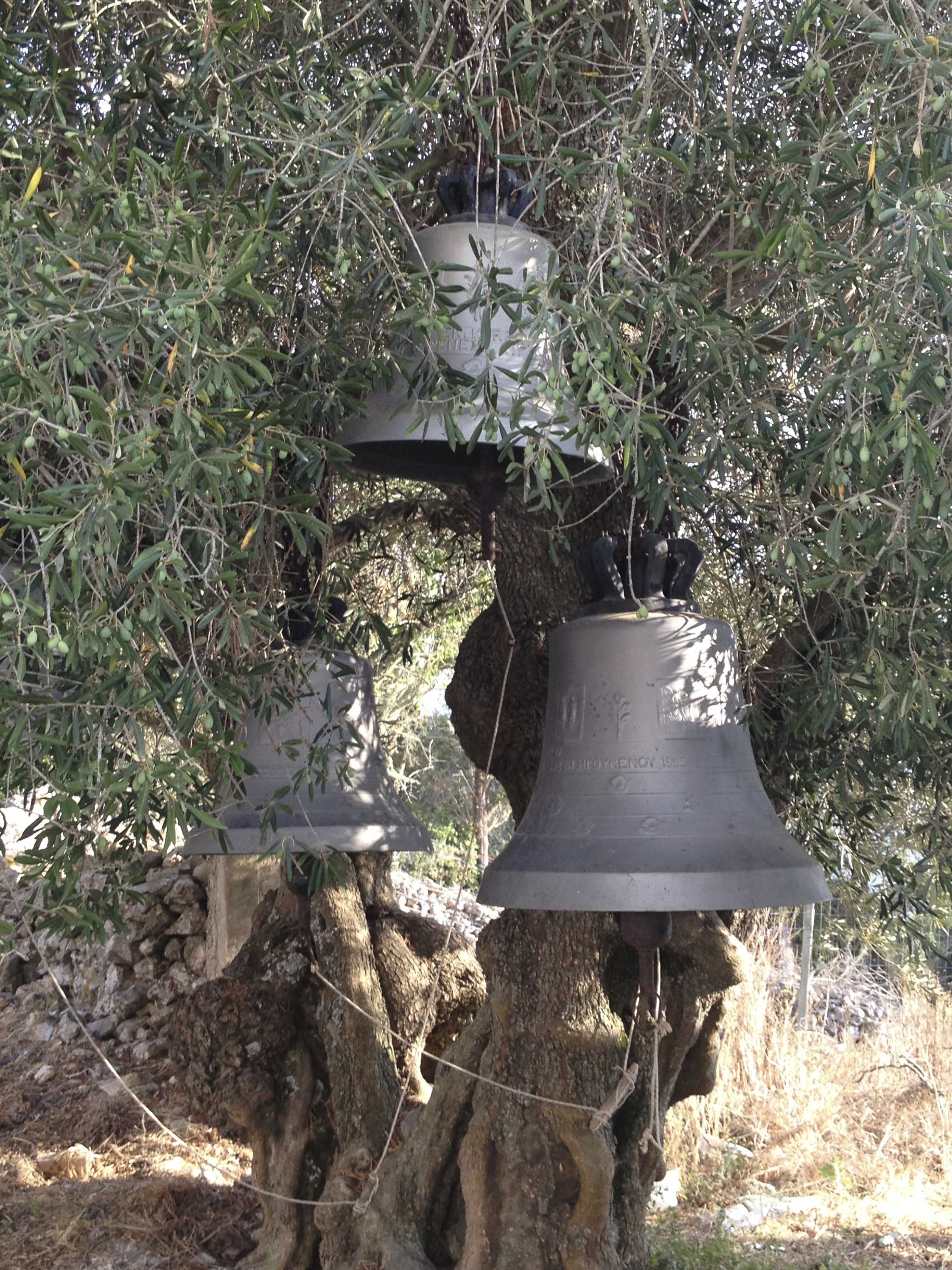
Best of all, just outside the gates of a small monastery, and rising majestically from a sea of plastic debris, was this magnificent olive tree, laden with working bells.

tree 1

tree 2

I walk through the garden one last time:

long lazy ribbons of bamboo are held horizontal, like streamers, by a soft roll of breeze at the edge of the deck. A soft rustling, comforting, subsiding and then another small wave of papery fluttering.

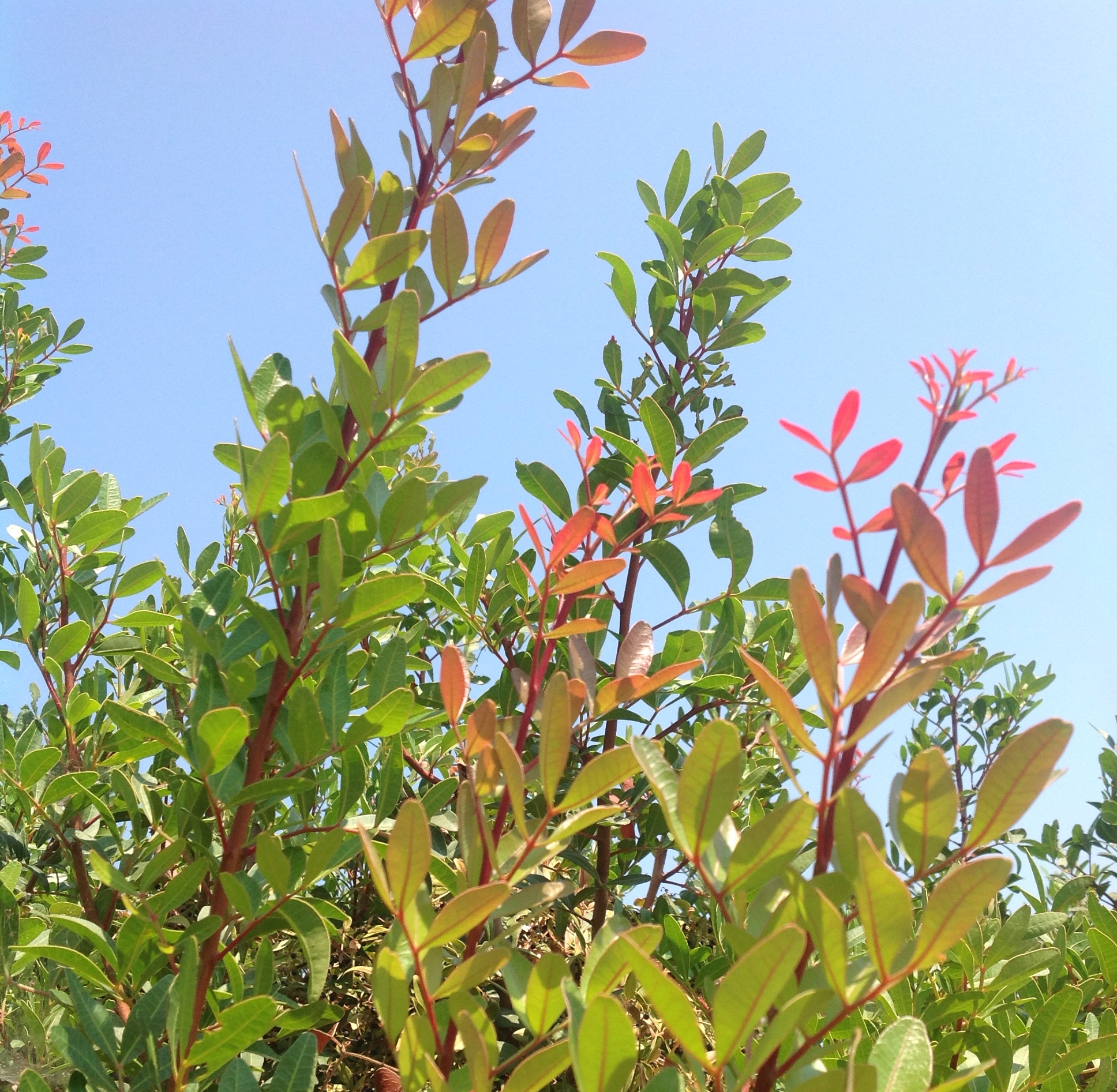
A spicy scent as you pass great mounds of myrtle, the new growth rosy-brown in the morning sun.

myrtle

Allium seed heads – fragile, dusty busbies on improbably slender stems – wave bravely on the cliff top as August turns to September.

allium heads

Swooping, elegant bunches of fine pine needles scratch their upward accents against the dazzling blue of the eleven o’clock sky. A maritime pine is a framer, a glamorous, instant holiday of a plant.

It is tough enough to leave.

garden 1