AN INSPIRING RETURN VISIT TO A FINE SUSSEX GARDEN
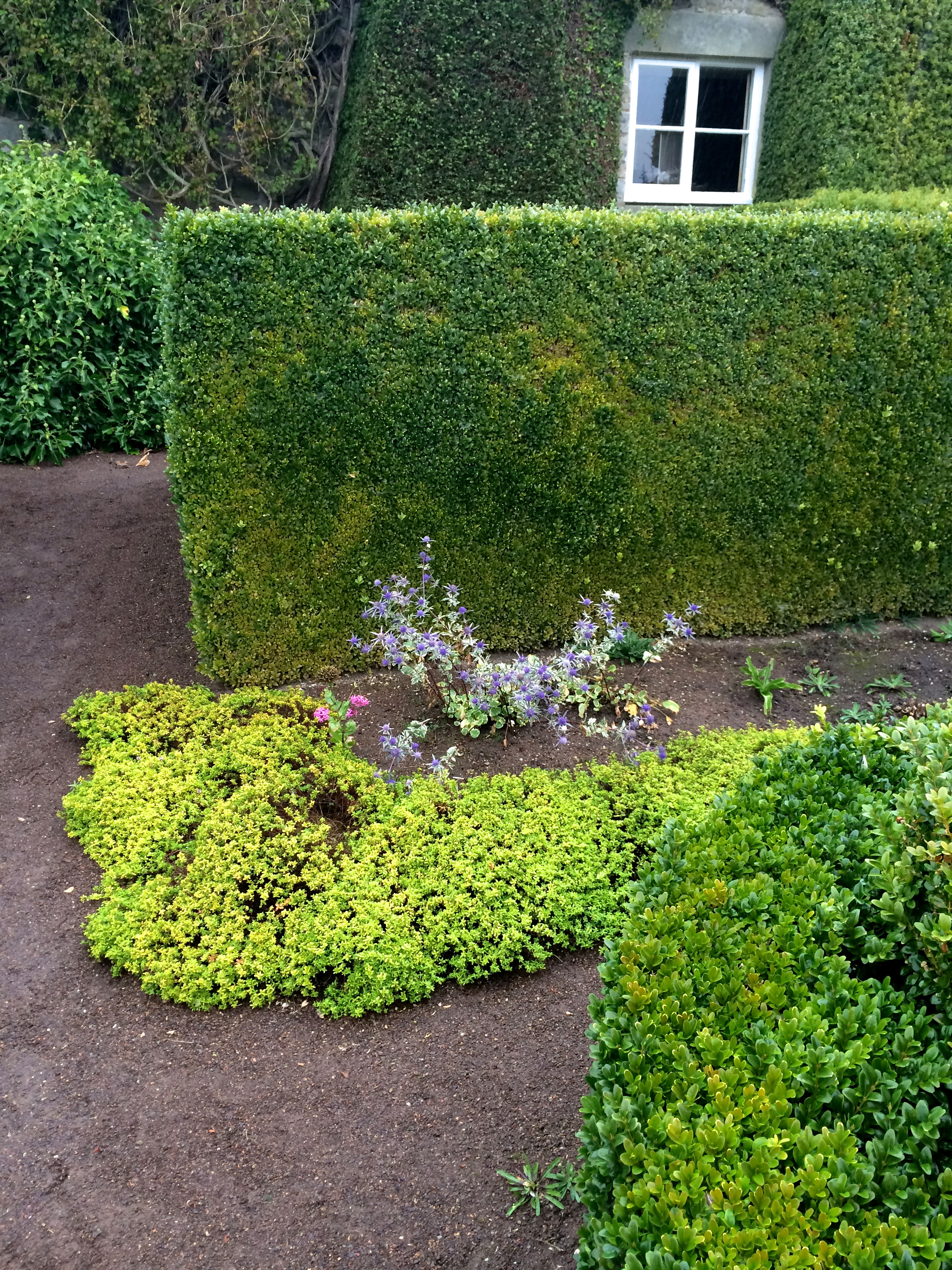
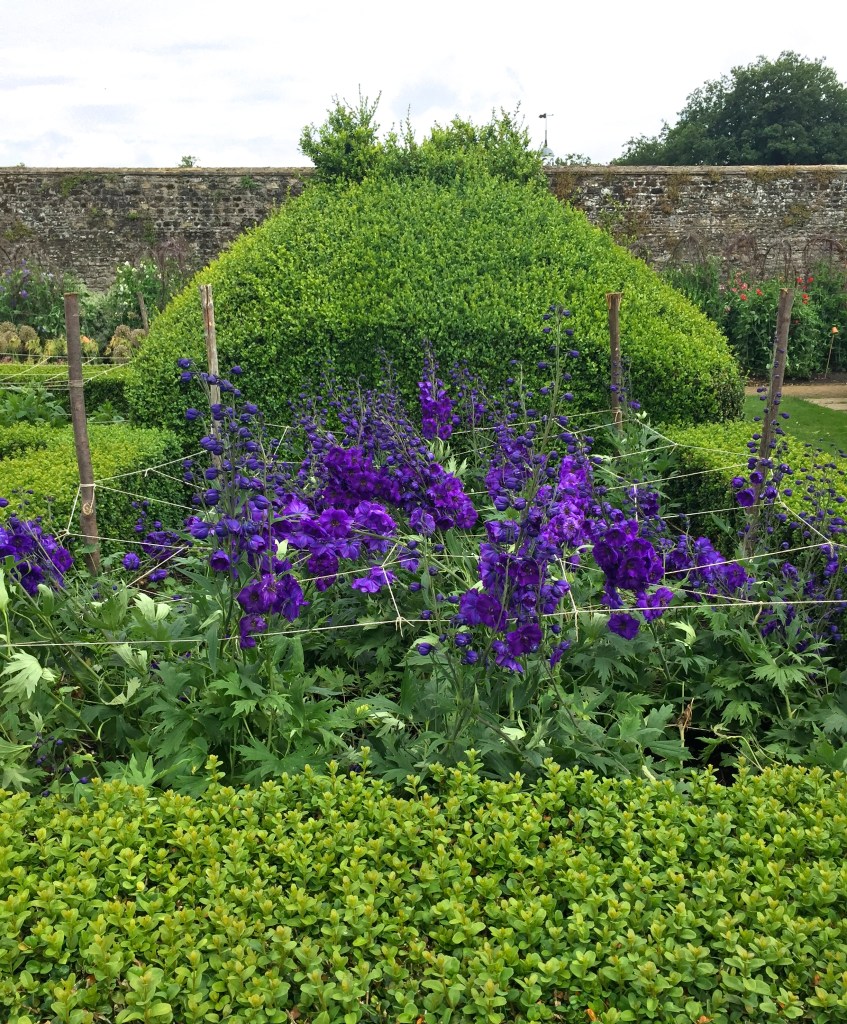 Electric blue delphiniums emerge from the box parterre in The Vegetable Garden, Parham
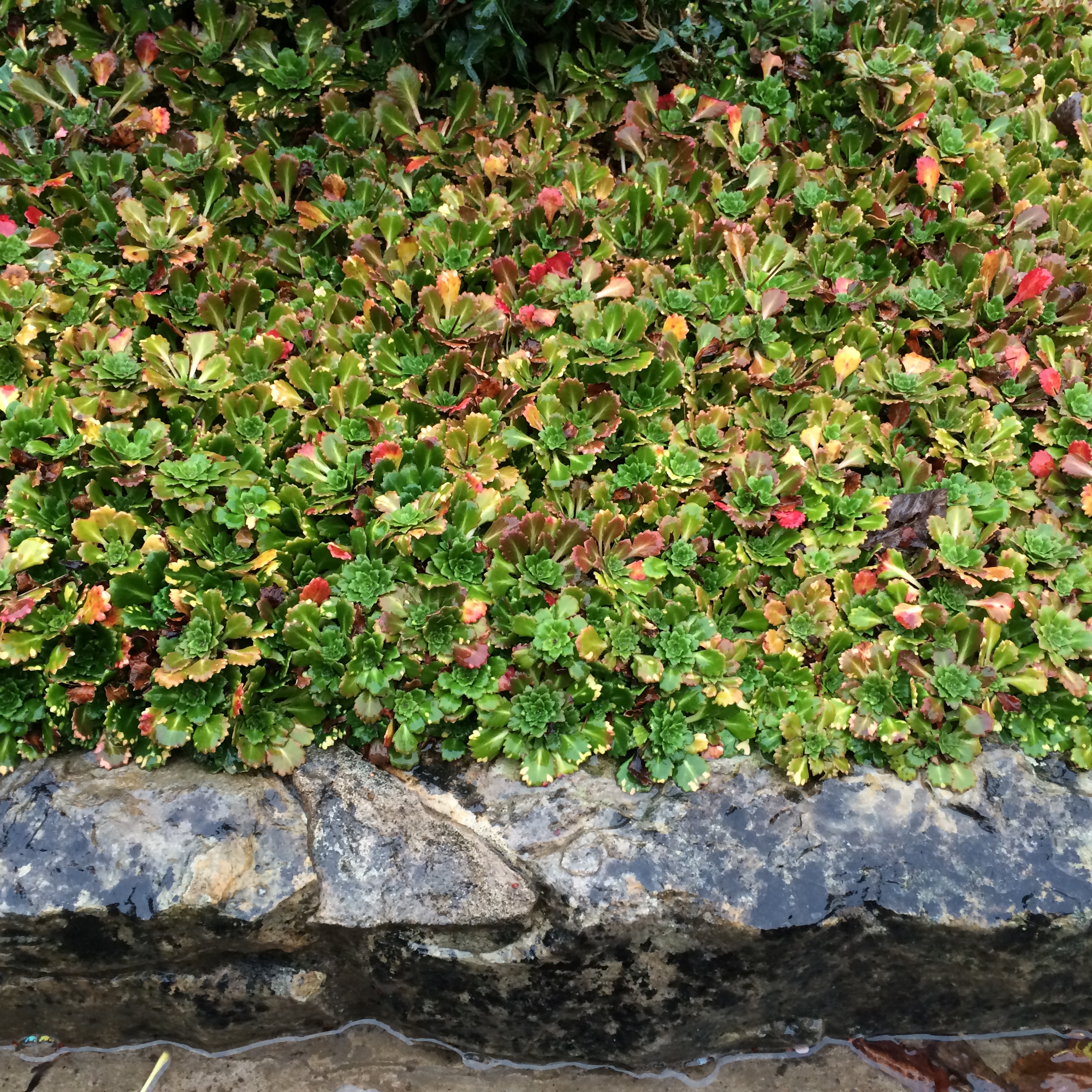
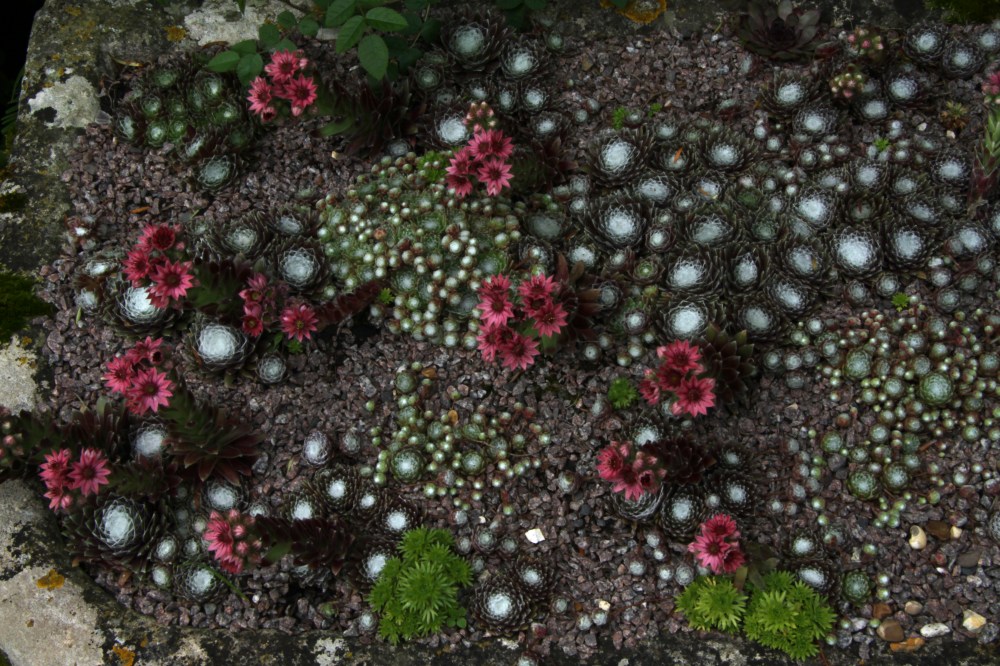 Quietly psychadelic succulents fill a stone trough in The Herb Garden
I must have visited the gardens of Parham House for the first time about ten years ago in the era of talented Head Gardeners Ray Gibbs and Joe Reardon-Smith. I remember the uplifting, overspilling opulence of the planting and trying to hold onto exactly what was making each group of plants sing. The dashes of white which turned out to be the palest blue Veronica gentianoides and the subtle interweaving of burnt – or not so burnt – orange and terracotta to jolt a border soft blues into something richer and more velvety.
 Parham House, West Sussex
The 16th Century house at Parham has been owned and lived in by a member of the Pearson family since the early 1920’s. The Pearsons, together with architect Victor Heal and American garden designer Lanning Roper, did much to create the shape and atmosphere of the current garden and there was another big push in the 1980’s when, with the help of garden designer Peter Coats, the 18th century walled enclosure was moved one step further away from its original life as a productive garden for a large household and turned into a garden of mixed borders and lawns. The current Head Gardener is Tom Brown. A Sarah Raven article in the Telegraph about his recent allium trial – ‘How to Grow the most show-stopping alliums for your garden’ – triggered seductive memories of my earlier visit. The last day of June was one of brooding skies, but no rain, and I found myself heading towards the South Coast, hoping quietly to find some midsummer inspiration.
 St Peter’s Church, Parham
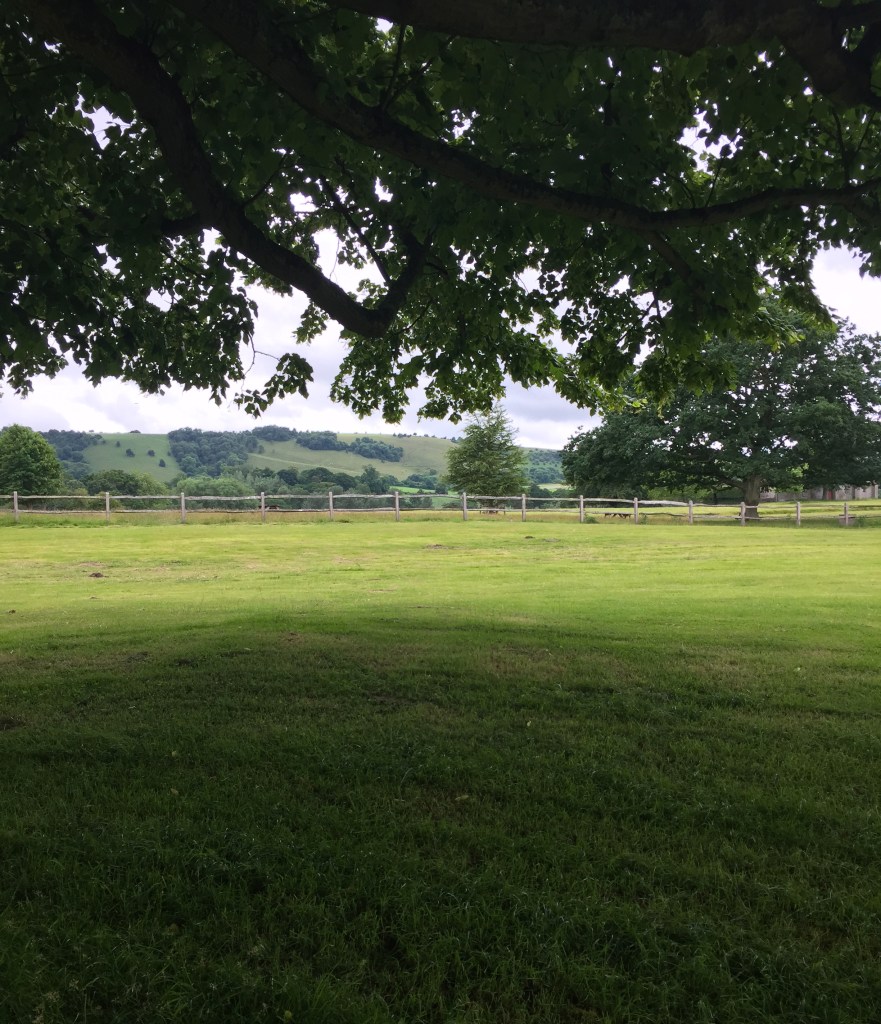 Parkland and views to rolling Sussex countryside, Parham
 A stand of mature oak trees, Parham
I am delighted by pretty much everything. The parkland around the house, stretching out to the rolling Sussex countryside, is exquisite, with views framed by the dipping branches of mature cedar and oak trees. The grass is still mostly green with just the beginnings of faded coral where bands of grass have allowed to grow tall.
I walk through the Clock Tower courtyard under glowering skies and enter the garden via a walkway of lovely multi-stemmed box and holly trees.
 The Clock Tower, entrance courtyard, Parham
 Multi-stemmed box trees lead the way into the garden.
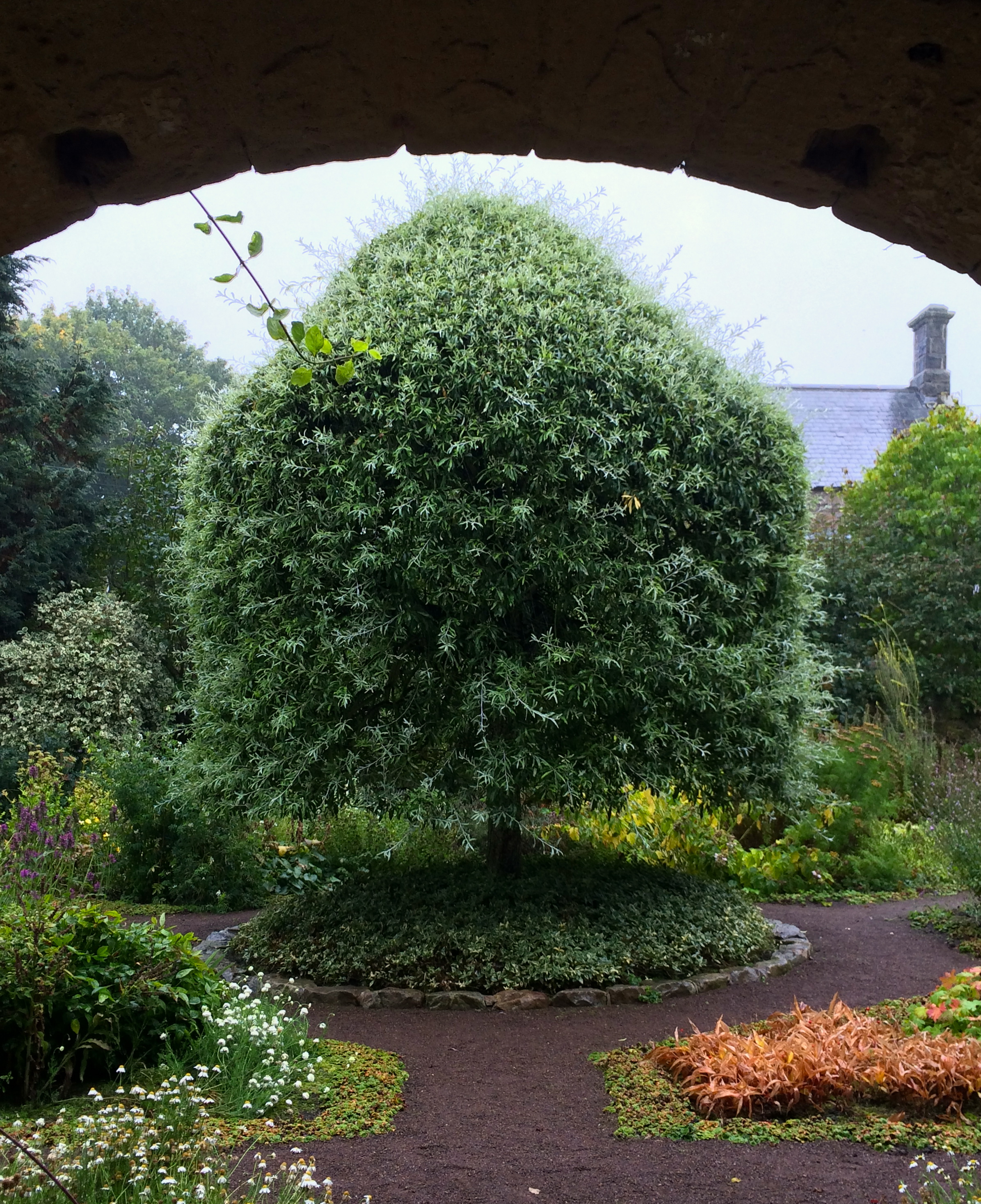
The Entrance Borders are just beginning to come into their own but I am thrilled to see the radiantly highlighted, bruised colouring I have been trying to recall. The borders are wide enough to accommodate a series of tree-like pineapple-scented philadelphus, and the famous tapestry-style planting uses claret coloured berberis and cotinus together with the bright greens of Alchemilla mollis and golden hops to frame the borders which are laced with fiery red marigolds, the cooler almost mint green of Sedum ‘Autumn Joy’ (in its June guise) and an almost apricot yellow daylily:
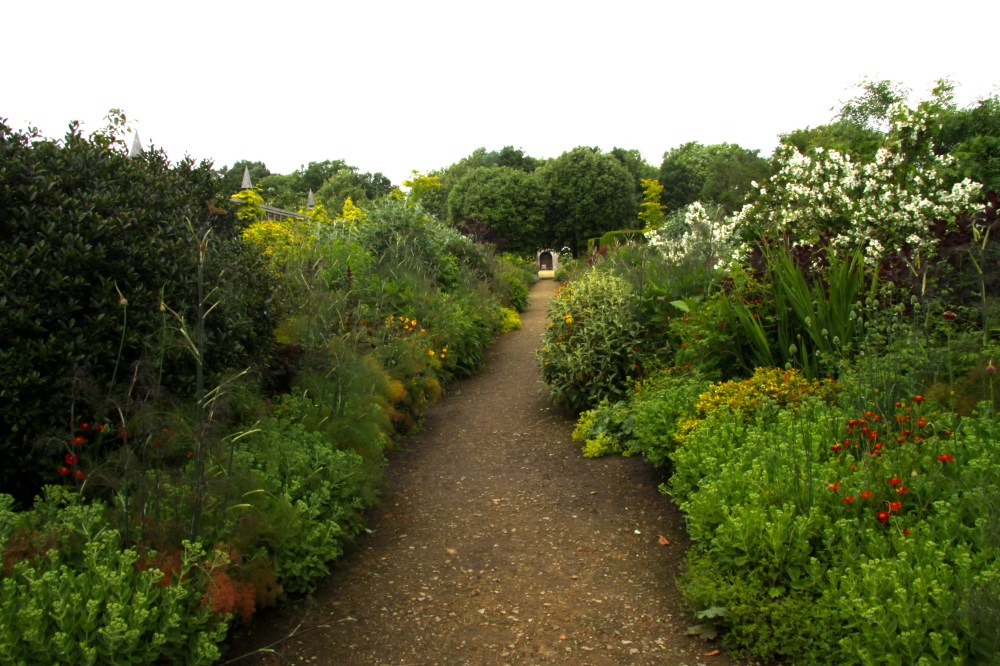 The dusky Entrance Borders, Parham, illuminated with spreading white Philadelphus
 Golden hops, bronze fennel, apricot-yellow day lilies, and yet-to-ripen head of Allium sphaerocephalon, The Entrance Borders, Parham
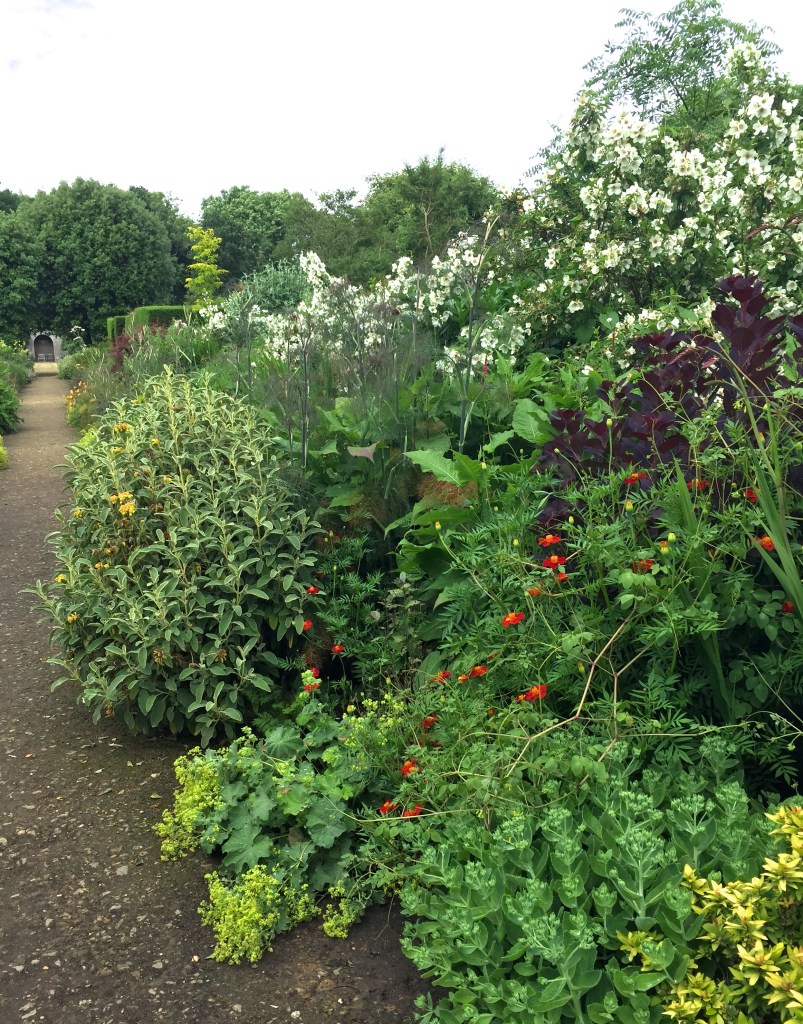


Philadelphus, Sedum ‘Autum Joy’ ( June stage!), Alchemilla mollis, aliums, marigolds, bronze fennel – Entrance Borders, Parham
As with all good planting the proportions of plants and the way they are combined is constantly and skilfully varied. There are more sombre areas – here a leggy mauve geranium is screened by a haze of bronze fennel with just a small quantity of red marigold at the base of the planting:
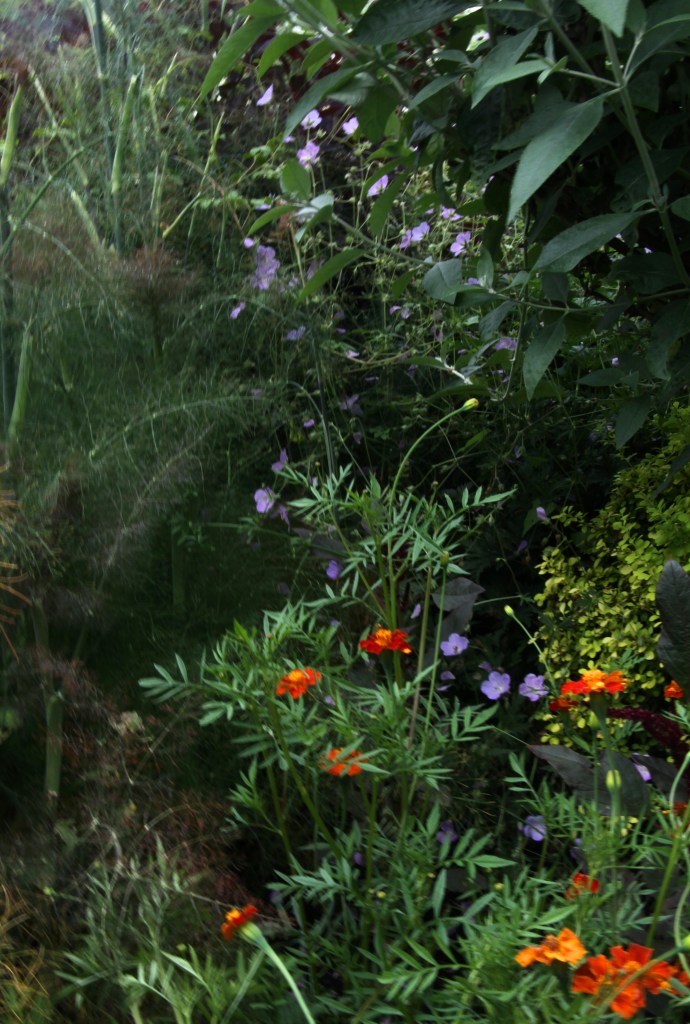 A sombre moment of geranium, bronze fennel and a flash of red marigold
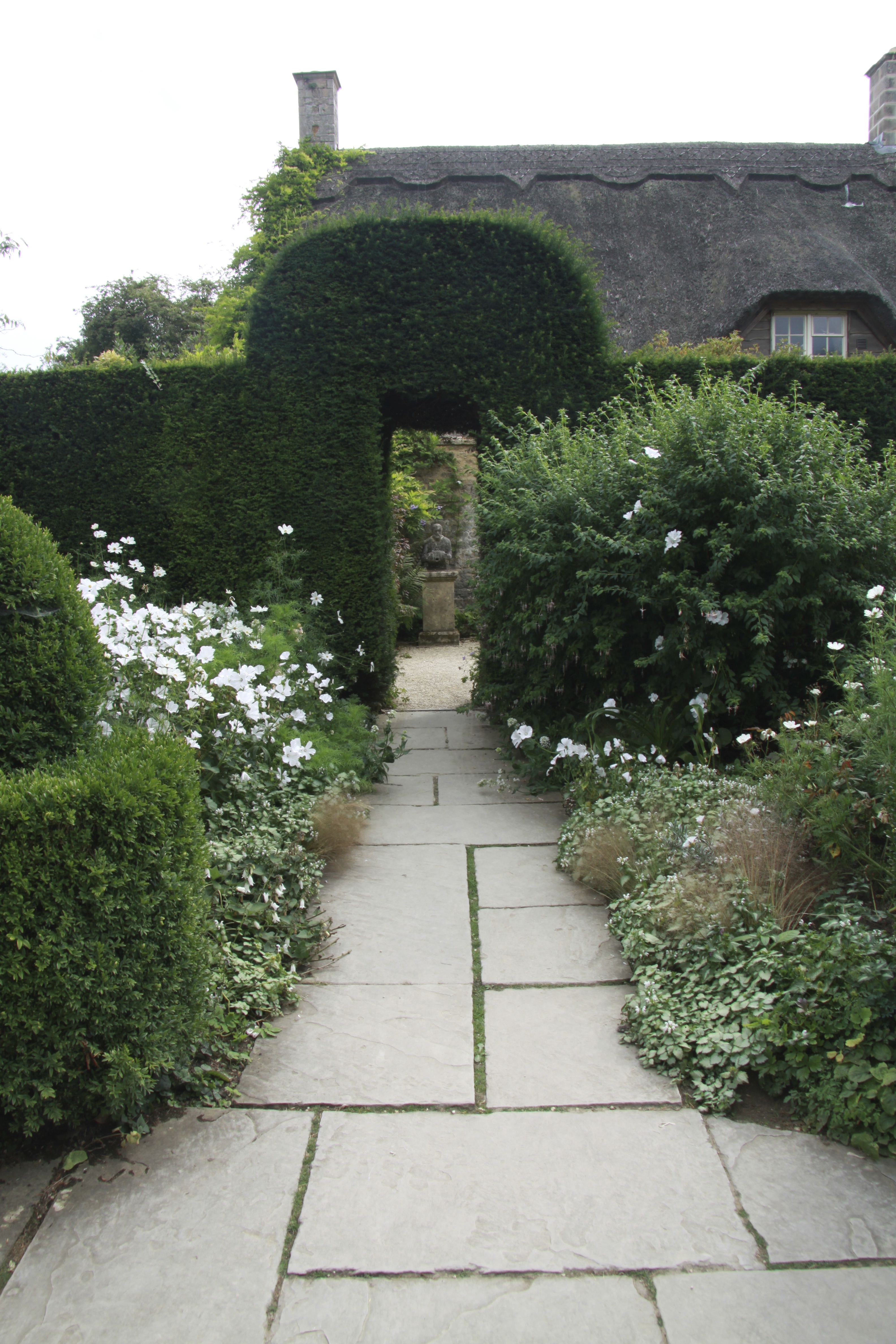
Elsewhere, a stretch of quiet green and white is lit up by a dazzling pocket of Berberis thunbergii “Aurea’:
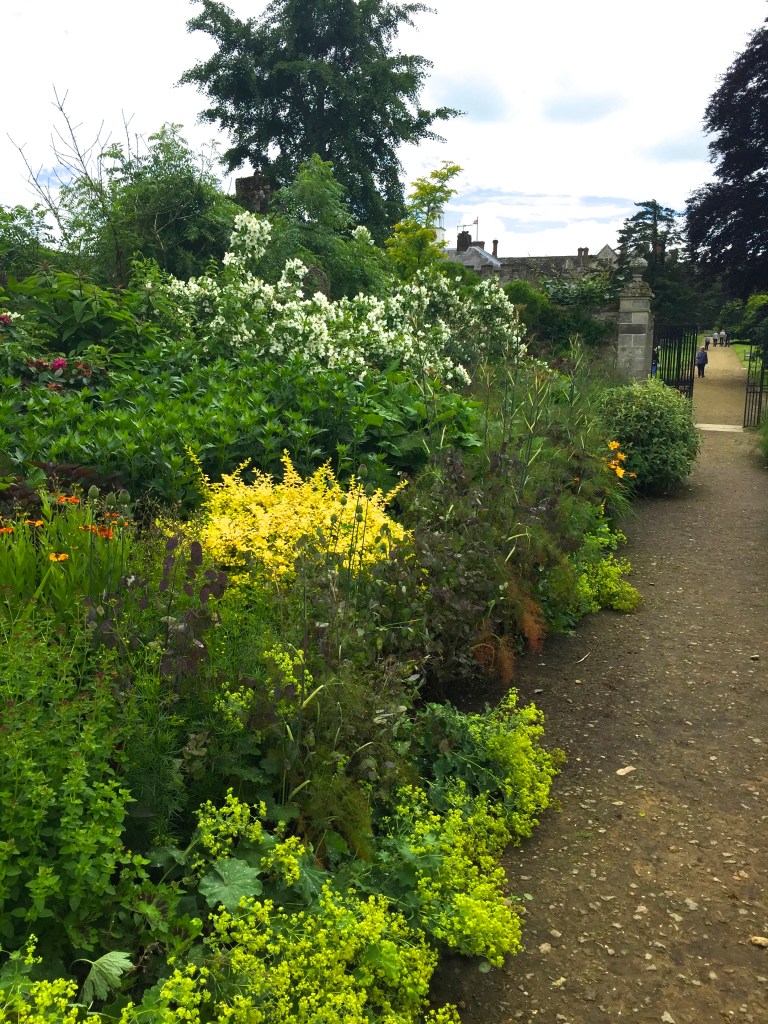 The border is lit up by a pocket of the shrub Berberis thunbergii ‘Aurea’
Berberis seems to me such an old-fashioned plant, but I am smitten by the way it works in this border and am tempted to try it myself. Here it is again as a fine contrast to a clear mauve geranium (possibly ‘Mrs Kendall Clarke’ ) which in turn sings out against the shady burgundy seed heads of honesty, Lunaria annua:
 Berberis thunbergii ‘Aurea’ , mauve geranium and seed heads of Lunaria annua
A little further up the same geranium is more intensely luminous against the rounded, deep red leaves of the smoke bush, Cotinus coggygria (probably ‘Royal Purple’):

Geranium ‘Mrs Kendall Clarke’ against Cotinus coggygria ‘Royal Purple
And a little further on still, the Cotinus becomes more intense – almost black – when it is a foil to the bright green leaves and vivid pink-red tapers of persicaria amplexicaulis ‘Firetail’:
 Persicaria amplexicaulis ‘Firetail’ against Cotinus coggygria ‘Royal Purple’
The smaller leaves of the equally dark red berberis, a form of Berberis thunbergii f. atropurpurea, catch the light more easily themselves and form a more balanced picture with the marigold, sedum and daylily in this group:
 A balanced, light-catching group of Berberis thunbergii f. atropurpurea, red marigold, orange yellow day lily and Sedum ‘Autumn Joy’
Looking up, I love the dirty gold-green of golden hops, Humulus lupus ‘Aureus’, and the way it is encouraged to loop and festoon its way over the handsome smudgy green trellis, casting a greenish light on the already not-completely-white Philadelphus.
 Golden hops festoons the trellis, with sweet-scented Philadelphus in the foreground
And I cannot help but be enchanted by the mushroom of brilliant green wisteria foliage that forms a fairy tale entrance into the nursery:

Wisteria foliage makes a fairy tale entrance into the nursery
Further along, another softly clothed opening in the border – alchemilla, pink geranium, red marigold: why not? – leads you through a brick opening into the Herb Garden: Softly clothed entrance into The Herb Garden
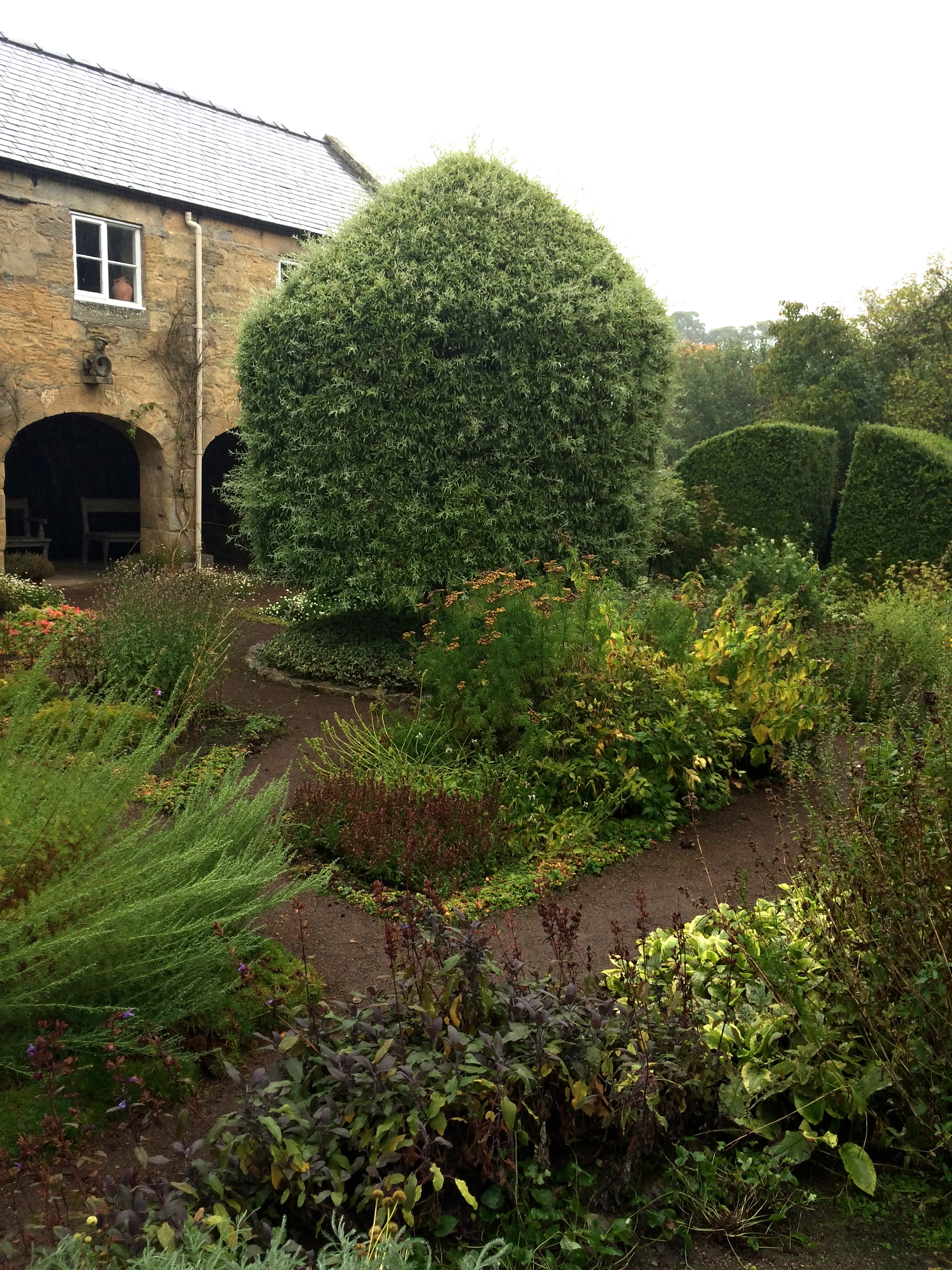
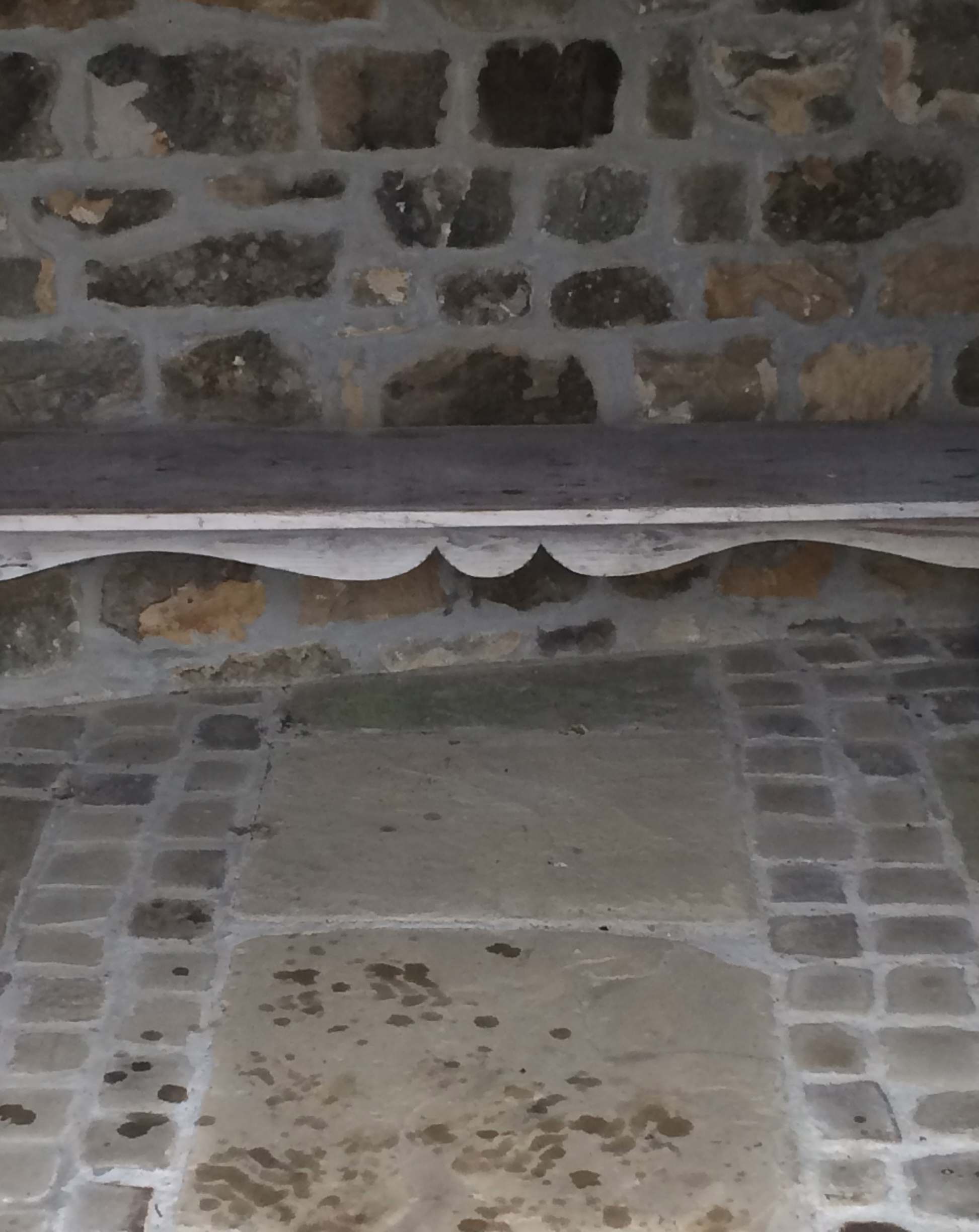
The Herb Garden at Parham is pretty perfect. There are four completely charming, immaculately proportioned, wooden benches, one in each corner of this voluptuous space enclosed in high hedges of clipped yew. Each bench is settled lightly and invitingly into its corner. I love the bench below with its patchwork apron of worn flagstones and Alchemilla mollis, its simple backdrop of upright ferns and its anchoring neighbour, a rectangular stone trough which is gently fizzing with slightly psychedelic pink and grey succulents.


One of four perfect benches in The Herb Garden – this one settled into its space with a stone trough planted with slightly psychedelic pink and grey succulents
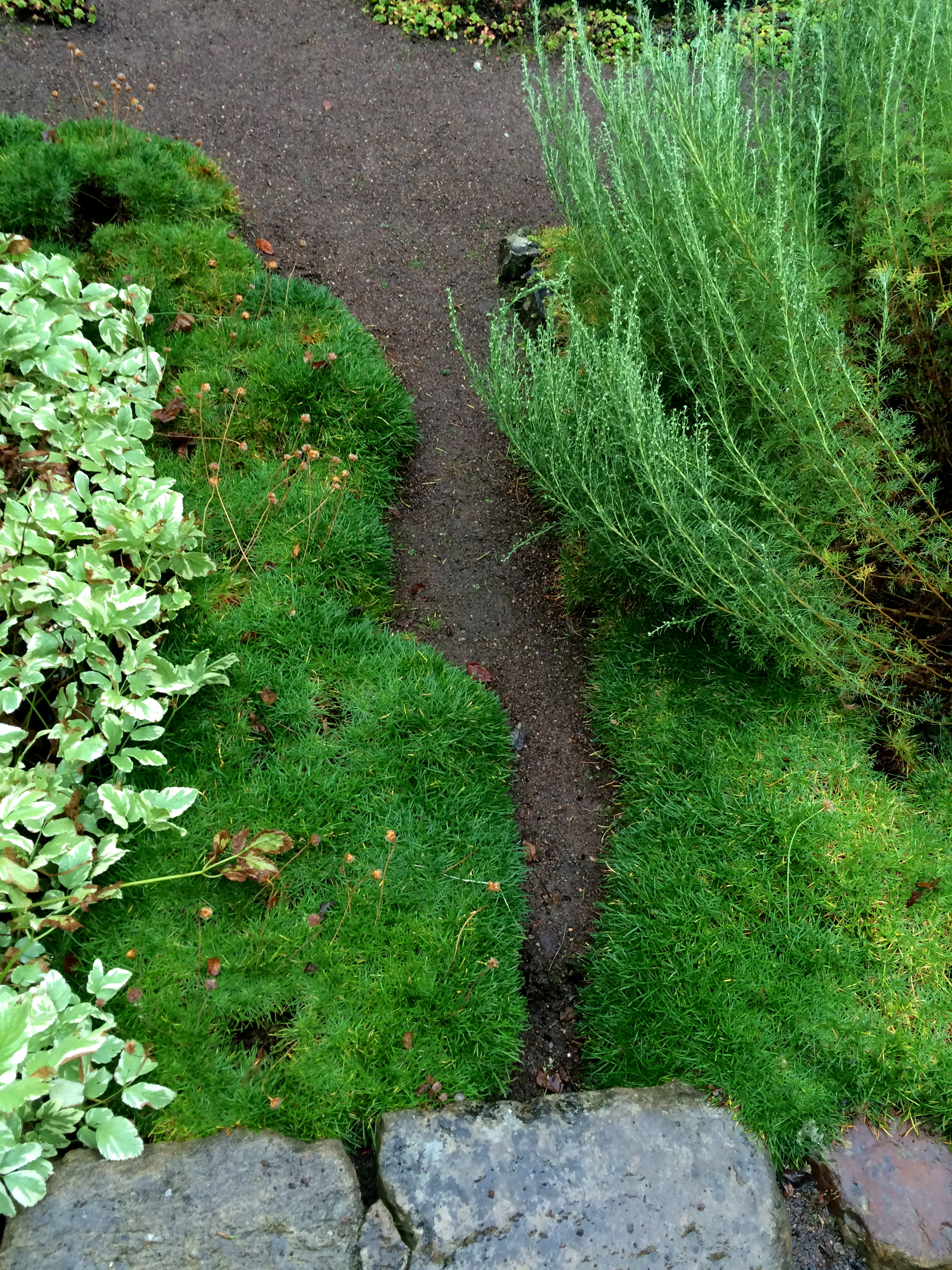
Another bench is at the end of a small, winding green path brightened with tantalising spires of the slender cream foxglove, Digitalis lutea:
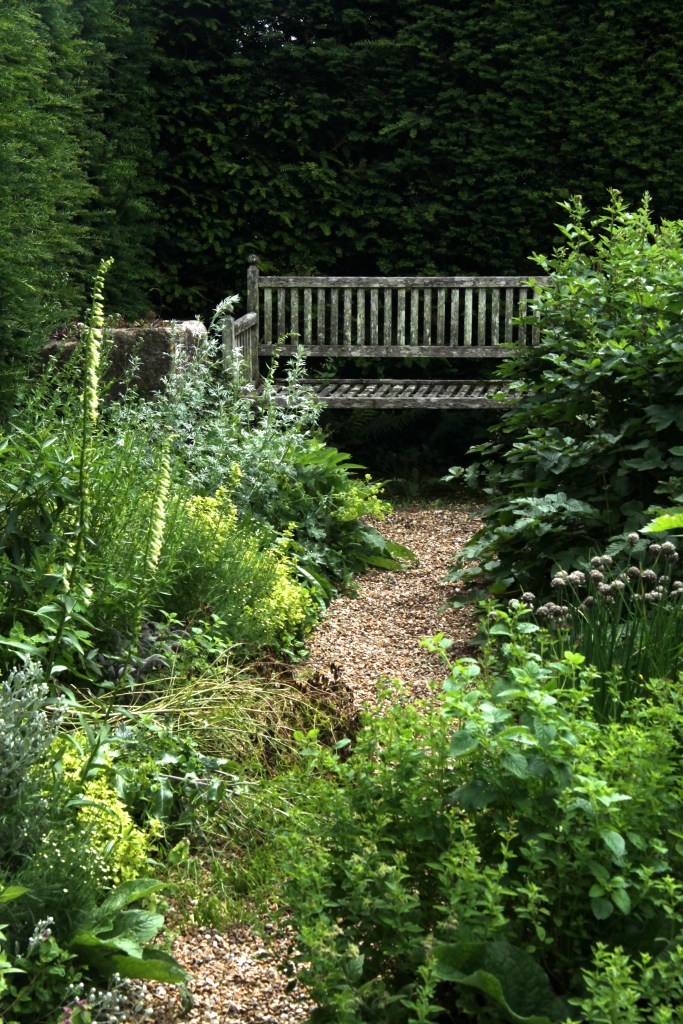 Winding gravel path to a second bench with slender spires of the creamy Digitalis lutea
A third bench is satisfyingly deeply set in the shade of an old apple tree:
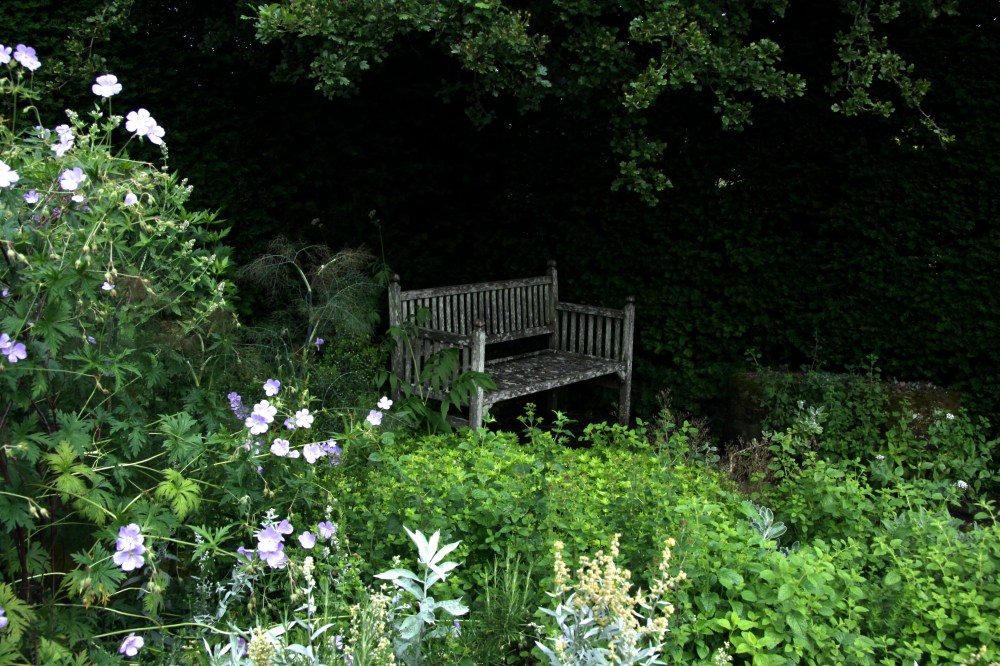 A third bench deep in the shade of an old apple tree
The centre of the Herb Garden is exuberantly planted with culinary herbs and herbaceous perennials. The almost decadently fading flowers of the towering Angelica archangelica take centre stage, with the tall daisy-like flowers of inula providing a fresher yellow, and the tiny button like lemon-yellow flowers of the green leaved santolina, Santolina pinnata subsp. neapolitana, making a handsome curved edging for the central pond.

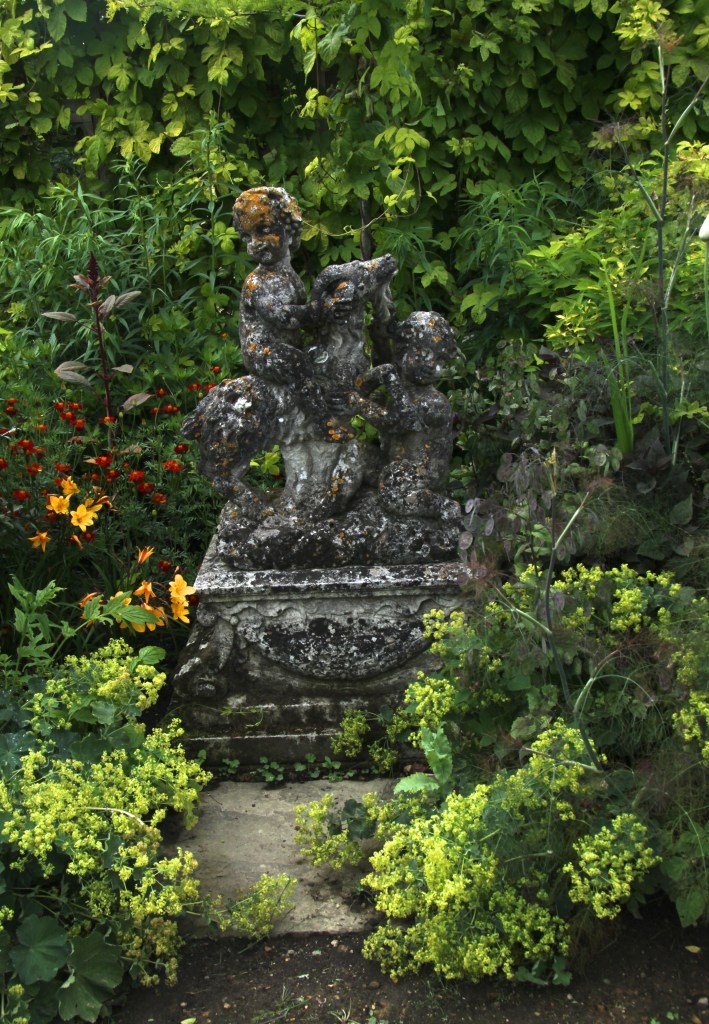

The centre of The Herb Garden with towering Angelica archangelica, Alchemilla mollis everywhere and the tiny lemon yellow flowers of Santollina pinnata subsp. neapolitana edging the pond.
The way out of the Herb Garden looks as richly enticing as the way in – you know you are in the hands of masterful gardeners:
 View as you leave The Herb Garden
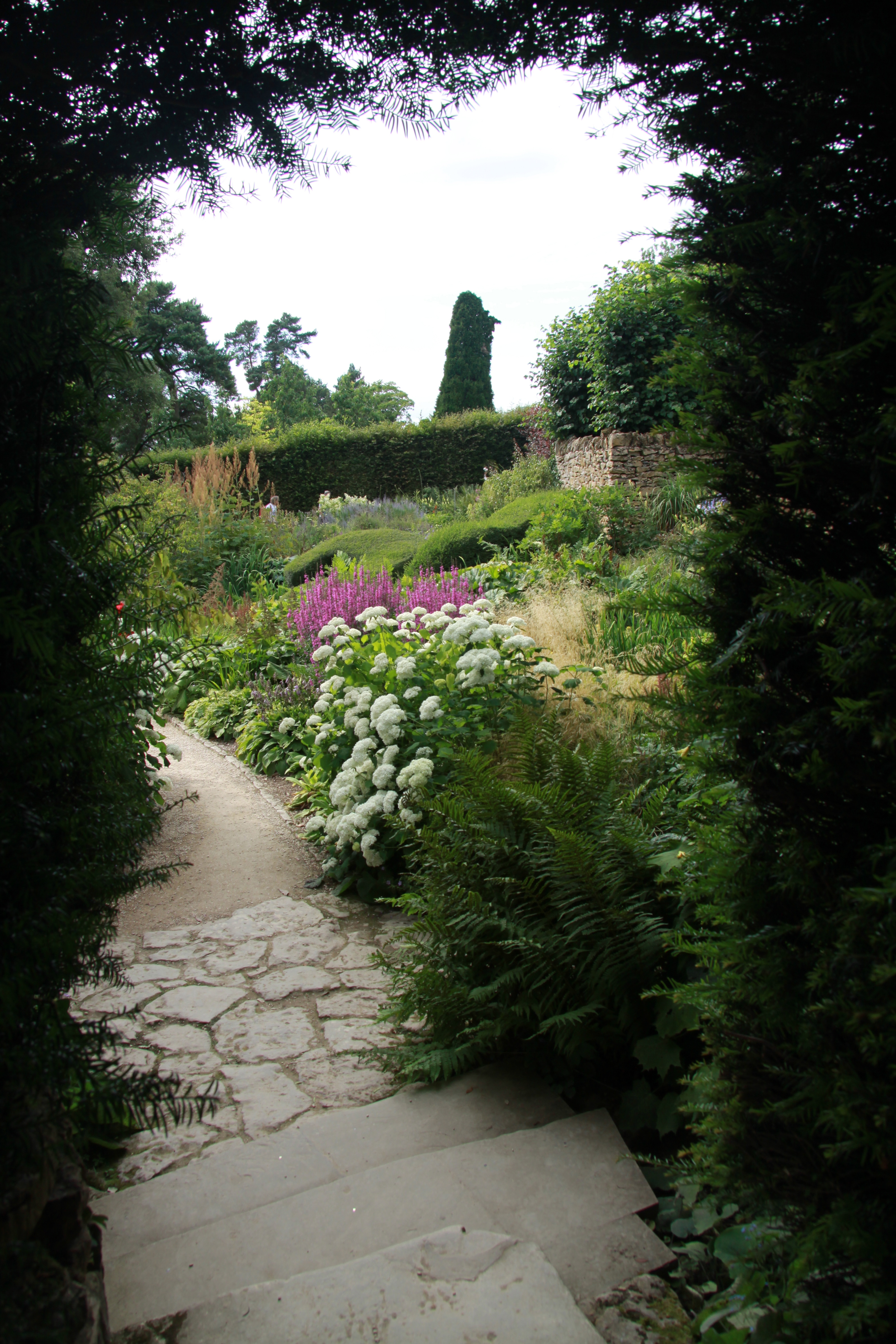
A central pair of borders, The Blue and Gold Borders, cross the entire walled garden, with cooler blue colours to the West and warmer gold colours to the East:
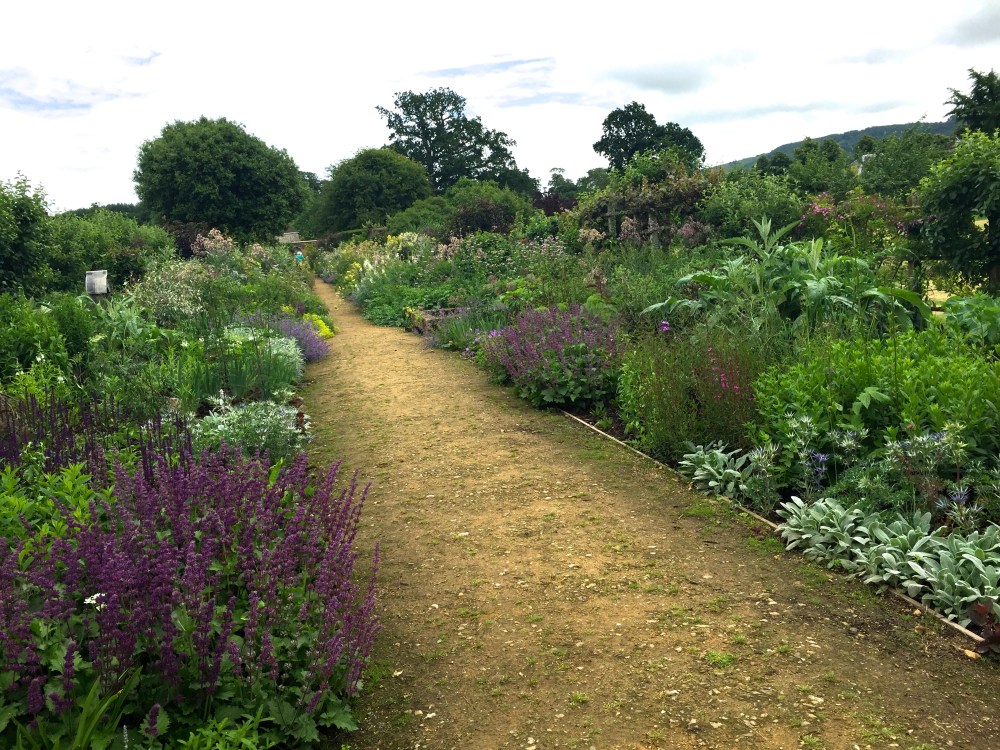 FIrst view of the Blue Border
The borders are flanked at intervals by muscly espalier apple trees and elsewhere by simple wooden fencing which is cleverly broken up by basic wooden arches in a staggered art deco shape. These work brilliantly, especially as they age and become covered in lichen and, as here, host the purple leaved vine Vitis vinifera ‘Purpurea’:
 Espalier apple trees edge the border

 Art deco style arches act as pause points in the fence – the older lichen-covered arch above is clothed in Vitis vinifera ‘Purpurea’
The planting at the ‘blue’ end is particularly inspiring. In this photograph, the white rosebay willow herb, Chamerion angustifolium ‘Album’, is planted with the palest lilac-flowered Valeriana pyrenaica. Tall stands of red orach, Atriplex hortensis var. rubra, pick up the maroon staining of the Valerian’s stems and allow the white and dusky lilac to be read. It is a gorgeous group of plants.
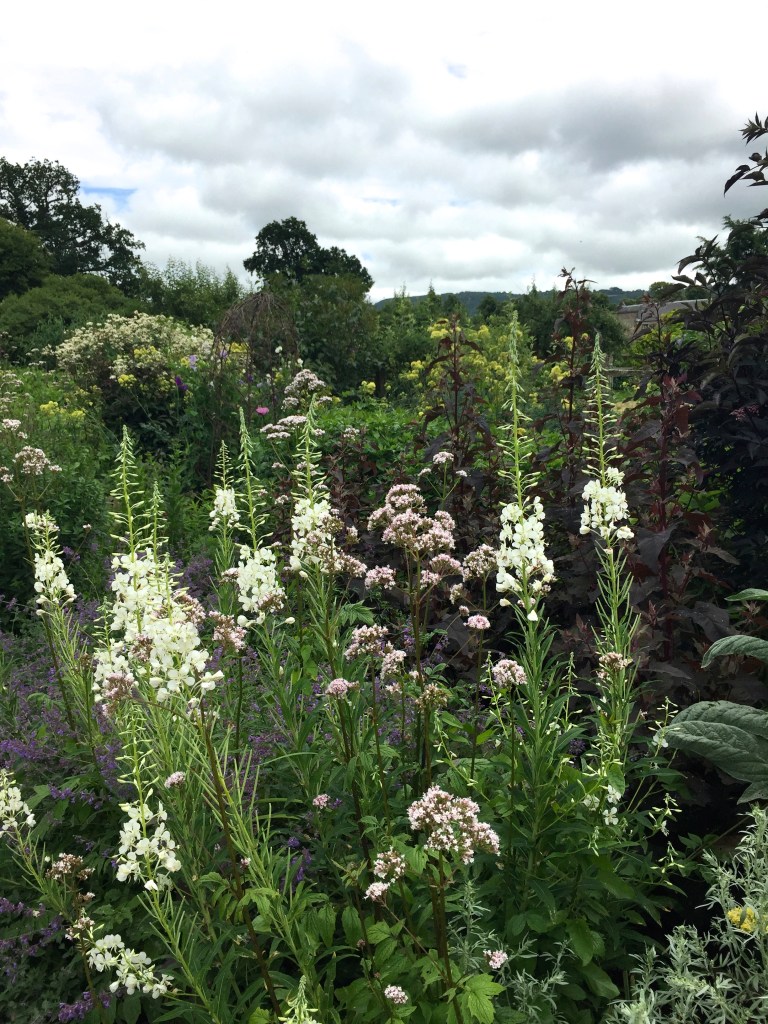 Chamerion angustifolium ‘Album’, Valeriana pyrenaica and red orach
A little further on, the all-yellow, fluffy headed thalictrum, Thalictrum flavum subsp. glaucum (which I have never used, but faithful readers will know that I am becoming an unstoppable fan of the colour yellow in the garden) provides a soft foil for the vibrant Persicaria amplexicaulis ‘Firetail’:
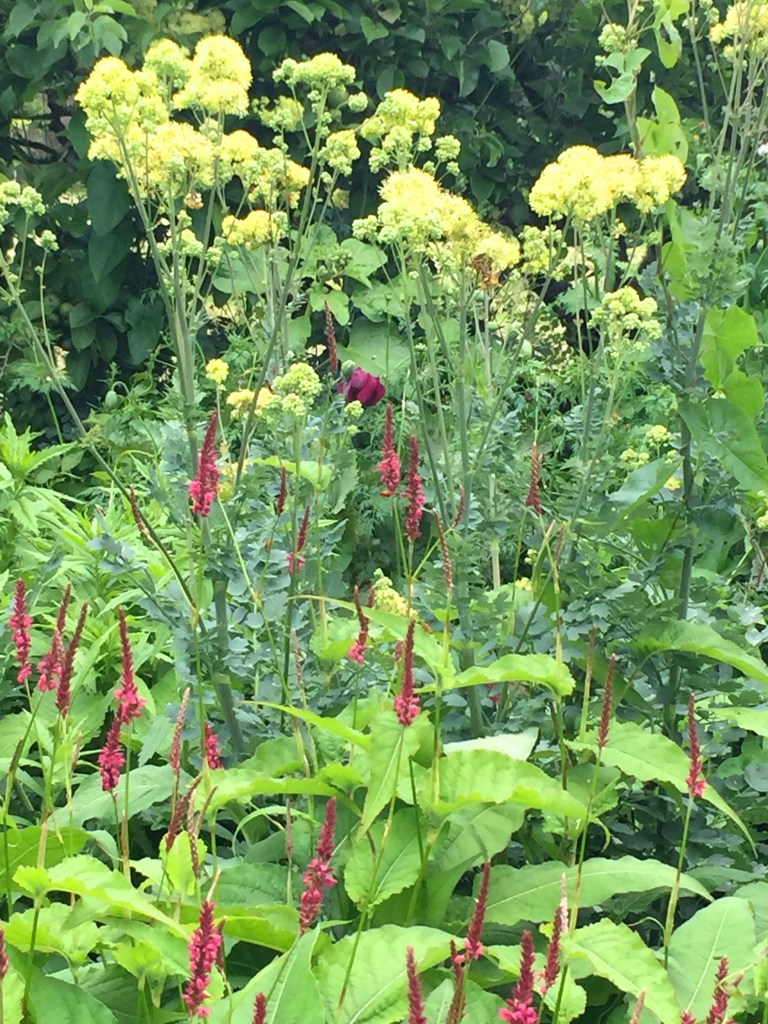 Thalictrum flavum subsp. glaucum and Persicaria ‘Firetail’
And elsewhere, the bicolour taller thalictrum, Thalilctrum ‘Elin’, is an intriguing combination of soft yellow and purple:
 Thalictrum ‘Elin’
At this point in the border, the mix of low-key yellow, faded pink and white have a seductive 70’s polaroid quality:
 Thalictrum flavum subsp. glaucum, Valeriana pyrenaica, Chamerion angustifolium ‘Album’
The classic, mound-forming, silver foliage plant, Artemisia ludoviciana ‘Valerie Finnis’ is one that has definitely moved higher up my list of plants to try to bring a border together with a gentle sparkle. It is used throughout the garden and is a wonderful foil for both bright and more subtle colours.
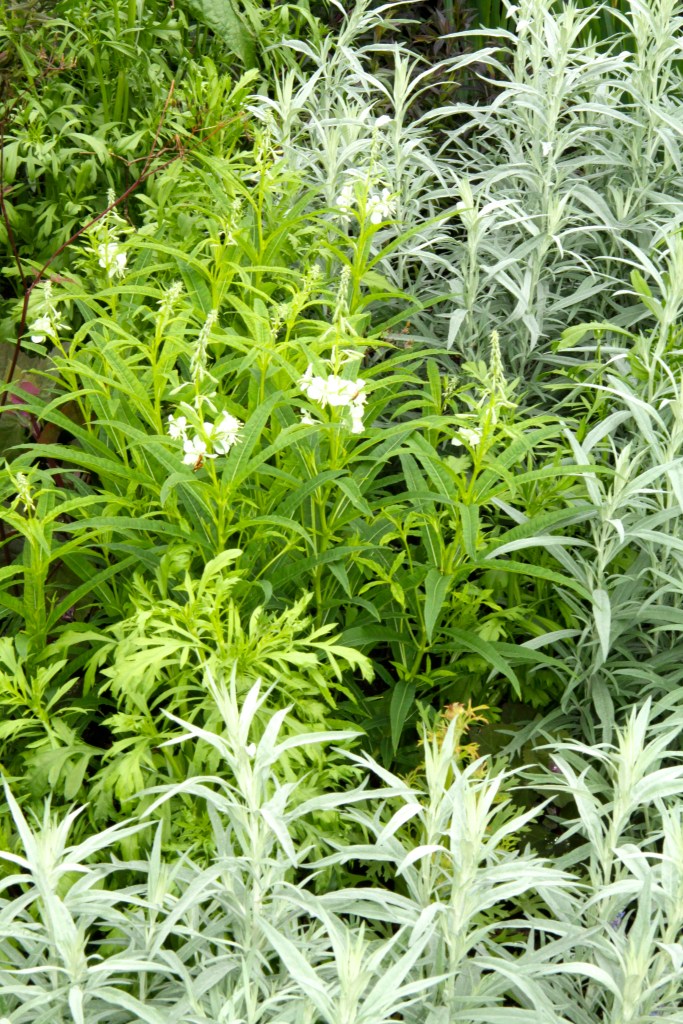
The silver foliage of Artemisa ludoviciana ‘Valerie Finnis’ with the just emerging Chamerion angustifolium ‘Album’
Elsewhere there are the rich purple uprights of Salvia nemerosa ‘Caradonna’ together with the dreamier mauve-pink catmint (probably) Nepeta grandiflora ‘Dawn to Dusk’ – the opposing qualities of each plant work surprisingly well when put next door to each other.
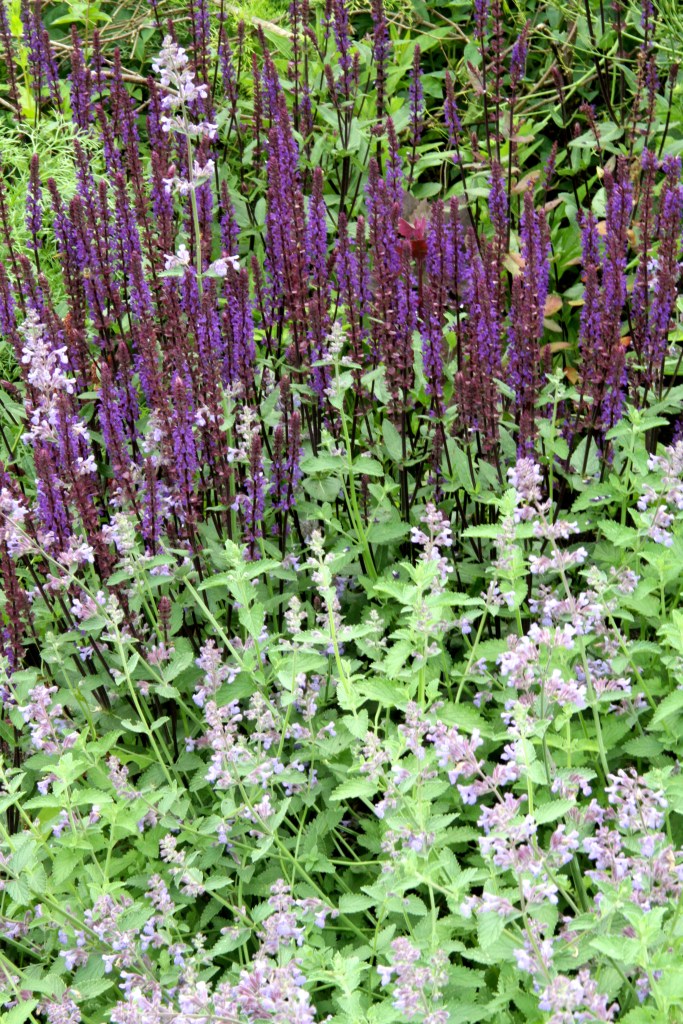
Salvia nemerosa ‘Caradonna’ with Nepeta grandiflora ‘Dawn to Dusk’
The salvia, together with classic blue catmint and a rich blue geranium, anchor the border and keep it just about in the blue/purple spectrum!
 Mounds of salvia, catmint and blue geranium anchor the border
There is an immediate colour shift as you approach the Gold Border. Stipa gigantea erupts with its usual brilliancy into a series of fine bronze fireworks and, here, the sword-like foliage and pale yellow flowers of Sisyrinchium striatum anchors the planting:
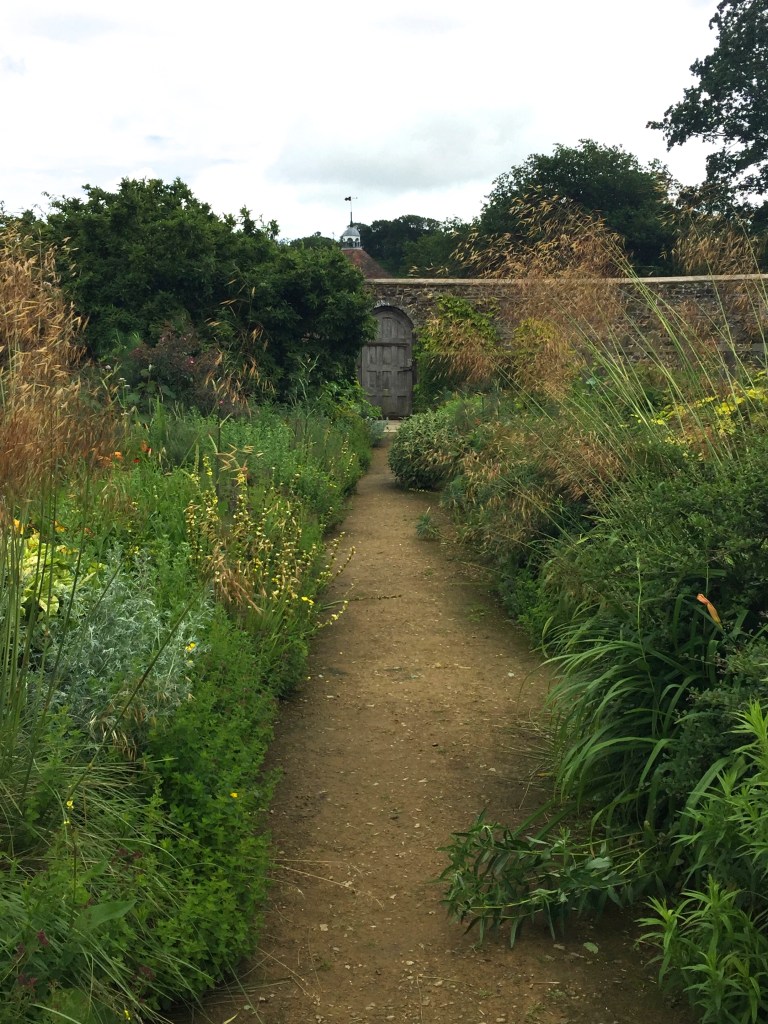
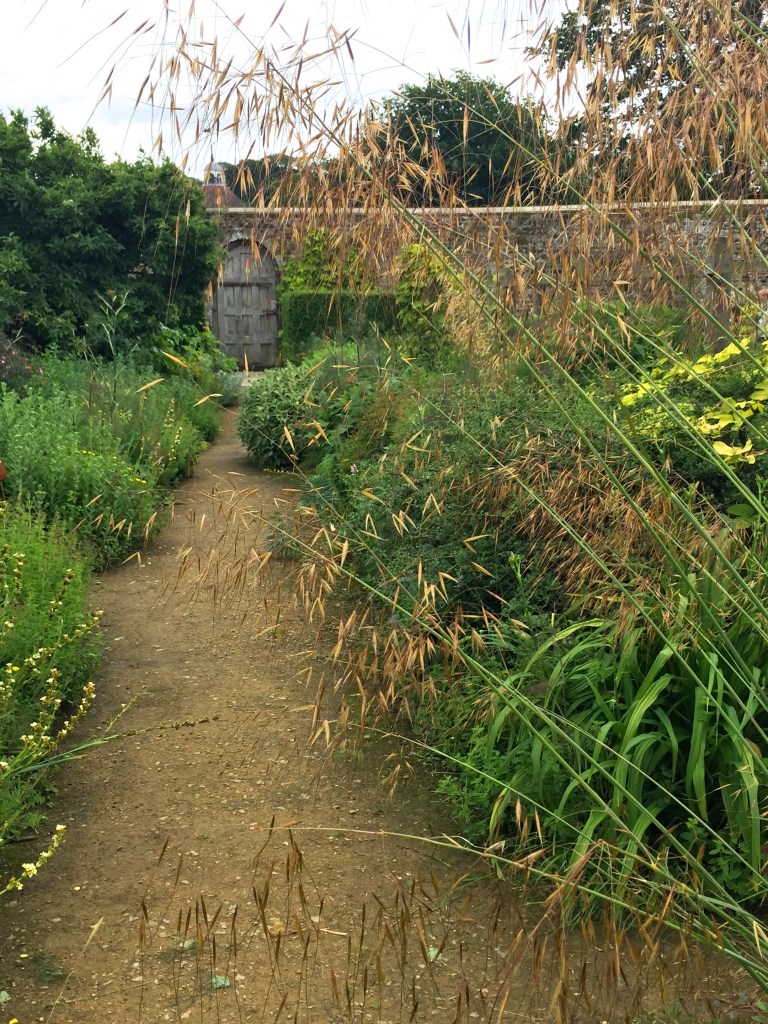
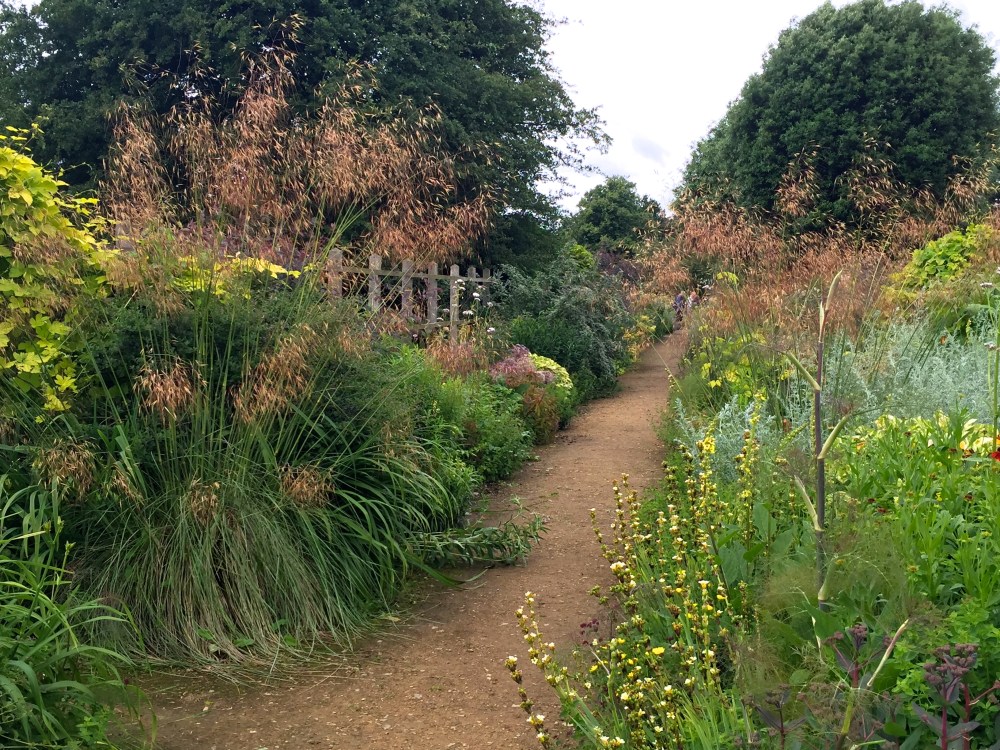 The bronze fireworks of Stipa gigantea are anchored by the swordlike foliage and pale yellow flowers of Sisyrinchium striatum in the Gold Border
The subtle colouring continues with the coppery mauve foliage of Rosa glauca acting as a foil for pale lilac Valeriana pyrenaica – with the dirty gold of Humulus lupulus ‘Aureus’ above and golden marjoram below lighting up the scene.
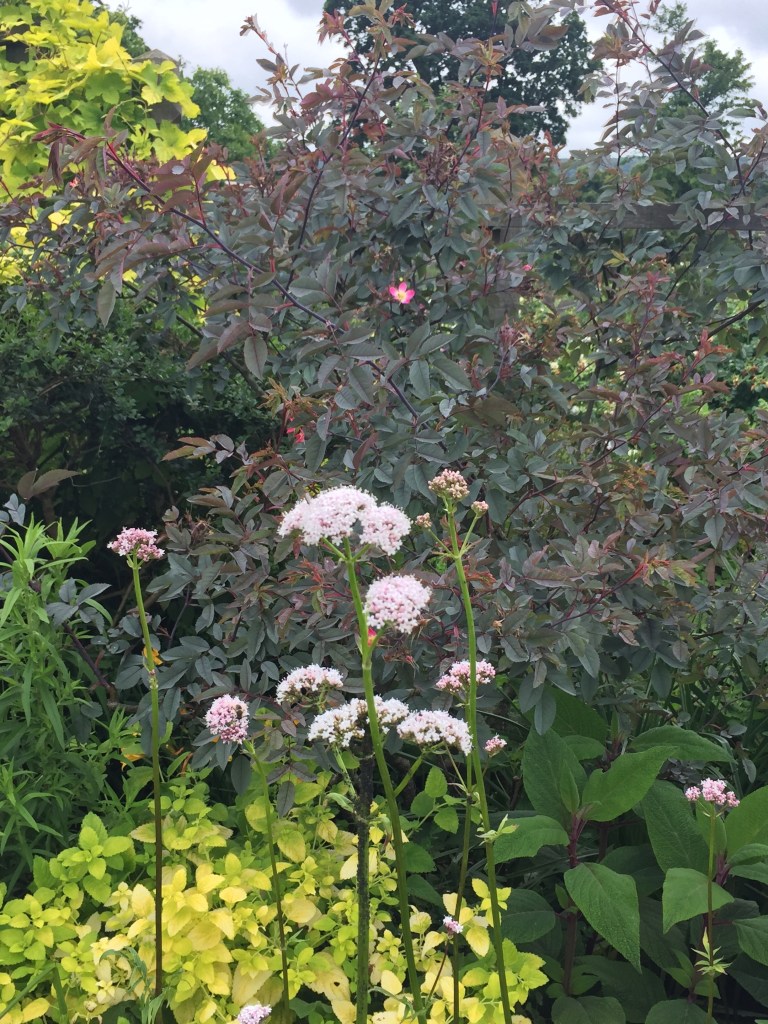
Rosa glauca with Valeriana pyrenaica, Humulus lupulus ‘Aureus’ and Origanum vulgare ‘Aureum’
The dusky mauve Sedum ‘Matrona’ – my favourite sedum – is introduced as a deft rhythmic base plant and then little shocks are introduced: more golden hops threaded though at low level, a burnt orange knifophia singing out from a haze of bronze fennel, and then a flotilla of flat red brown heads amongst the mauves: Achillea millefolium ‘Terracotta’:

Sedum ‘Matrona’ Sedum ‘Matrona’ with golden hops
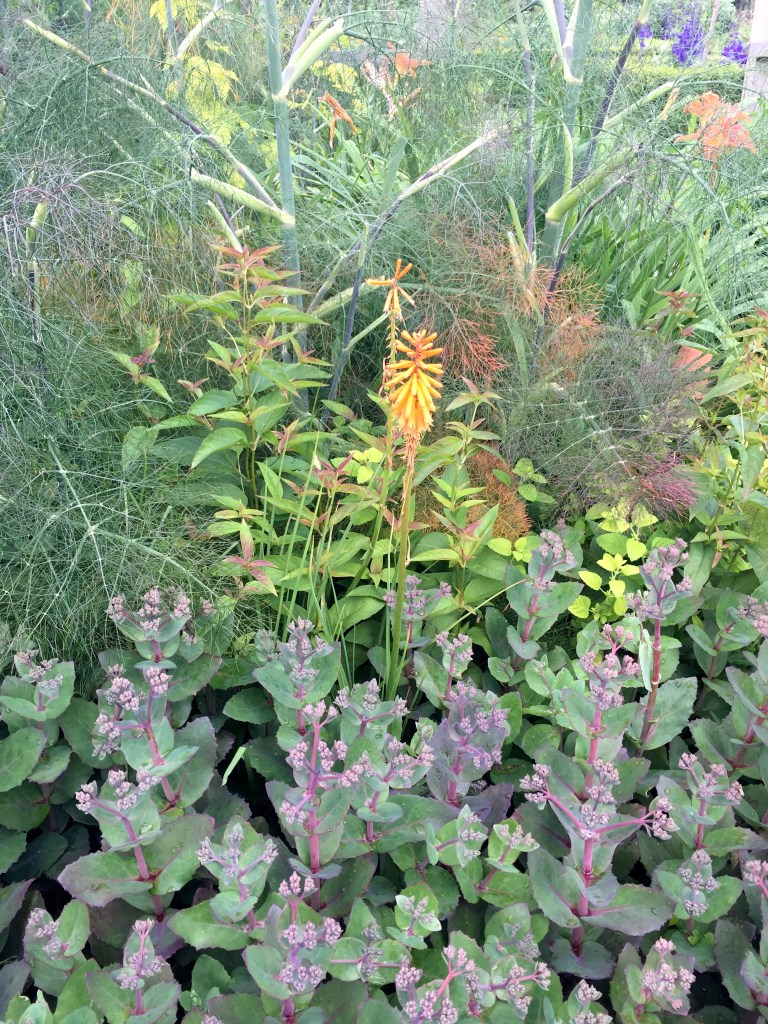 An orange Kniphofia amongst sedum and bronze fennel
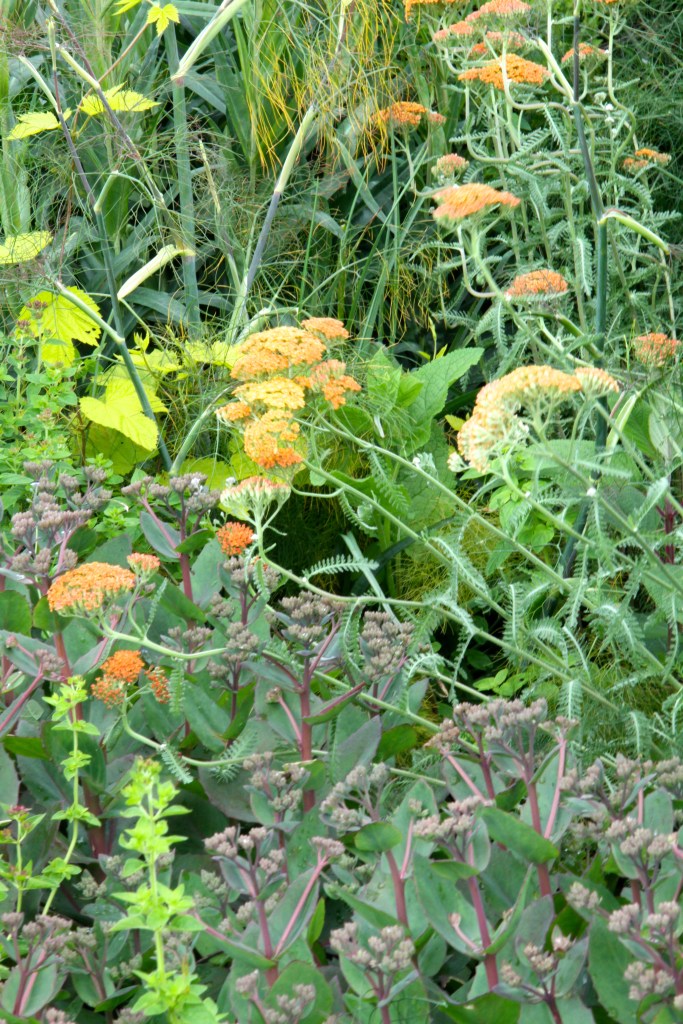 The flat heads of Achillea millefolium ‘Terracotta’ with Sedum ‘Matrona’
Next to the Blue and Gold borders is The Vegetable Garden – a huge box parterre for growing cut flowers so there are sudden bursts of electric blue delphinium, cloudy white heads of Amni magus, or pokey heads of the last-to-flower giant allium from the June allium trials.


 Clipped box, electric blue delphinium, Amni majus, and giant allium in bud
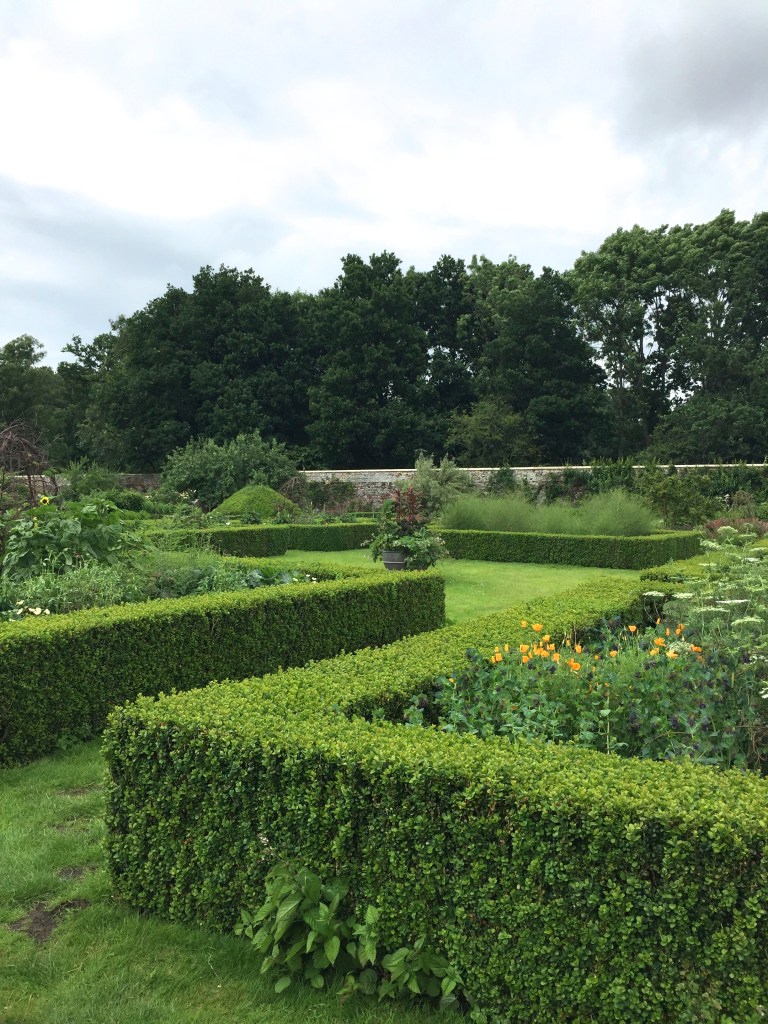 The Vegetable Garden Parterre
The spring meadow grass around a pair of charismatically ageing medlar trees has been raked into stook-like piles at the base of the trees. I am suddenly transported to the South of France and summer holidays:
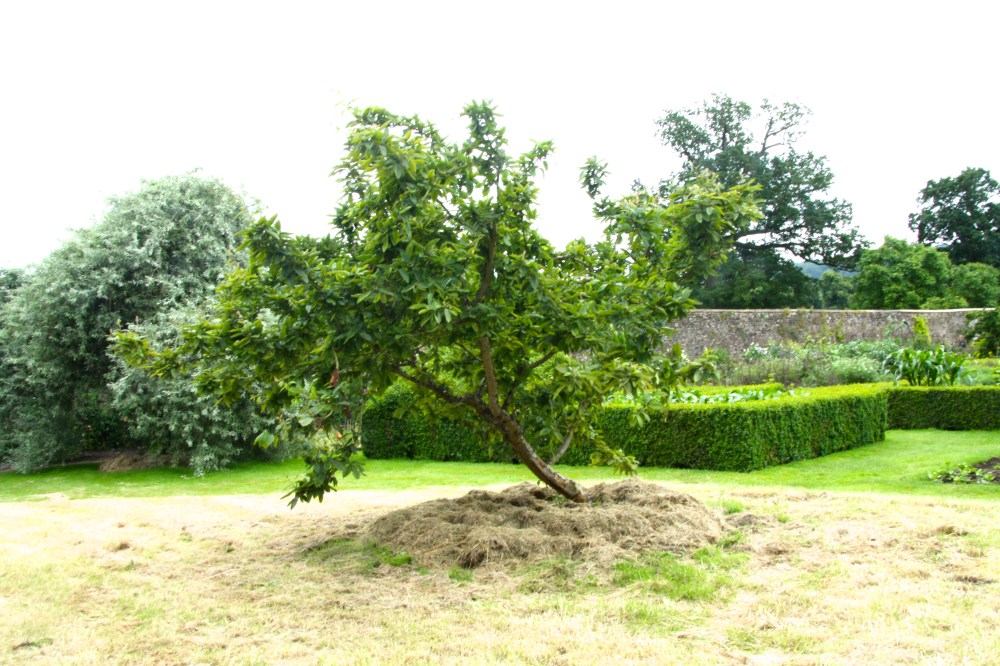

Medlar trees with raked meadow grass
There is the charming wendy house built in 1928 by Clive Pearson for his three daughters – a perfectly detailed two storey cottage built into the garden wall – and there is the rather less impressive photographic record of me hopelessly trying help you work out the scale of the perfectly formed wendy house for yourself…. I love the idea that the family still have an annual tradition of spending one summer night here, lighting the fire, cooking sausages and telling ghost stories.
 The 1928 Wendy House
 A not very helpful selfie to show the scale of Wendy House …
Next to the wendy house, another perfectly lichened bench surrounded by ferns and mounds of silver Artemisia ludoviciana ‘Valerie Finnis’:

And then a lovely stretch of old brick and flint wall, gates painted with red estate paint and confident shady planting of Digitalis lutea, hosta, Alchemilla mollis, and the rather brilliant addition of sea holly – Eryngium giganteum ‘Silver Ghost’? – which at this point of the year is a pale silvery green (it will turn to silver blue as it matures) and a fantastic counterpoint to the acid green of the alchemilla: Digitalis lutea


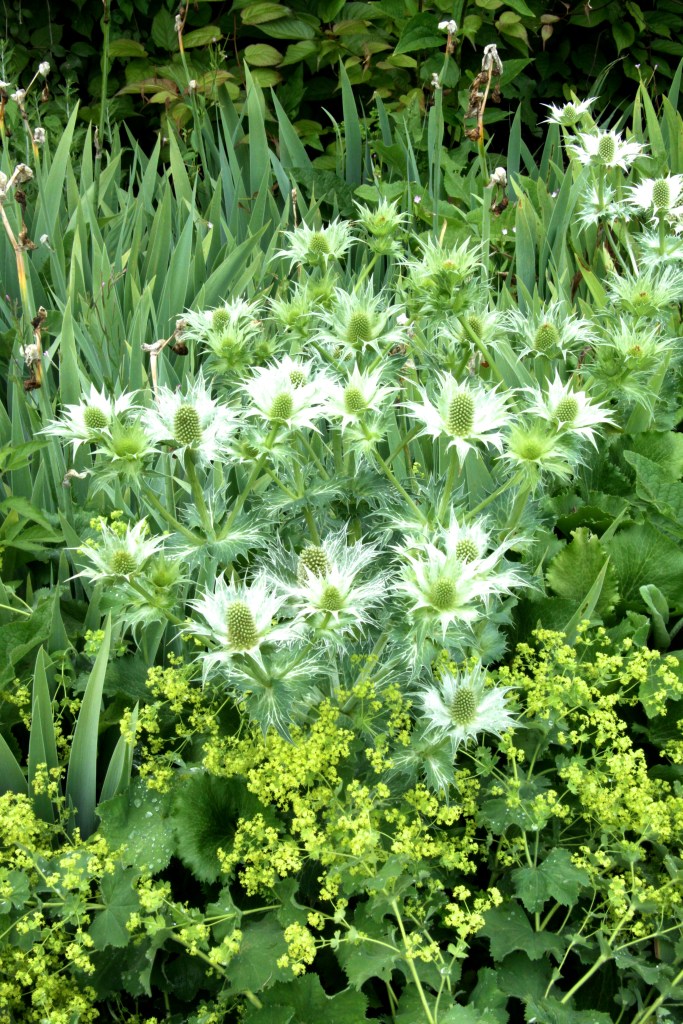 A fine stretch of shady planting – the bottom photo shows the acid green of Alchemilla mollis and the pale silvery green of the young Eryngium giganteum ‘Silver Ghost’
Moving round the garden, the orchard has also been mown and neatly raked, and is ready for summer. There is a feisty wildlife-friendly strip of ferns and stinging nettles against the orchard wall: proof that wild life friendliness and a sense of order can be happy bedfellows.
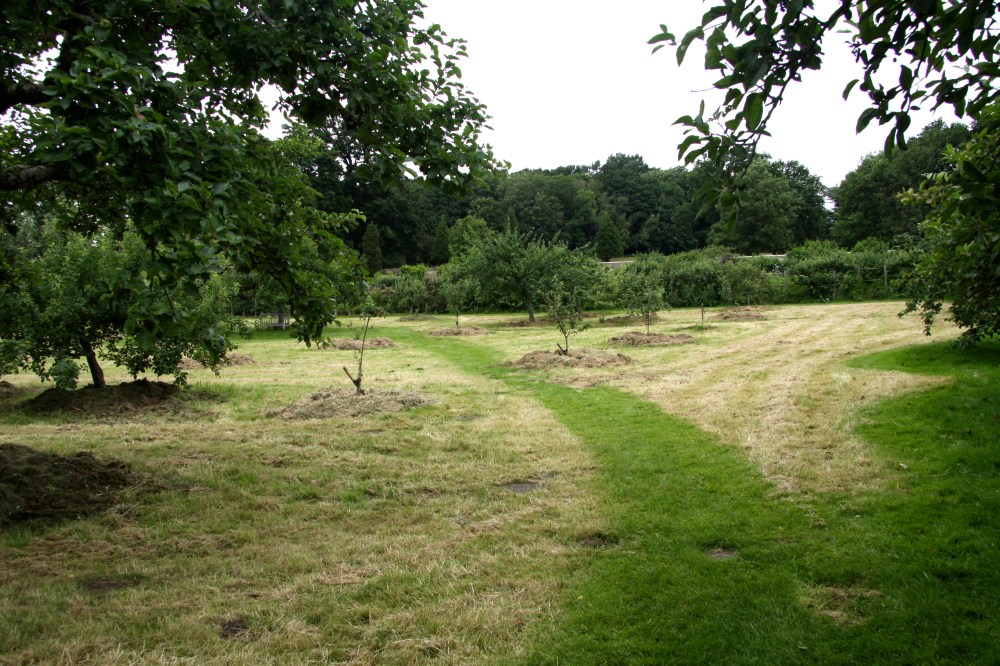
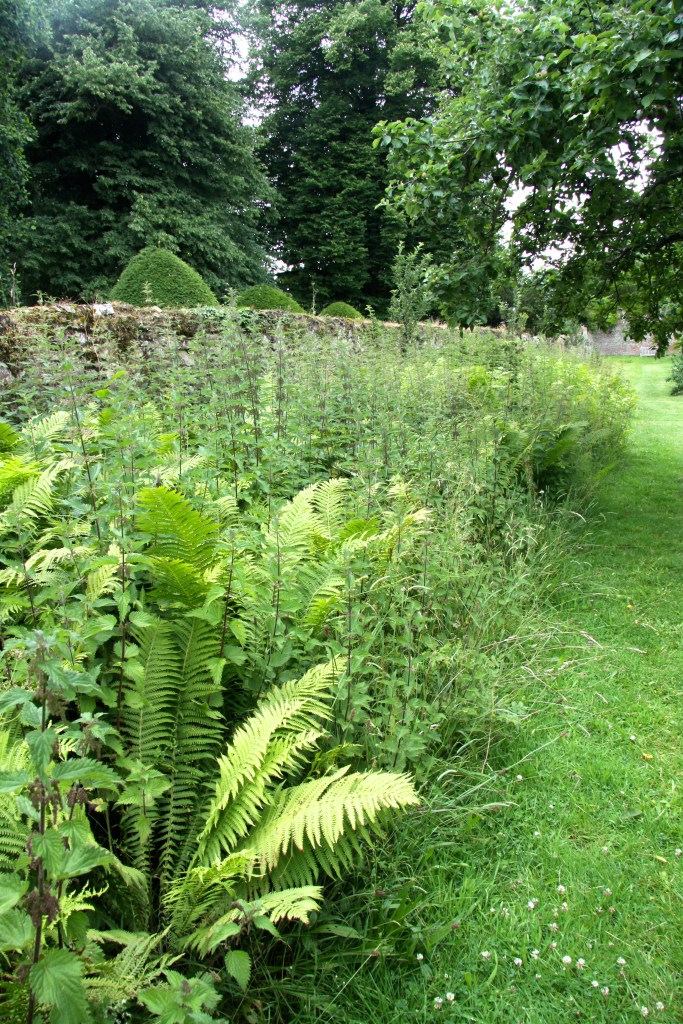 The orchard with a strip of wild-life friendly nettles at its edge
I pass the elegant lake with its latticed wall and views out to the Sussex hills:
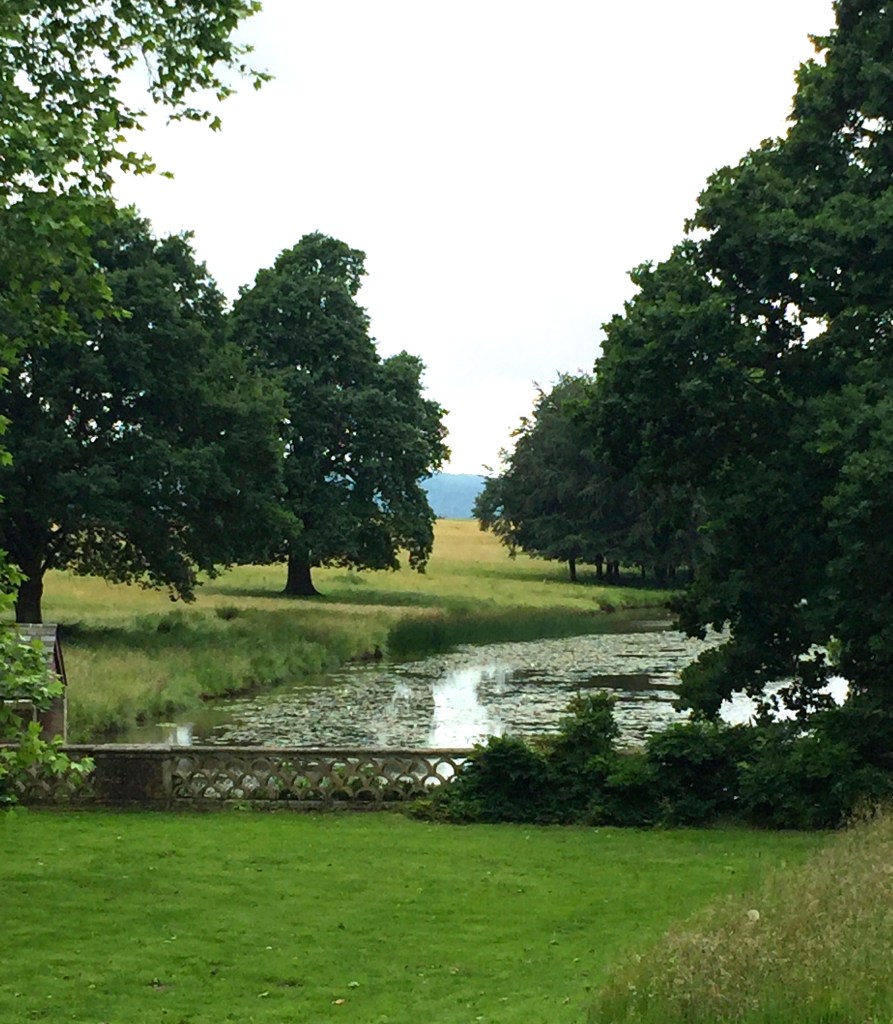 The lake at Parham
And as I leave the main part of the garden I notice this excellent combination of plants for shade – Begonia evansiana ssp. evansiana whose heart shaped leaves will be joined by simple shell pink flowers in late summer – and Tiarella ‘Spring Symphony’ with its starry pale pink flowers and purple blotched leaves which will carpet the ground all summer.

Begonia grandis sbsp. evansiana and Tiarella ‘Spring Symphony’
One final leg to my tour. I pass through a shadowy room with lead paned windows where jewel coloured pelargonium flowers are collected in simple glass vases:
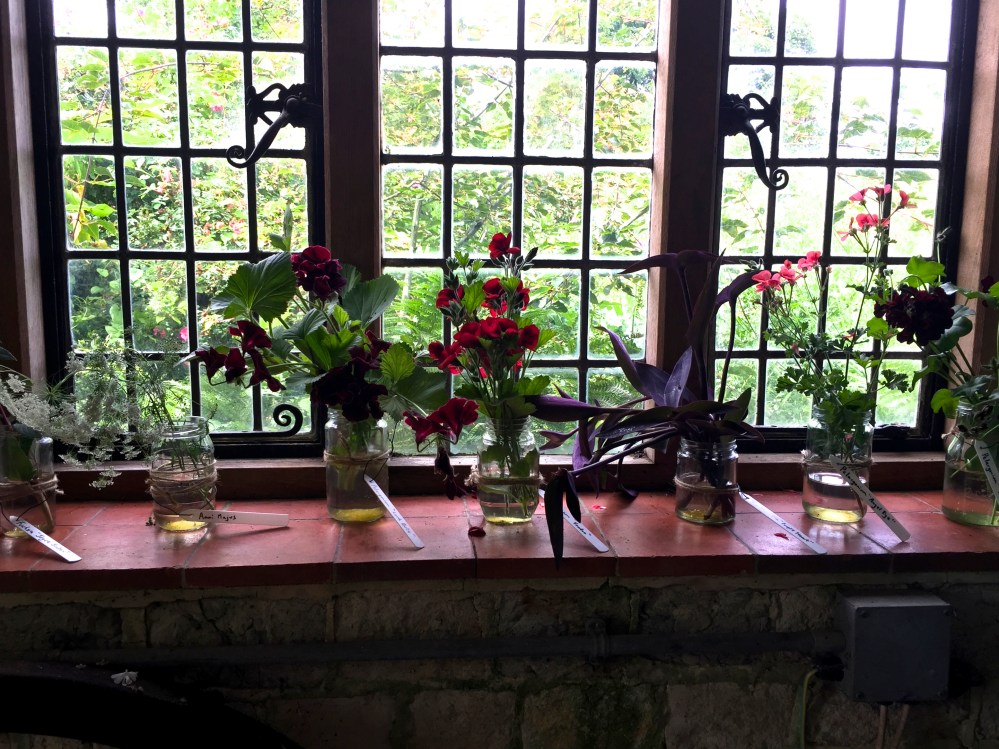
 Pelargoniums in simple glass vases against lead paned windows
through the elongated kaleidoscope of the greenhouses:
 Route through the greenhouses
to the loveliest, completely simple composition of flint wall, catmint in quantity, stone pineapple, glossy banana plant and pair of orange fox tail lilies:

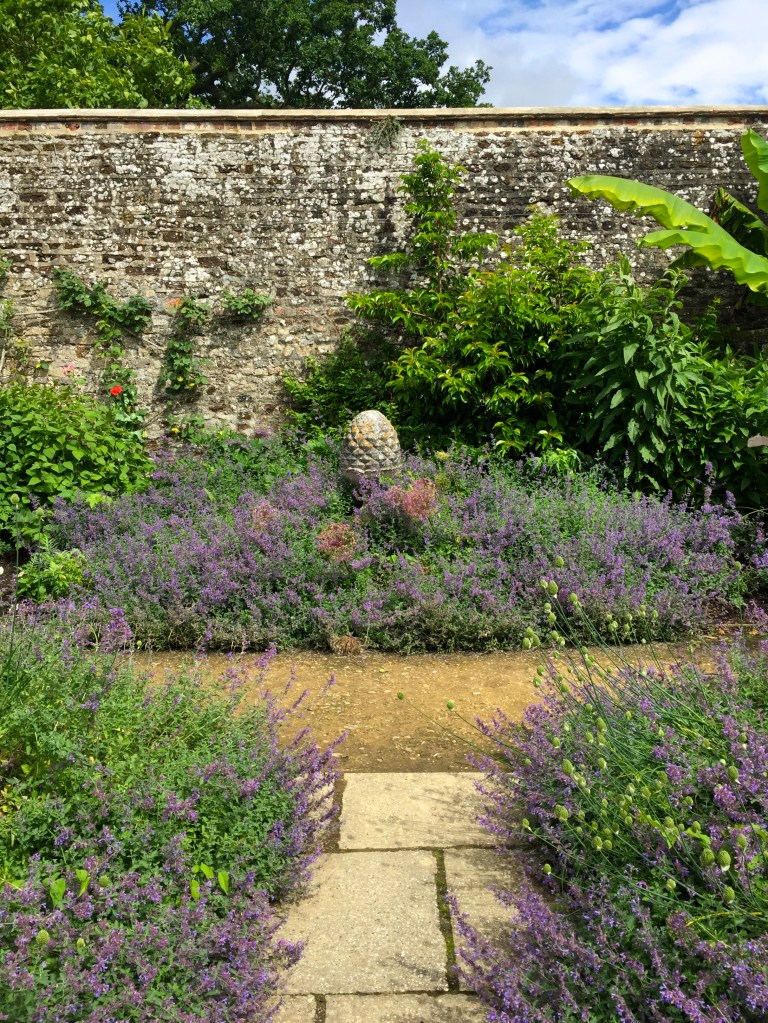


Emerging from the green houses to a sea of catmint, a stone pineapple, a banana plant and some brilliant orange foxtail lilies
I sneak inside the house before I leave, I am running out of time. Worth visiting alone for the 160ft Elizabethan Long Gallery ceiling painted with a twisting design of leaves and flowers in green and gold against white by stage and set designer Oliver Messel in the 20th century:
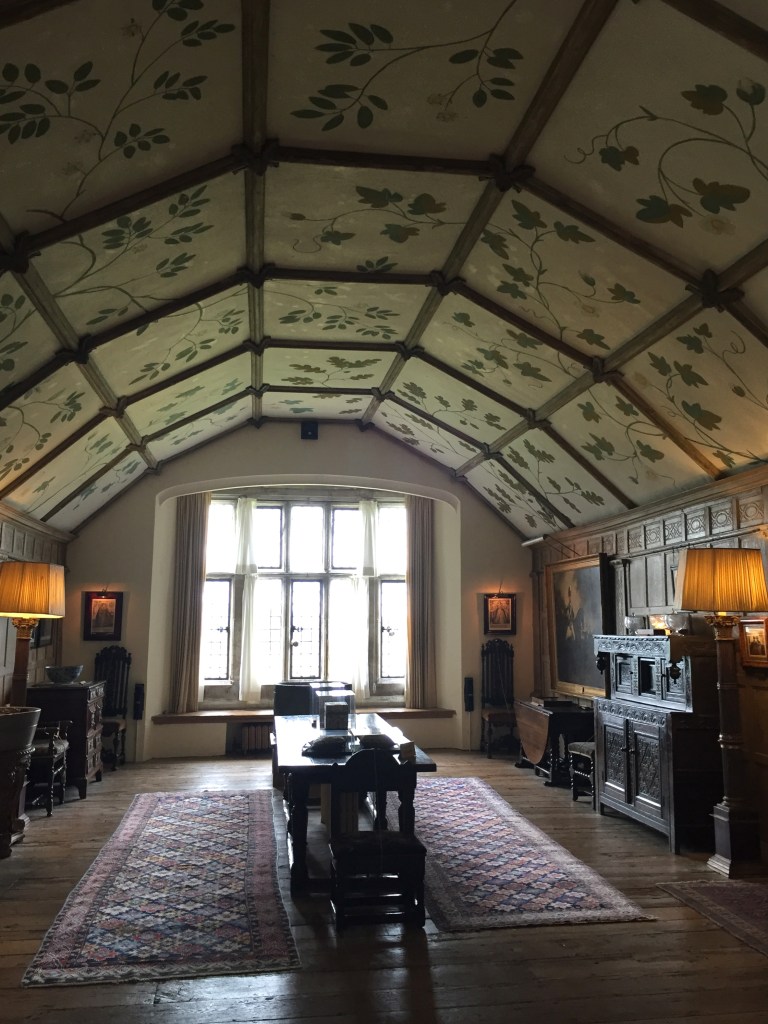


Barrel vaulted ceiling of the Long Gallery, Parham, restored in the 20’s and 30’s and painted with a design by Oliver Messel which was completed in the 1960’s
Even the windows of the house have subtle colour shifts that offer dreamy pallor and sweet intensity in the most enticing combinations:
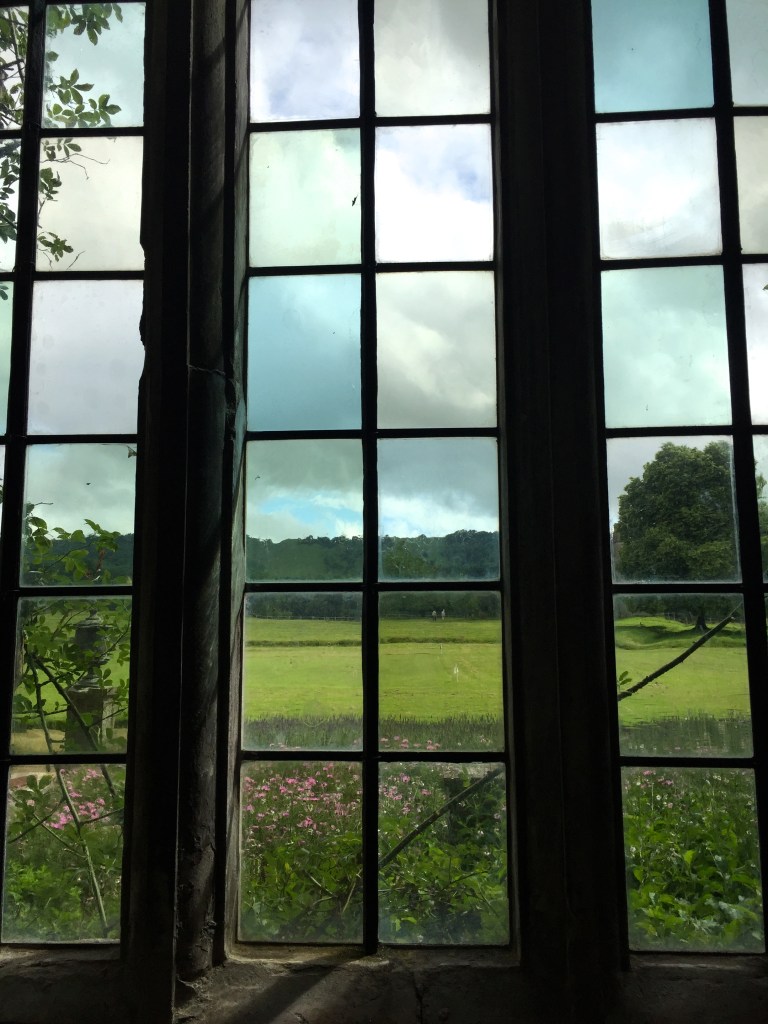
View of the park at Parham from one of the house windows.
Post Script: I will not be posting again for a couple of months as I am travelling all over the UK on writing and also garden design commissions . Wishing you a very good summer, Non.
 Tulipa sylvestris ssp. australis and Muscari neglectum, Monti Sibillini National Park, 1500m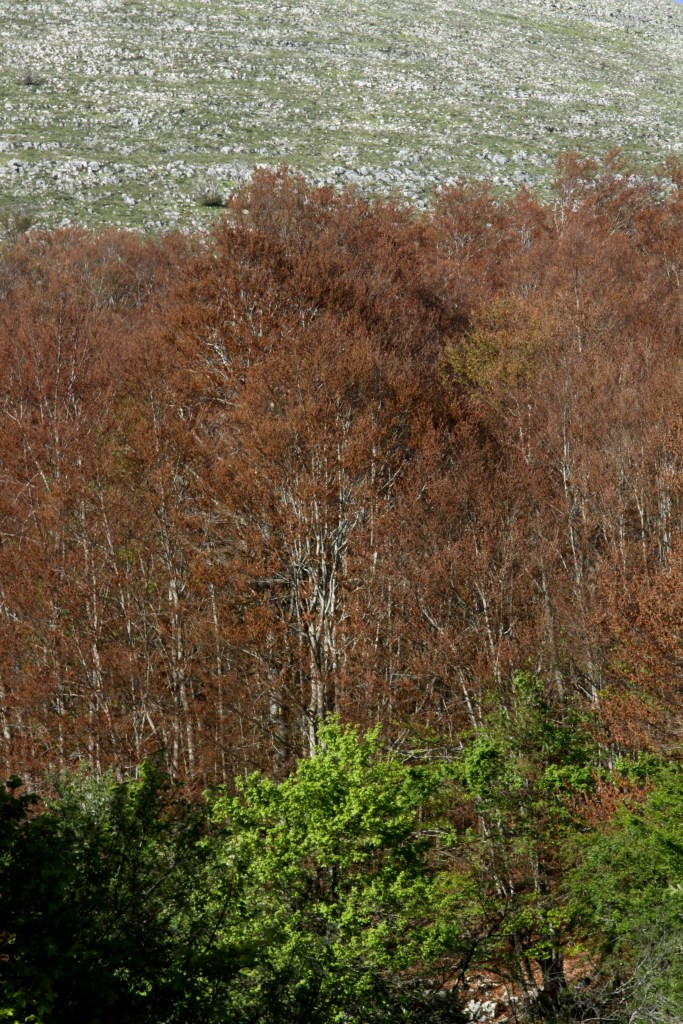
 Frost- crisped beech leaves, Monti Sibillini
 Saponaria oxymoides
 Onosma echioides
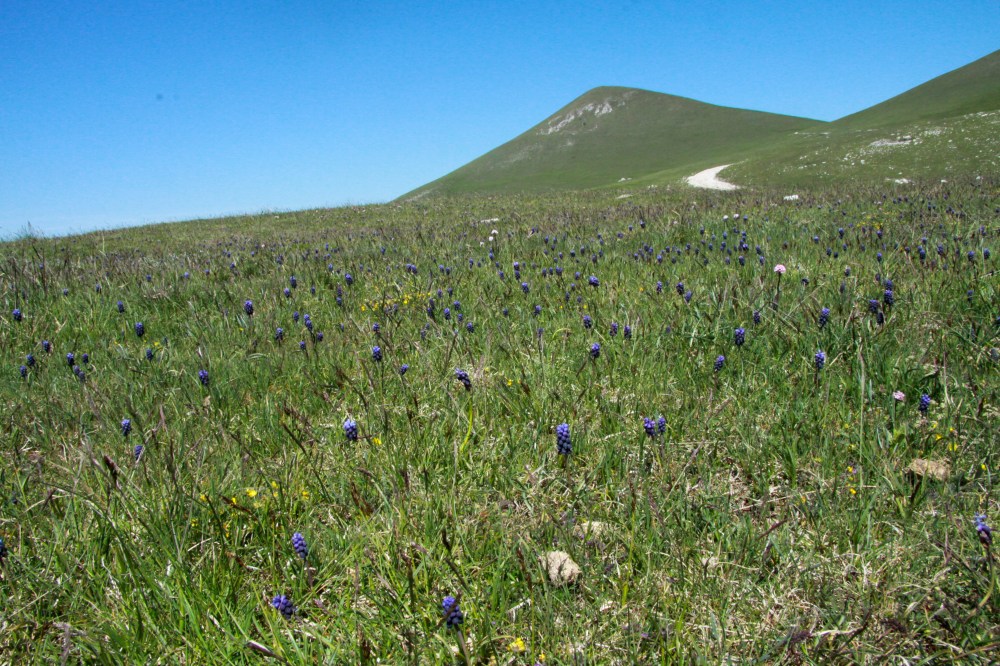 Muscari neglectum extending in every direction

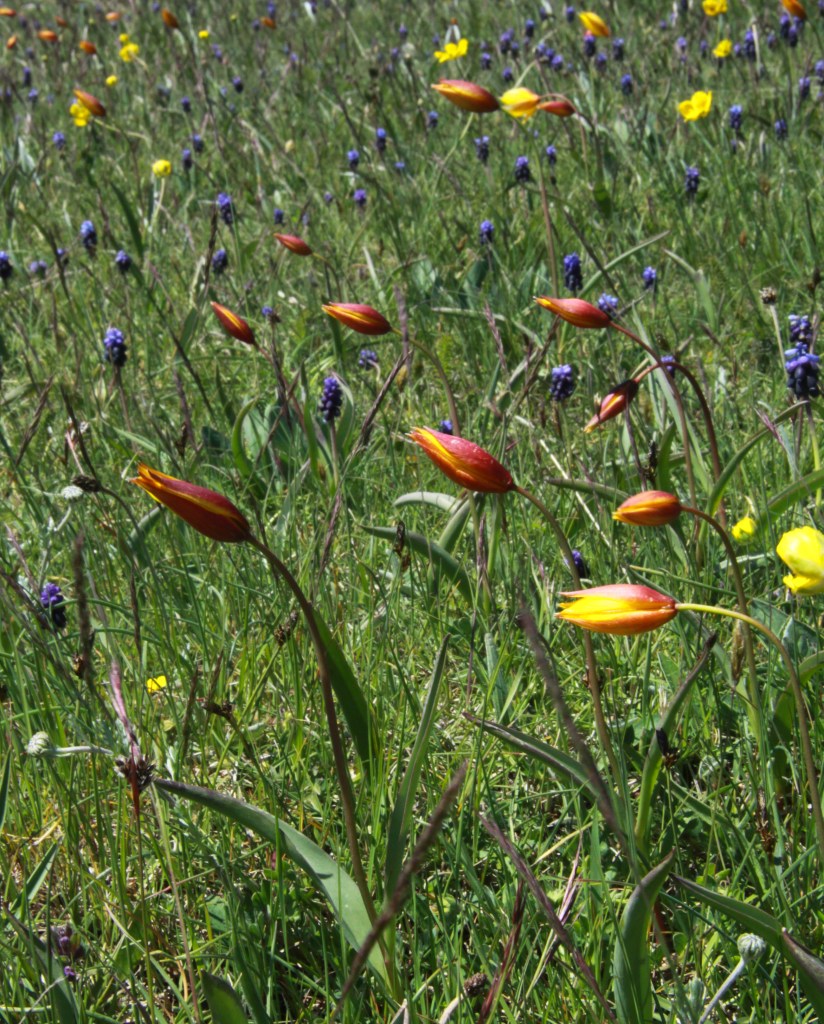
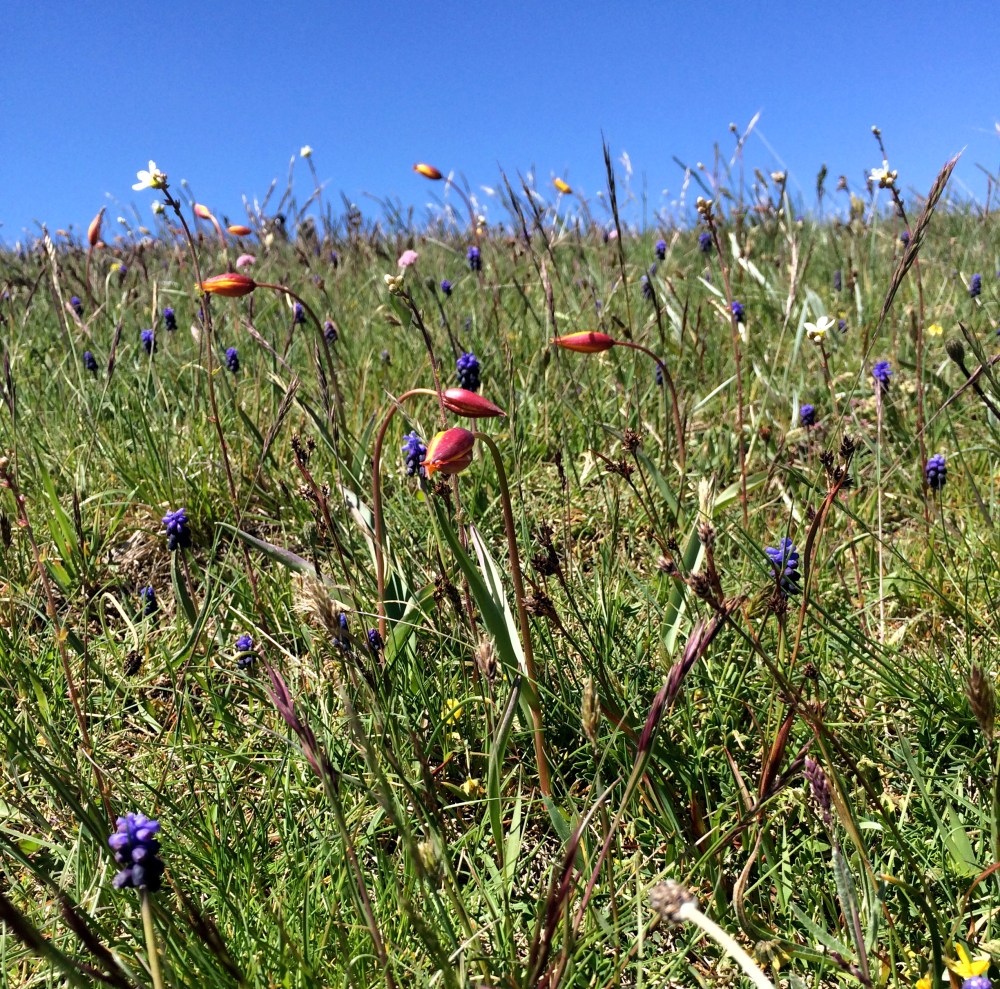 Tulipa sylvestris ssp. australis with Muscari neglectum and other wild flowers, Monti Sibillini National Park
 The Elder-flowered orchid, Dachtylorhiza sambucina
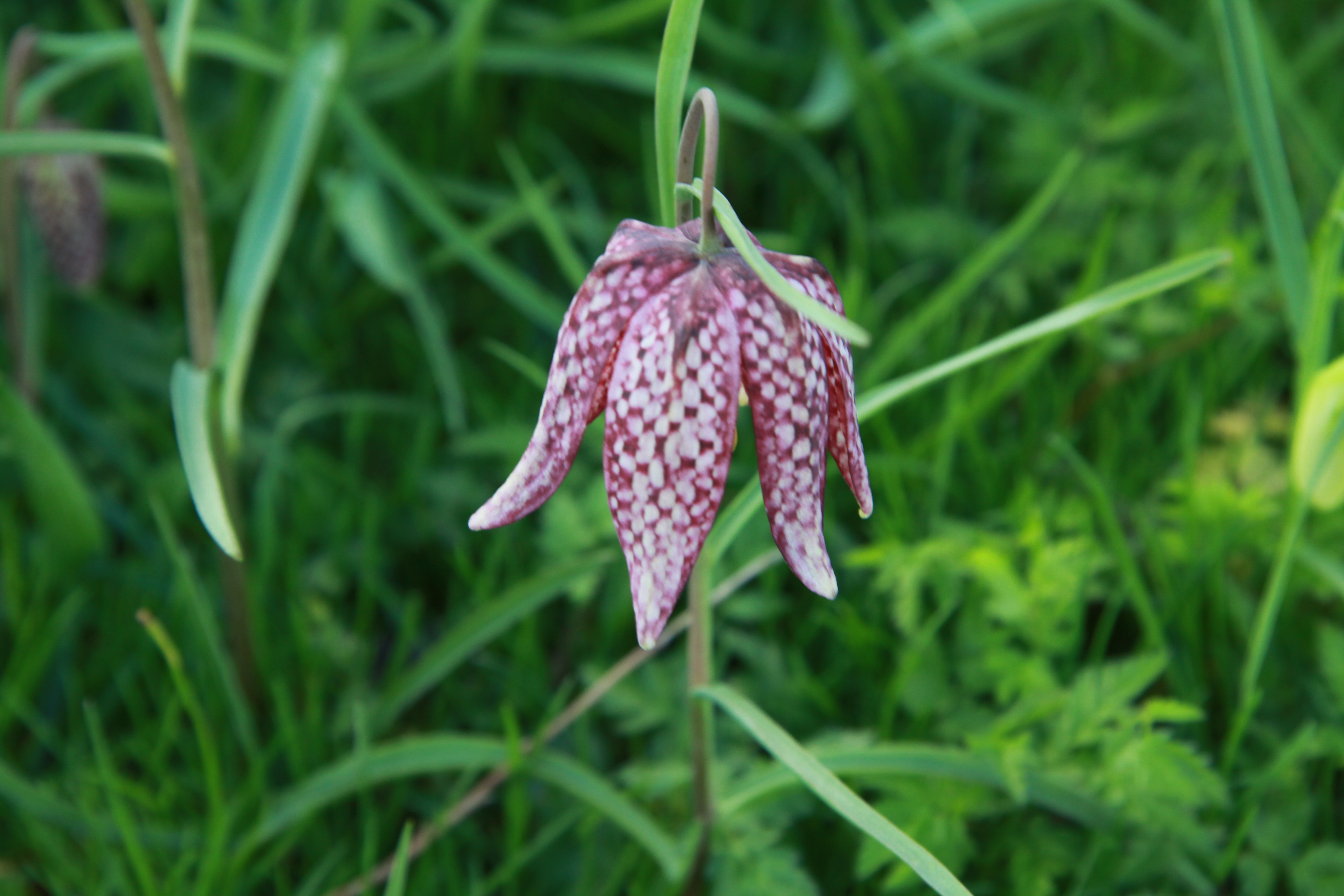
 Fritillaria orsiniana
 Saxifraga granulata
 Tulipa sylvestris ssp. australis, fully open
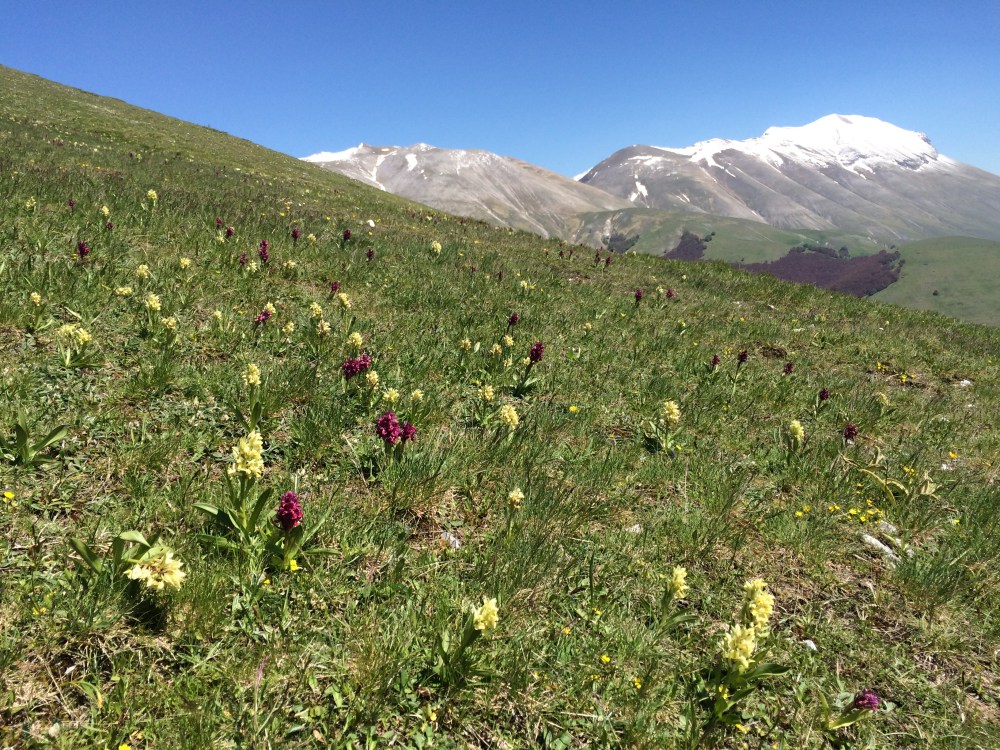 Sheets of pale lemon and dark red Elder-flowered orchid
 Elder-flowered orchids with spring gentian
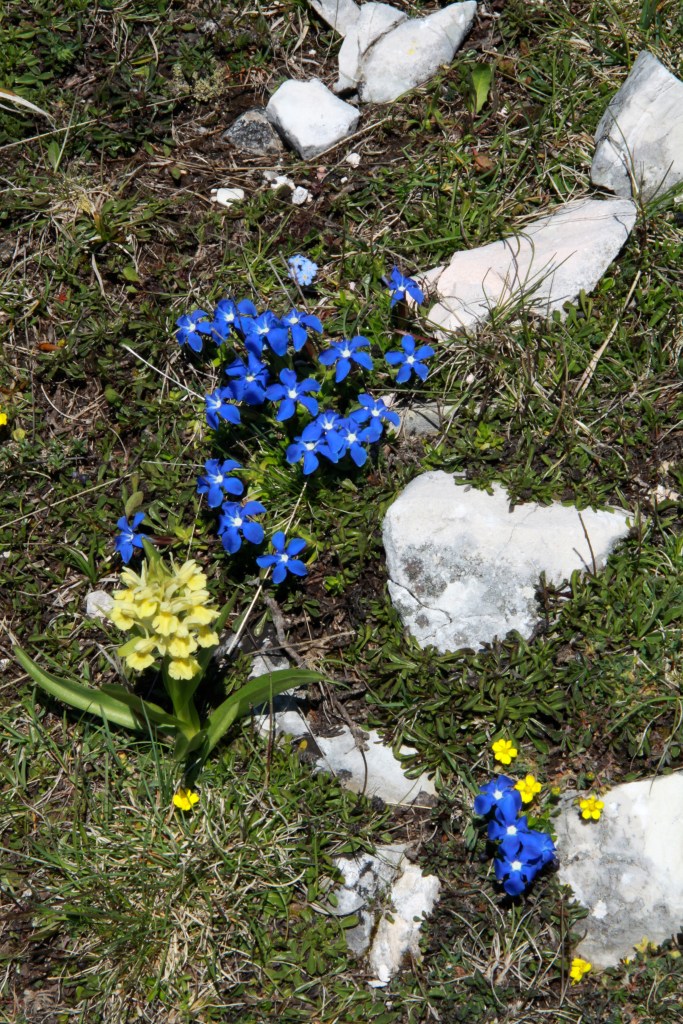 Spring gentian, Elder-flowered orchid and rock rose
 Spring gentian, rock rose and limestone
 Gentiana dinarica
 Patchwork of cultivated fields, Piano Grande, Casteluccio
 Postcard image of the fields in June, thanks to Ristorante Hotel ‘Sibilla’, Castelluccio di Norcia


 The Piano Grande, Monti Sibillini: buttercups, Cross-wort and beech woods
 Pheasant’s Eye narcissus, Piano Grande, Monte Sibillini National Park




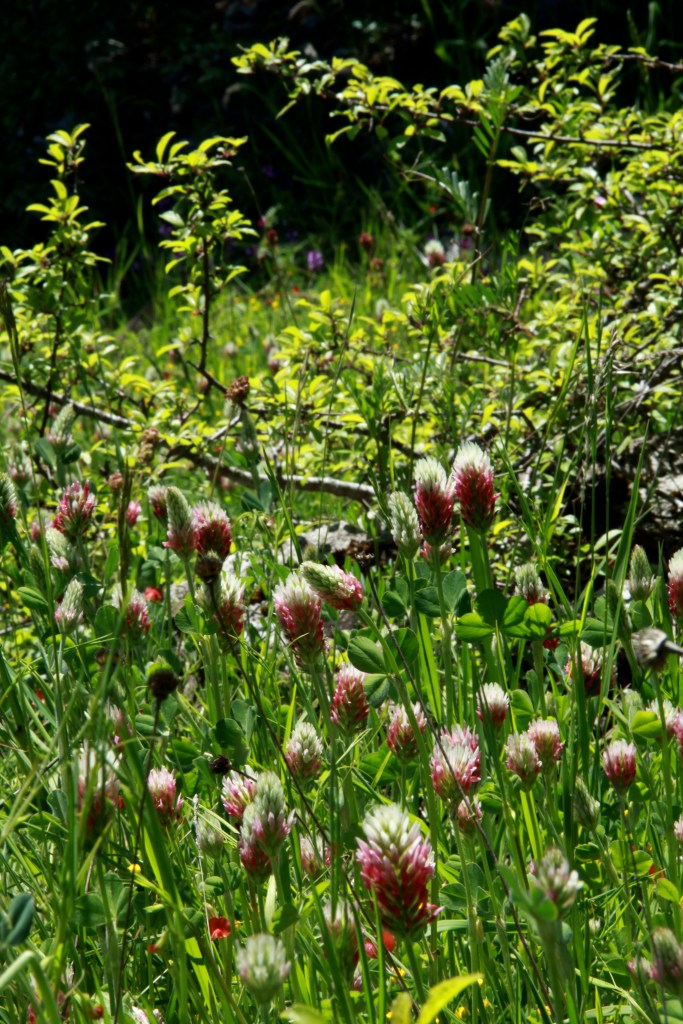 The long-headed clover, Trifolium incarnatum ssp. molinerii
 A large, hairier yellow rattle, Rhinanthus alectorolophus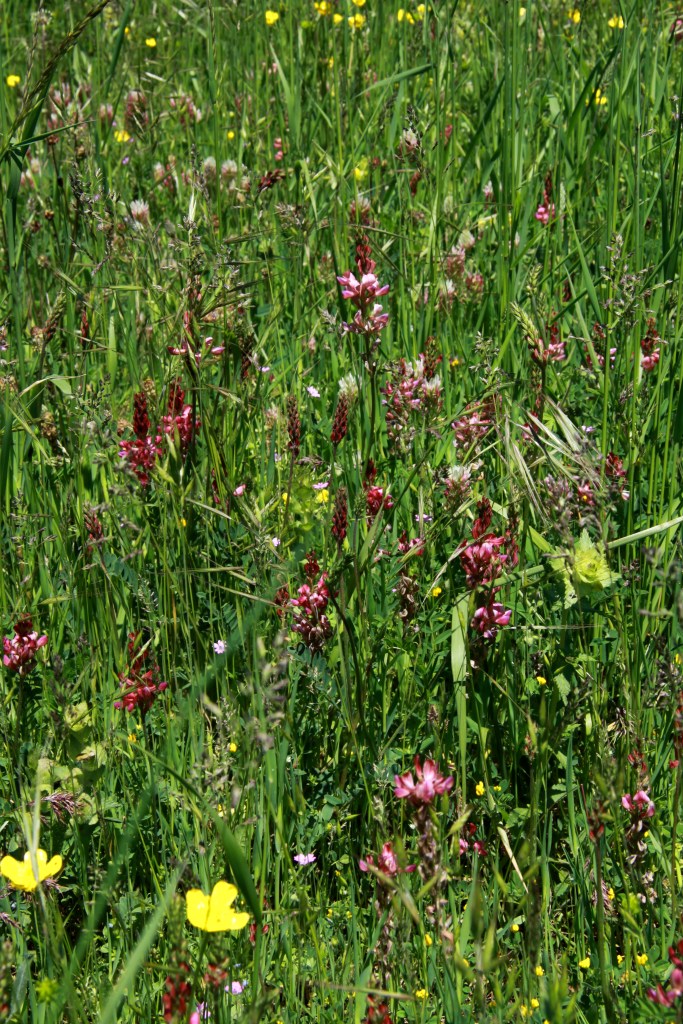

 Cynoglottis barrelieri, Thymus glabrescens and Ornithogalum divergens
 Garden of private house – the orchid lawn is on a bank to the left of the house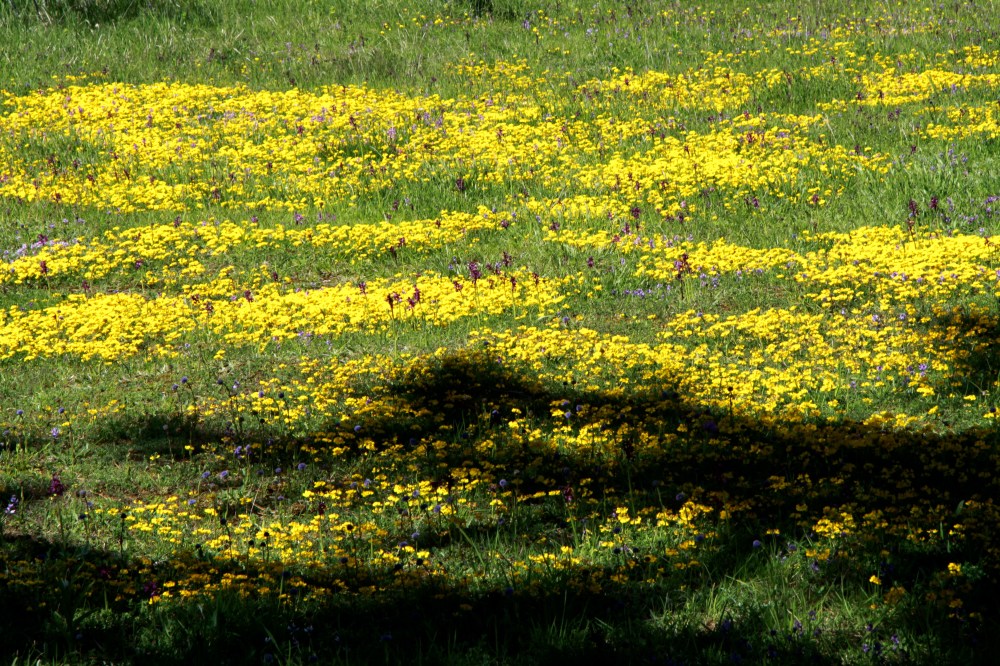

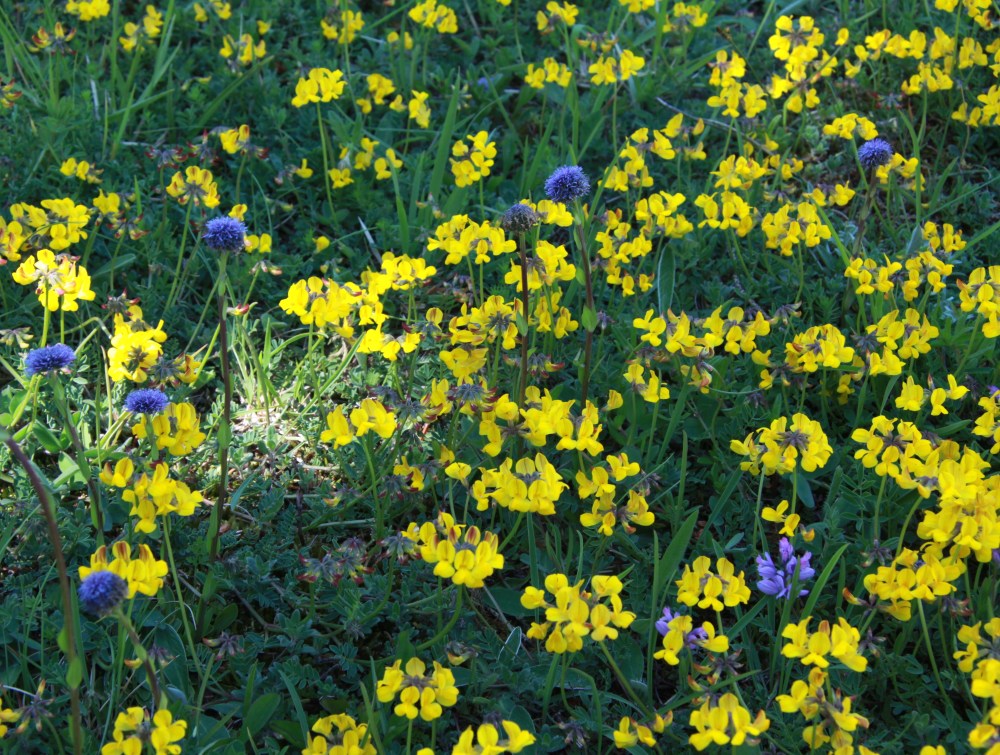 Horse shoe vetch Hippocrepis comosa with green winged and toothed orchids (above) and globularia (below)
 Orchis purpurea, the lady orchid
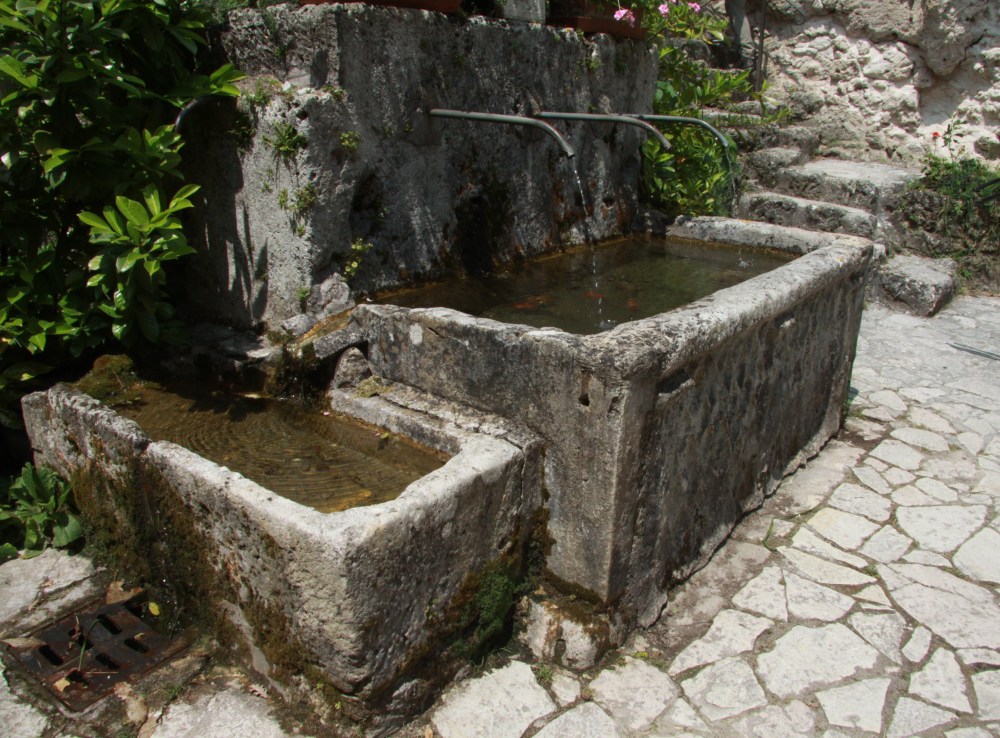
 Handsome stone fountain troughs

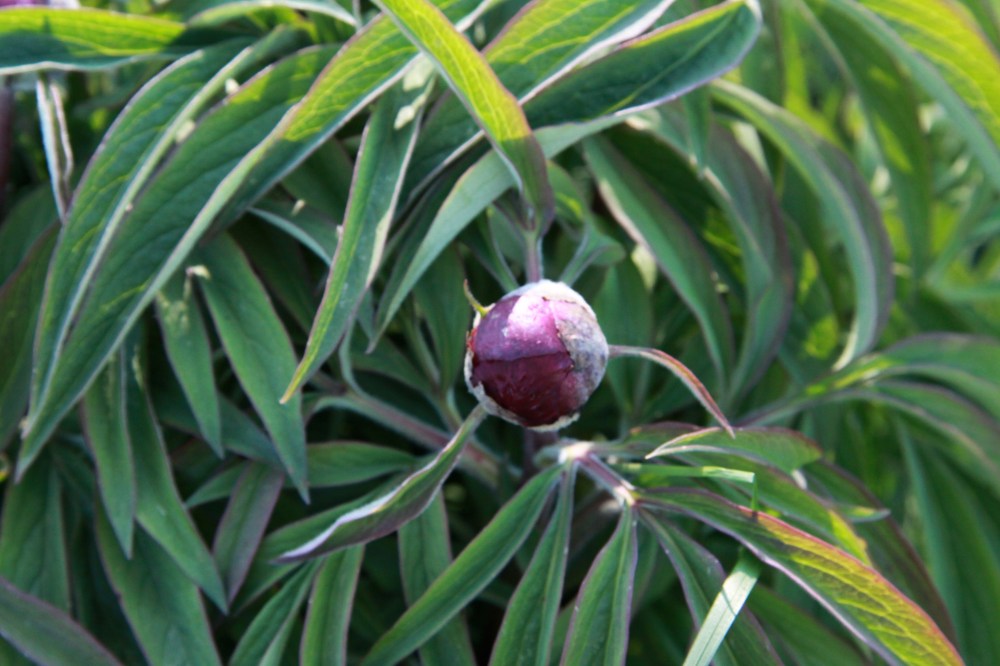
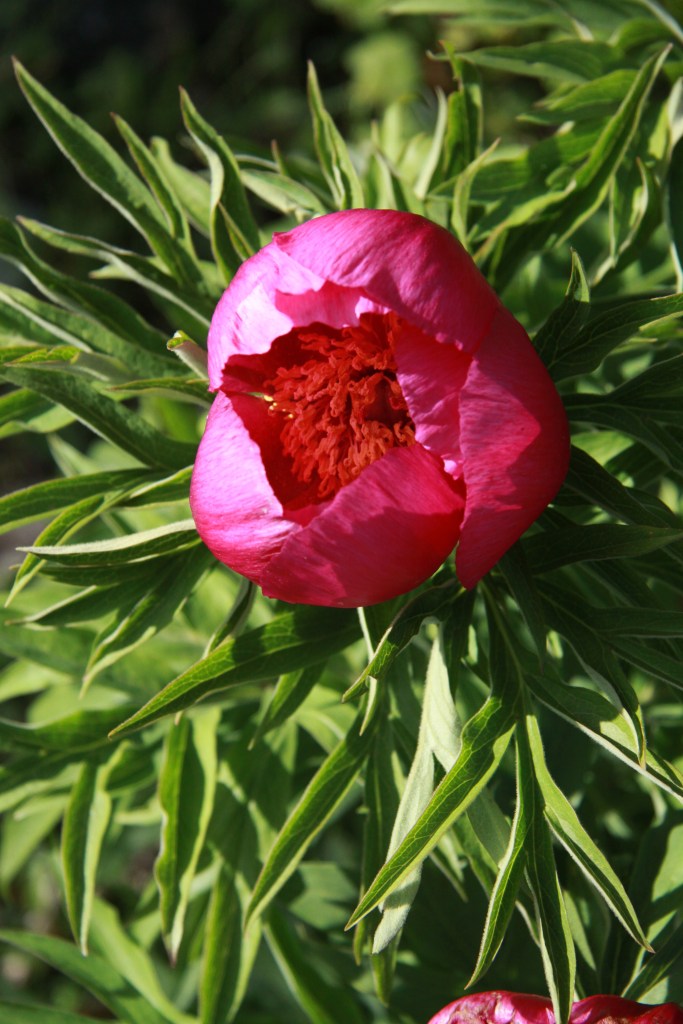 Paeonia officinalis looking a little overdressed
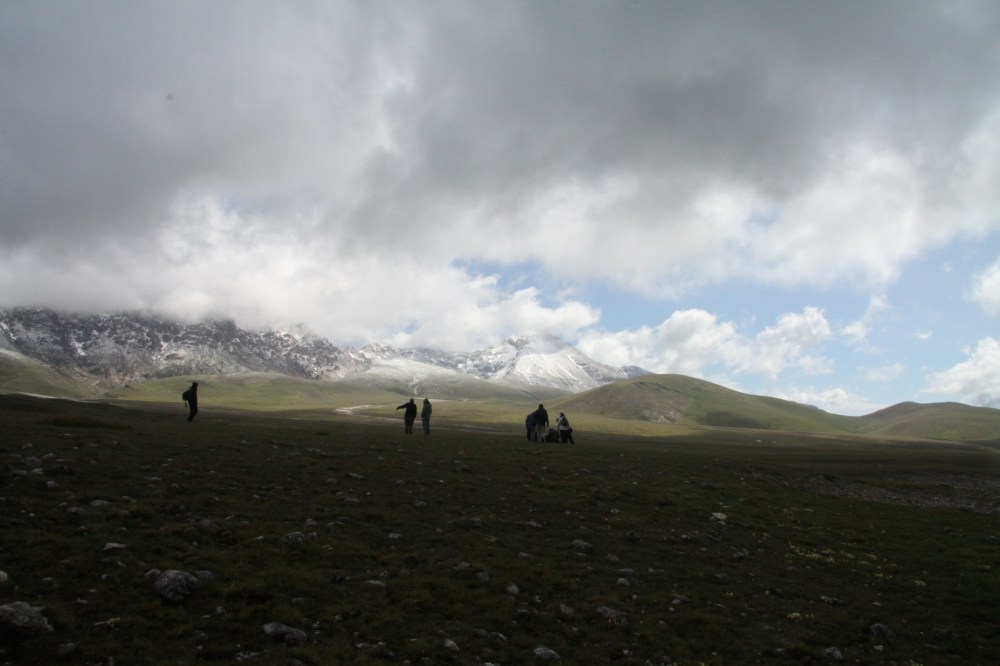 Botanising continues under glowering skies
 Prunus malaheb – the St Lucie cherry
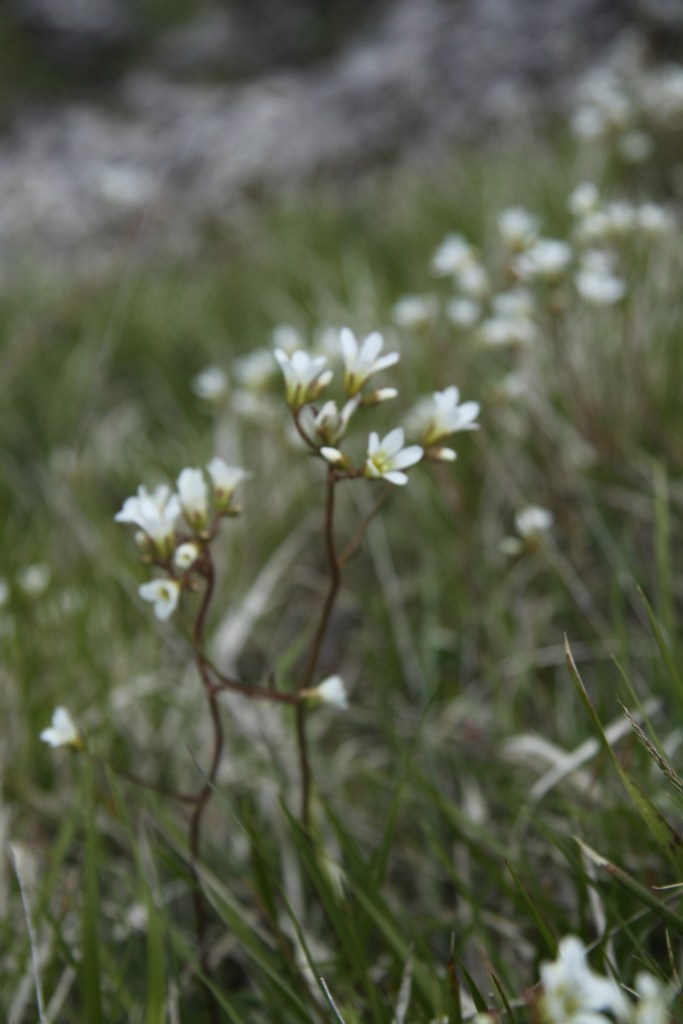 Meadow saxifrage, Saxifraga granulata
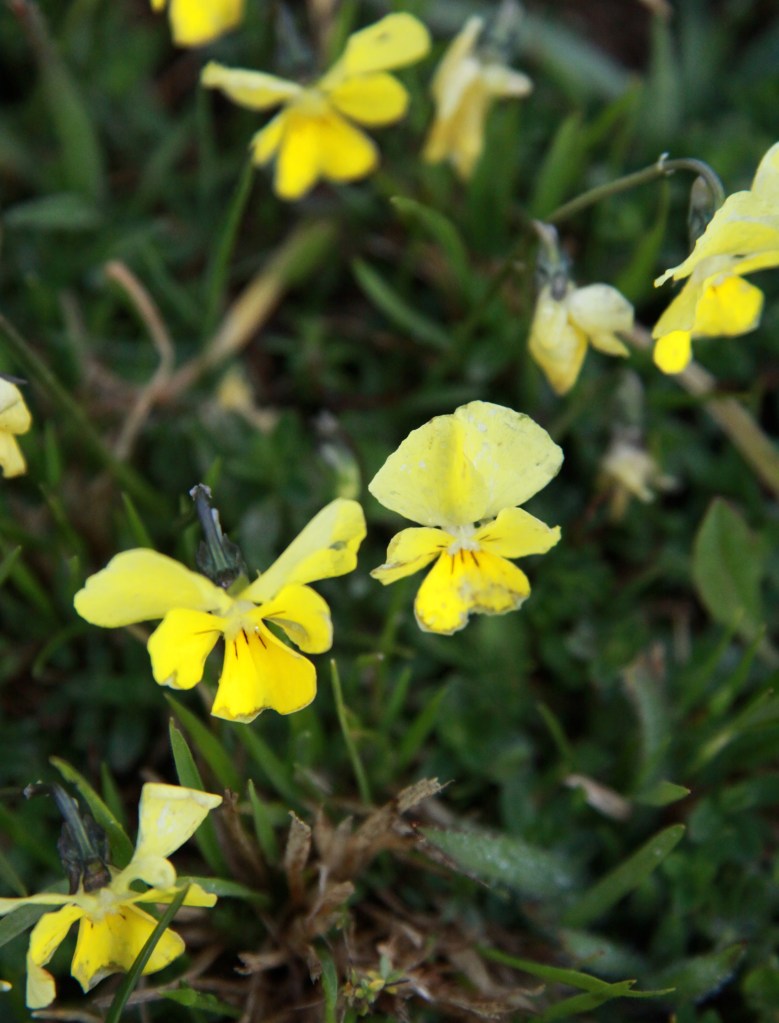 Viola eugeniae on the Campo Imperatore
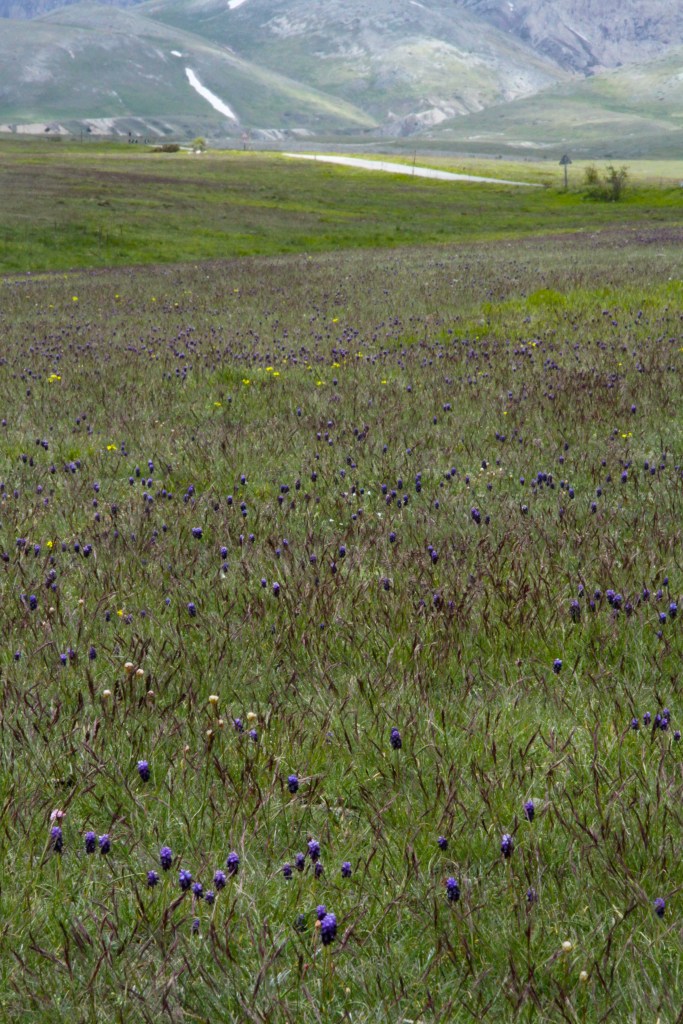 Huge expanses of Muscari neglectum, Campo Imperatore
 Hunting for crocus in the snow
 Crocus vernus ssp albiflorus
 Spanish broom, Sparticum junceum
 Convolvulus althaeoides
 Stipa pennata and Linum tenuifoliium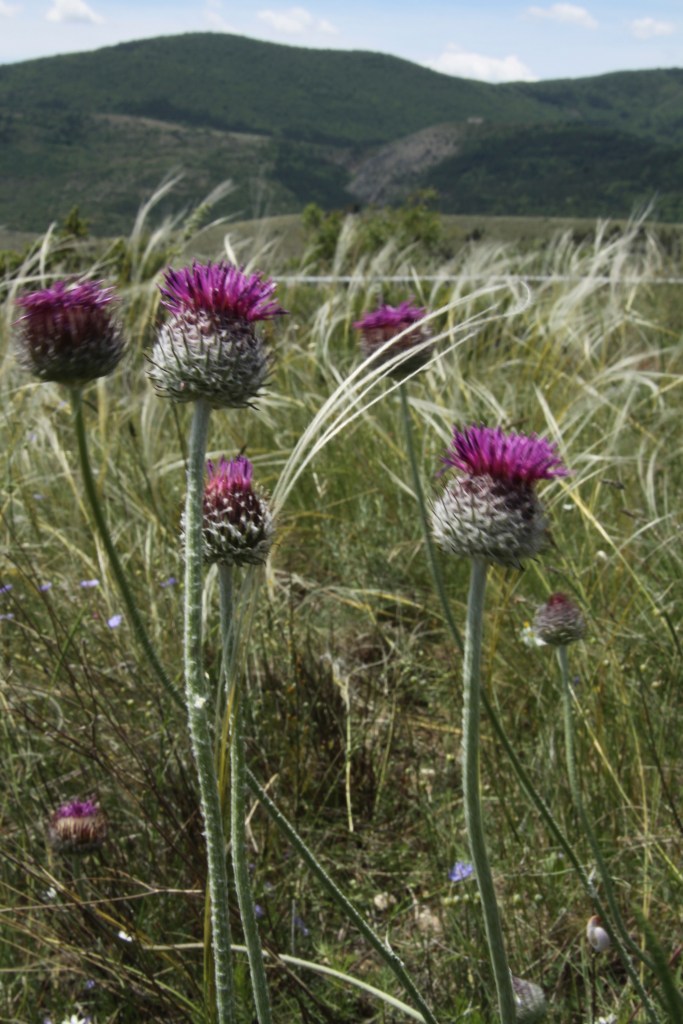
 Jurinea mollis and Stipa pennata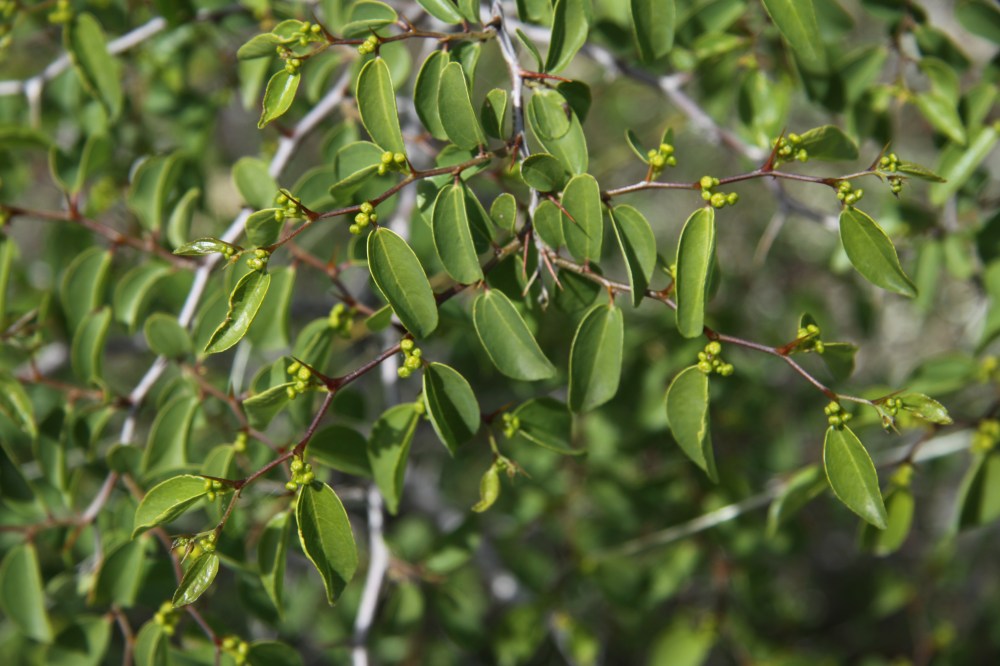
 Christ’s Thorn, Paliurus spina-christi


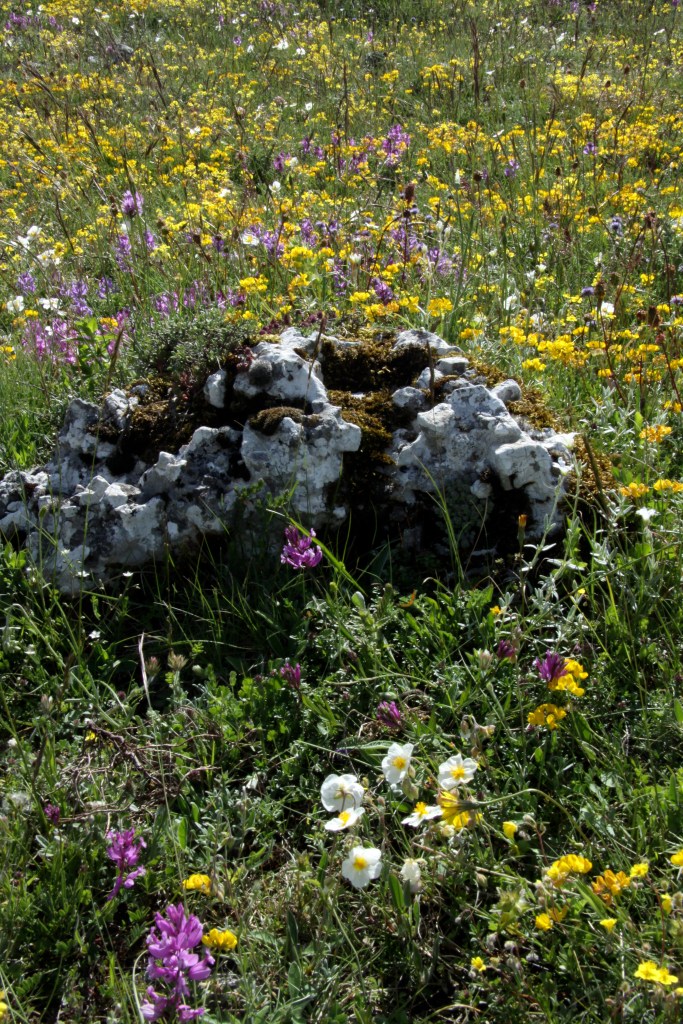
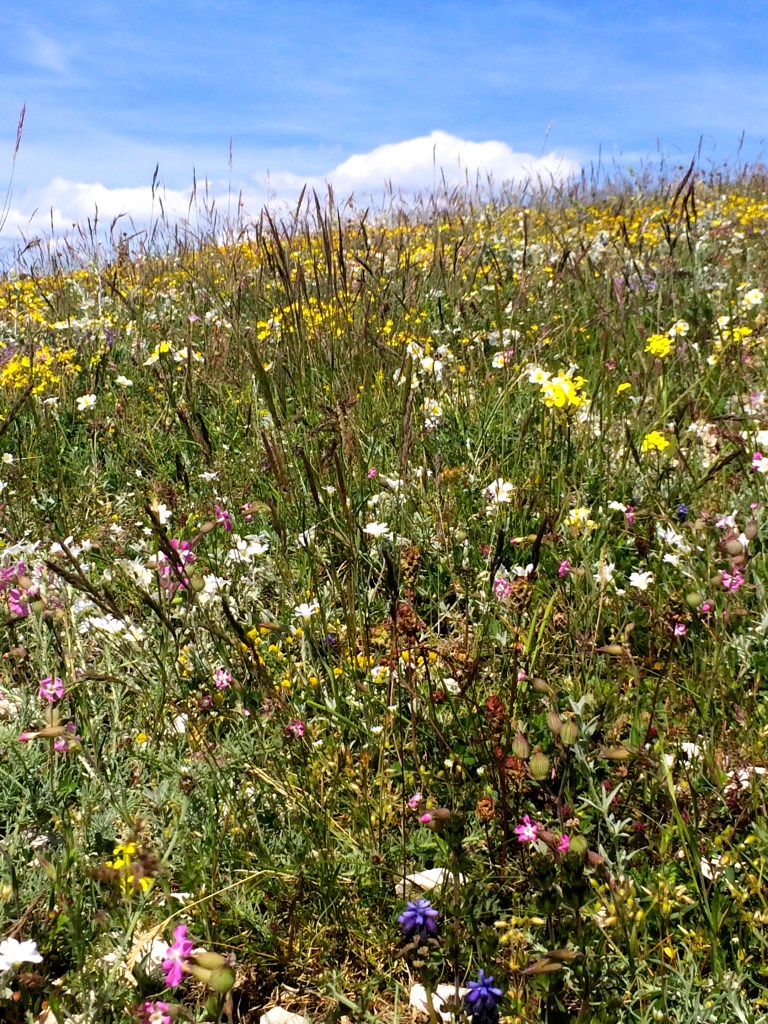


 Idyllic spring meadows near the Abruzzo National Park
 A simple planting of Cerastium tomentosum
 Bob Gibbons and Libby Ingalls
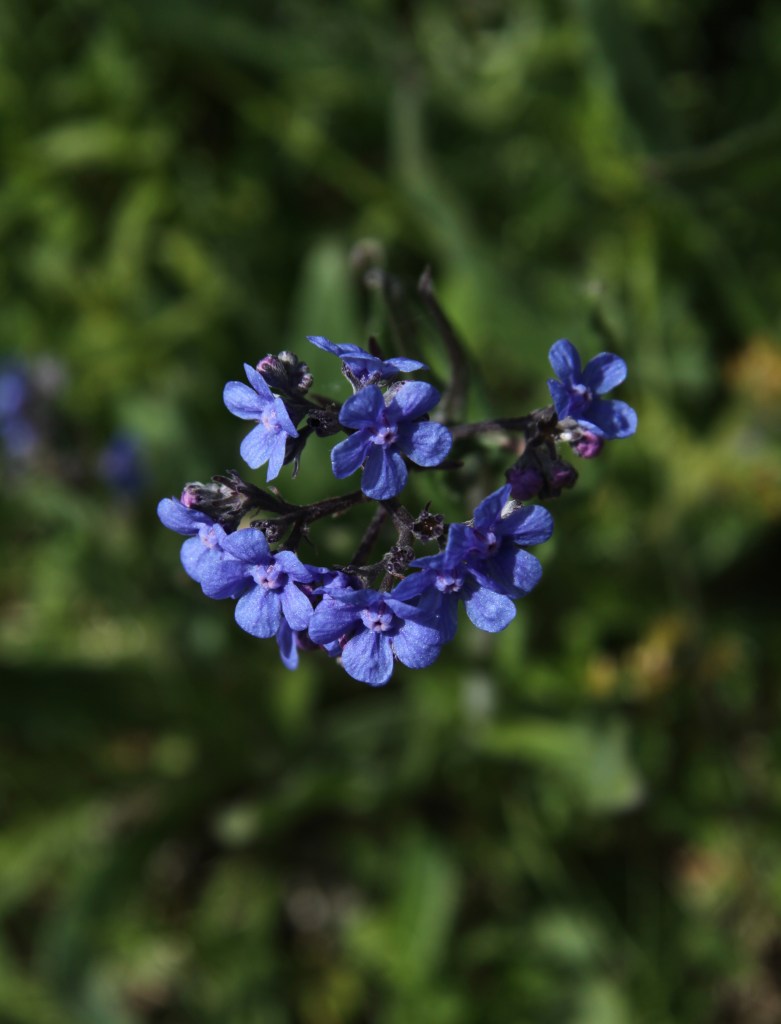 The richest blue Cynoglottis barrelieri seen on our speedy last walk up the mountain before getting in the car and driving back to Rome.

 Painted fences and garage door, Pescarolo, Abruzzo
 Fallen cherry blossom, Richmond Park
 Yoshino Cherry against sky,


 Portrait of our three sons by Paco Garcia, spring 2003

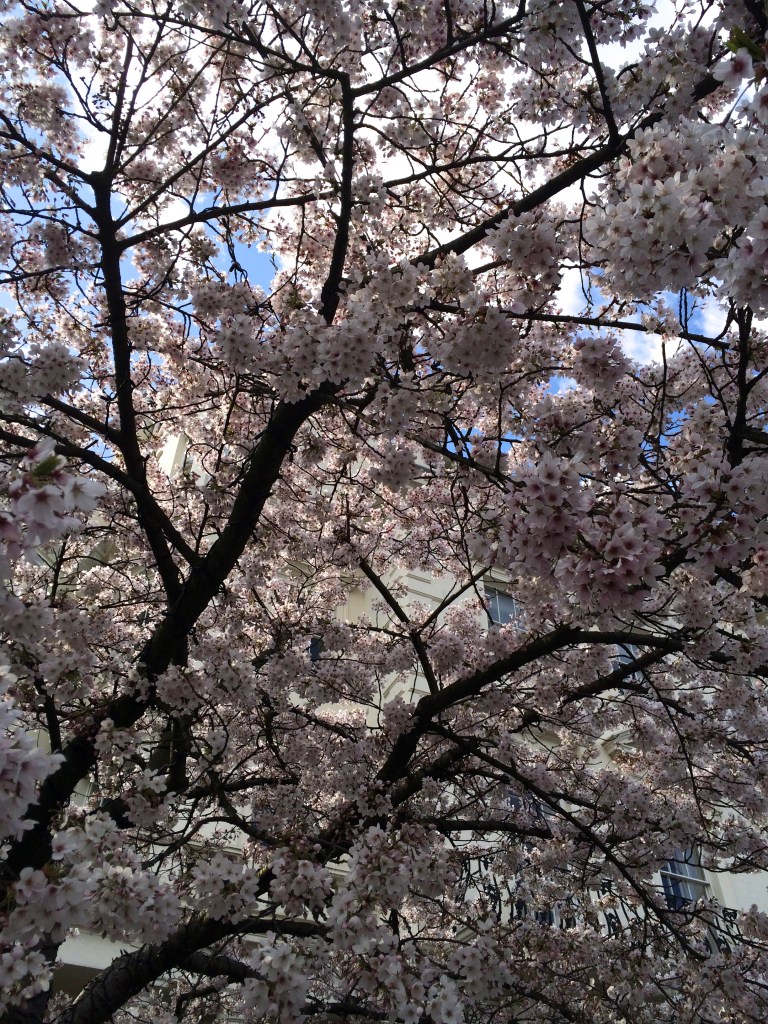

 Prunus cerasifera ‘Pissardii’ – Holland Park, London
 Cherry trees in Chesterton Road, tightly in bud
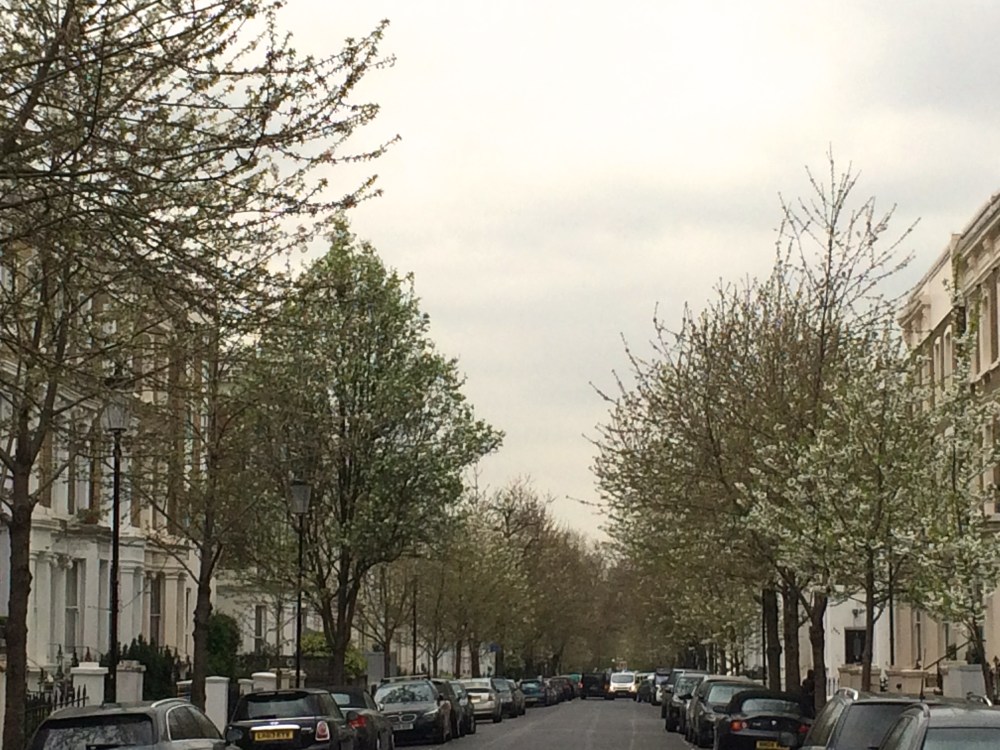
 Prunus avium ‘Plena’ in flower, Chesterton Road, London

 Prunus avium ‘Plena’ – against terracotta and white painted stucco
 Railway-side cherry trees, Peckham
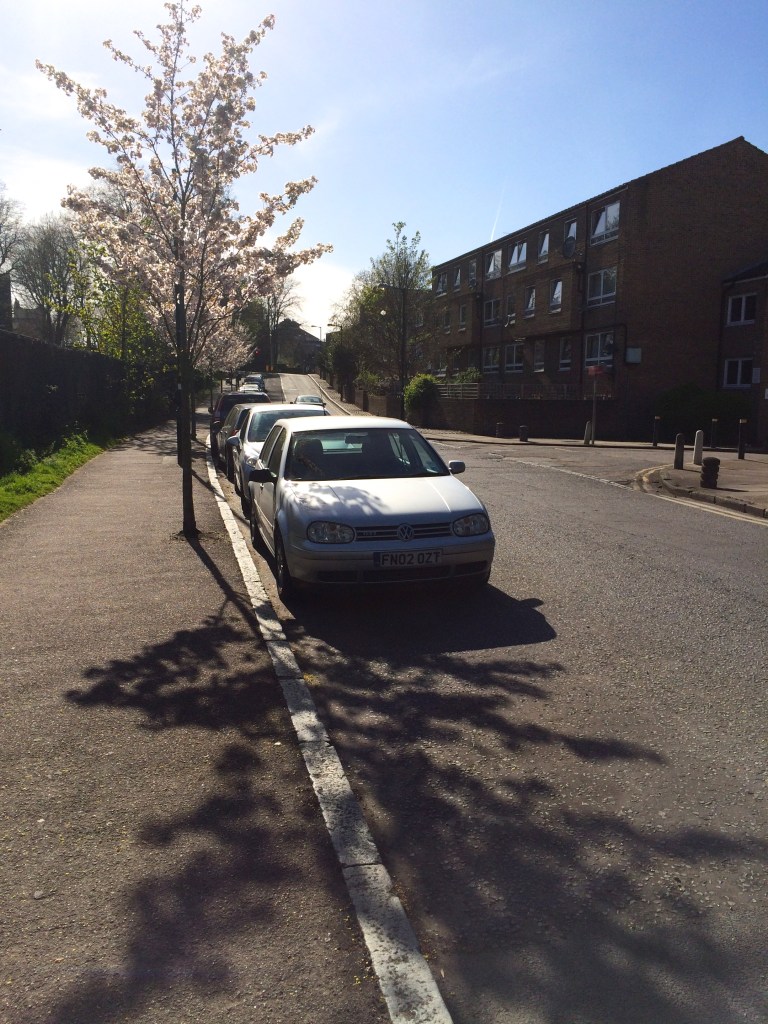 Cherry tree with elongated shadow

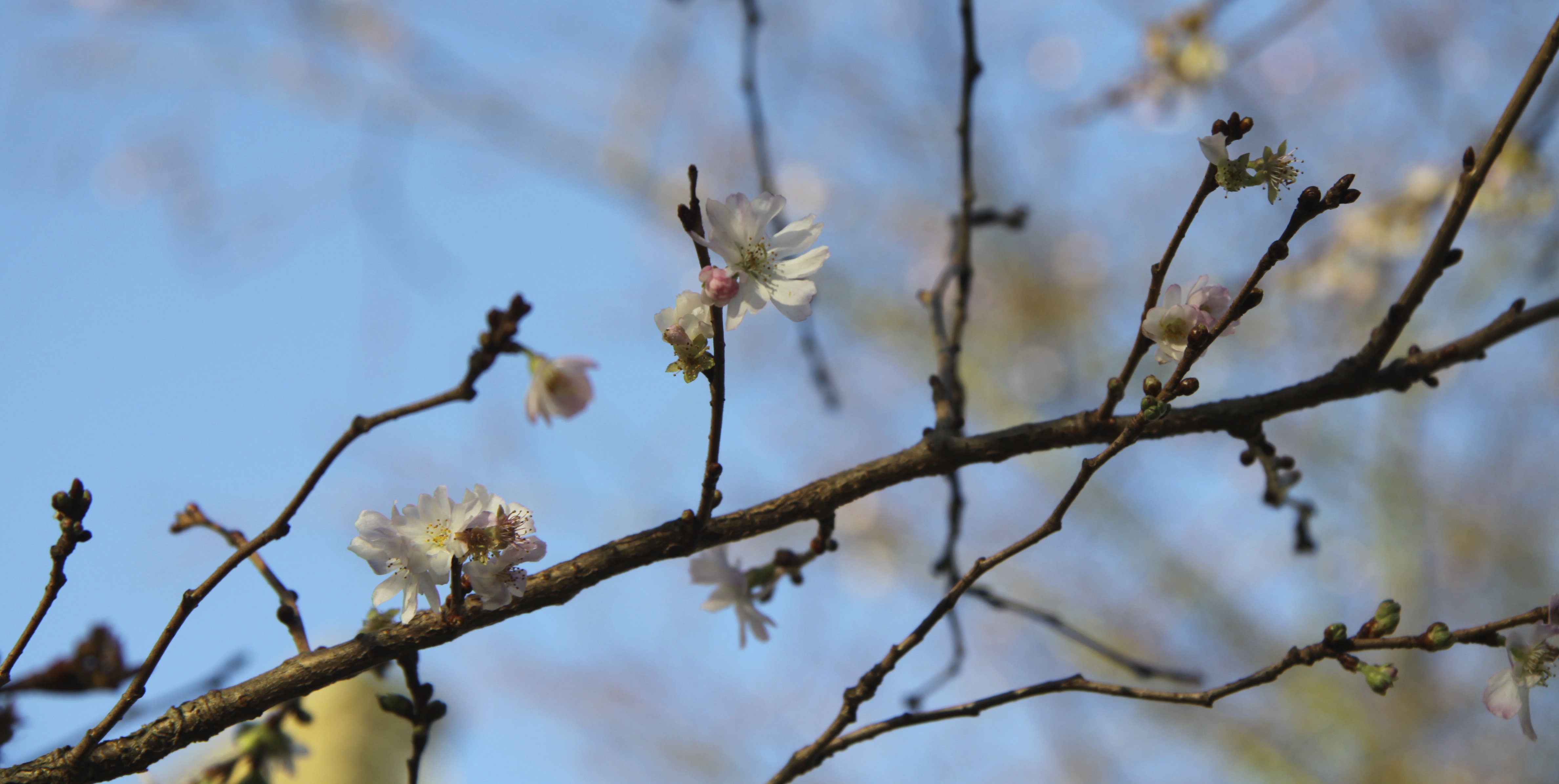
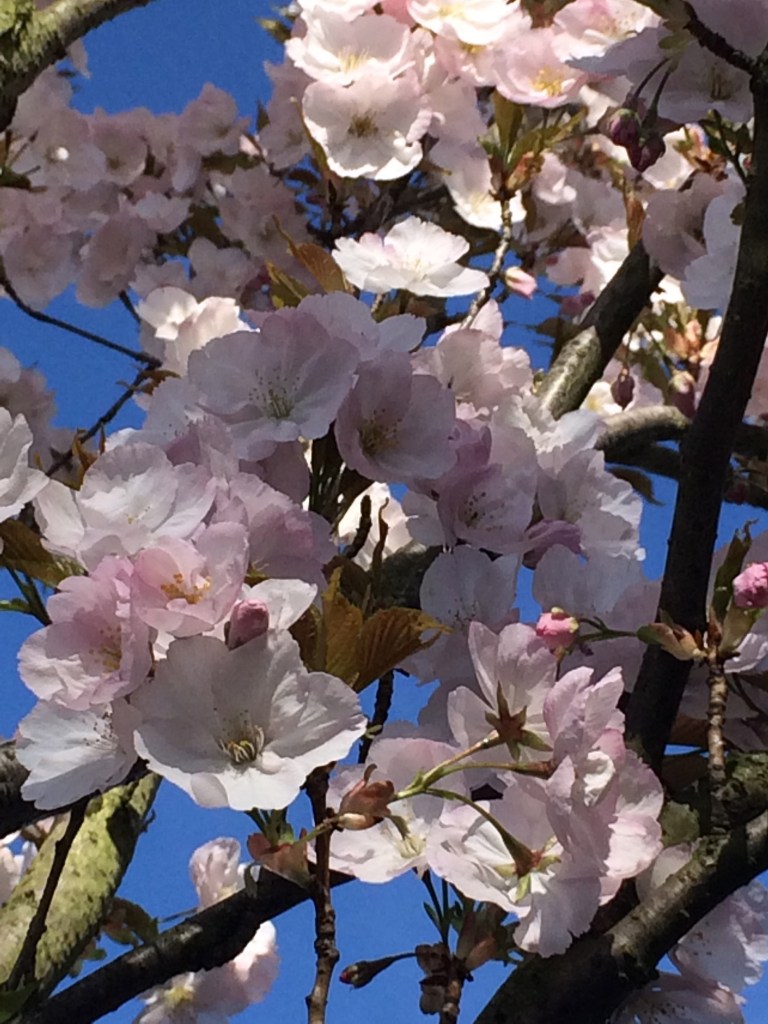 Cherry blossom against blue sky, South London
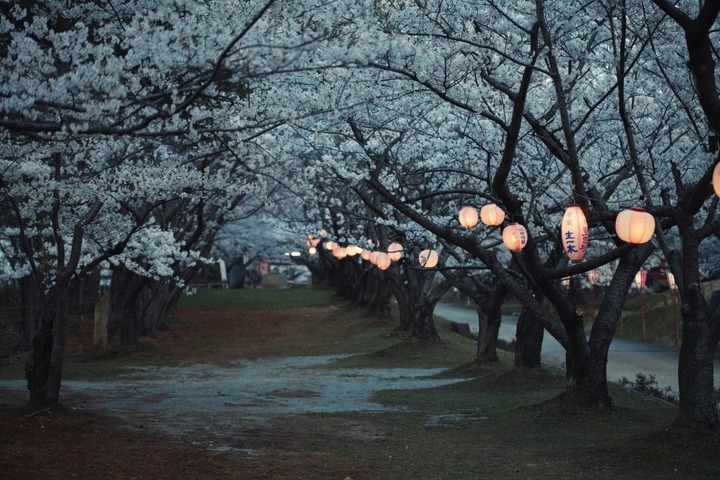 Cherry blossom with Mount Fuji and ‘night sakura’ from the excellent blogpost

 How to pickle cherry blossoms – photograph from a series by Chloe Aftel on


 Prunus spinosa, Ibstone Common
 First wild cherry sighting, Ibstone Common
 Wild cherry – Prunus avium – in full flower, in the sunshine, at the edge of woodland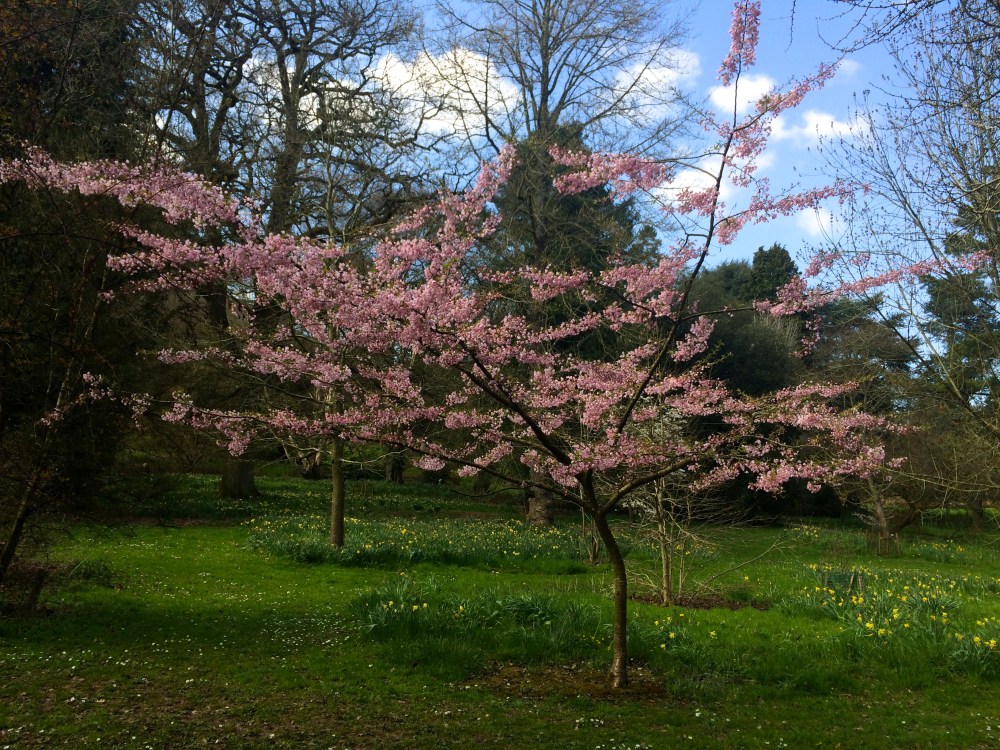
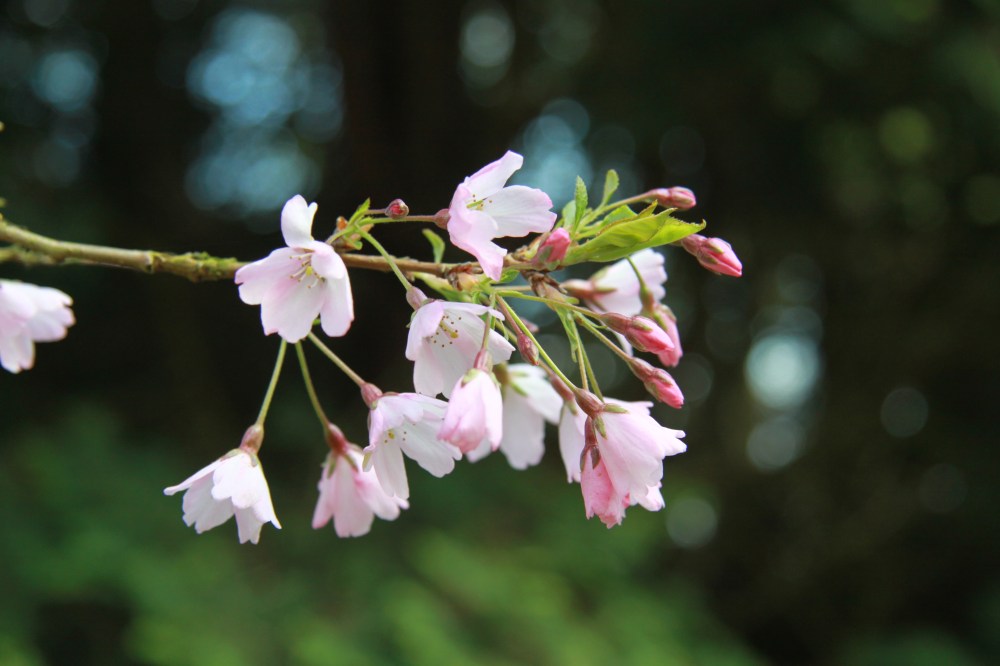 Prunus ‘Pink Shell’, Batsford Arboretum

 Yoshino Cherry, Batsford Arboretum
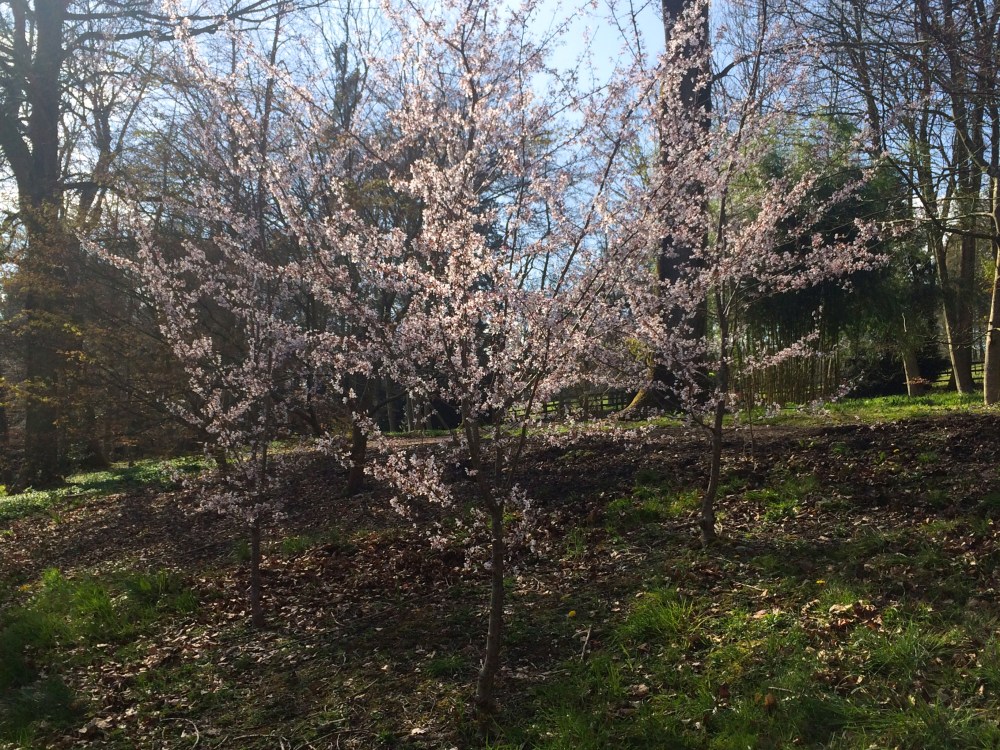 A group of three Prunus incisa ‘Fujima’, Batsford Arboretum
 Buds and flowers of Prunus ‘The Bride’
 Handsome, spreading Prunus cerasifera ‘Pissardii’, Batsford Arboretum
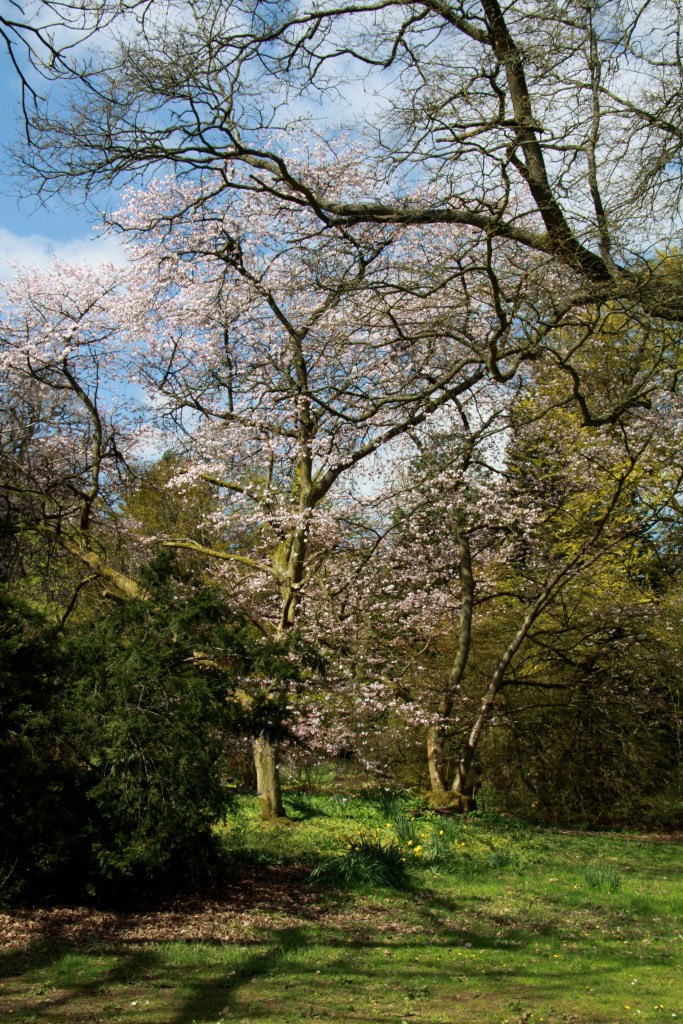 Prunus ‘Hillieri’, Batsford Arboretum
 A pair of Prunus ‘Hillier’ framing the view beyond

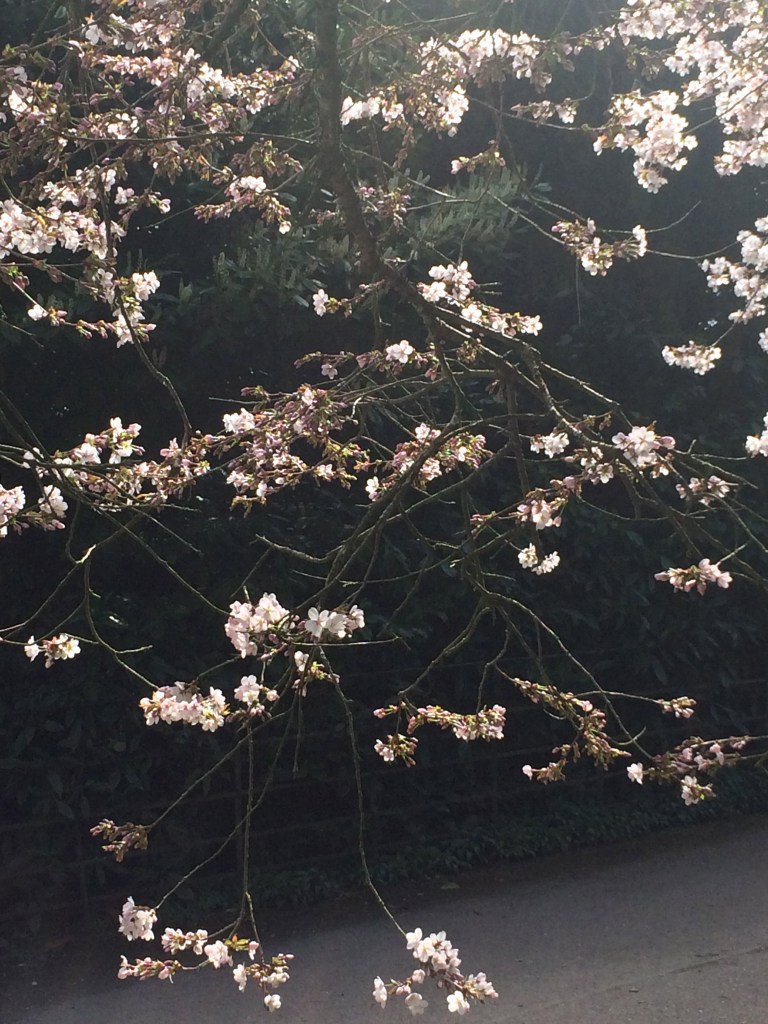 Hanging branches of Prunus ‘Hillieri’, Batsford Arboretum
 The elegant dirty gold leaves of Cercidiphyllum japonicum

 Cercidiphyllum japonicum and Prunus ‘Hillieri’


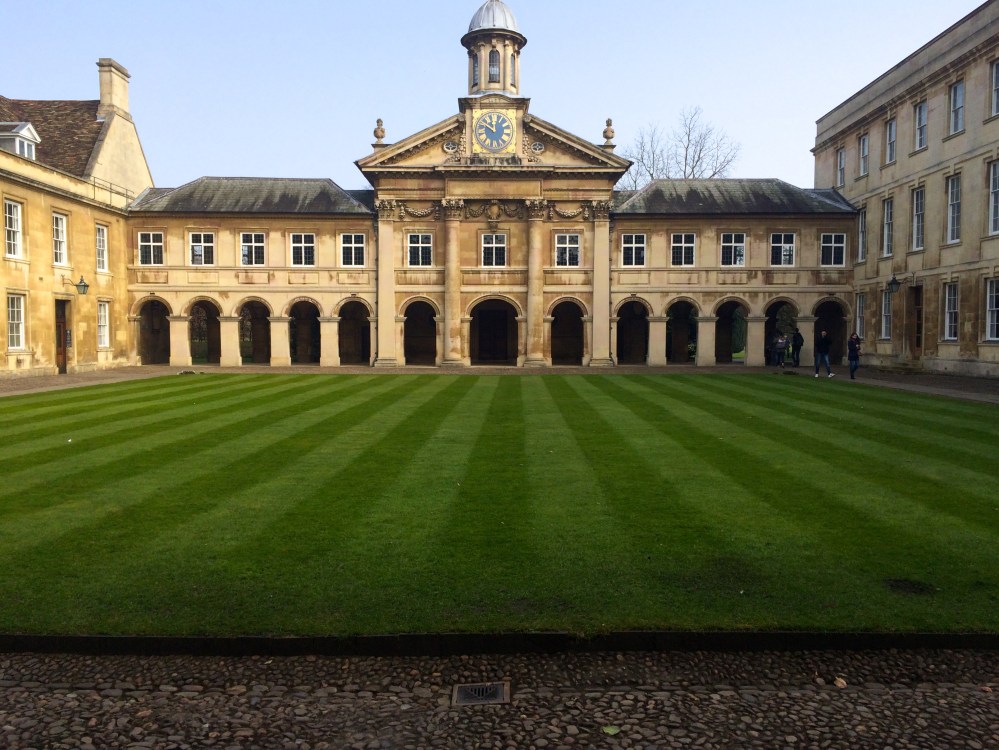 First Court, Emmanuel College, Cambridge
 Emmanuel College, colonnade
 Pink cherry, bergenia and hellebore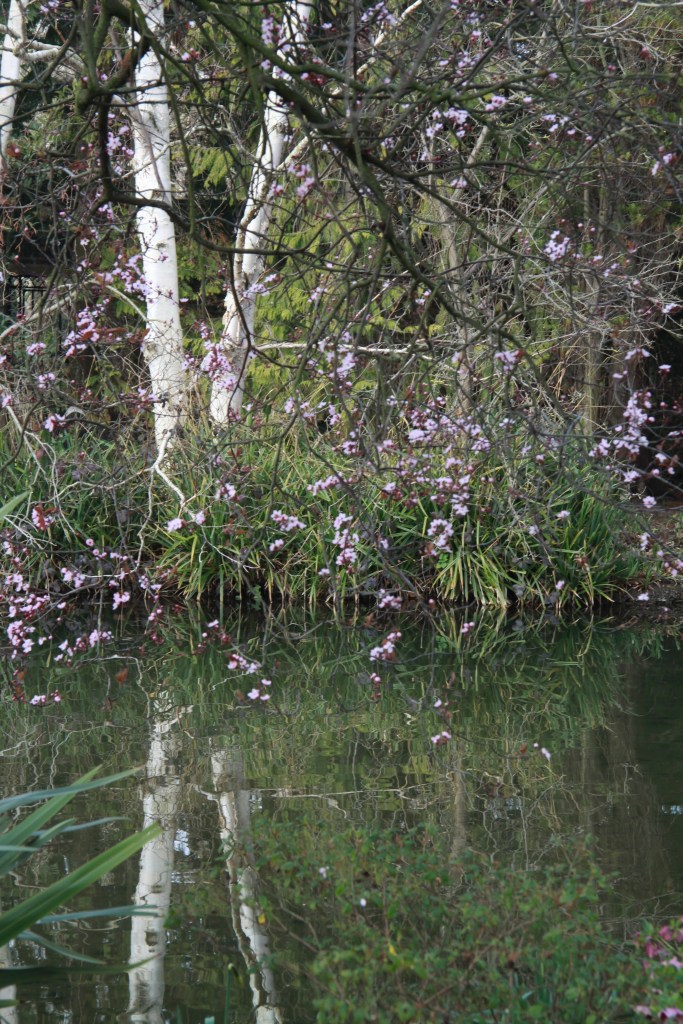
 First Court, Christ’s College, Cambridge
 Magnolia grandiflora and wisteria, Christ’s College, Cambridge
 Trained wisteria, First Court, Christ’s College Cambridge


 Wall trained Chaenomeles – flowering quince, First Court, Christ’s College, Cambridge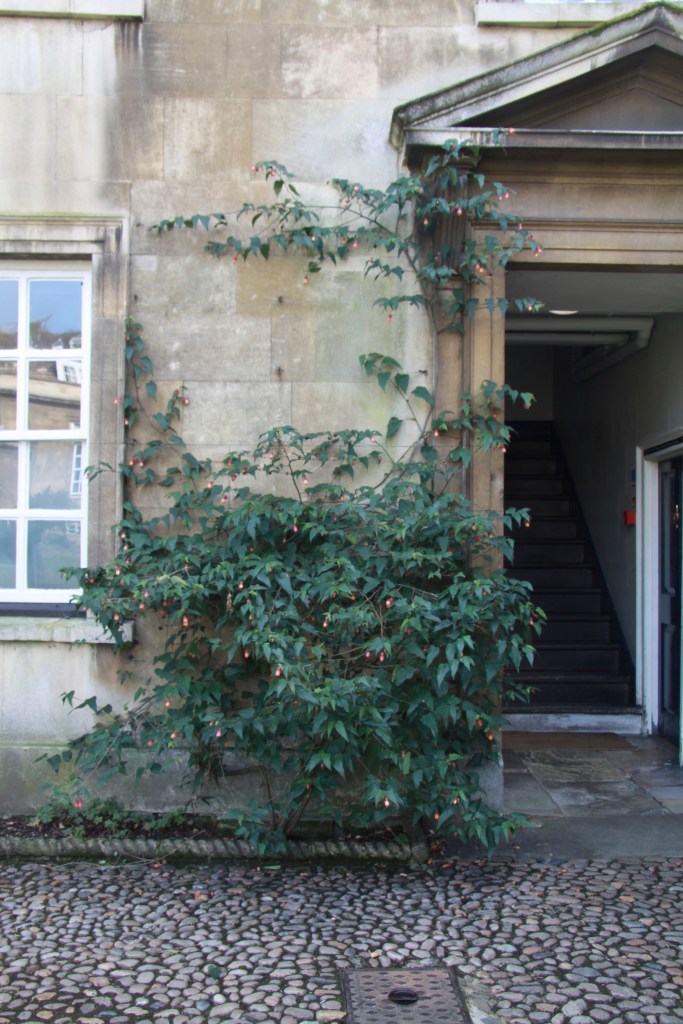


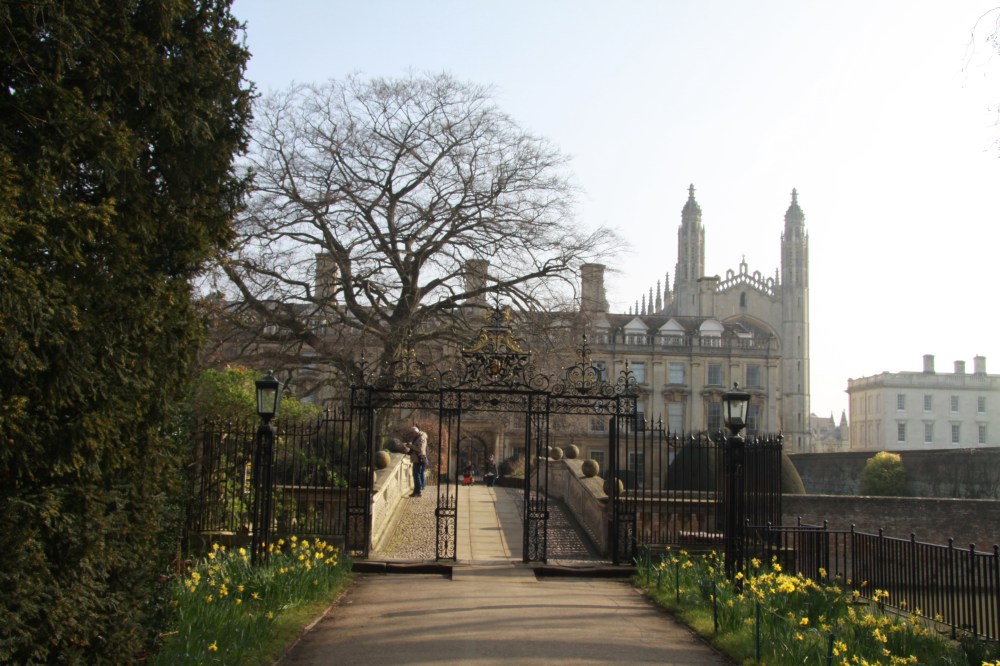


 View across Clare College Bridge to the Scholars’ Garden
 Scholars’ Garden, Clare College, Cambridge
 Prunus ‘Taihaku’ against King’s College Chapel, Cambridge
 Prunus ‘Taihaku’ flowers
 Gate of Honour, Gonville and Caius College, Cambridge
 Senate House, Cambridge, with Bronze copy of the Warwick Vase
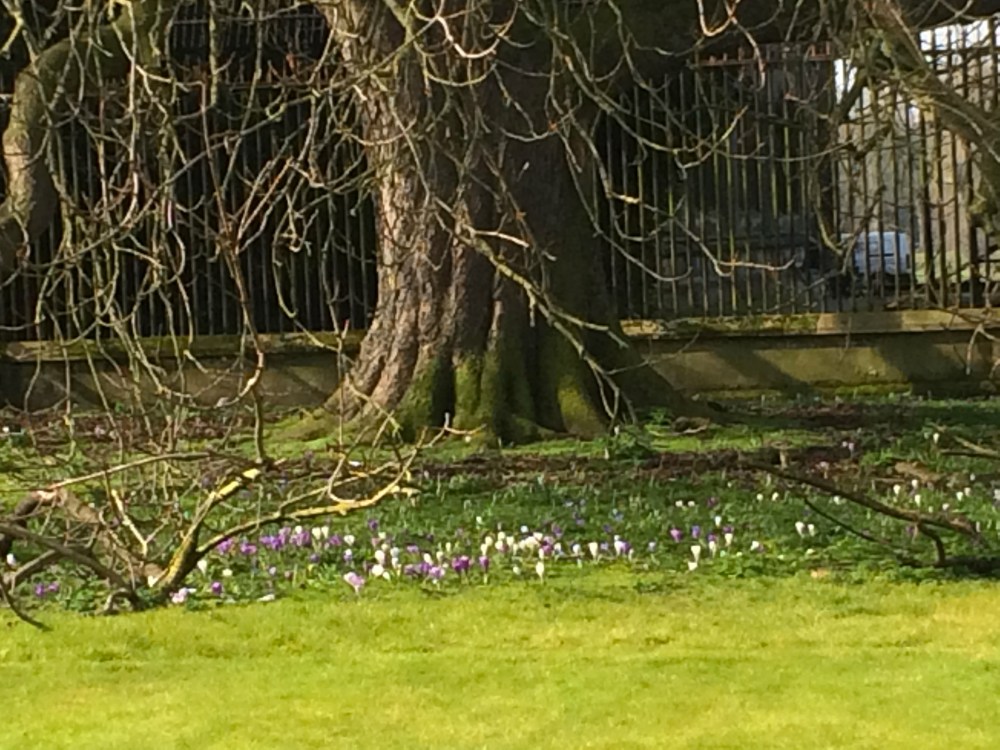 Kings College Chapel and Horse Chestnut tree
 Bronze green and 23.5 carat gold railings, Fitzwilliam Museum, Cambridge.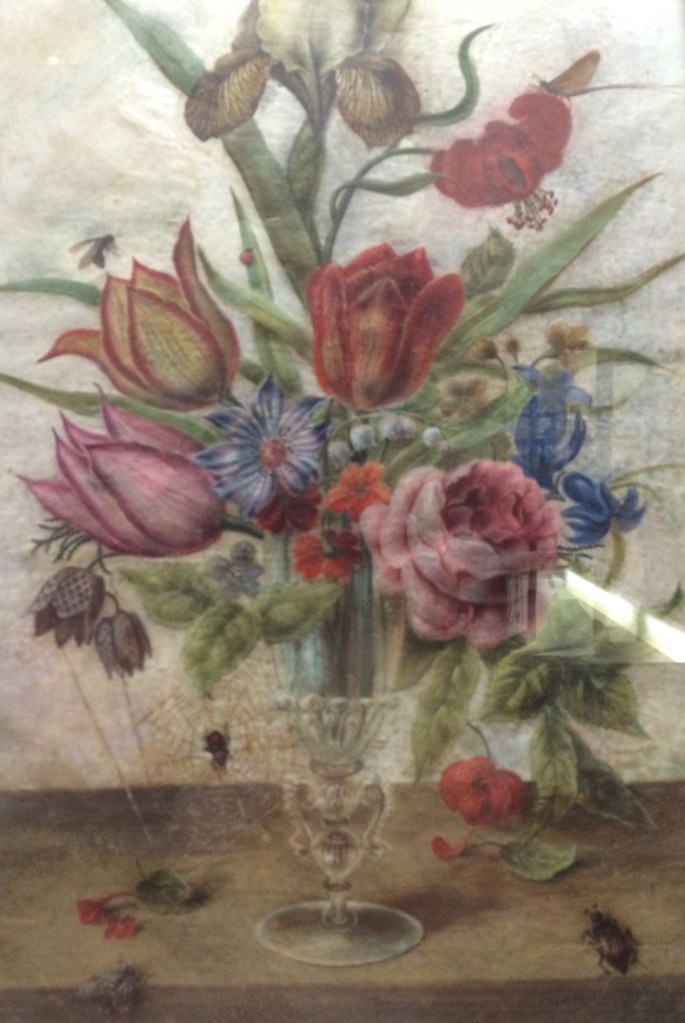
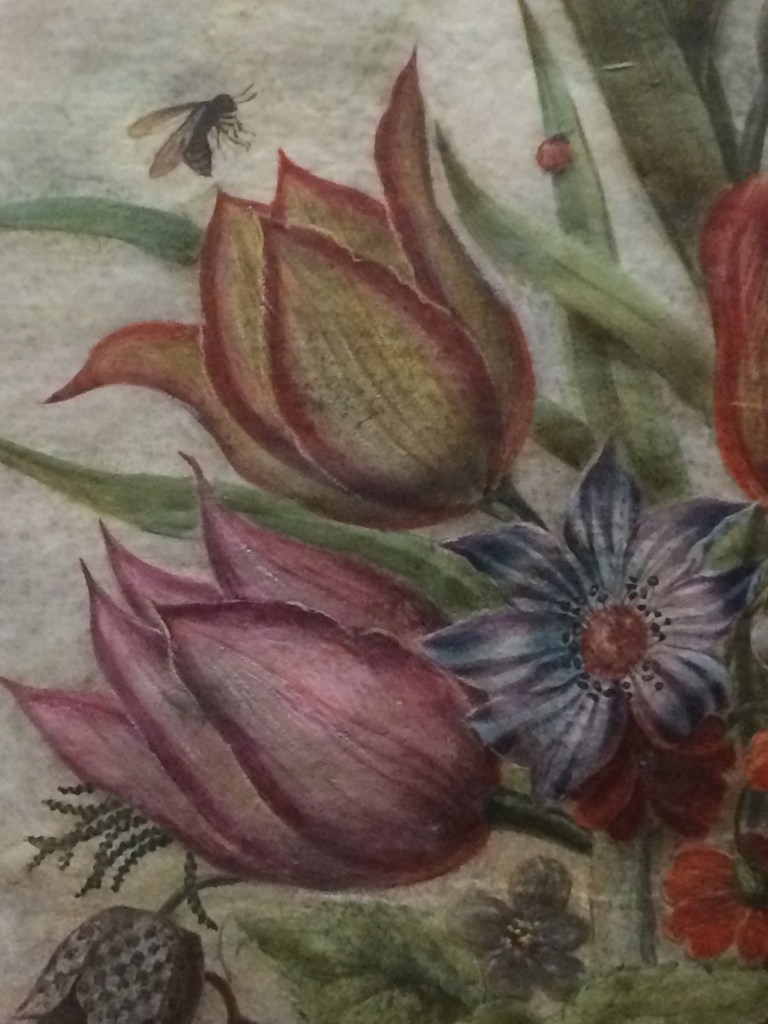
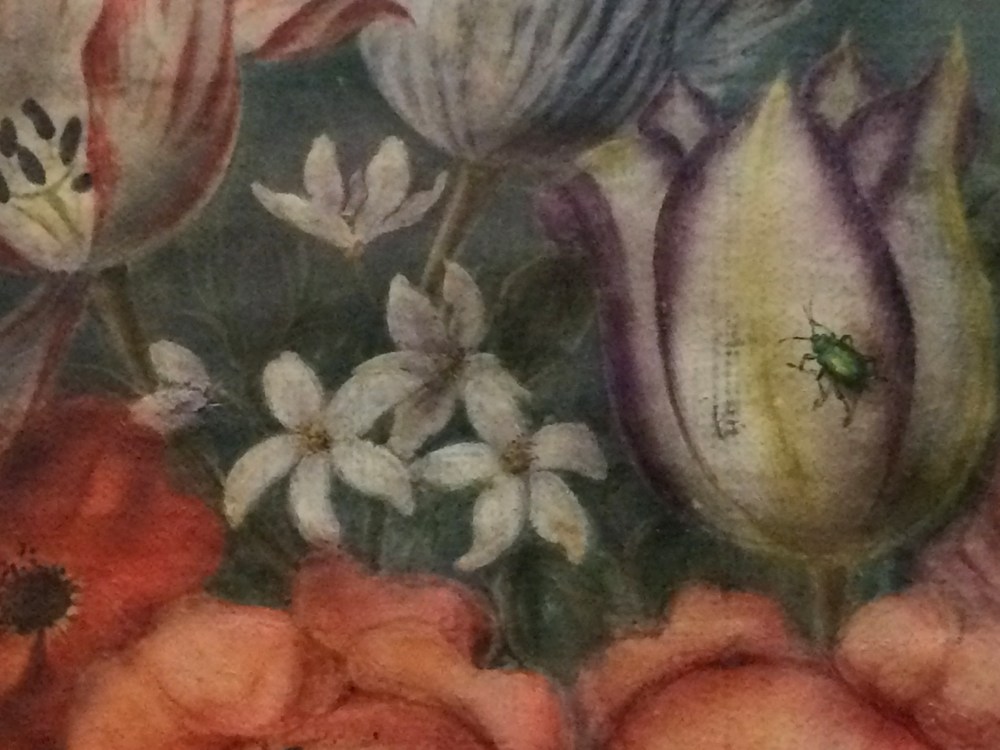 Venetian Glass Goblet with Flowers and Insects, Jacob Marel, 1634, plus a detail from ‘An Open Wicker Basket of Flowers with a Frog and Insects, Jacob Marel, Henry Rogers Broughton Bequest, Fitzwilliam Museum
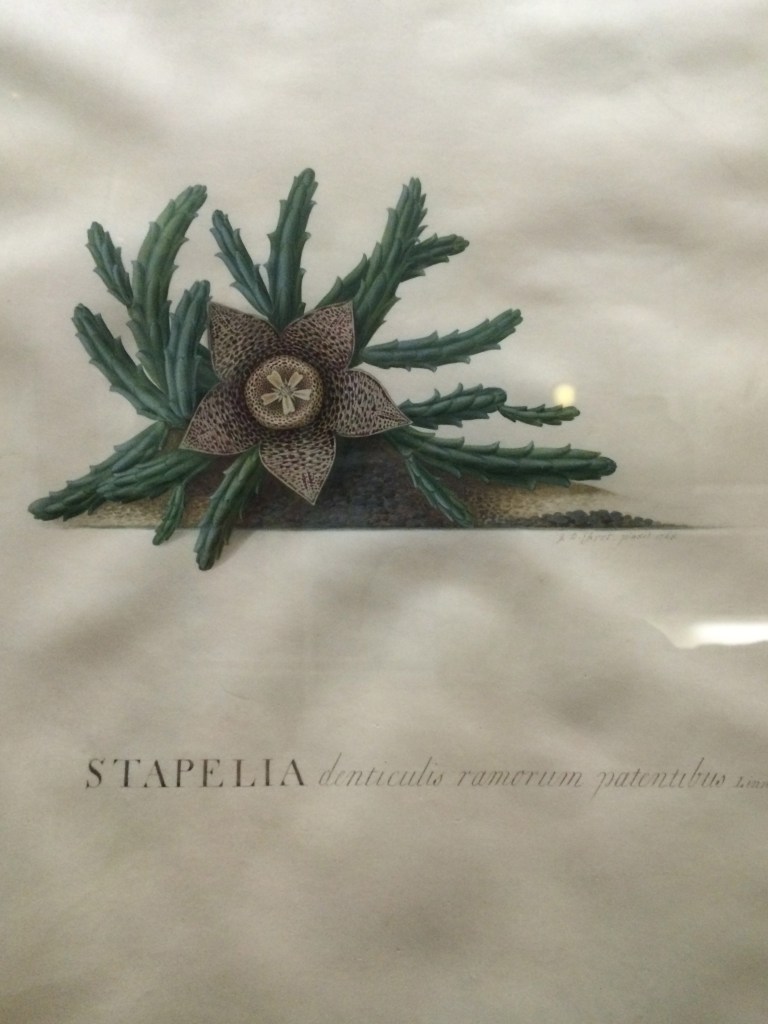 Stapelia, George Dionysius Ehret, 1765, Henry Rogers Broughton Bequest, Fitzwilliam Museum
 Primula auricula
  Common dandelion with a garden tiger moth, Margaretha Barbara Dietzsch (1726-1795), Henry Rogers Broughton Bequest, Fitzwilliam Museum
 History of Art Faculty, Cambridge
 Department of Engineering nameplate
 Cambridge Botanic Garden Systematic Beds (grouped in plant families) – I only went in for a moment!
 Poster smothered railing, Cambridge.
 Path leading into Little St Mary’s Churchyard
 Gravestone with foxgloves
 Moss covered tomb seen through a screen of winter branches
 Narrow curving paths through lush heart-shaped leaves of Petasites fragrans
 Soaring yew and magnolia against the Church
 Roses, Philadelphus and yew share the space with ancient headstones
 Headstones used as steps and path
 A fleet of gravestones each with a small cloak of snowdrops floating steadily in its wake.
 Dancing seedheads against late afternoon light, Little St Mary’s Churchyard, Cambridge.

 Petit Palais garden – grasses, cherry tree, euphorbia



 Mosiac floor, entrance hall, Petit Palais.


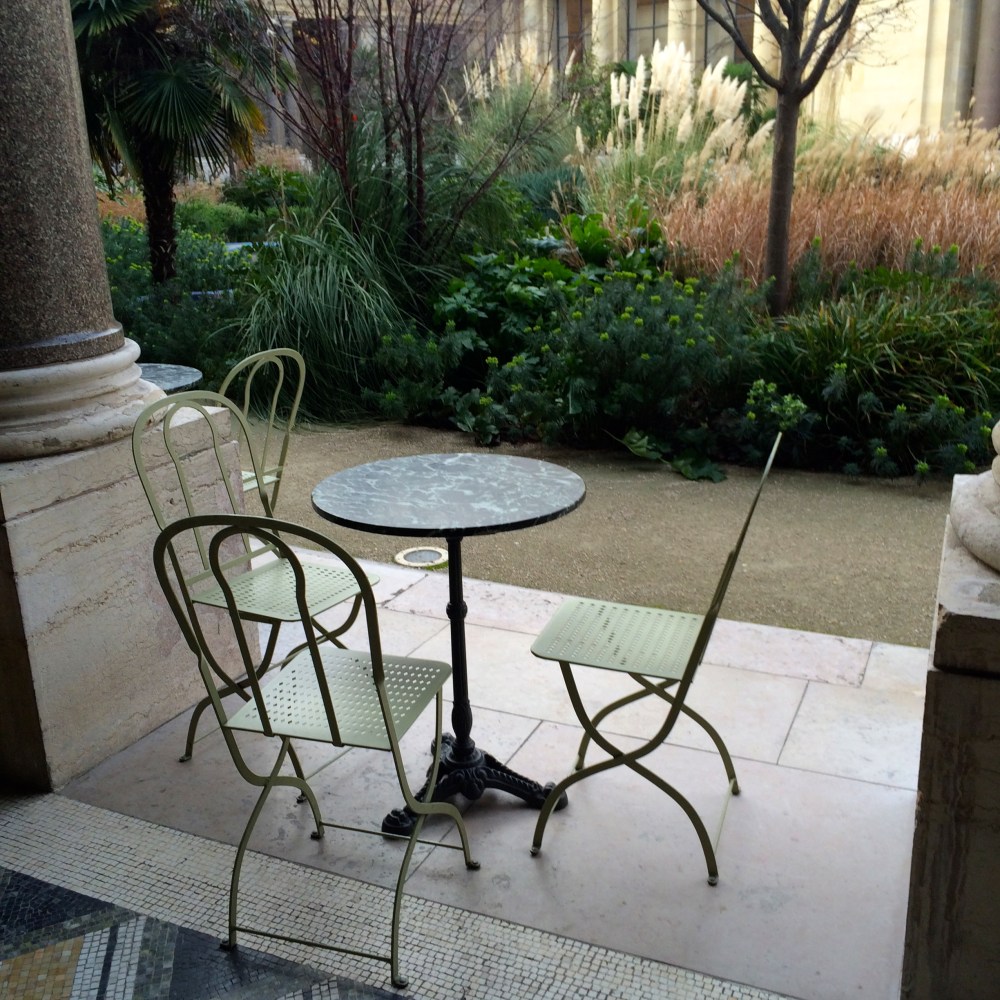
 Perfectly judged café chairs and table, Petit Palais.
 The Petit Palais garden, framed by Vosges granite columns.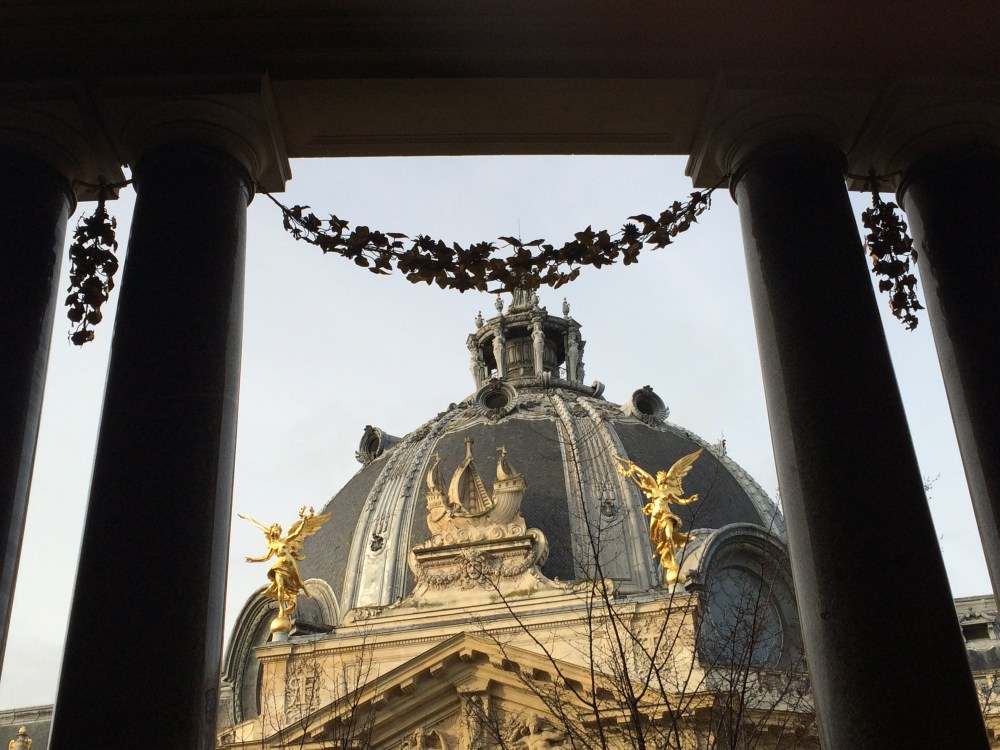
 The lush planting of the Petit Palais garden
 View along the central axis of the Petit Palais garden.
 Curves and columns of the Petit Palais garden.
 Close up swirly marble table top and skinny milk-green café chair against strong shapes in pale stone.
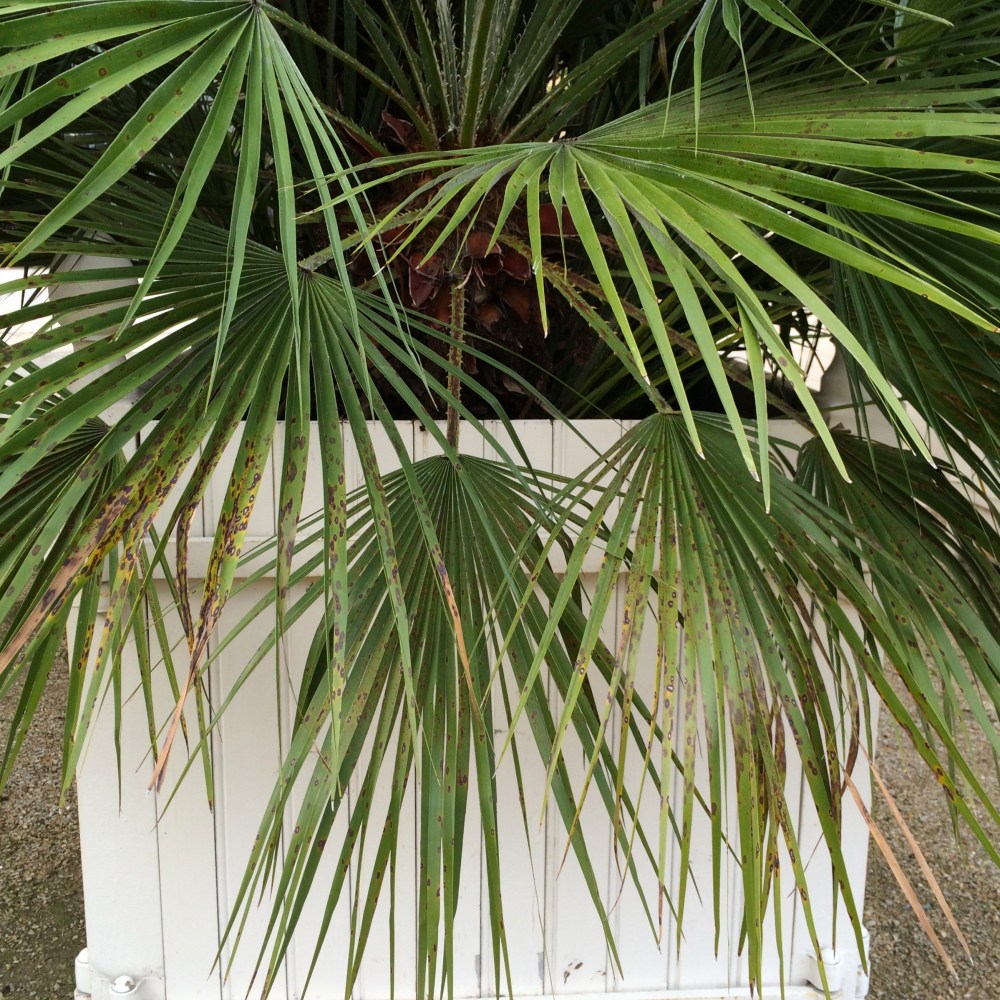
 Palm trees adding structure, gloss and glamour.
 Prunus x subhirtella ‘Autumnalis’ against banana leaves.
 Fatsia japonica, Petit Palais garden.
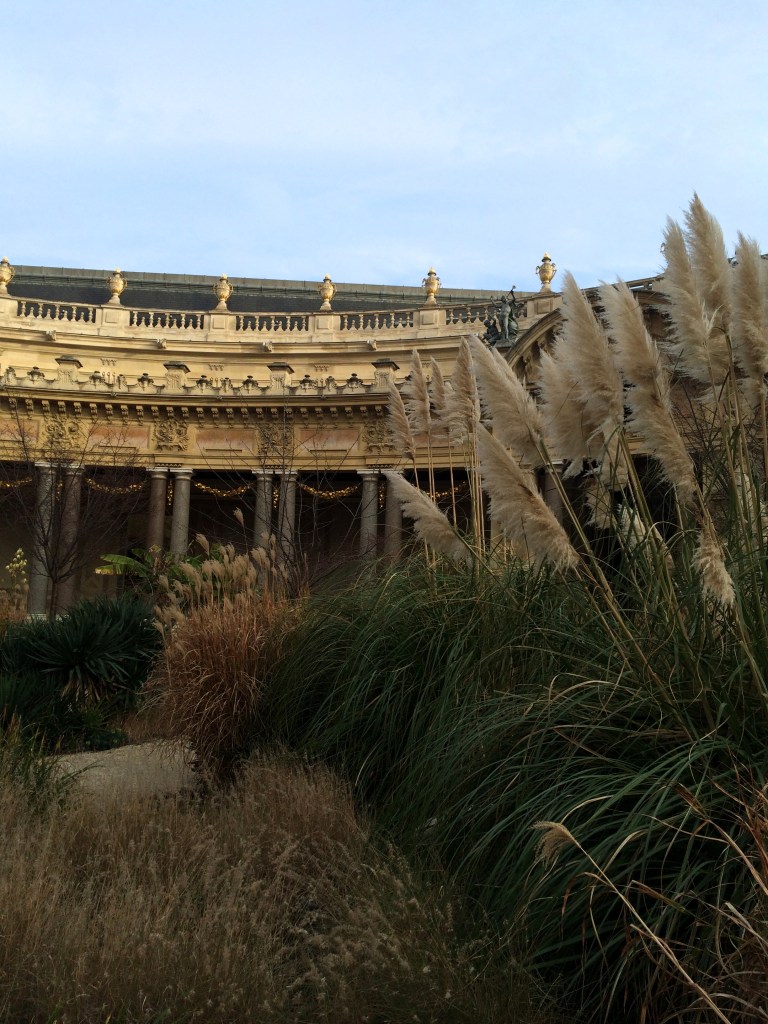

 Grasses, including Pampas grass Cortaderia selloana & Miscanthus sinensis, Petit Palais garden.

 Winter heads of Miscanthus sinensis and banana leaves catching the winter sunlight, Petit Palais garden.
 Royal Academy, Painting the Modern Garden, 30 January – 20 April 2016.


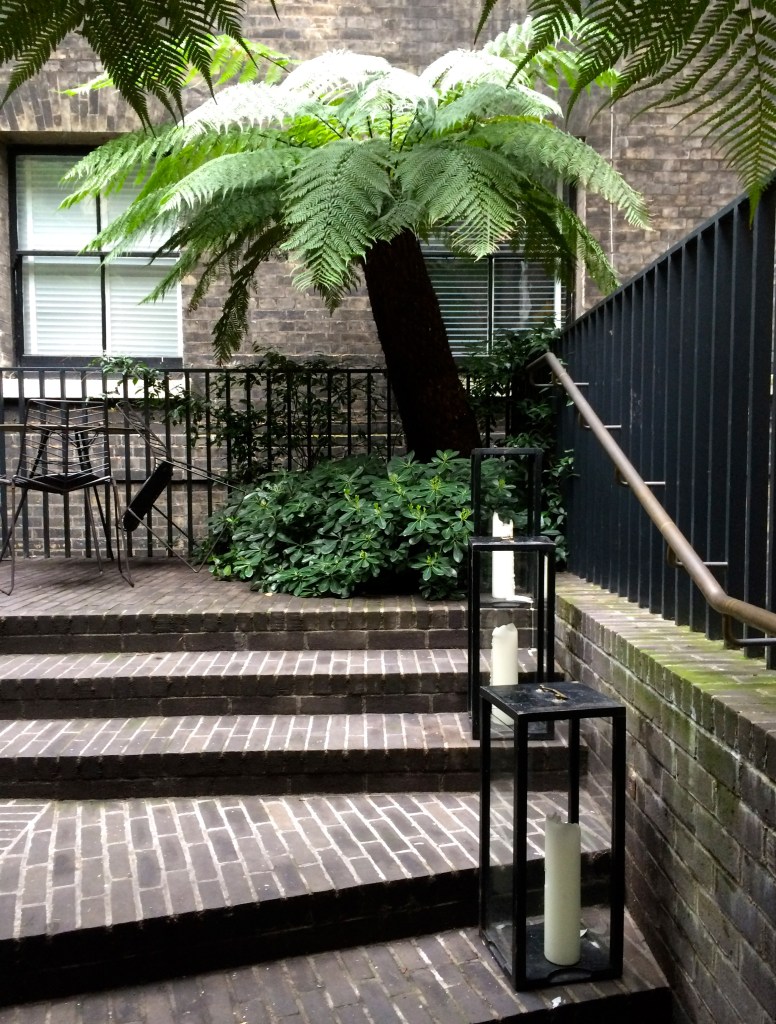
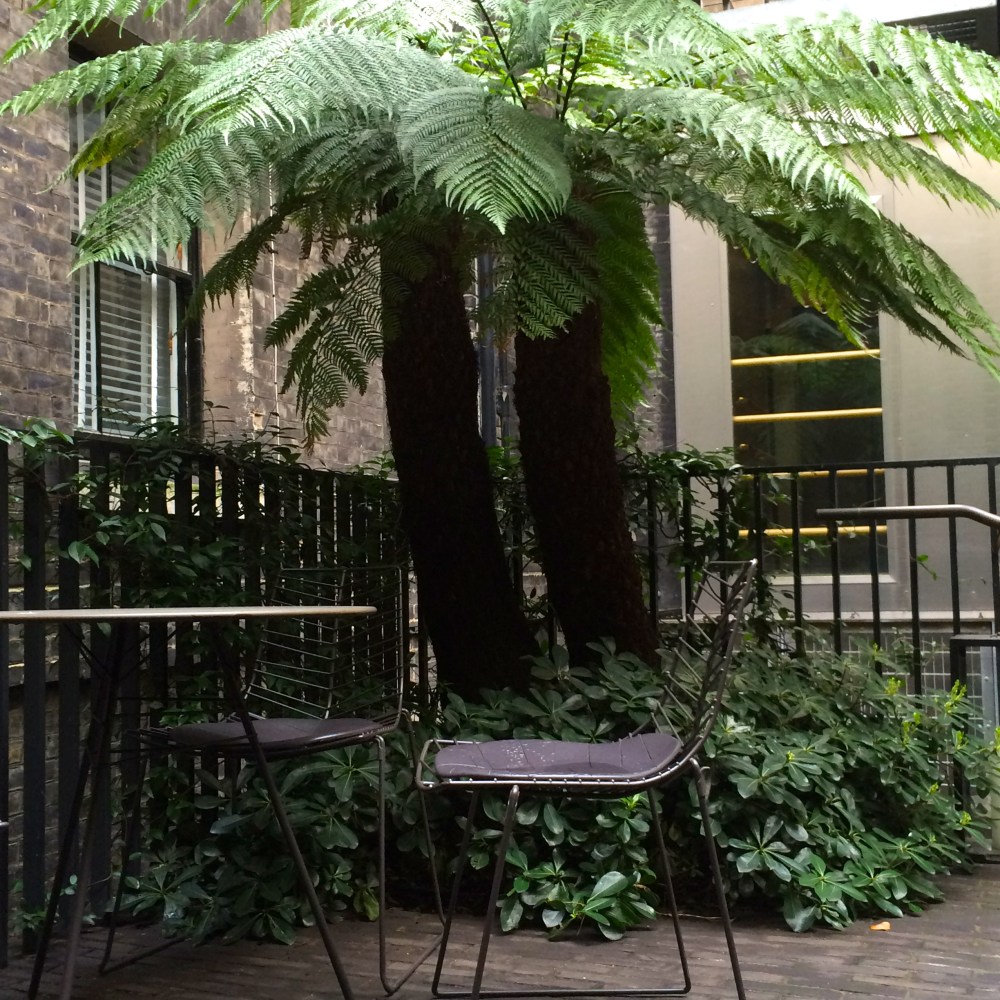
 Ground level views of the Keeper’s House garden, Royal Academy.
 Looking upwards, Keeper’s House garden, Royal Academy.
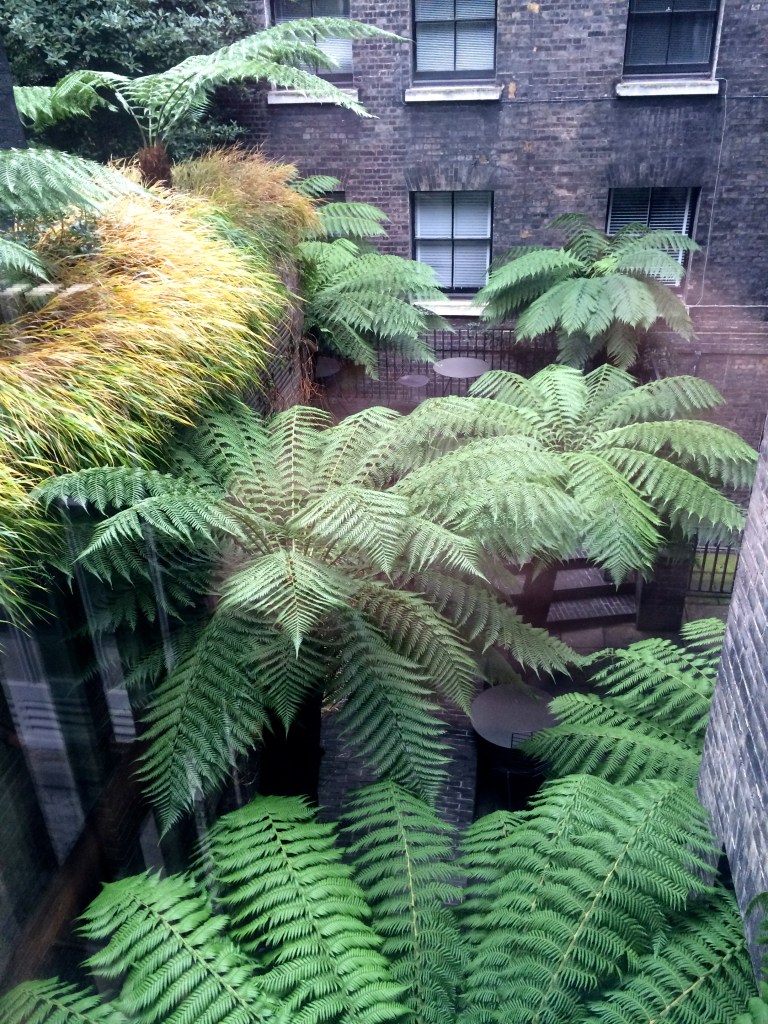

 View onto the Keeper’s House garden, Royal Academy, with ‘King and Queen’ by David Nash.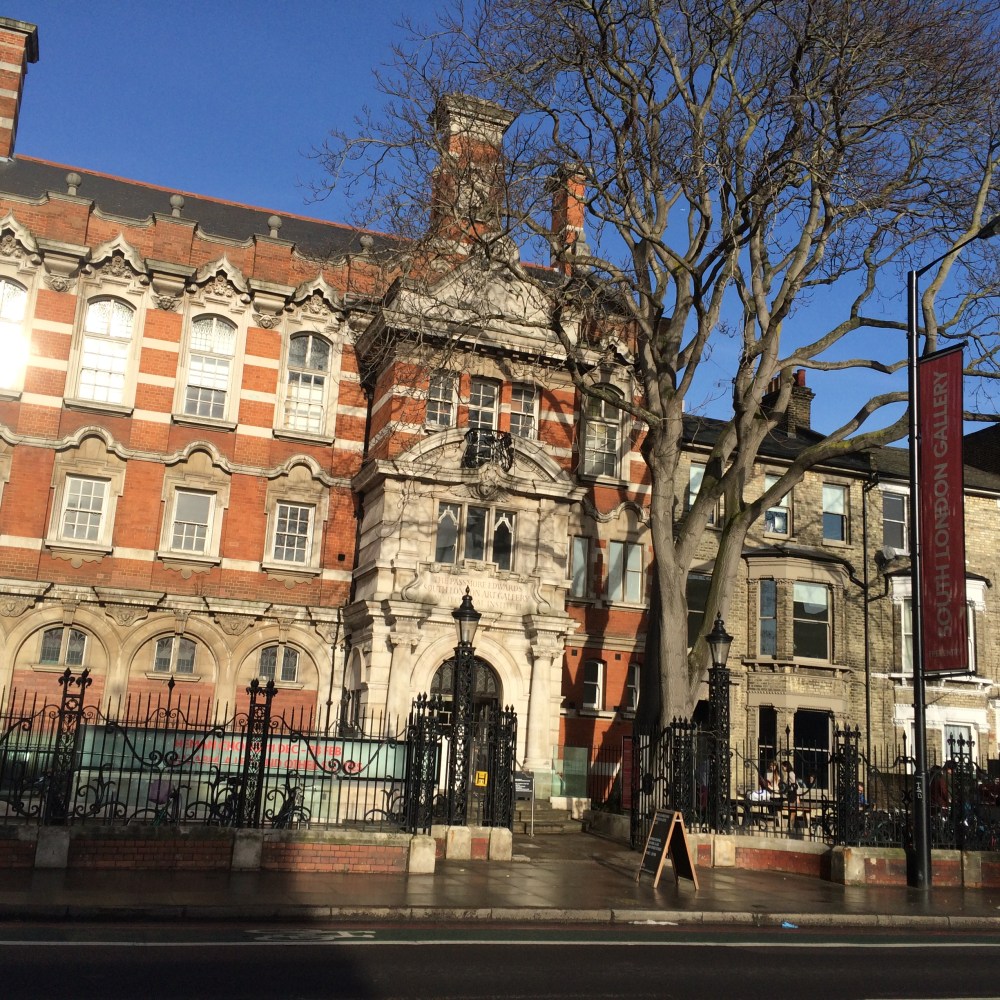
 Exterior of the South London Gallery with and without bus

 Framework of The Fox Garden – the towering gallery wall with elegant new buildings by 6a architects at either end and a wonderful, sinuous brick path.


 Nandina domestica – or heavenly bamboo – creating a lush and welcoming atmosphere in The Fox Garden, South London Gallery on a January day.
 Cornus kousa var Chinensis – with a close up of the beautiful white bracts which surround the tiny flowerhead.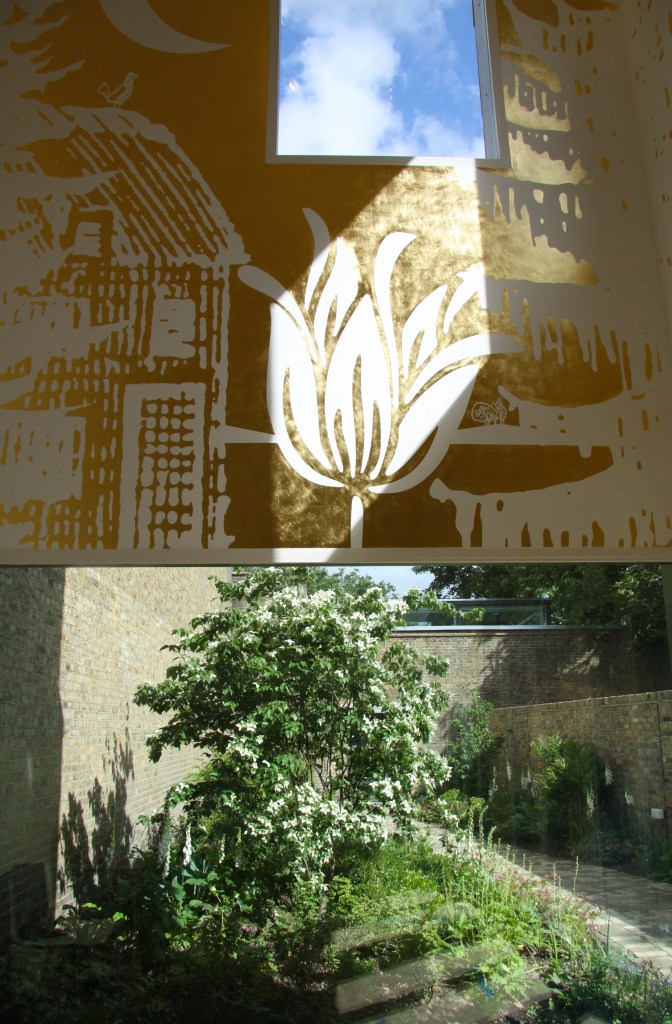
 Claret red autumn colour of the Cornus kousa var Chinensis with Lawrence Weiner’s swooping ‘wall sculture’ on the gallery wall, part of his 2014 ‘All in Due Course’ exhibition.
 Euphorbia characias with its lime green bracts.
 Libertia grandiflora which makes everyone smile the garden in May.
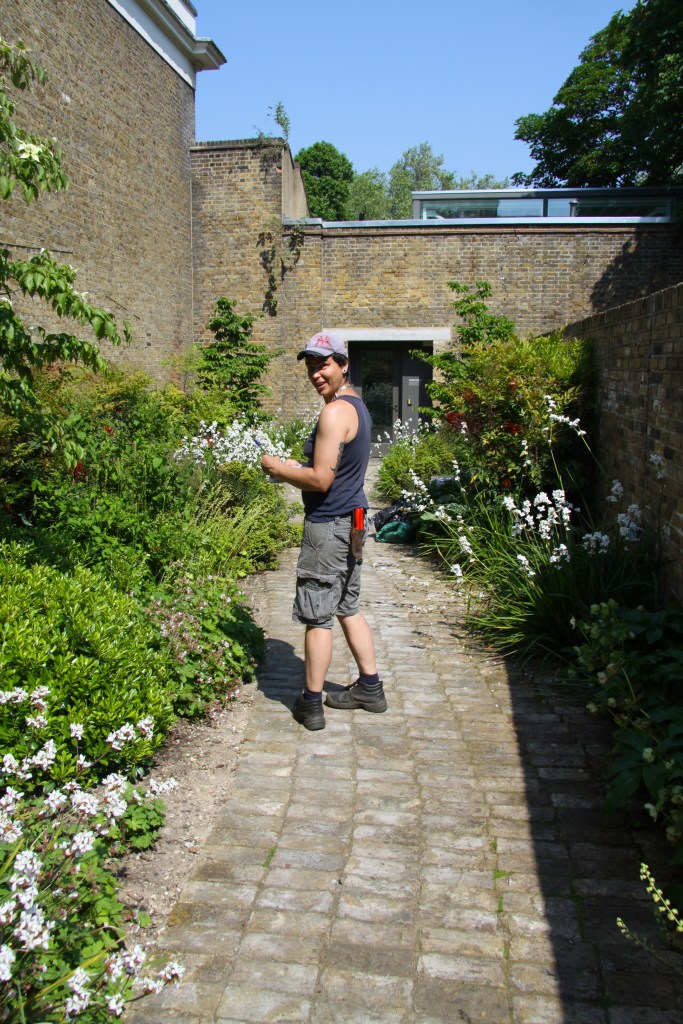 Heidi – The Fox Garden’s secret ingredient.
 Proposed garden café within the new Dow Jones Architects’ pavilions. Garden to be designed by Dan Pearson. Visualisation by Forbes Massie, image courtesy of The Garden Museum.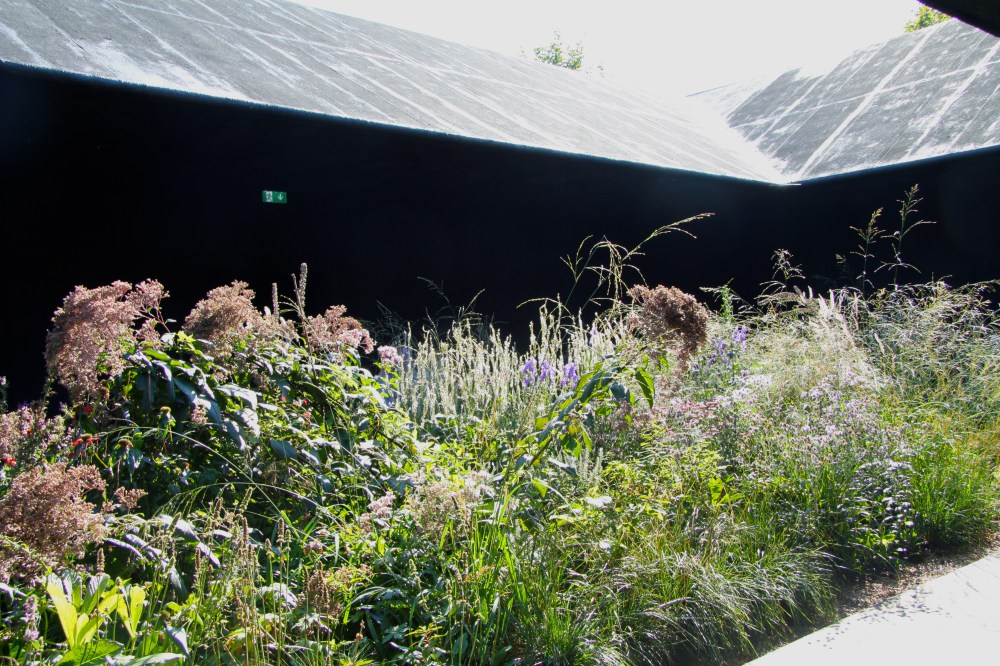

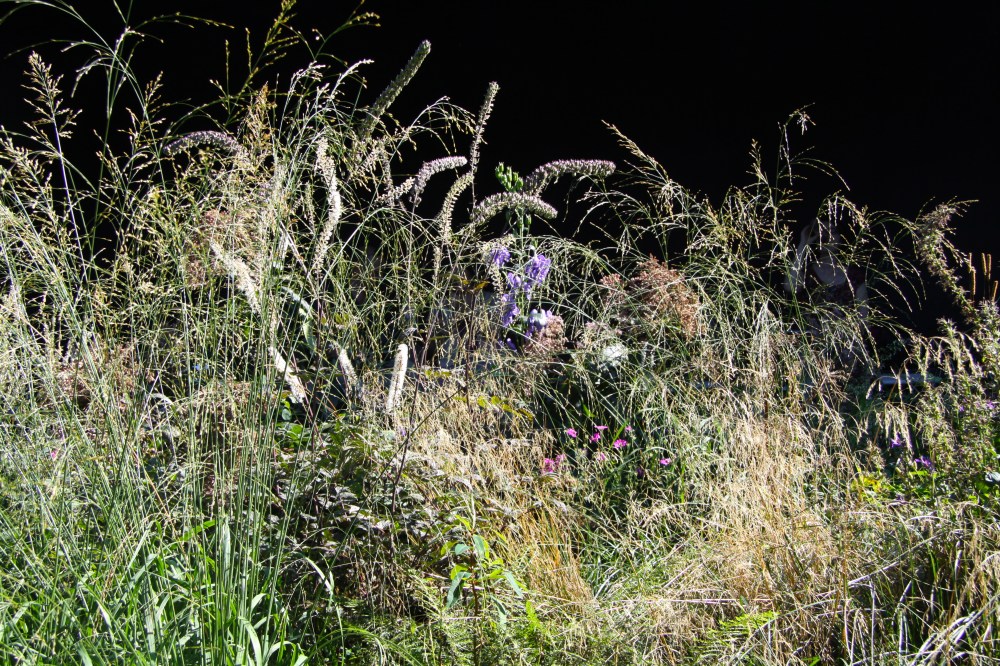
 Images of the Piet Oudolf planting within the Peter Zumthor Serptentine Gallery Pavilion, September 2011.
 Ethereal seedheads of Pennisetum alopecuroides ‘Hameln’, RHS Wisley
 Hamamelis mollis ‘Boskoop’
 Hamamelis x intermedia ‘Orange Peel’


 Vinca difformis, RHS Garden, Wisley – palest blue flowers and pairs of leaves like angels’ wings
 Rosa ‘Mortimer Sackler’
 Rosmarinus officinalis Prostratus Group


 The Nativity, Piero della Francesca, oil on poplar, 1470-75, National Gallery London, Room 66

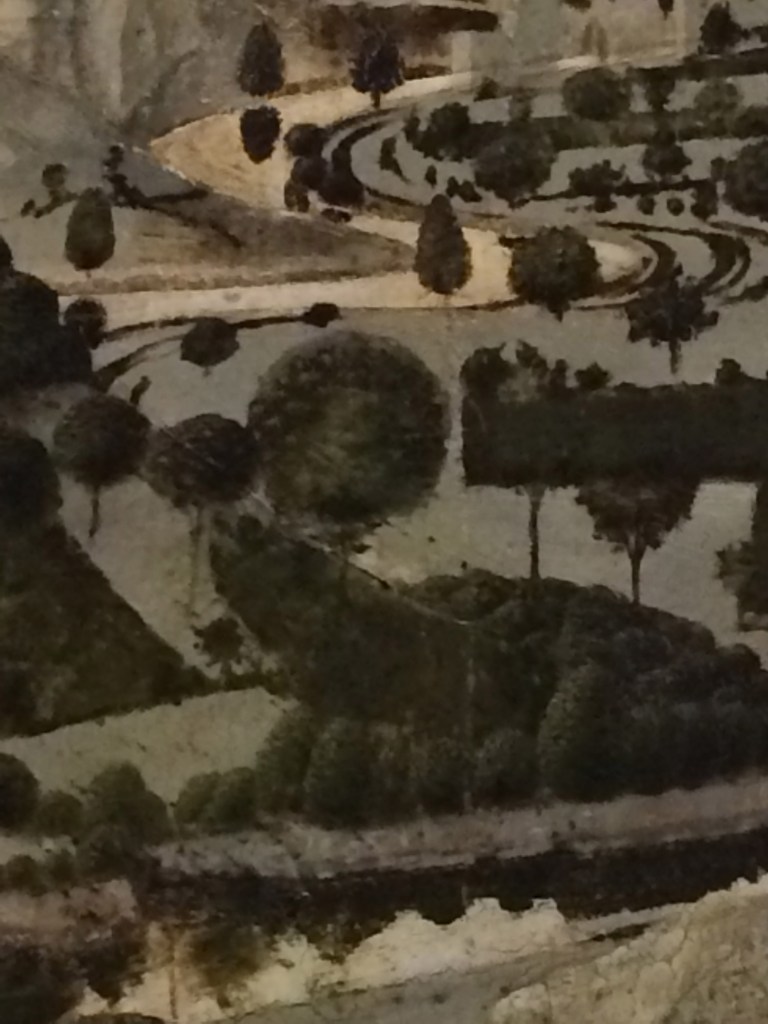 Details from: The Nativity, Piero della Francesca, oil on poplar, 1470-75, National Gallery, London, Room 66
 Winter seed heads of artichokes, Gravetye Manor
 WInter seed heads of Artichokes with Calamagrostis, Gravetye Manor



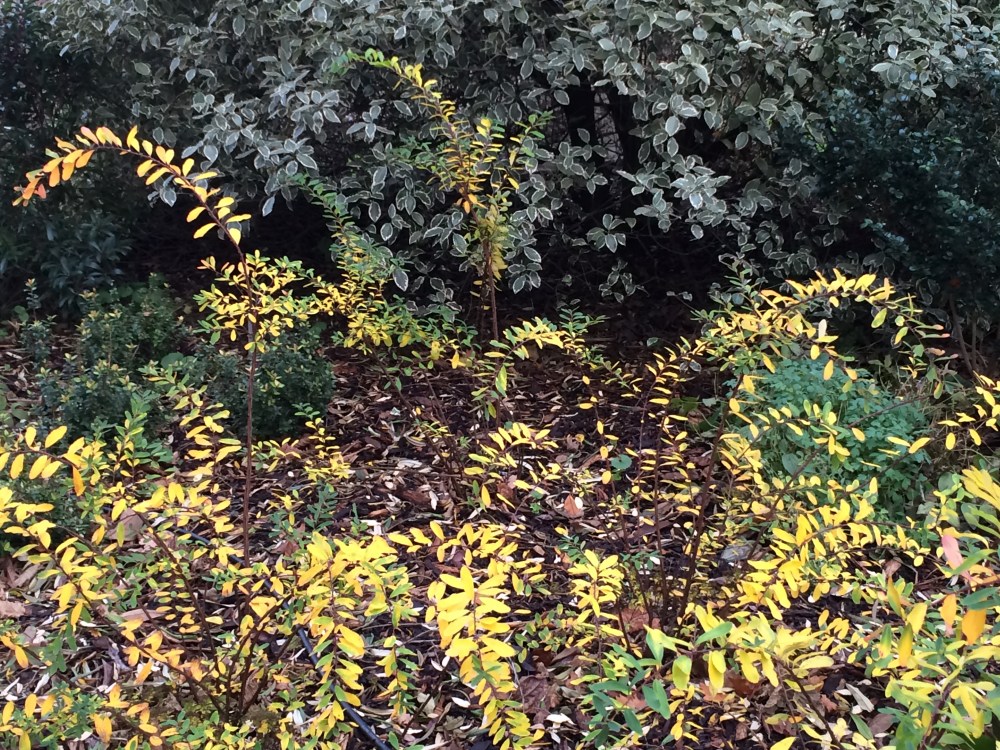
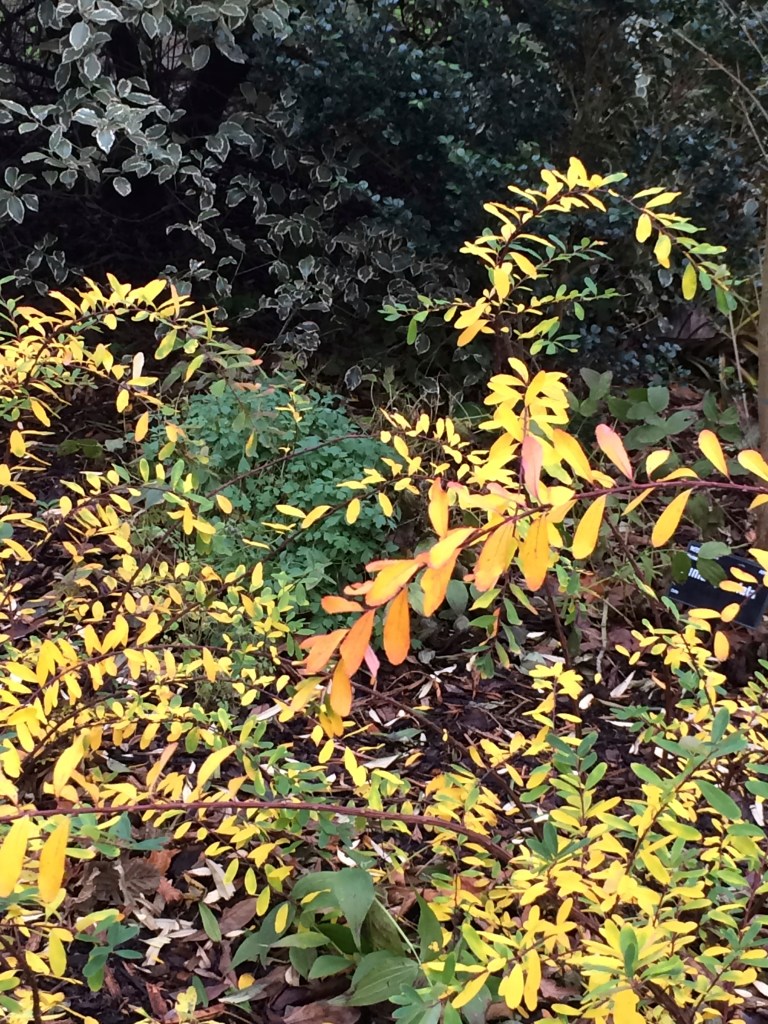 Arching stems of berberis, RHS Wisley
 The first flower in a mat of Cyclamen coum



 Edgeworthia chysantha, RHS Wisley
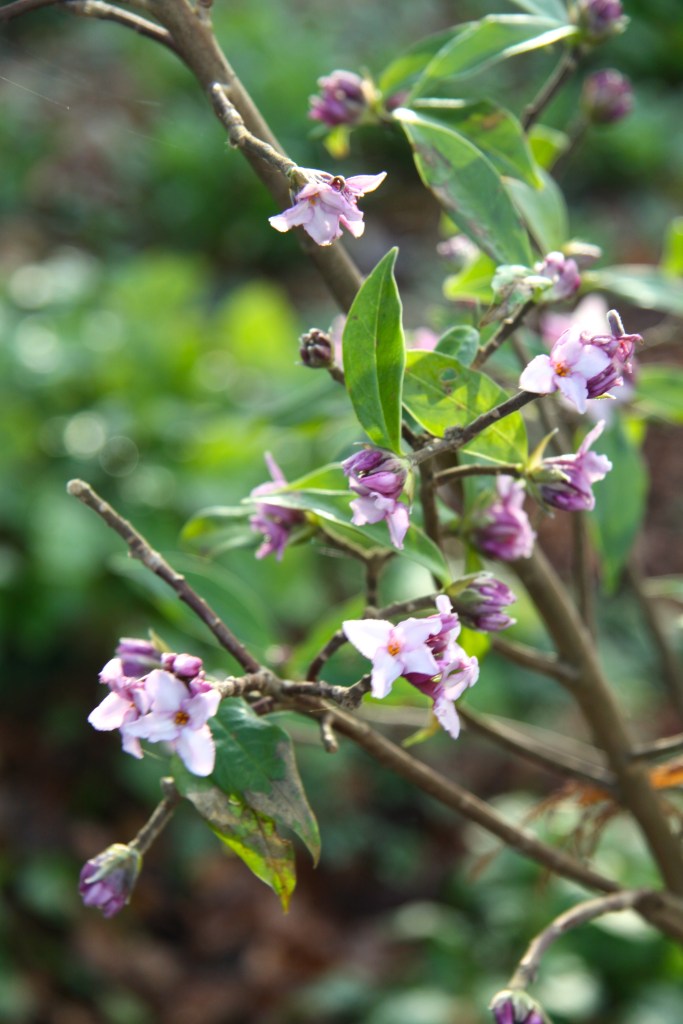 Daphne bholua, RHS WISLEY
 The Nativity at Night, Geertgen tot Sint Jans, oil on oak, possibly about 1490, National Gallery, London, Room 63
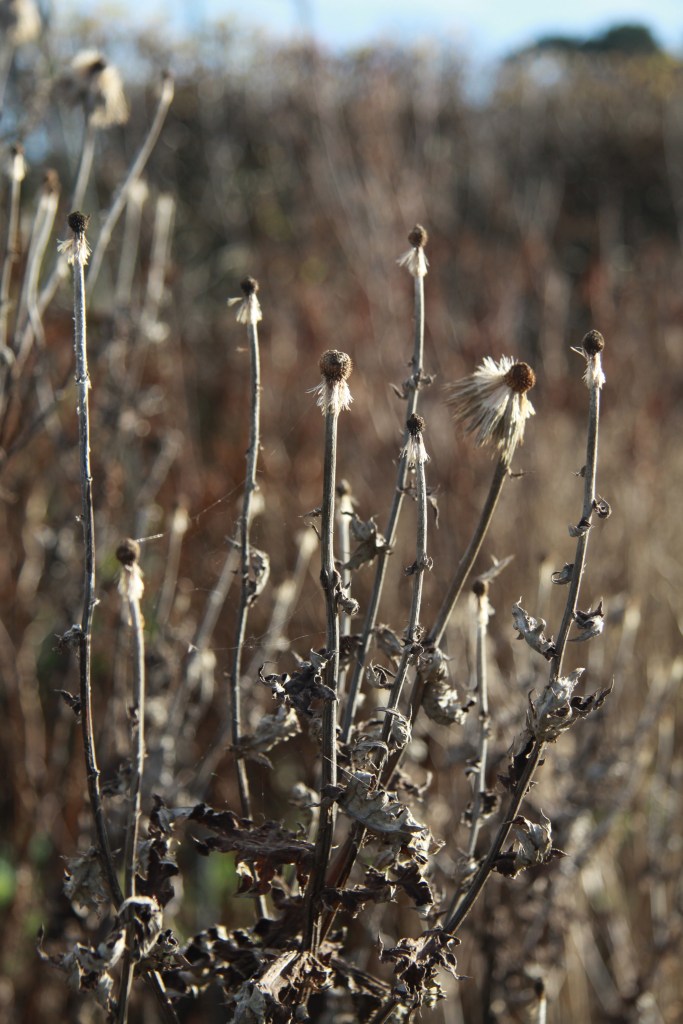 Echinops bannaticus ‘Star Frost’, RHS Wisley
 Anemone x hybrida ‘Honorine Jobert’, RHS Wisley
 Lichen on naked branches, Gravetye Manor
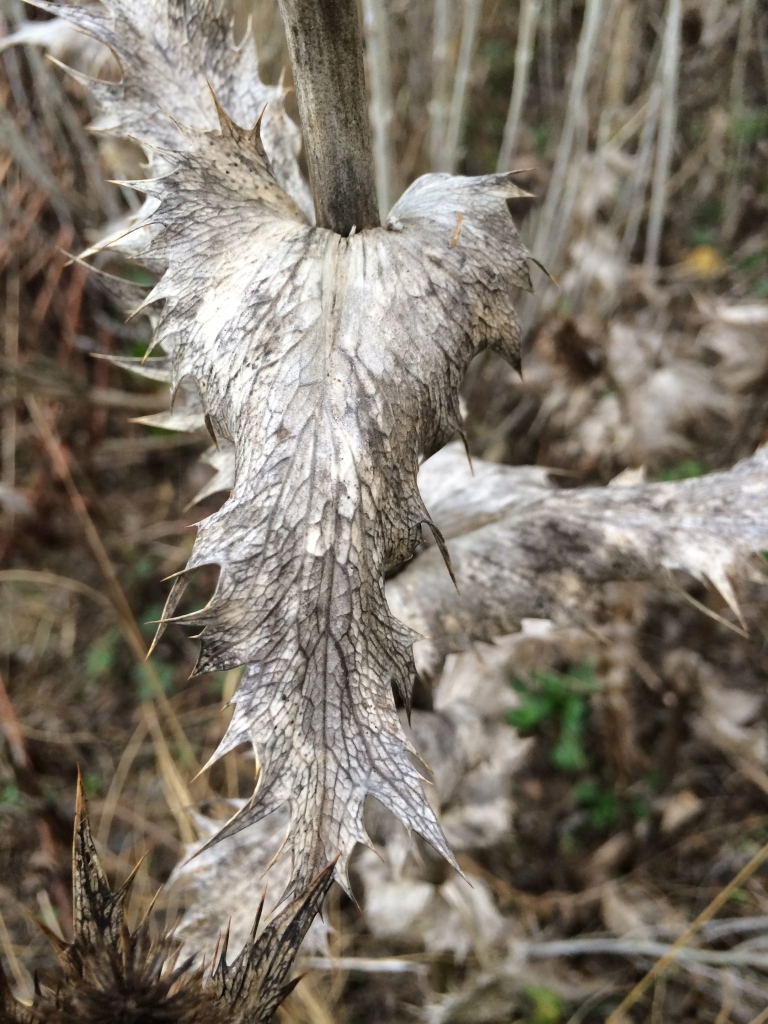

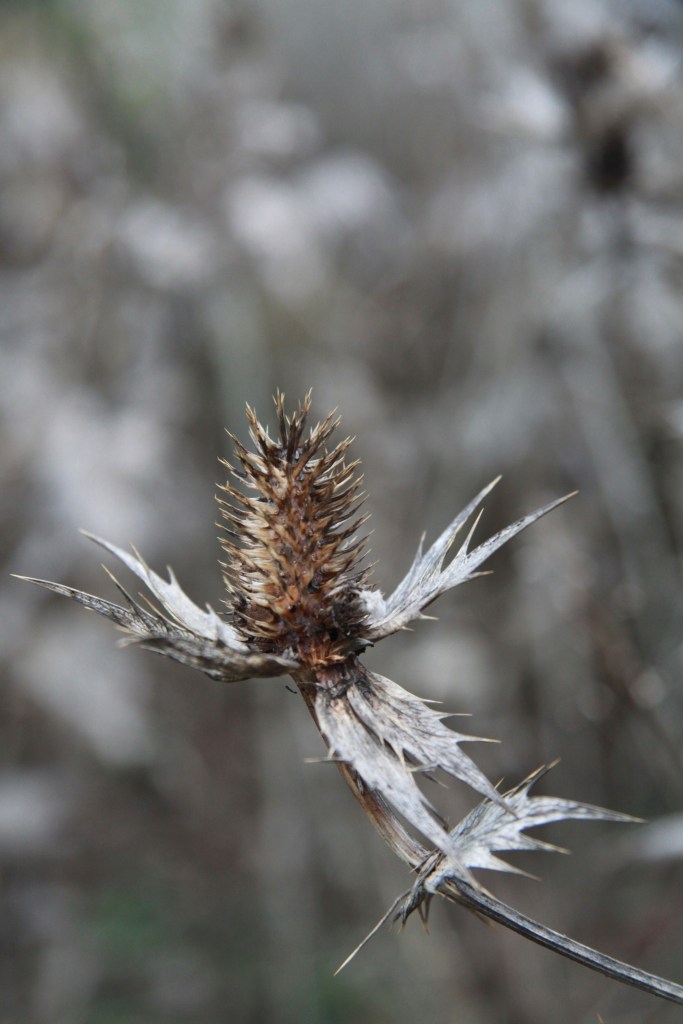 Eryngium giganteum ‘Silver Ghost’, RHS Wisley




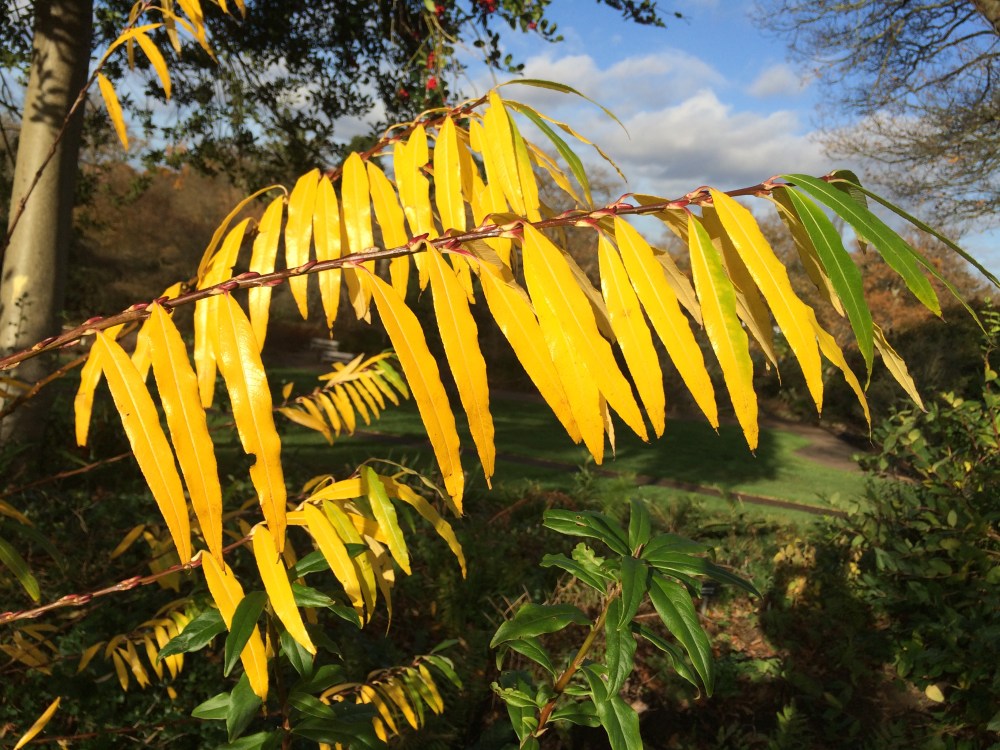
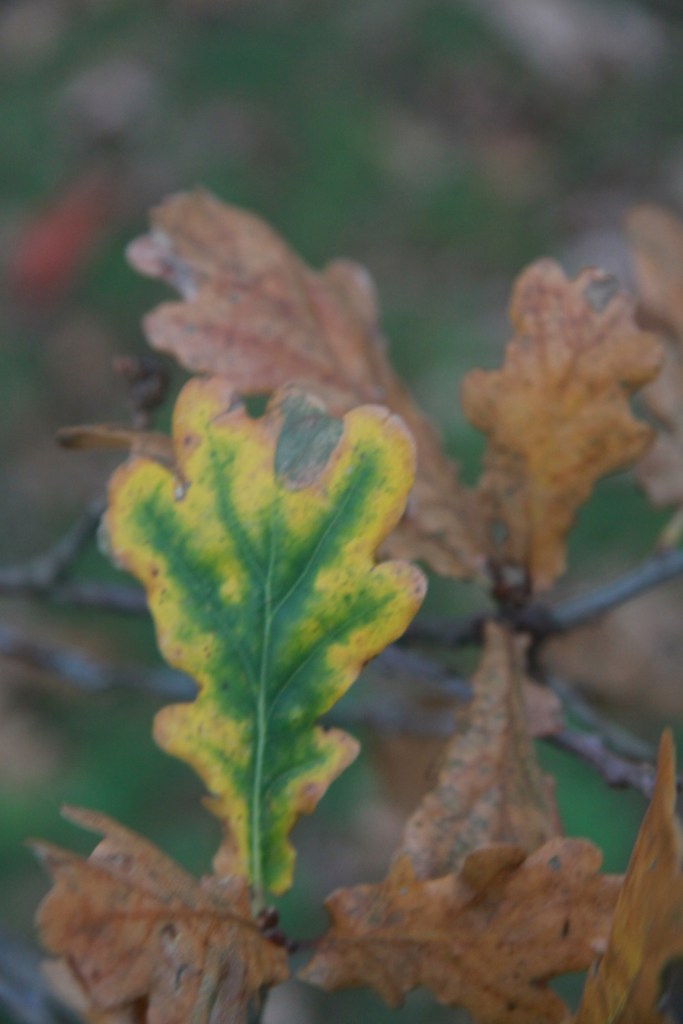 Oak leaf, December, RHS Wisley


 Cornus sericea ‘Hedgerows Gold’, RHS Wisley
 Detail of The Donne Triptych, Hans Memling, about 1478, National Gallery, London, Room 63

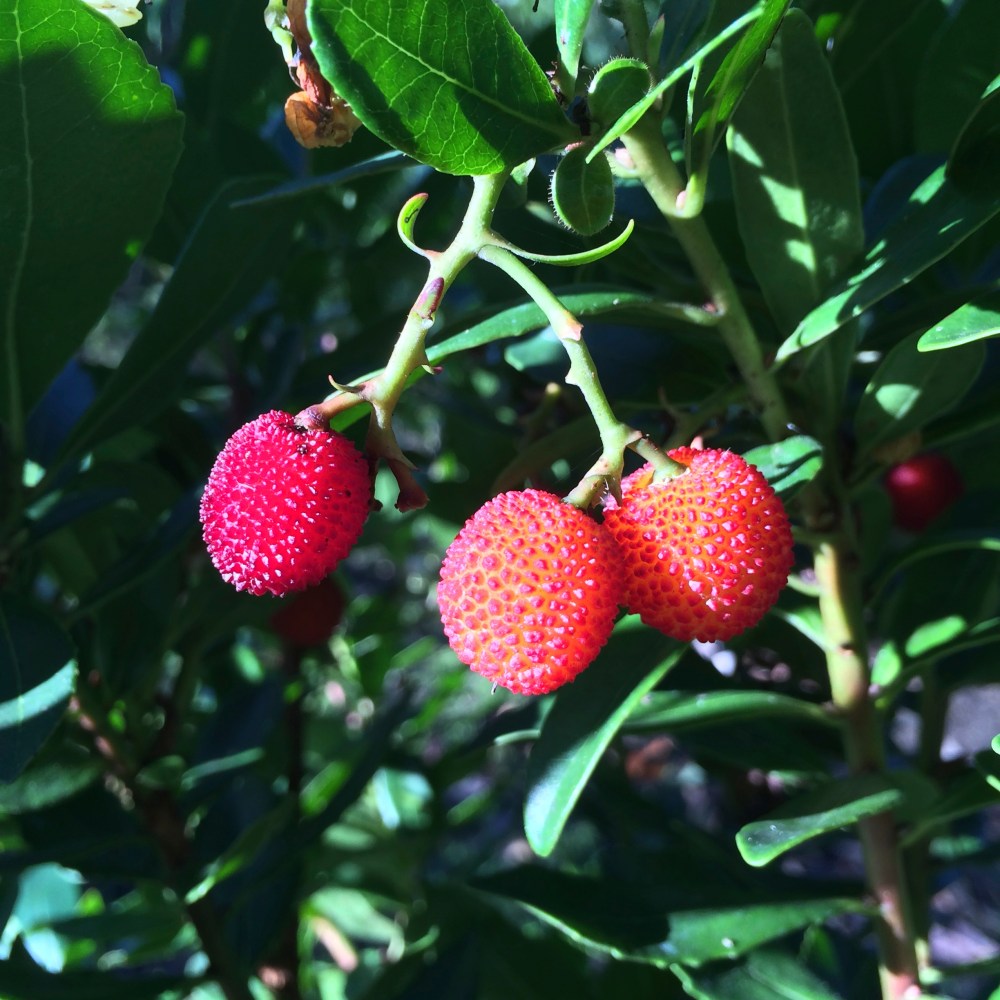
 Arbutus unedo ‘Roselily Minlily’, RHS Wisley


 Davidia involucrata fruit, Gravetye Manor
 Monkey Puzzle tree in the December sunshine, RHS WIsley




 Detail of oak leaf embroidery in gold thread, late 18th Century French uniform
 Eiffel Tower, late October, late afternoon

 Autumn colour along a network of pale paths viewed from the Eiffel Tower
 Sunset over Paris, October 2015
 I love the pearly green of the elliptical central pool and the way the soft light of the water seems to fragment into sophisticated pockets of glowing green light as darkness falls:
 The milky green of the elliptical pool, Le Champ de Mars
 Le Champ de Mars at night – an elegant network of green lights
 Cast iron frame of the Jardins du Roi Soleil Versailles planter
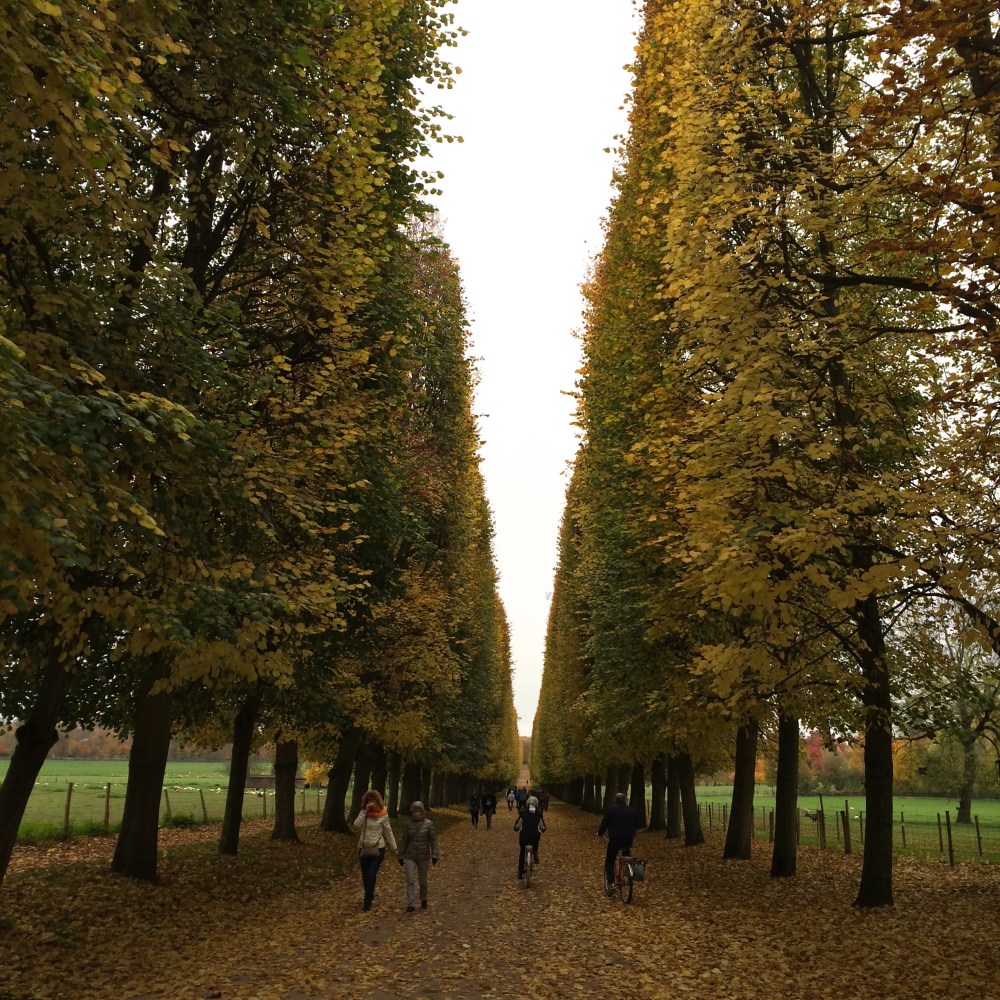 Avenue of Lime Trees, Chateau de Versailles

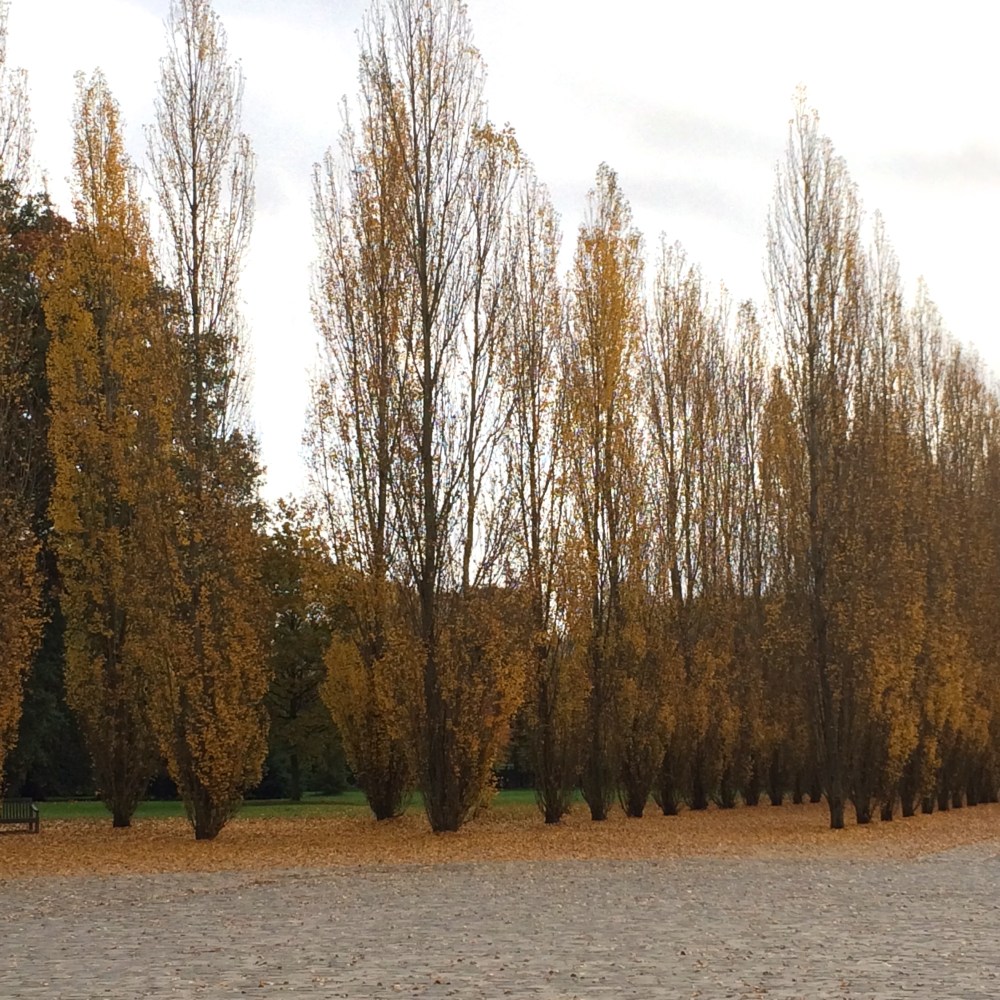
 Autumn colour in the parkland, Château de Versailles


 Rustic buildings with immaculate kitchen gardens, chestnut fencing and glowing autumn woodland behind, The ‘Queen’s Hamlet’, Versailles






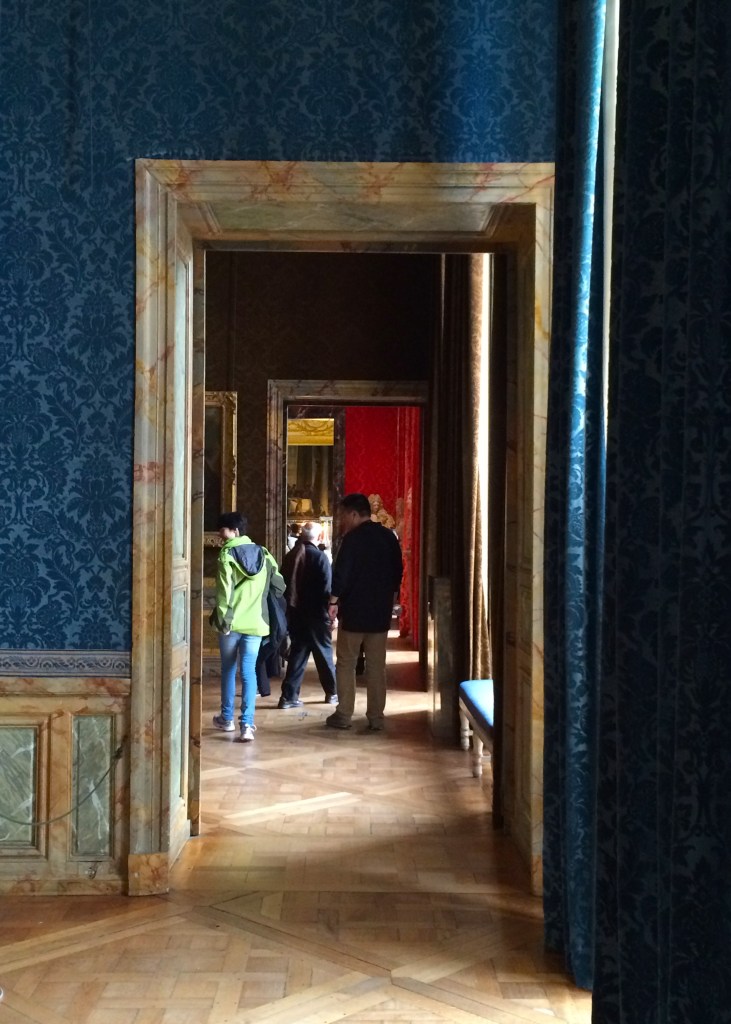 Room upon room of intense colour in the Palace of Versailles

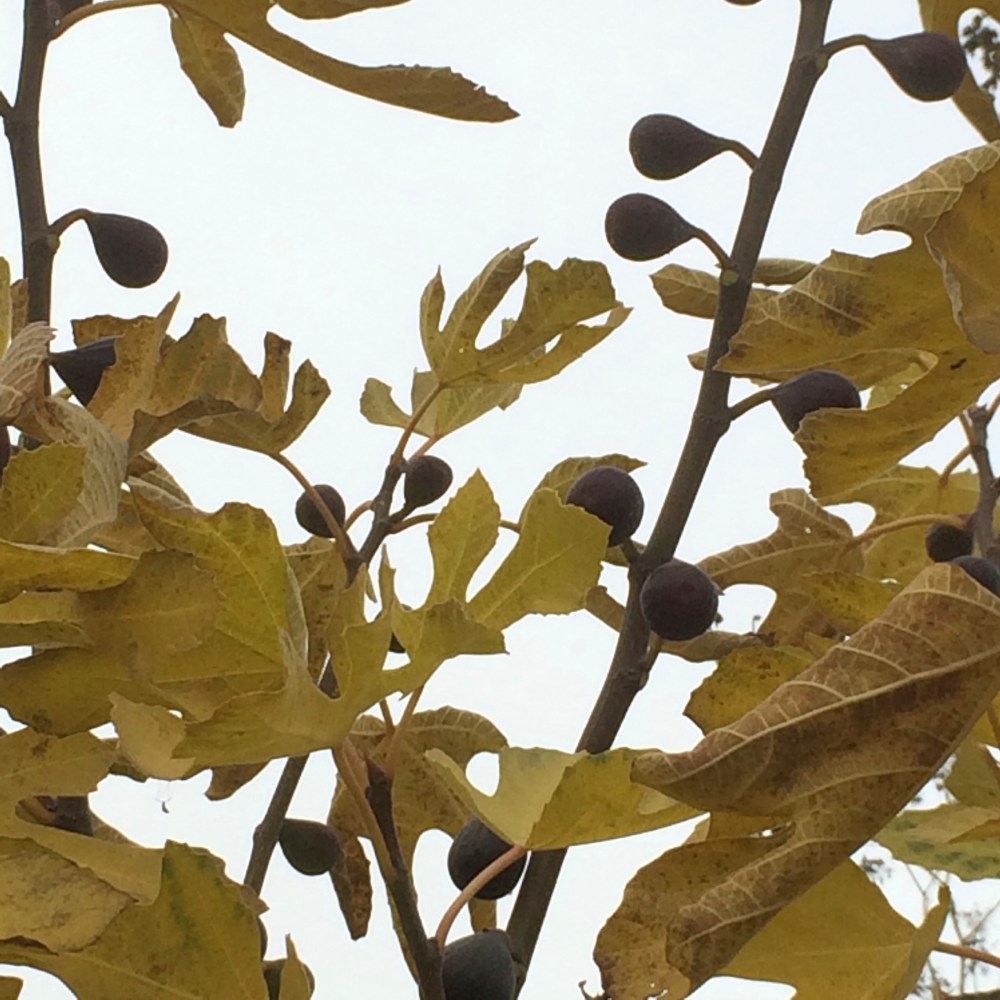
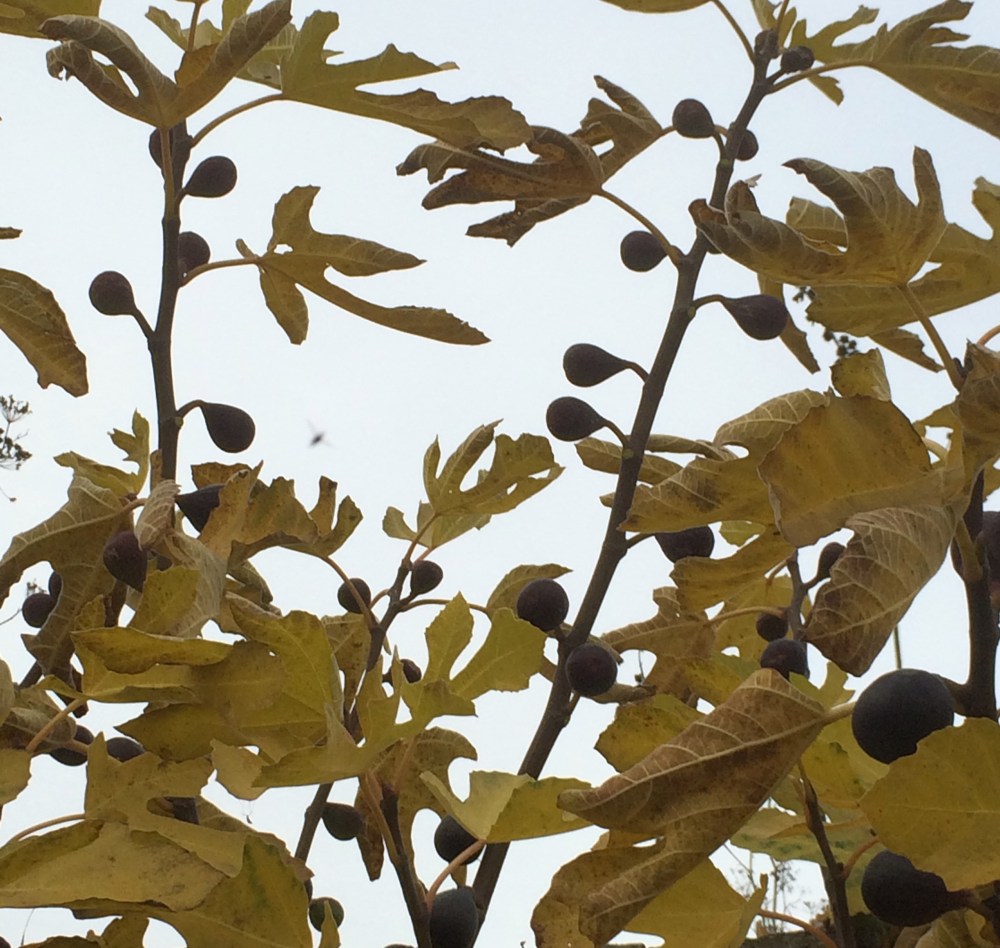 wall of figs, Potager du Roi, October 2015
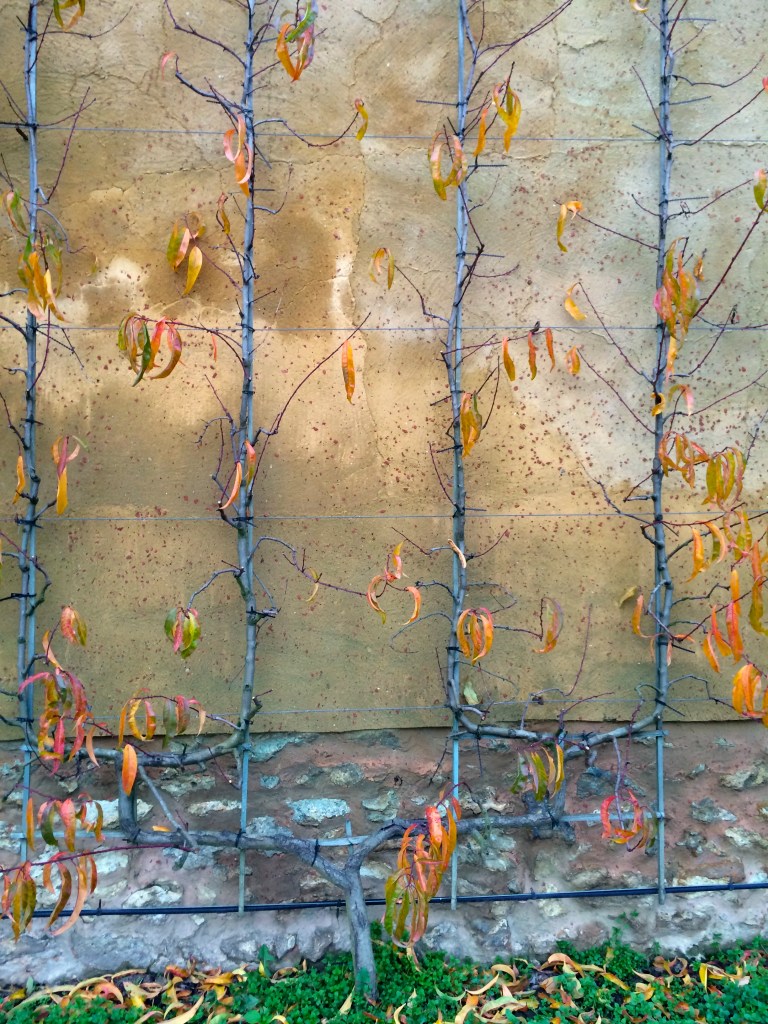

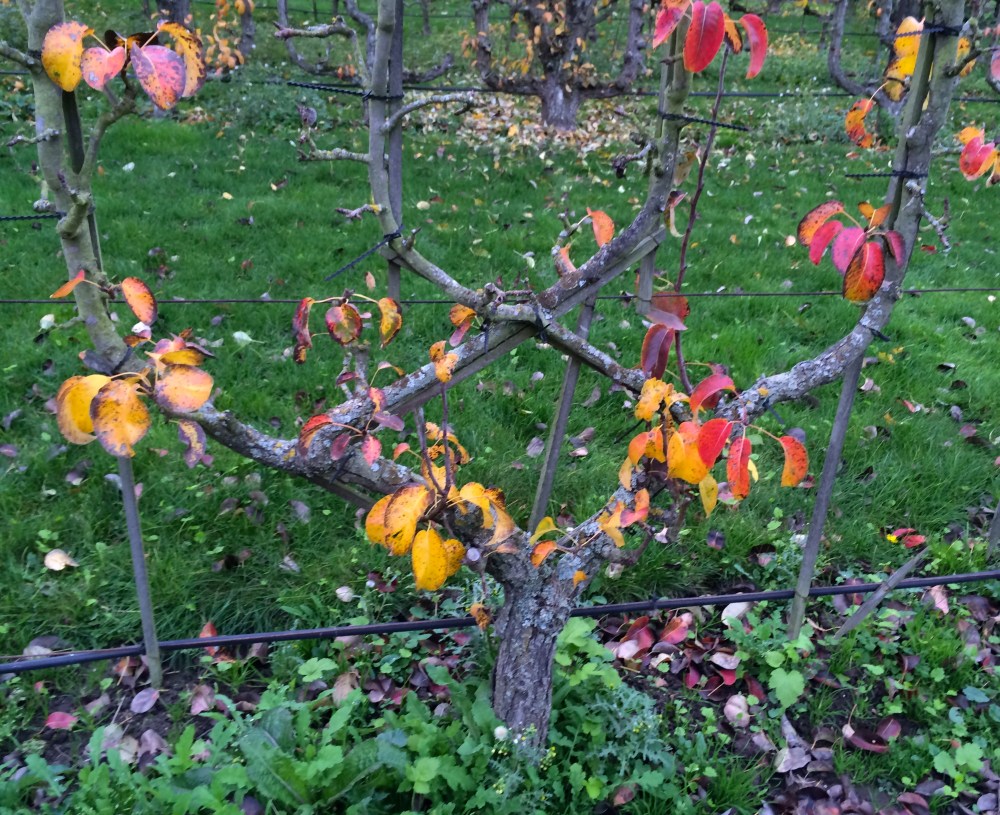 A tiny sample of trained apple and pear trees, Potager du Roi, October 2015
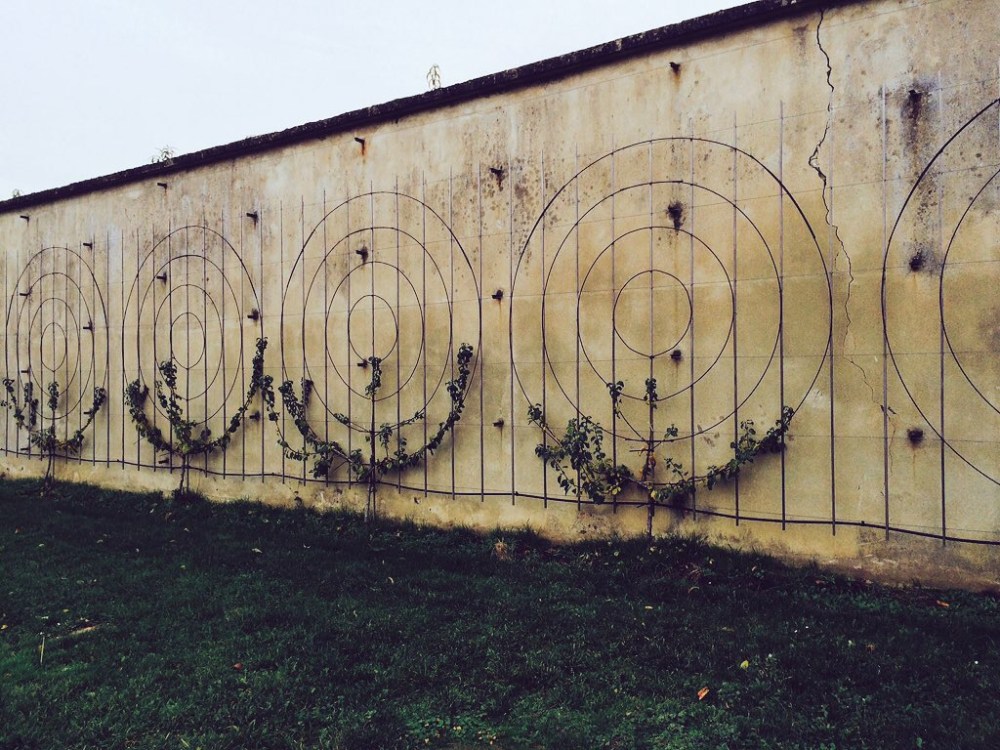 Reine Claude greengages being trained into circles, Potager du Roi


 The sumptuous front and back covers of ‘Heirloom Harvest’ by Amy Goldman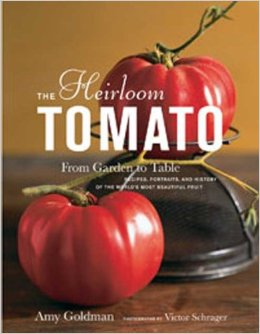
 ‘Heirloom Harvest’ is gripping because it is the story of one person’s life and the garden they have made and how one stage of the journey lead to another. She is clear that two key books changed the course of her life. Rosalind Creasy’s ‘Cooking from the Garden’ which ‘opened my eyes to the splendour and diversity of heirlooms, their uses in cookery and edible landscaping’ and Cary Fowler and Pat Mooney’s ‘Shattering: Food, Politics and the Loss of Genetic Diversity’ which ‘alerted me to the dangers of crop uniformity and the staggering and mounting losses of genetic diversity in agriculture’. If Paris is the ‘City of Love’, it fits well with this post that Amy ended up falling in love with and marrying Cary, and they now live and farm together, always trying to grow and protect new varieties of fruits, vegetables and now rare breeds of animal too, and storing seeds in their basement refrigerator seed bank.
 ‘American Flag Leek’ by Jerry Spagnoli from ‘Heirloom Harvest’ by Amy Goldman
 ‘Garlic Chives’ by Jerry Spagnoli from ‘Heirloom Harvest’ by Amy Goldman
 ‘Tyson Pear’, photograph by Jerry Spagnoli from ‘Heirloom Harvest’ by Amy Goldman
 ‘White Currants’ by Jerry Spagnoli from ‘Heirloom Harvest’ by Amy Goldman


 Bleuet Coquelicot, florist, inside and out
 ‘Luxembourg’ chairs, Tuileries Gardens, Paris













































































 The Dahlia Papers