FIREWORK BAMBOO AND WILD LUPINS IN PERU

A FAMILY JOURNEY FROM THE MANU RAINFOREST TO THE HIGH ANDESred treegAn utterly beautiful Erythrina tree in flower above the Madre de Dios River, Manu National Park

It took a lot of organising – a month in Peru with our three teenage boys. Our itinerary was to take us deep into the rainforest, back onto the beaten track of Cusco and Machu Picchu and then up to the remote cragginess of the Cordillera Blanca (think Touching the Void … albeit we were to be trekking in sunshine and not ice climbing).

packing 2

Pre holiday packing

The preparation – acquisition of head to toe anti mosquito outfits (including anti mosquito socks but drawing the line at anti mosquito underwear), trekking kit – and entire bags full of medical supplies seemed to take up most of July.

I arrive in Cusco – the “Inca Capital of Peru’ at an altitude of 3400m – clutching Patrick Leigh Fermor’s : ‘Three Letters from the Andes’:

IMG

Leigh Fermor’s description of the tiring, dazzling climate is brilliantly accurate “the glare is blinding, the shade cool and sunset icy … the briefest walk is exhausting; one is short of breath, hearts pound and heads throb’

But then he and his charismatic 1971 party (which included an international ski champion cum high end jeweller, the Deputy Director, Historic Buildings, of the National Trust and the Duke of Devonshire) seemed less dependent on maleria tablets and altitude sickness medication than the modern traveller- relying instead on daily rations of two vast ‘double’ whiskies per head.

altitude sickness posterThe unnerving if hilarious altitude sickness poster that greets you at Cusco airport

We spend two days getting used to the altitude and beginning to enjoy the newness of South America:

cusco flower market

Flower seller in Mercado Centrale de San Pedro, Cusco – a fantastic balance of magenta, red and bright green

IMG_1485one of the many kinds of sweetcorn we tasted in Peru  – along with some of the 3500 varieties of potatoes and quinoa cooked 100 ways including these rather delicious pancakes:

IMG_1568Quinoa pancakes

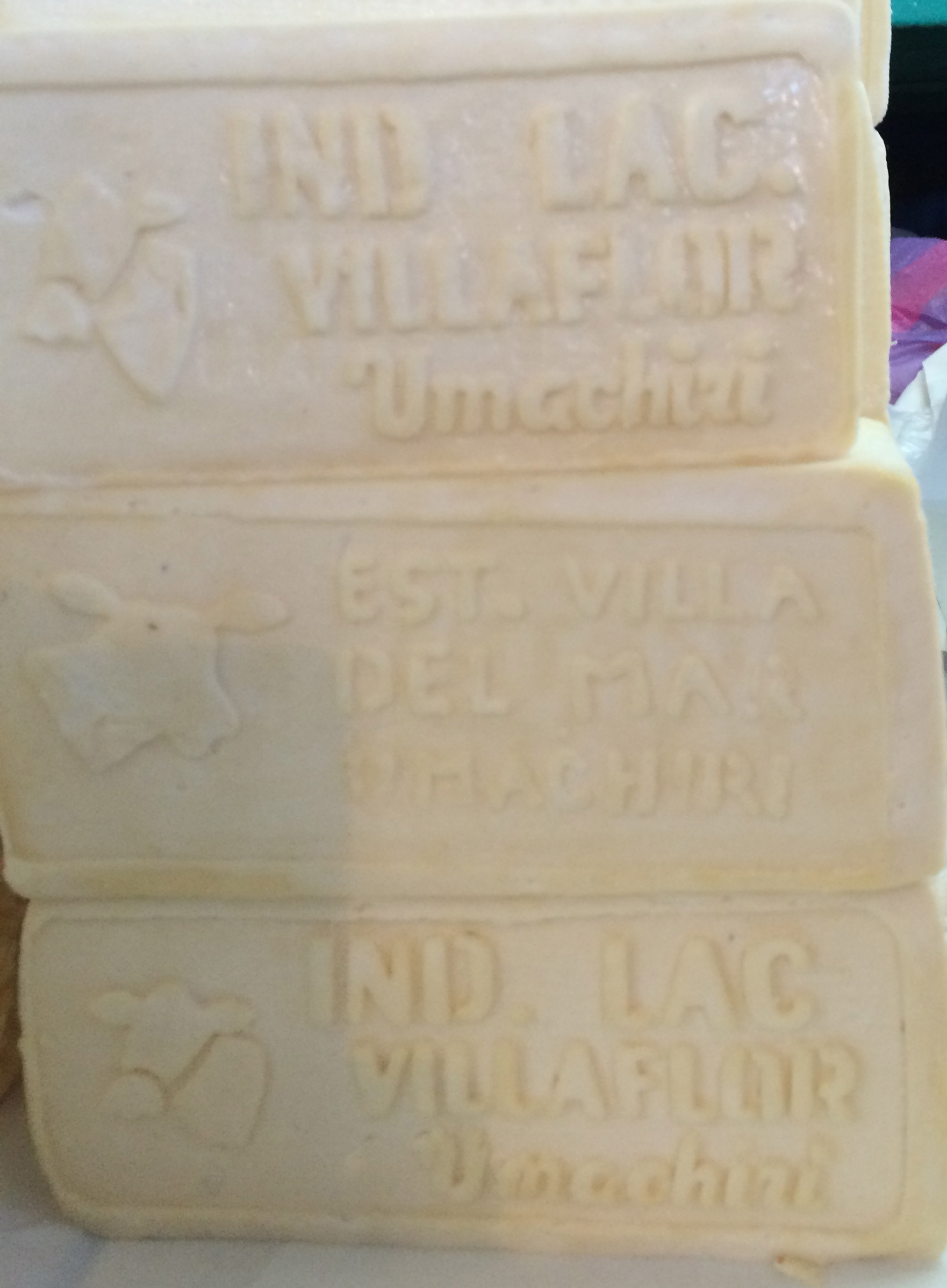
IMG_1481Fantastic pale blocks of stamped cheese which look like giant bars of old fashioned soap

Leigh Fermor did have some problems on his travels – for example he had to switch from fountain pen to pencil as the altitude affected the ink flow of his preferred writing instrument. I would like to trump this by warning you in advance that my camera plus new lenses –  which were to bring you gorgeous blow by blow illustrations of the jungle and wildflowers of the Andes only survived a few days in the high humidity of the rainforest. So instead I will give you a whistlestop collage – with grateful thanks to my iPhone – of some of my favourite Peruvian things:

We set off to the Manu National Park with two wonderful guides from the Crees Foundation – which runs education and research projects to develop sustainable Amazon rain forest. Our hearts skip a beat as we arrive at the Elfin Cloud Forest:
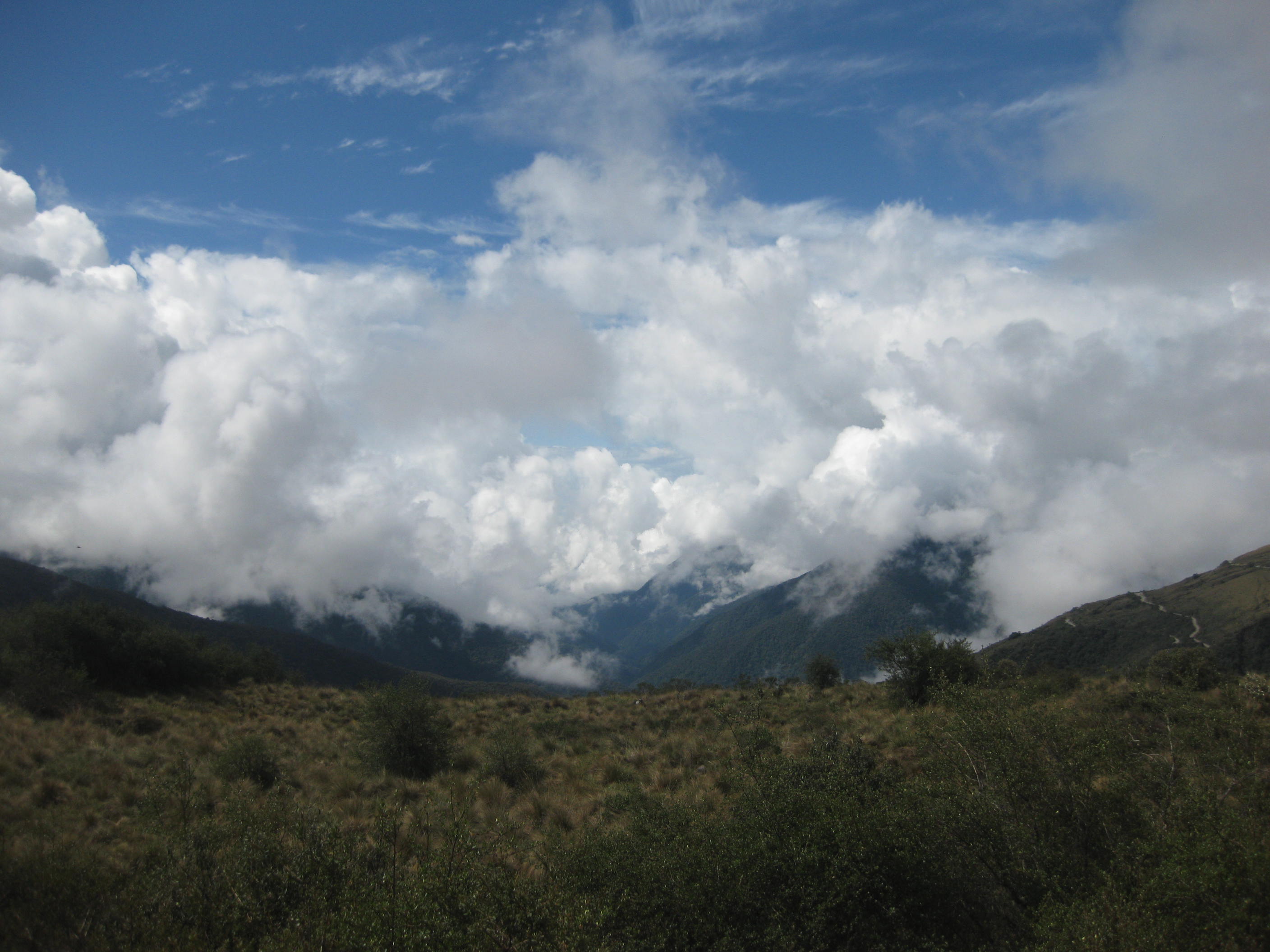
elfin cloud forestLooking down onto cloud forest at the entrance to Manu National Park
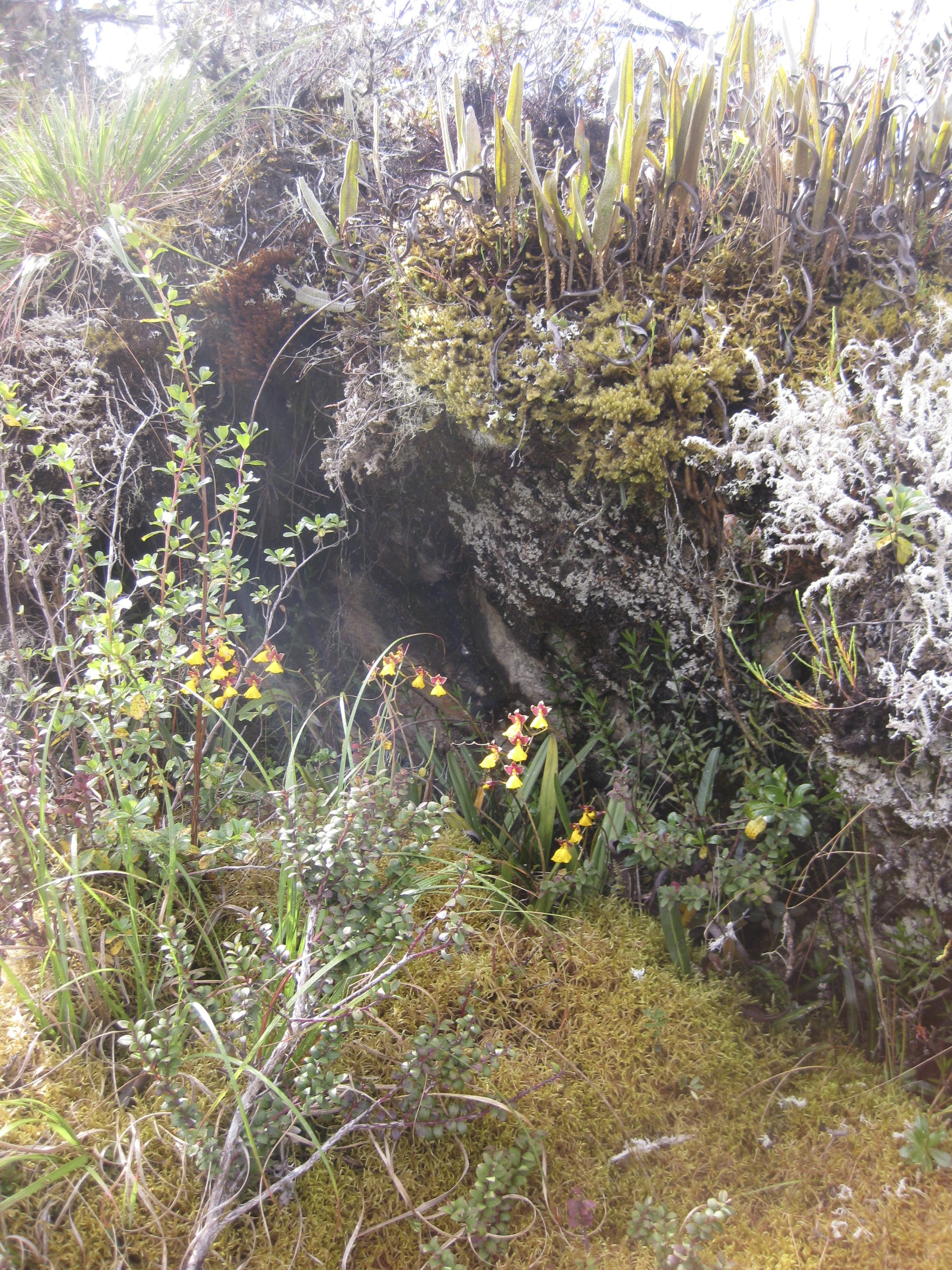
IMG_6488

At ground level, I am entranced by a shrine-like arrangement of tIny egg-yolk yellow Odontolglossum orchids amongst sphagnum moss, lichen and a dancing headdress of skinny ferns. first silhoette
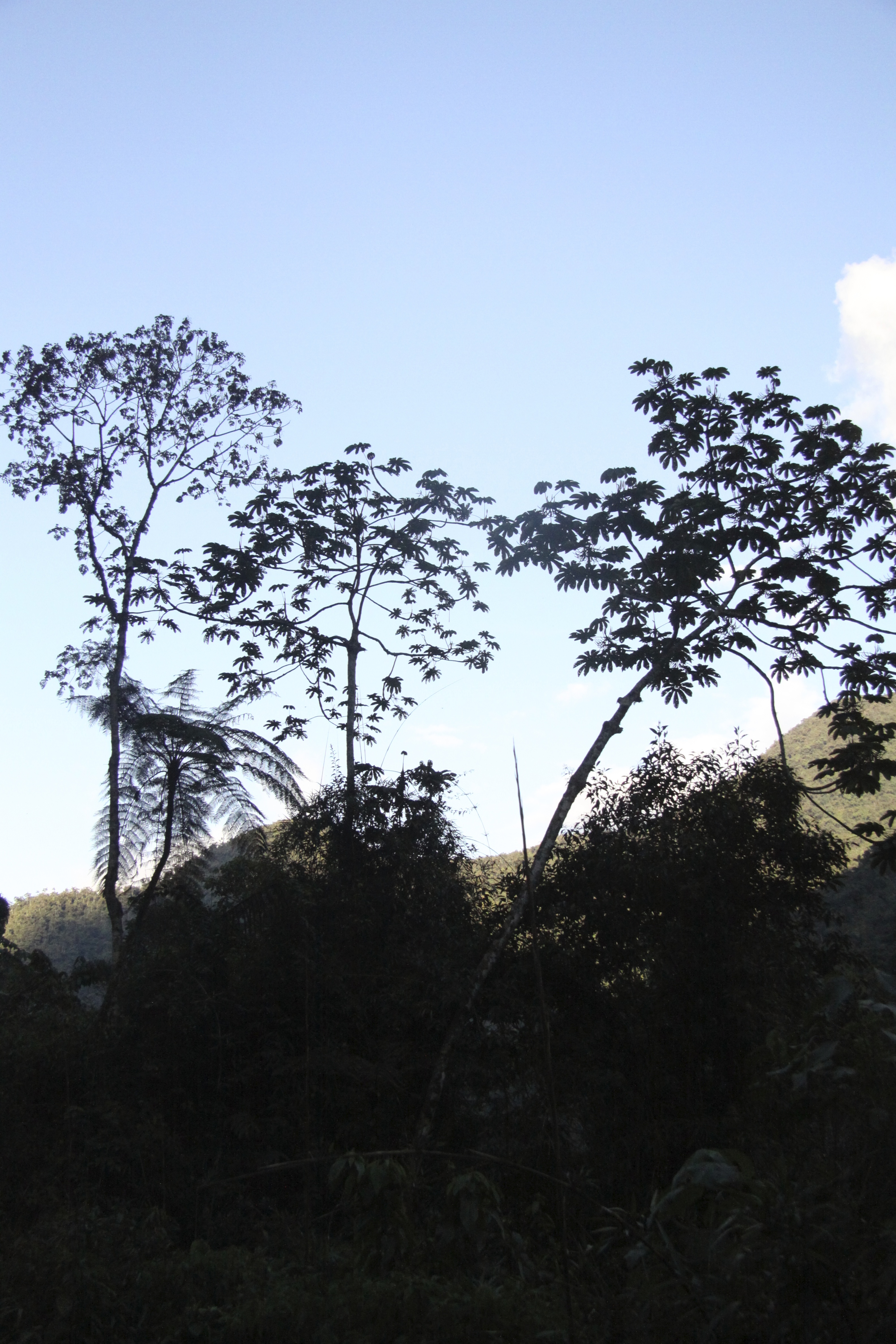
Looking up, the first silhouette of long limbed Cercropia trees confirms that the rain forest is beginning.

elfin establishWe walk down towards our lodge, drinking in the new sights:
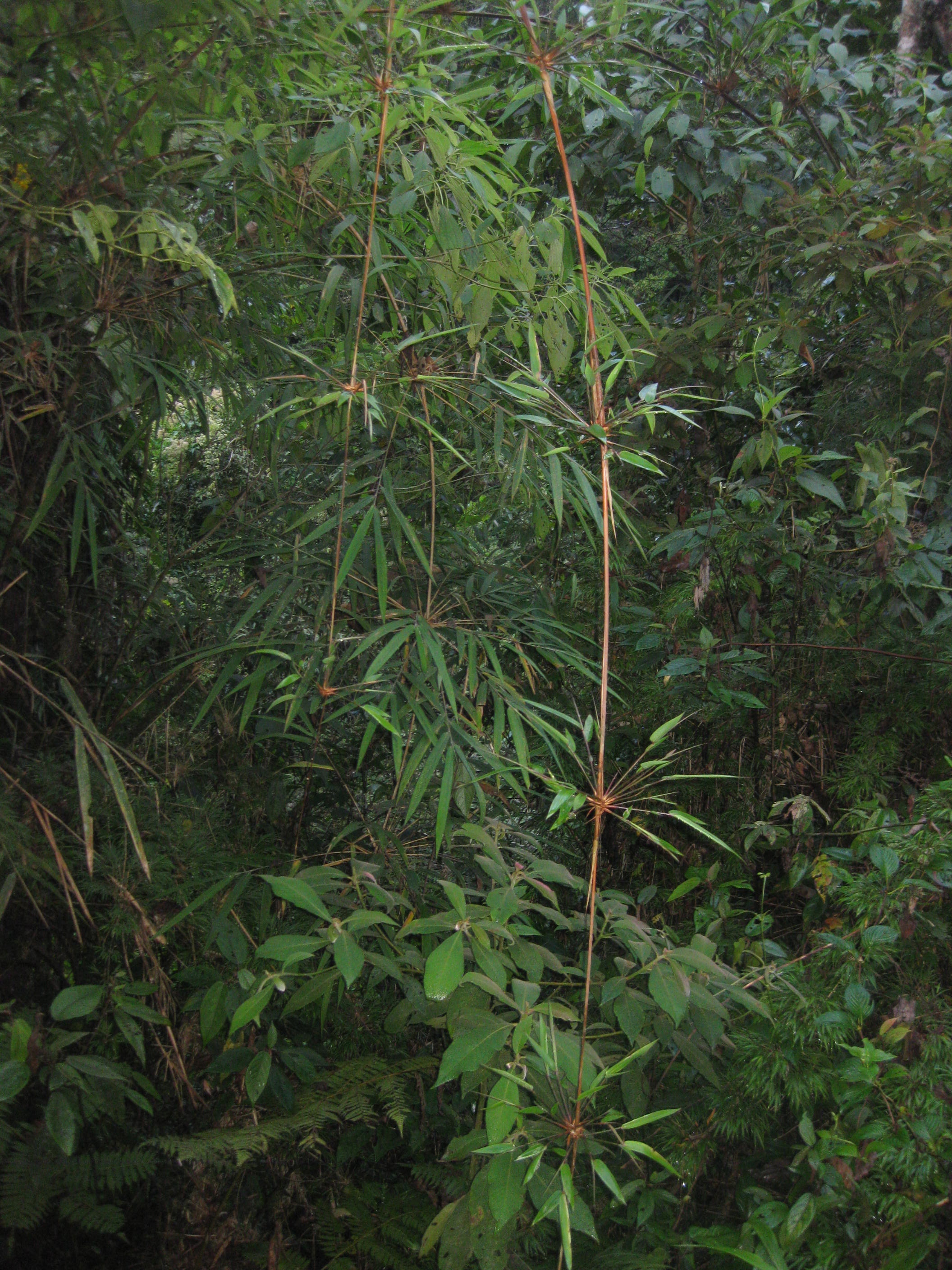
firework bamboo The brilliantly named ‘firework bamboo’ whose arching stems bear starbursts of green foliage.
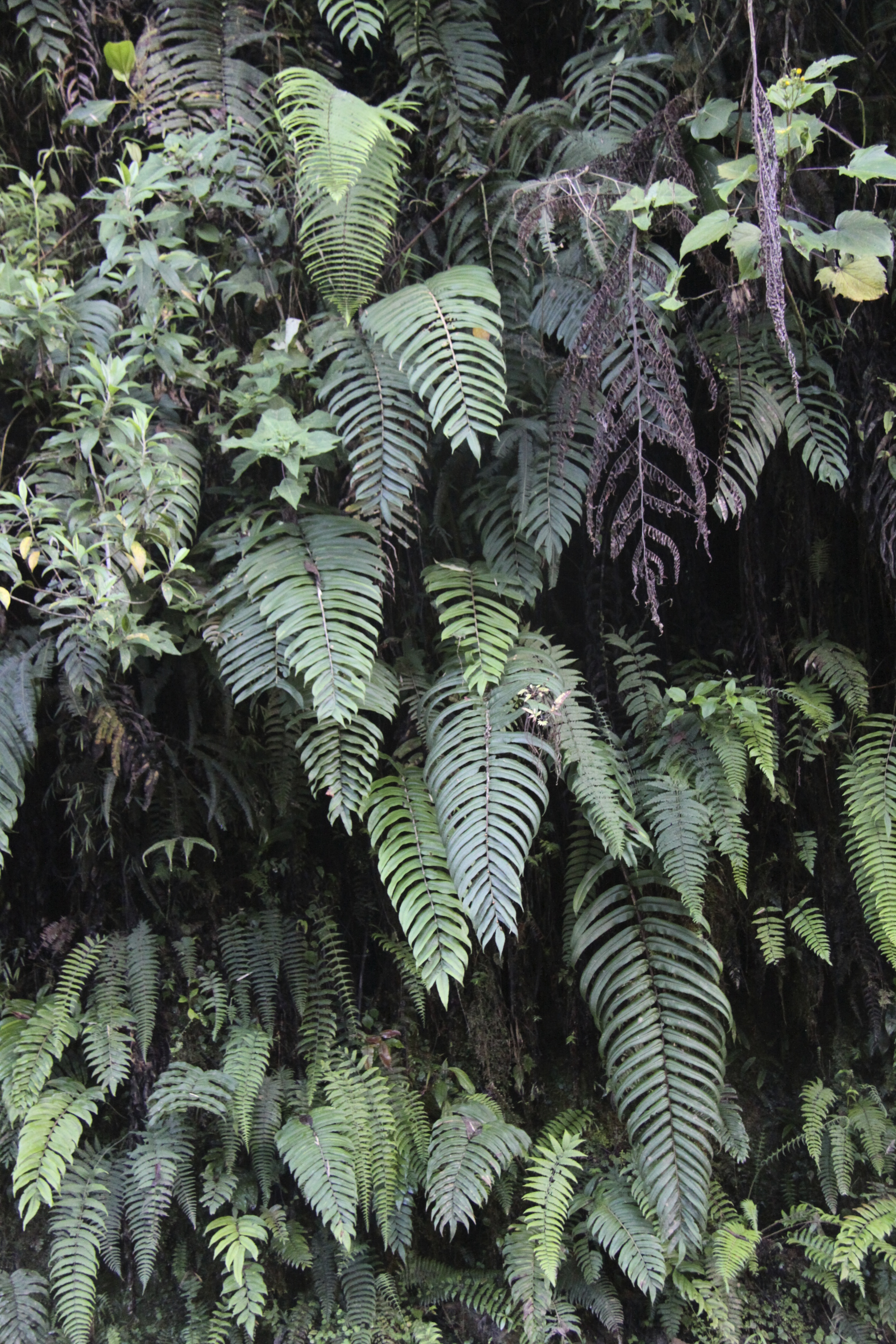
wall of fernEntire walls of outsize fern

rake fernperky rake-like ferns

elfin ferngorgeous green-stockinged, dancing-leg ferns

screen of fernlacy screens of fern

orange slipper plantthe sudden brilliance of a tiny velvety slipper flower

begoniadusty, palest pink Begonia trailing lightly down the steep banks to the roadside
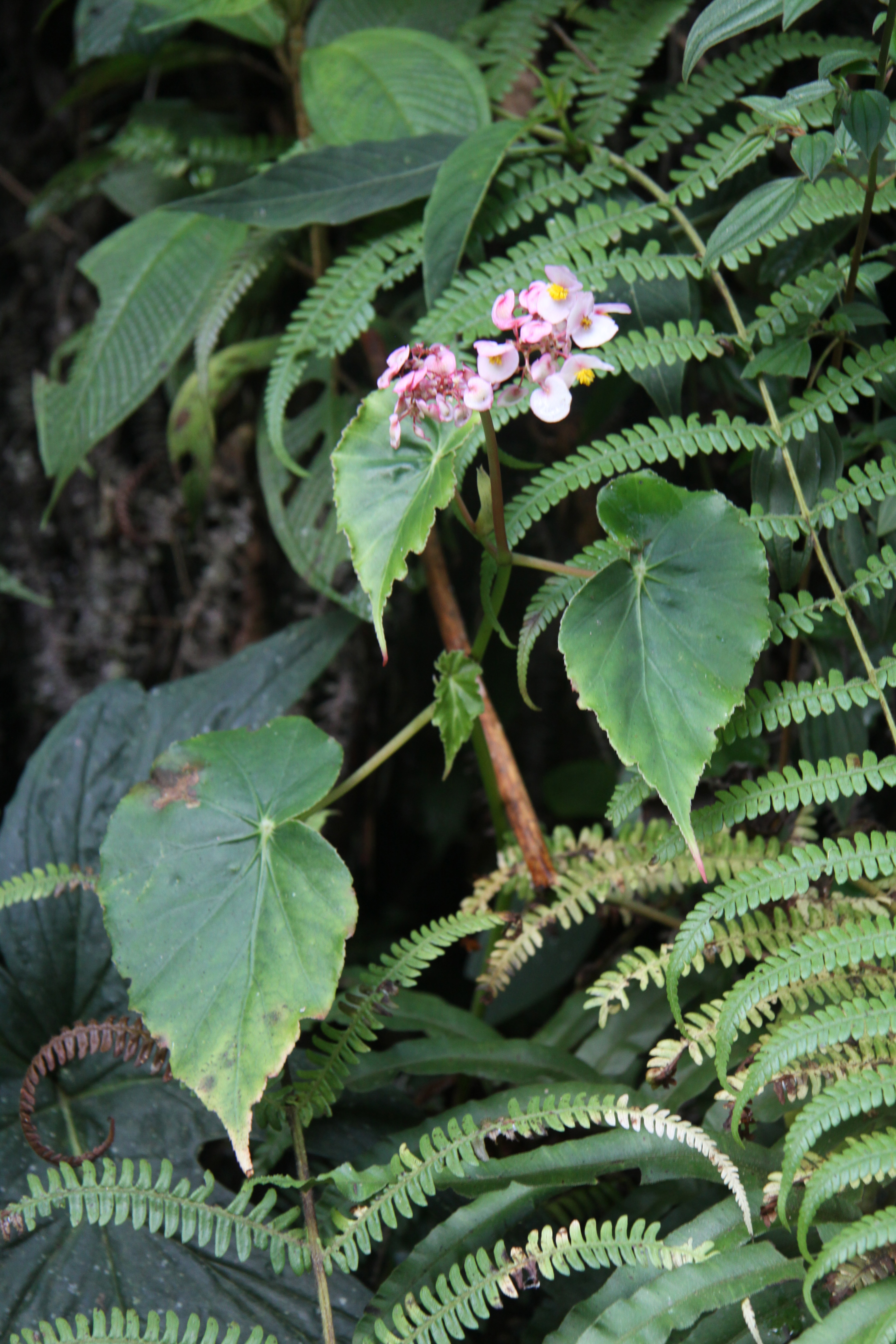
begonia 2A deeper pink Begonia

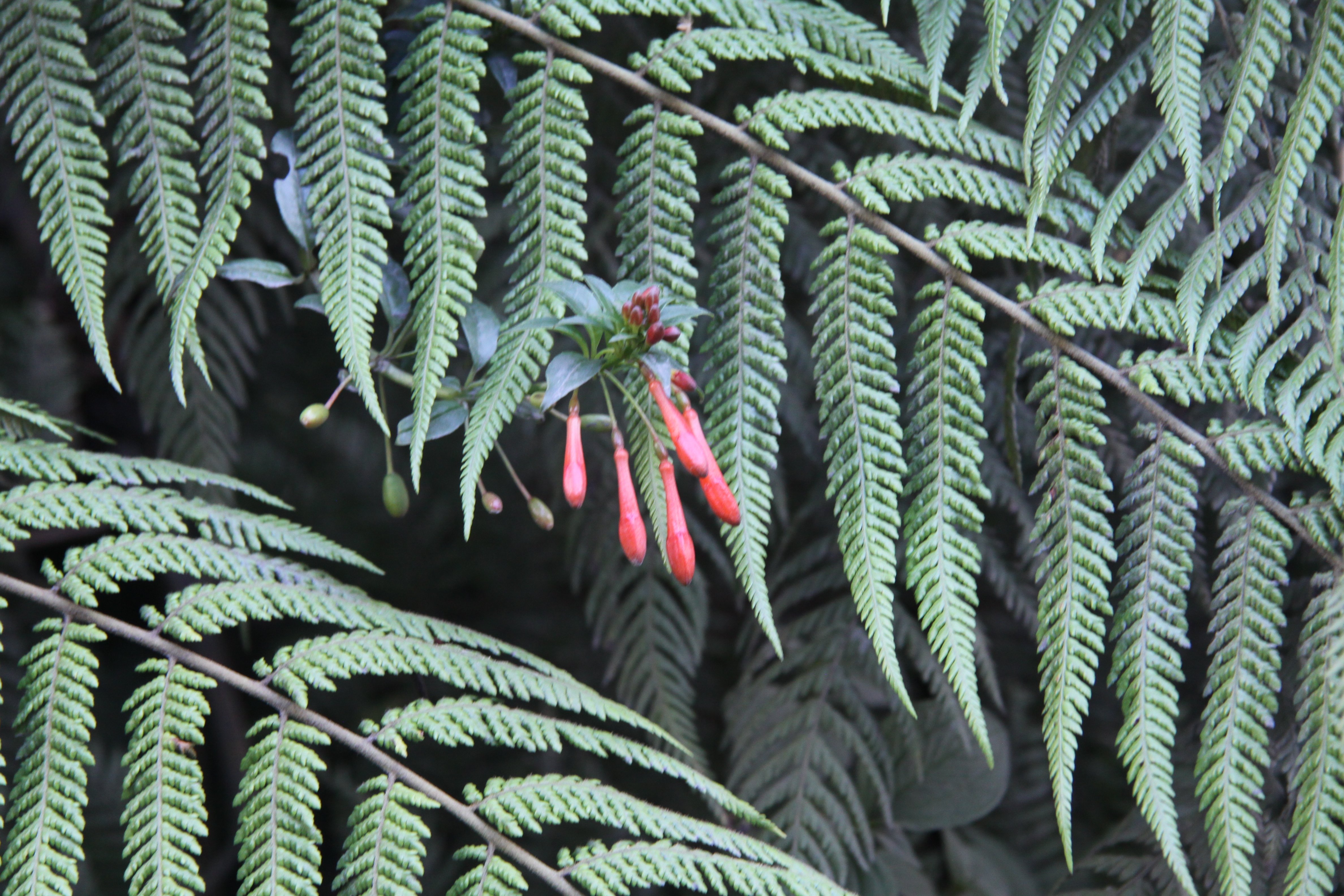
fuchsia and fern 1Slender, coral-red fuchsias against tightly regimented fern leaves

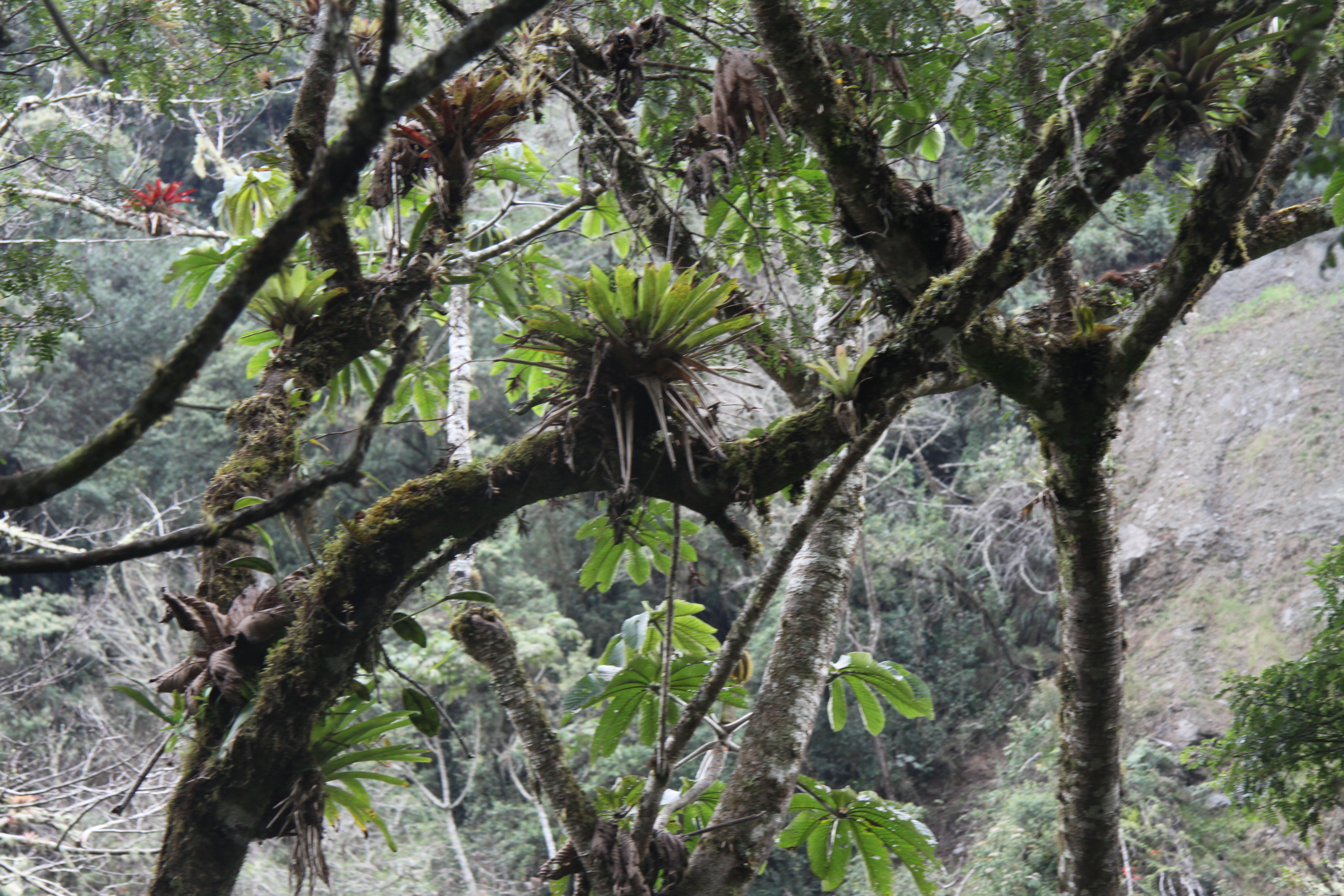
There are jauntily angled tree ferns throughout and branches laden with bromeliads just coming into flower:
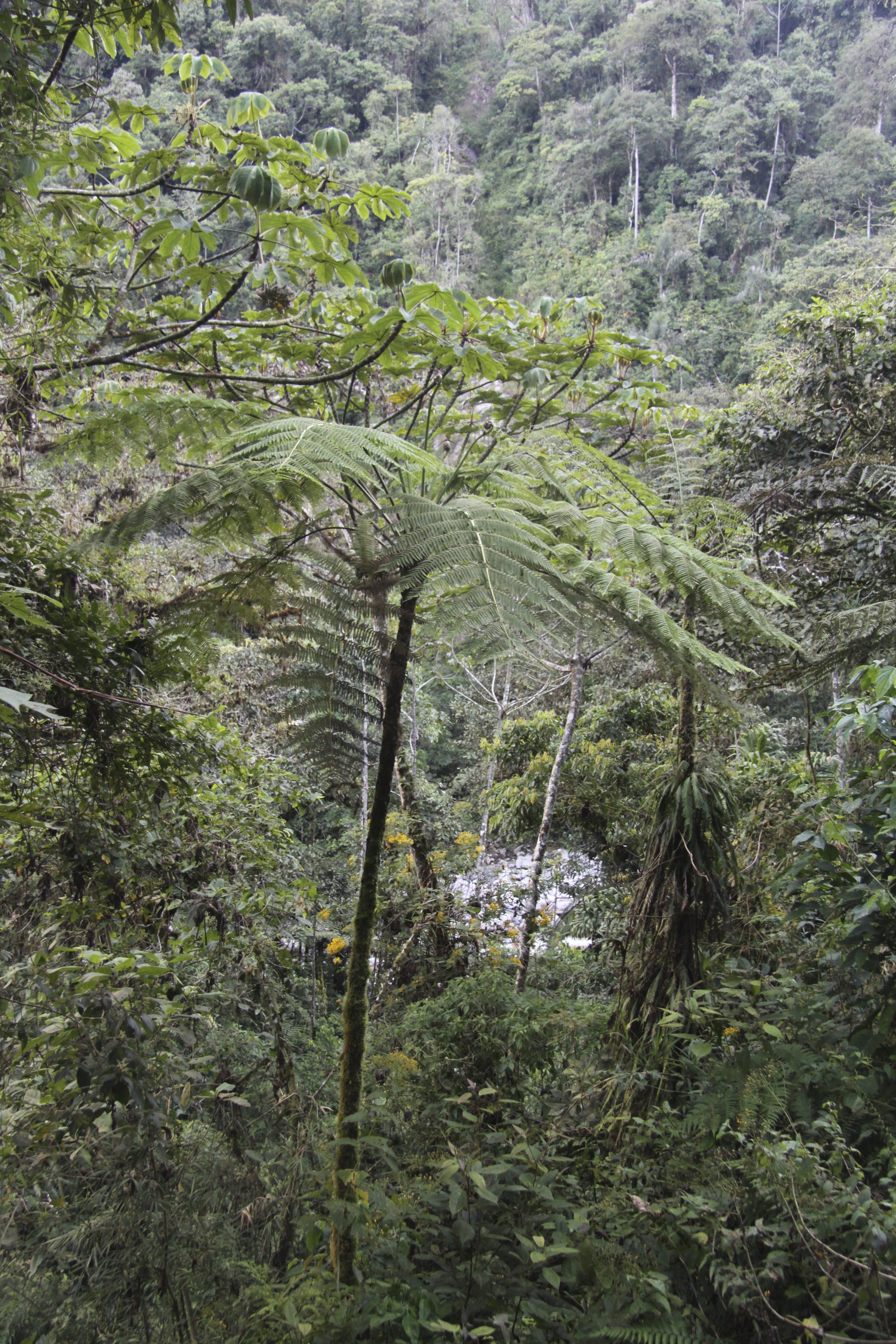
tree fernTree ferns make for a vibrant understorey.bromeliad 2Bromeliads on branches
I am gently frustrated because this is not really a botanist’s trip (I have a newly besotted twitcher husband and three boys whose highlights are the jaguar, camen alligators and monkeys we are to spot in the next few days) so I just drink in the lushness and the patterns and start quietly planning my return trip …

We spend the night in a stilted hut at a lodge with paths lit by these simple post and corrugated iron lamp holders:
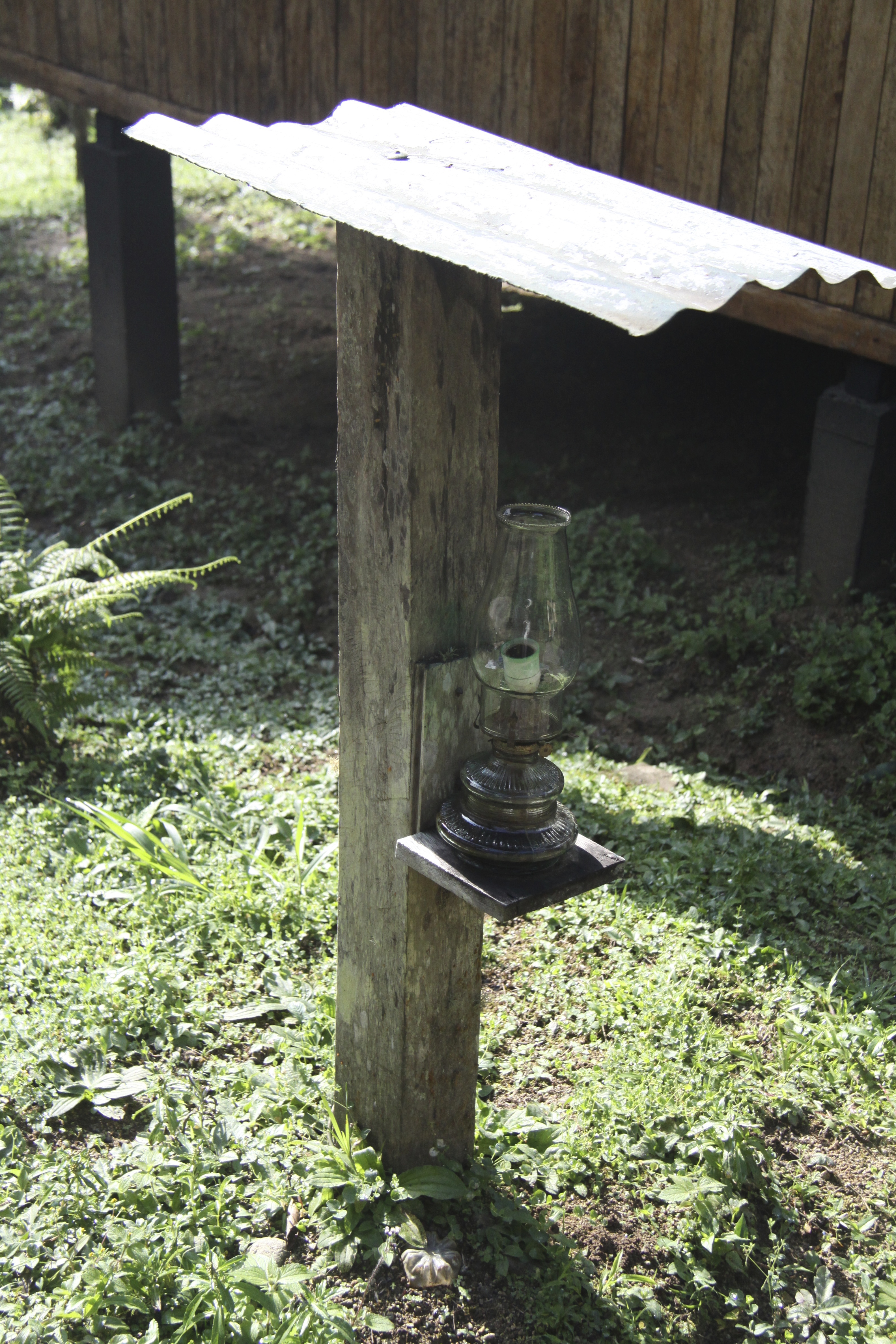
IMG_5224Post and corrugated iron lamp holder

We rise early rise to watch a dawn display of the Cock-of-the-rock (the national bird of Peru) and then travel on,  excited to glimpse at last the Madre de Dios river through fans of the vigorous pioneer grass, Gynerium sagittatum:

view down to riverMadre de Dios River seen through Gynerium sagittatum

 We are soon loading our boat which will take us to the Manu Learning Centre:

loading boatWe say goodbye to the few brightly coloured shops and houses at the river edge:

IMG_5282And set off with nothing but river and rain forest ahead of us:

river viewAt the Manu Learning Centre we have pretty rooms on stilts, open to the heady, looping birdsong of the jungle and we put our head torches onto our bedside tables for midnight trips to the bathroom and nighttime treks to find frogs and spiders…

jungle cabnpalm leafThe next day is dark and furiously noisy with constant heavy rain.  Our guides, Leo and Andy take us on a soaking walk through paths milky with deepening puddles.  It feels autumnal, almost, but every falling leaf is giant and doubly bright:

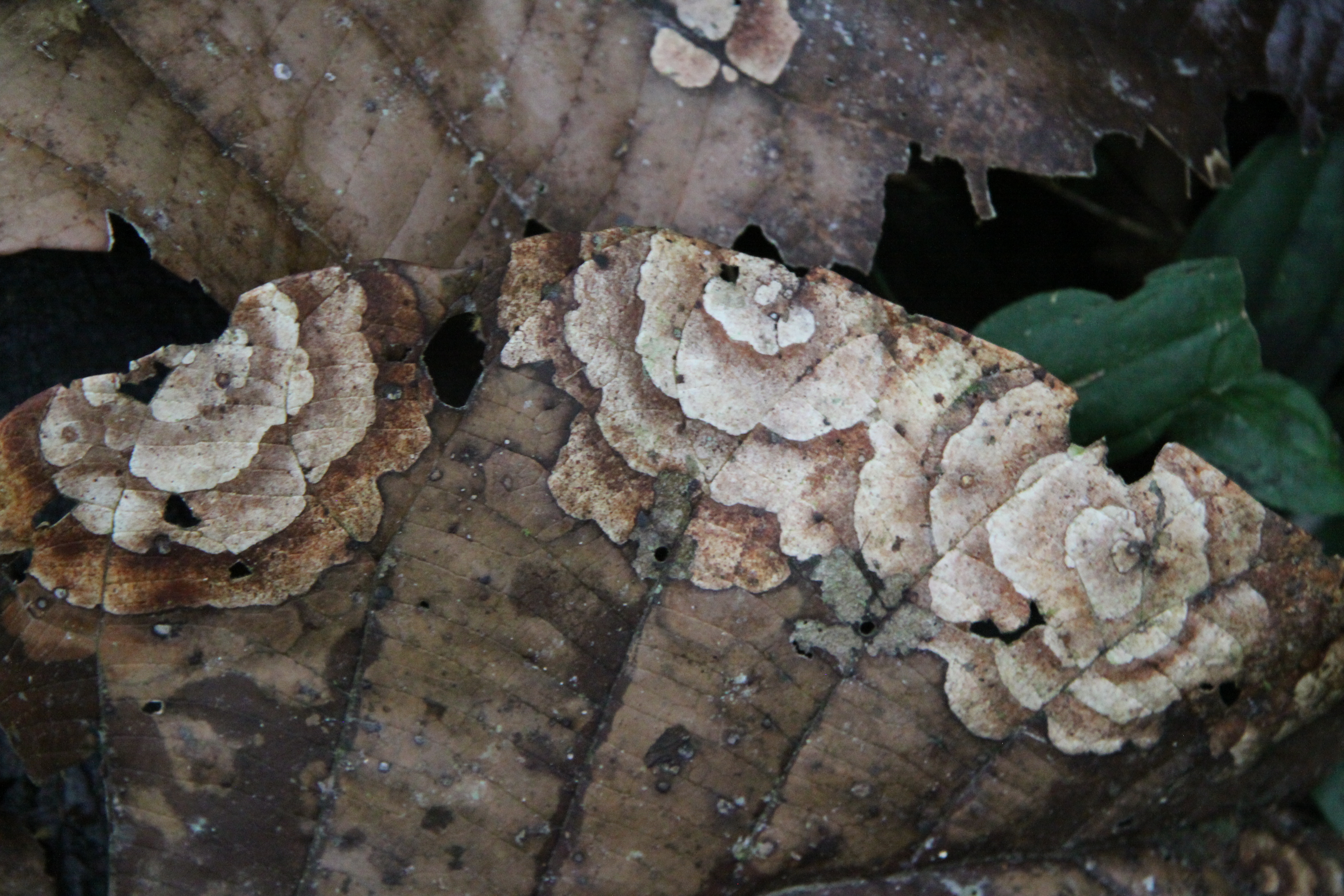
IMG_6521Andy shows us the most amazing, rose-like fungal patterns which form on some of the leaves:

fungus leaf 1 fungus leaf 2Beautiful fungal patterns on leaves

Strings of lipstick red passion flowers festoon the path edge:
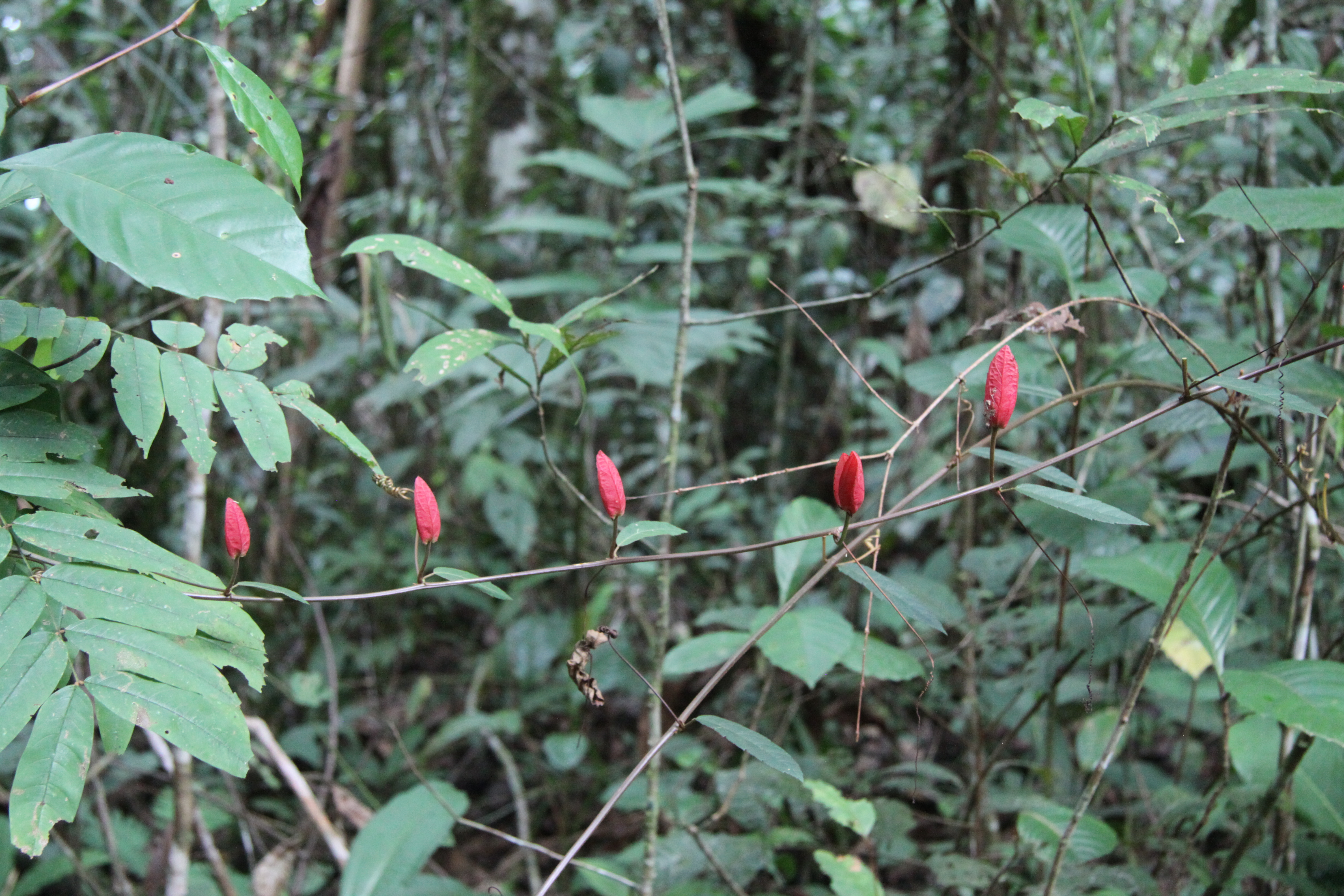
passion flower string

strings of passion flower budspassion flowerPassion Flower

Everywhere there is a root more extraordinary, a leaf more luscious, a tree taller than I am expecting:rain forestpanama hat leaf

liana tree

We arrive at the Mirador and I meet my favourite jungle tree – an Erythrina which is in full flower and radiant even against the heavy grey of the soaking skies:

red tree hideView from Manu Learning Centre Mirador

I love the almost Japanese quality of this spare burst of colour from leafless branches framed by the tight dark green foliage of the neighbouring trees:

red tree and japan in rain

The next morning we visit the Mirador again – it is positioned above a salt lick and the Erythrina tree is a magnet for pairs of Blueheaded Macaws, Crested Oropendola, Sparkling Violetear hummingbirds (what an name!) and many other birds:

bird in red treeA Roadside Hawk
pair macaw

A pair of Macaws arriving at the Erythrina tree

It is enthralling to see the early morning cloud, gently rolling,  quilting the black-emerald, densely laced, canopy of trees:

cloud over river

As the sun rises the flowers of the Erythrina glow suddenly and brilliantly:

first sun on red treeThe Erythrina tree illuminated by the morning sun.

As we learn about the rainforest – the pressure it is under from logging and mining, the hopeful work of organisations such as Crees in regenerating depleted forest,  I am reading Germaine Greer’s ‘White Beech’ – her account of trying to regenerate 60 acres of sub tropical rainforest in Queensland Australia.  It is not a smooth read but I admire her spirit and am shocked by her reminder of the United States’ use of ‘Agent Orange’ in Vietnam – apparently by the early 70’s, 20% of the Vietnamese rainforest was destroyed, as well as tracts of rainforest in Laos and Cambodia.  Greer is unrelentingly feisty: “For years I carried a can of Agent Orange in my luggage, ready at the first opportunity to spray it on the White House rhododendrons..”

As we head deeper into the rain forest, the quality of light on the Manu River is increasingly memorable.

We spend ten hours travelling down river just watching and reading – and eating ‘Juane de Gallina’ for lunch – a fantastic parcel of rice, yucca, chicken and olives steamed in Bijao leaves from the forest:

lunch parcel

Our Amazonian lunch – Juane de Gallina
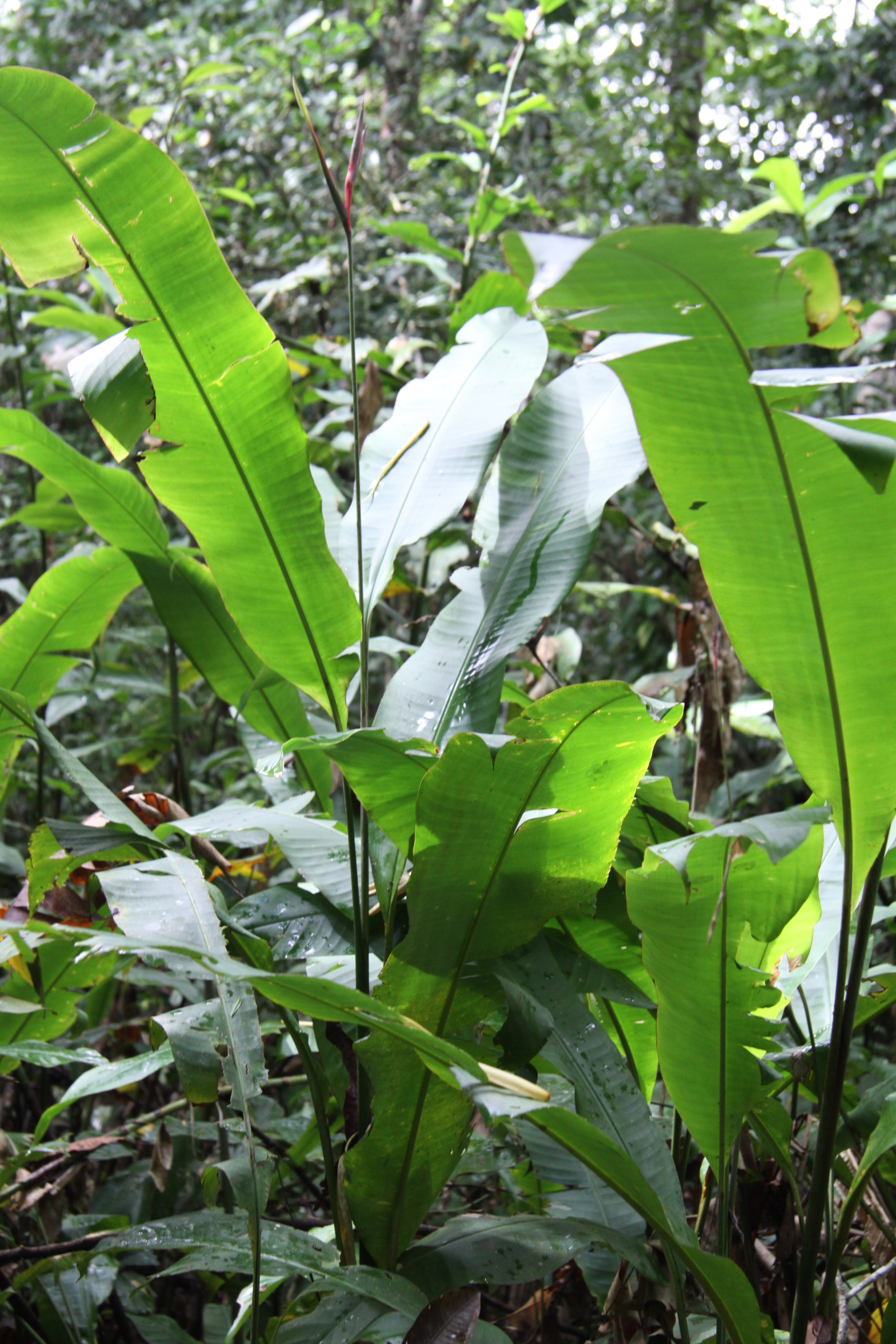
leaves for parcel bijaoBijao growing in the rainforest.

We spend a wonderful late afternoon on a wooden catamaran, rowing quietly about in an oxbow lake, following a family of giant otters. The water is completely still and the reflected forest is beautiful:


earlier refelction reflection end day 2 andyOur guide, Andy Whitworth, Head of Research at the MLC

On our final day we are back in our boat before sunrise. The sunlight swells up, pink then orange, creating fantastic filigree silhouettes. We eat a perfect breakfast of cold, slightly lemony pancakes and fruit salad – papaya, watermelon, pineapple – with plastic cups of Nescafe while we watch. 

dawn amazon pink light dawn woodcut silhouette trees orange dawn light woodcut bamboo

And completely suddenly it is bright daylight!

its day time

All at once we are bundled out into dusty logging village, racing for a plane.  The colours are bright but there is the sudden slap of plastic and petrol and sexy calendars and women walking with grubby babies under strangely genteel, pastel-coloured umbrellas amidst towering piles of sawn timber:

funky logging house IMG_1474IMG_1464

The ghostly leafless trees we pass speak for themselves:

logged forestDying trees in logged rainforest South-Eastern Peru

After a couple of days in a regular hotel back in Cusco – and supper the first night in a brightly coloured hamburger bar enjoying the calming music, red wine, chilled fizzy water and all the comforts we thought we had been missing – we were simultaneously hit with that wave of disappointment you always feel when you have exchanged the intense for the ordinary.

We feel rather tied into a visit to Machu Picchu and head off with an air hostess of a guide by car along the Urumbamba River. Luckily I am perked up by the ruggedness of the views and by the exciting cowboy-cactus planting and gorgeous Inka stonework at the town of Ollantaytambo:

fab view from car to cuscoView from the the Urubamba Road

silhouette town before machu

town before machuTough native plants scrabble for survival on the hills around Ollantaytambo
stone town before machu

Beautiful simple carving at the Inka settlement at Ollantaytambo

The next day we take a terrible Peru Rail ride towards Machu Picchu – we feel hemmed in by the unspeakable Andean-piped Beatles’ songs and drinks served on Inka-style table mats and even a fashion show delivered by a cheery combination of both rail stewards AND passengers to show off a range of luxury Alpaca ponchos …

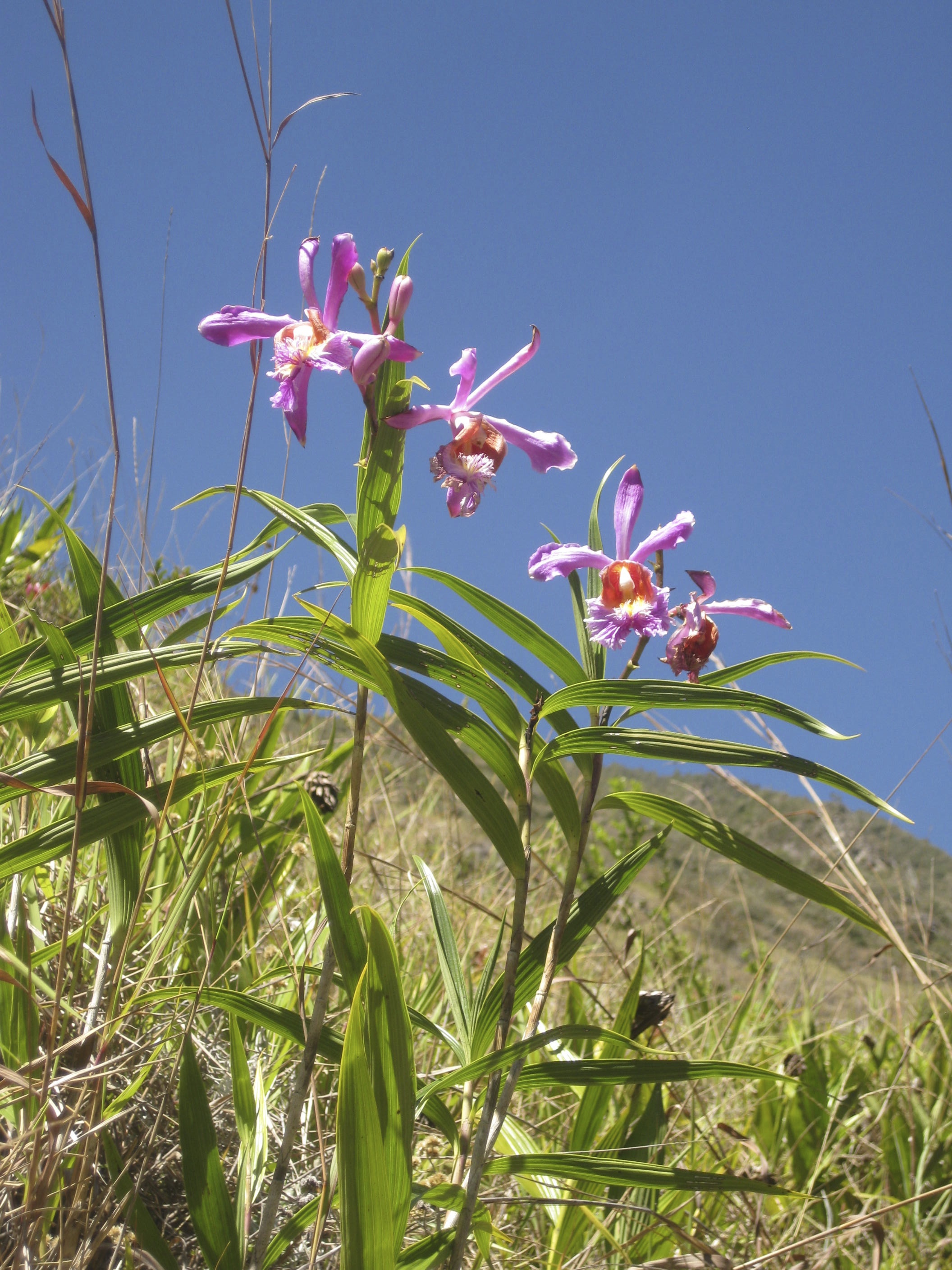
I remember, enviously, the almost outrageous freedom of Patrick Leigh Fermor and his party who visited the site on foot in 1971: ” We found a few marvellous giant yellow orchids, growing as large as daffodils on the tips of bamboo-like stalks six feet high. Carl (the ex ski champion and jeweller) and Andrew (Duke of Devonshire ) laboriously hacked up the tangled roots of one of them next day with a kitchen knife.  It is to be replanted in the new conservatory at Chatsworth, and if it takes, we’ll all get cuttings or bulbs.”

At least there are still some splendid views and some lovely wild flowers to see on our day long approach to Machu Picchu:machu pichu shrub machu pichu orchid sobralia 55

Sobralia dichotoma – an orchid commonly found on the Inka Trail – with long stems up to 6m in height
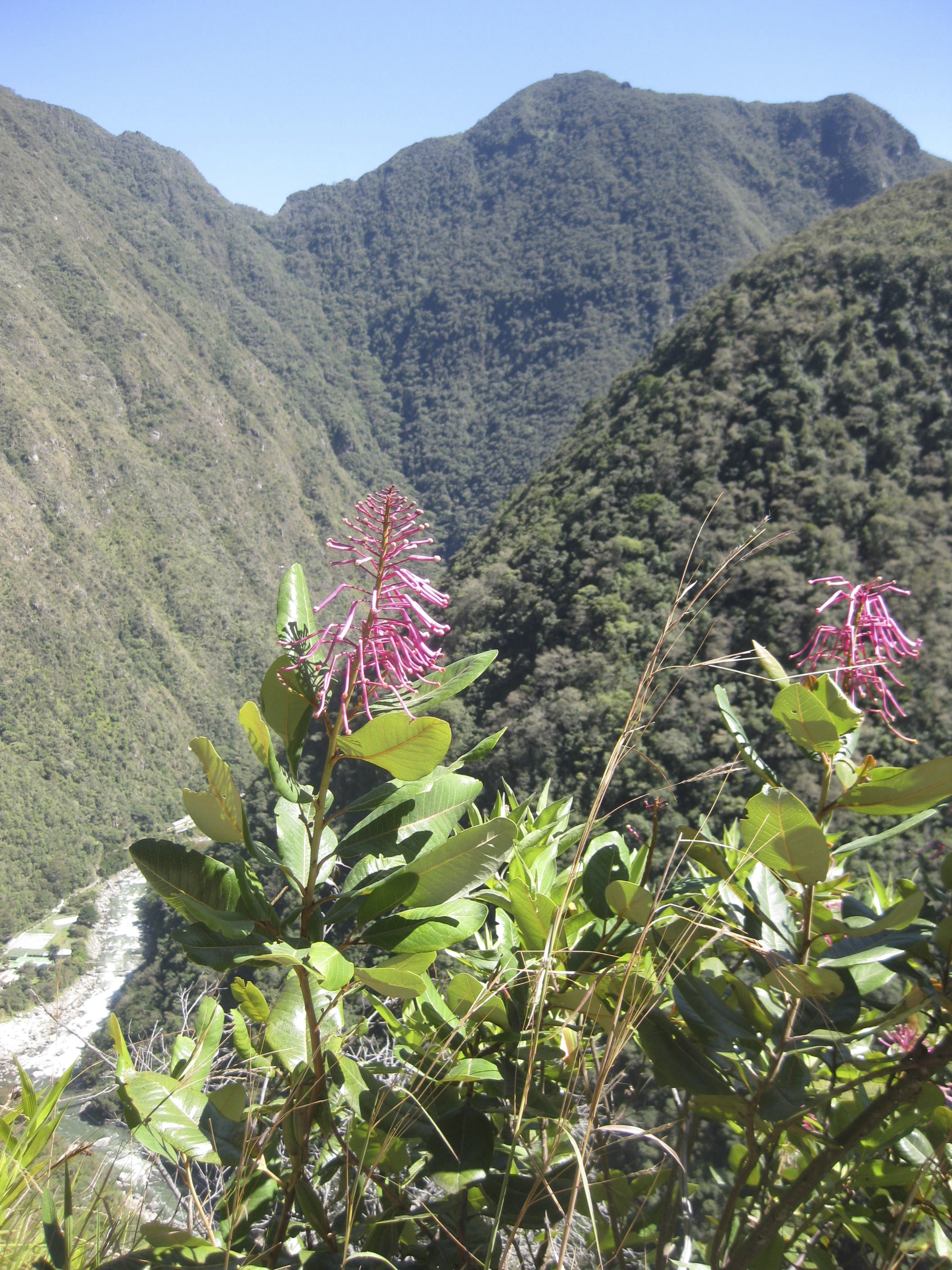
llama llama 52 shrubsOreacallis grandiflora or Llama Llama plant near Machu Picchu

machu pichu treeMachu Picchu itself – resplendant with proud single stem tree at its centre

And there are some wonderful five hundred year old examples of a view perfectly framed:

machu picchu view machu pichu stone view close up stone view

An Opening in a stone wall frames the view magnificently at Machu Picchu

That night we stay at the gorgeous Inka Terra Machu Picchu Pueblo Hotel.  This time I am completely ready for crisp white sheets, eucalyptus scented hallways, paths lined with headily perfumed Brugmansia arborea:brugmansia arborea

Brugmansia arborea at The Inka Terra Machu Picchu

handsome stone holders for outdoor candles:
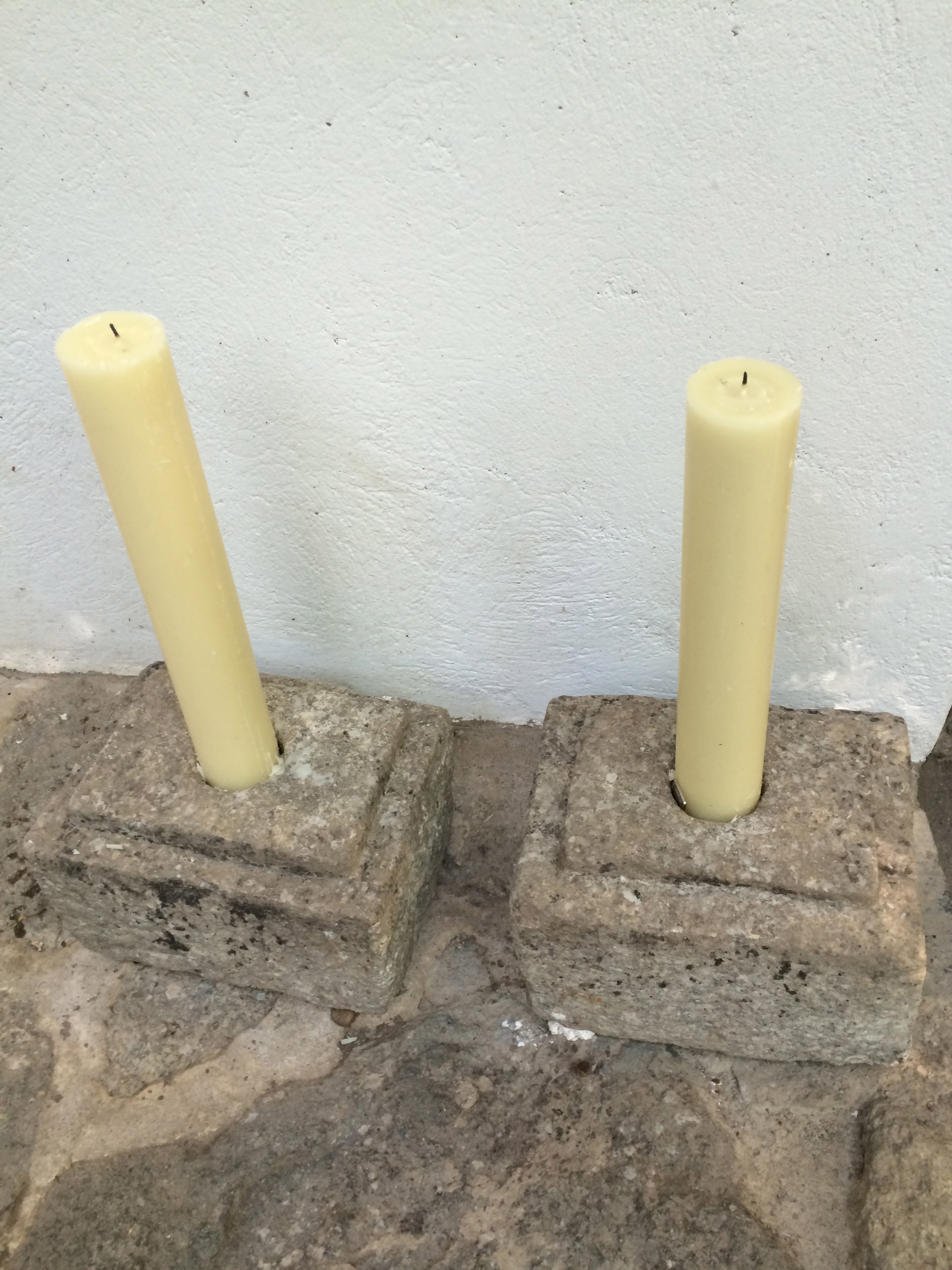
stone candle holders

… and a wonderfully controlled lush view from my room:

lush green view hotelView from our bedroom at the Inka Terra Machu Picchu

Our final leg of the journey is by bizarrely comfortable, black-leather seated all night bus to Huaraz, high up in the central Sierra of Peru.

The sky on the days we are here is a constant exhilarating blue. We are at over 3000m altitude and climb quickly by taxi to the cosy, eco b&B ‘The Lazy Dog Inn’ at 3600m

IMG_1798IMG_1822There is an uplifting, almost aching, clarity to every walk. By the time we reach a magnificently cold, milky blue glacial lake a half day trek – and a further rise in altitude of 600m – from our hotel, air is rasping at our lungs. The wind suddenly whips down the temperature and one of the boys throws up – a swift darting reminder of how fragile we are in this beautiful wildness.

glacial lakeGlacial Lake, Cordillera Blanca

I love the Cézanne-like jagged shapes and shadows of the mountains:cezanneI love the sculptural toughness of the Agave americana and its soaring flower stems against the bleached blondness of the sierra:
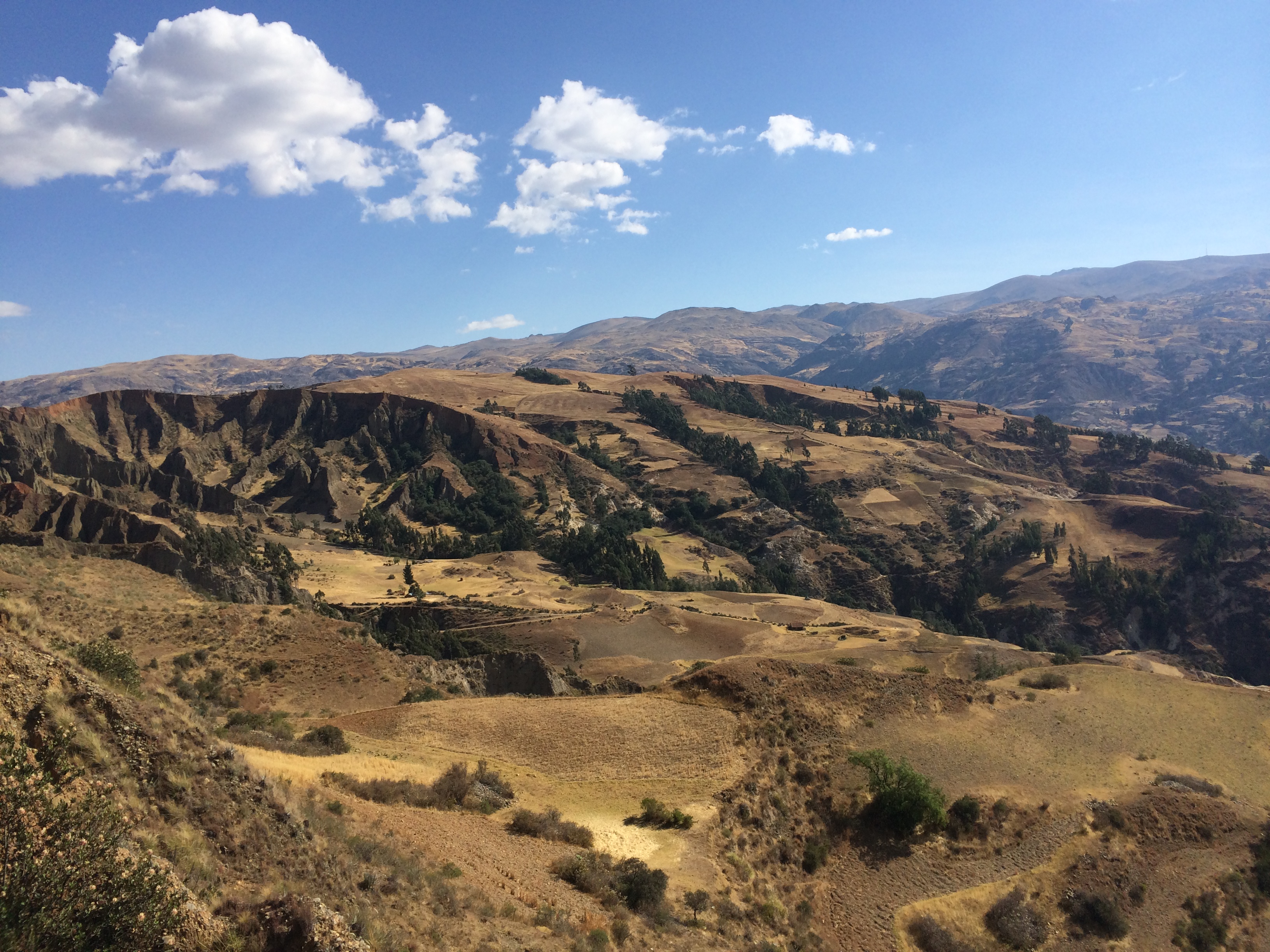
agave high andesagave
agave americana 58high AThere are postcard perfect empty valleys where we find swathes of wild lupins:

startrite walktree lupin plus streamtree lupinAndean Wild Lupin – Lupinus mutablis

And everywhere there are cushions of brightly flowered cactus nestling on rocks covered  in fine webs of spun wool:
cactus 1cactus 2

cushions of flowering cactus

The turf in the valleys is nibbled tight and studded with the tiniest palest blue primrose like flowers:tiny starry flowers At the valley edges stands of thorny Barnadesia horrida are alive with humming birds and the Andean bee:startrite  walk with shrub pink flower llaulli p54 startrite walk
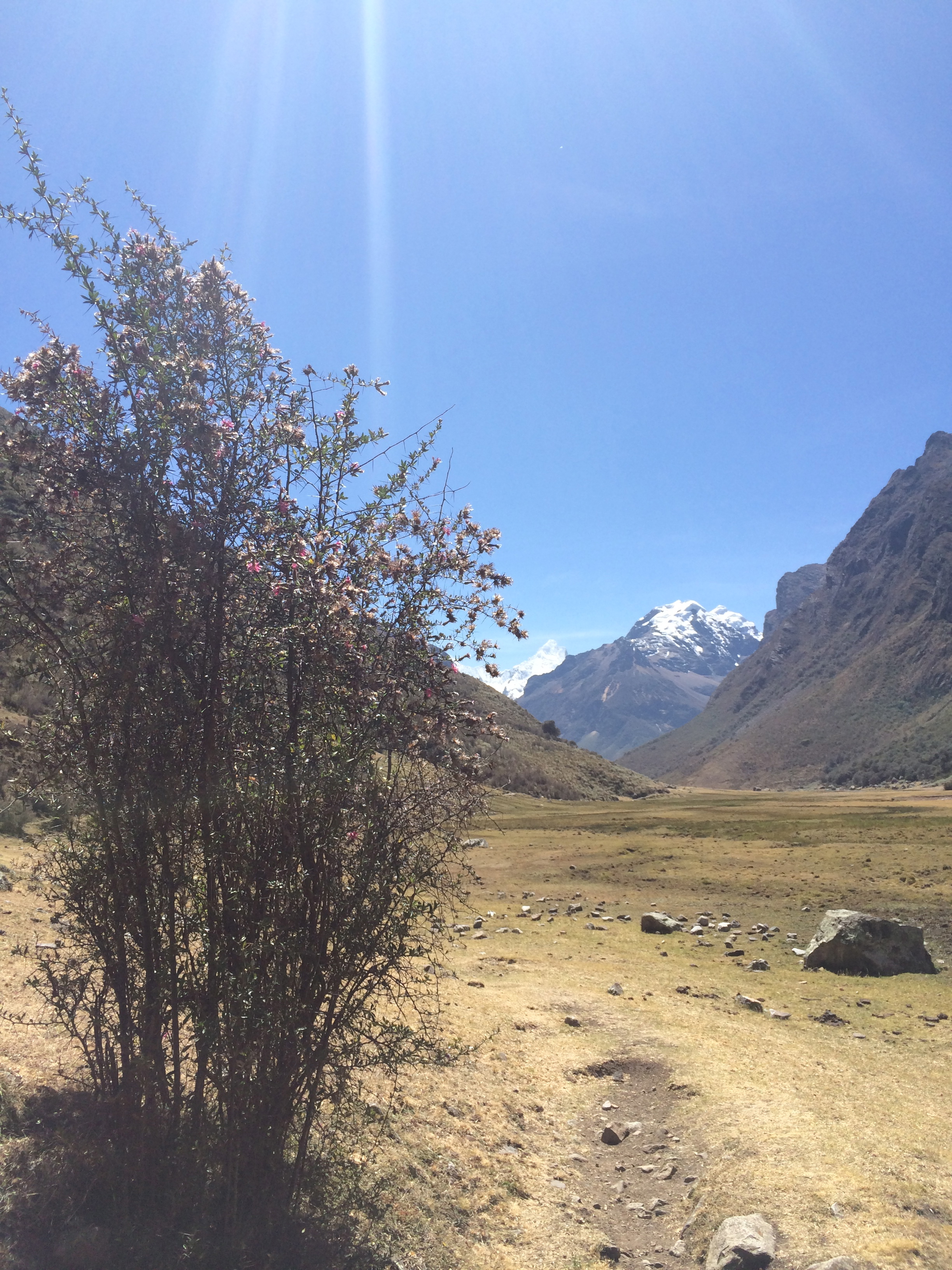
Barnadesia horrida

As a taxi takes us back to The Lazy Dog Inn at the end of another trek –  the soft late afternoon light illuminates the silvery wands of roadside pampas grass:

pampas grass from car

Pampas grass growing by the roadside

IMG_1740

Me with my cheery, bearded, traveller-husband in the Cordillera Blanca

We return to The Lazy Dog, to cosy soups and chocolate chip cookies and fragrant fires made up with Eucalyptus kindling and started with dry Eucalyptus leaves:

lazy dog eucapluptusg

Eucalyptus trees towering over the stables at The Lazy Dog Inn

The view before nightfall is barely believable:

lazy dog sunsetSunset viewed from the Lazy Dog Inn, Cordillera Blanca


WHAT TO EAT UNDER A MOUNT ETNA BROOM?

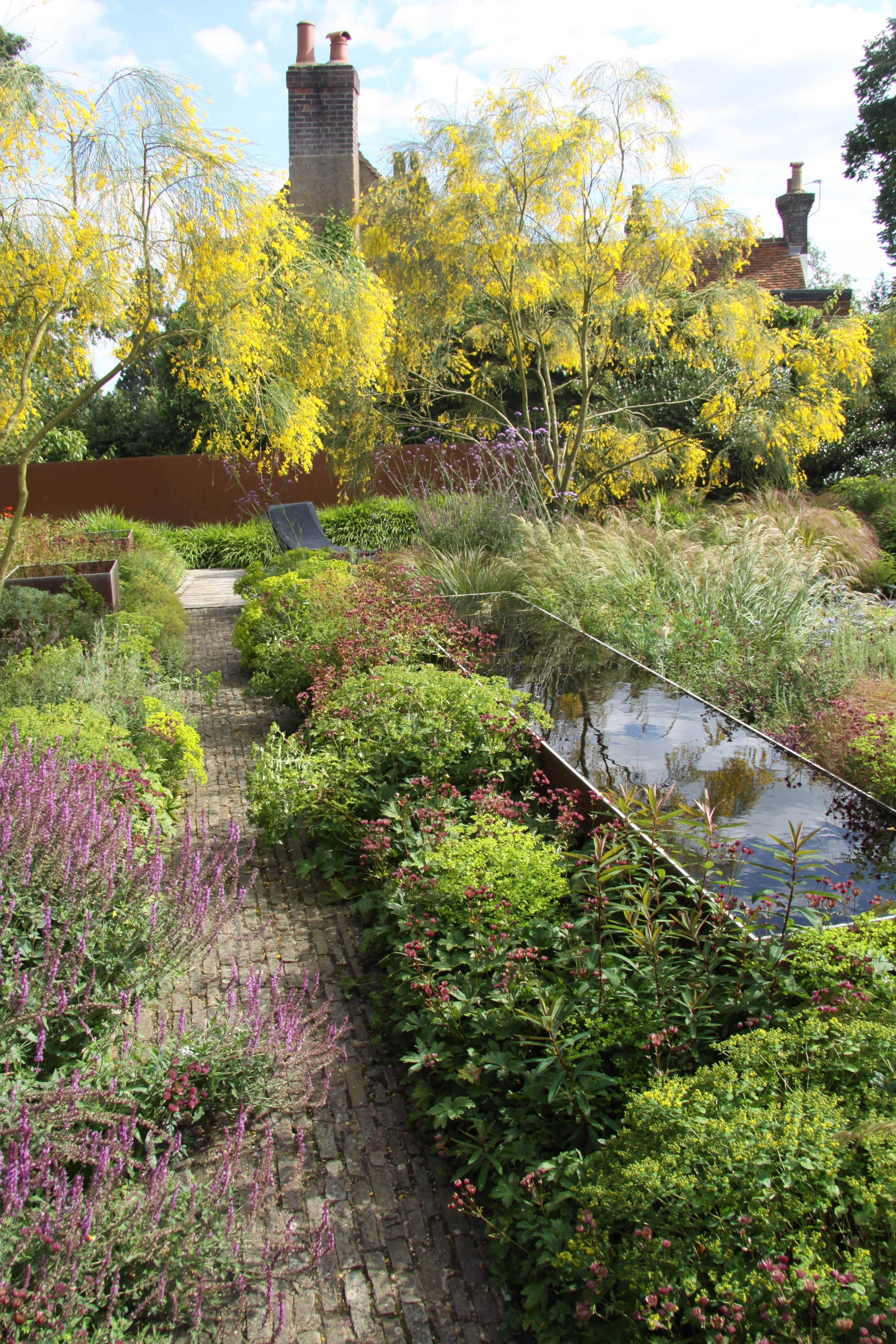
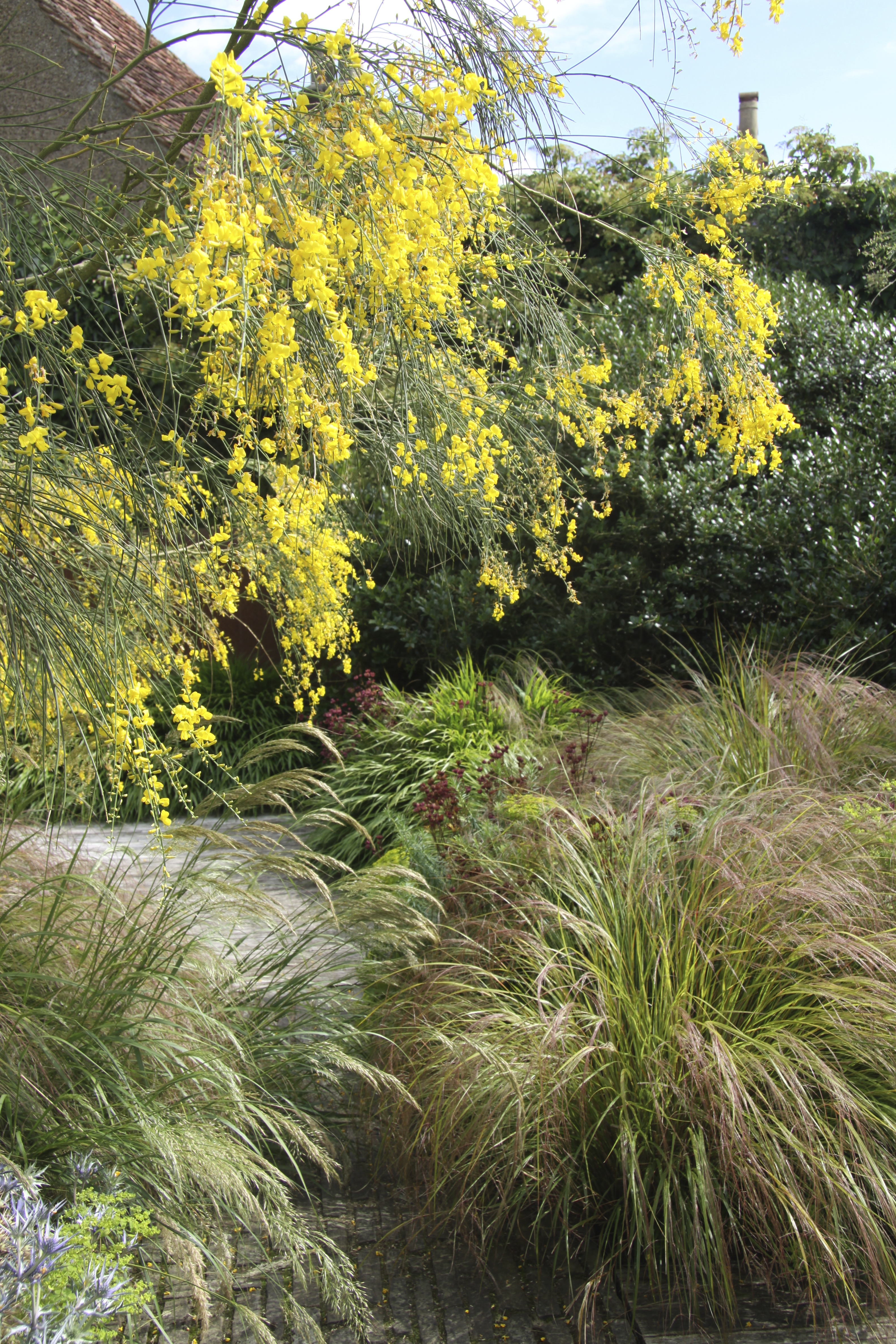
    TOM STUART-SMITH’S VIBRANT, SCENTED JULY GARDEN (AND THE CAKE TO MATCH IT) broom and seatThe Sunken courtyard garden, Serge Hill  with brilliant yellow Mount Etna Broom billowing overhead and a soft tapestry of grasses, salvia, astrantia and Euphorbia at ground level


The problem Tom Stuart-Smith must face when he occasionally opens his Hertfordshire garden is that none of the visitors are inclined to leave.  It is a glorious Monday in July and only a few miles north of the clutter and bustle of the Edgware Road. I step out of my car and am immediately met with this: idyllic, gently rolling parkland –  blond grass and spreading oaks, the view softened by perfectly judged swathes of uncut meadow that divide the house from the countryside beyond:

the view from Serge Hill

The view from Serge Hill

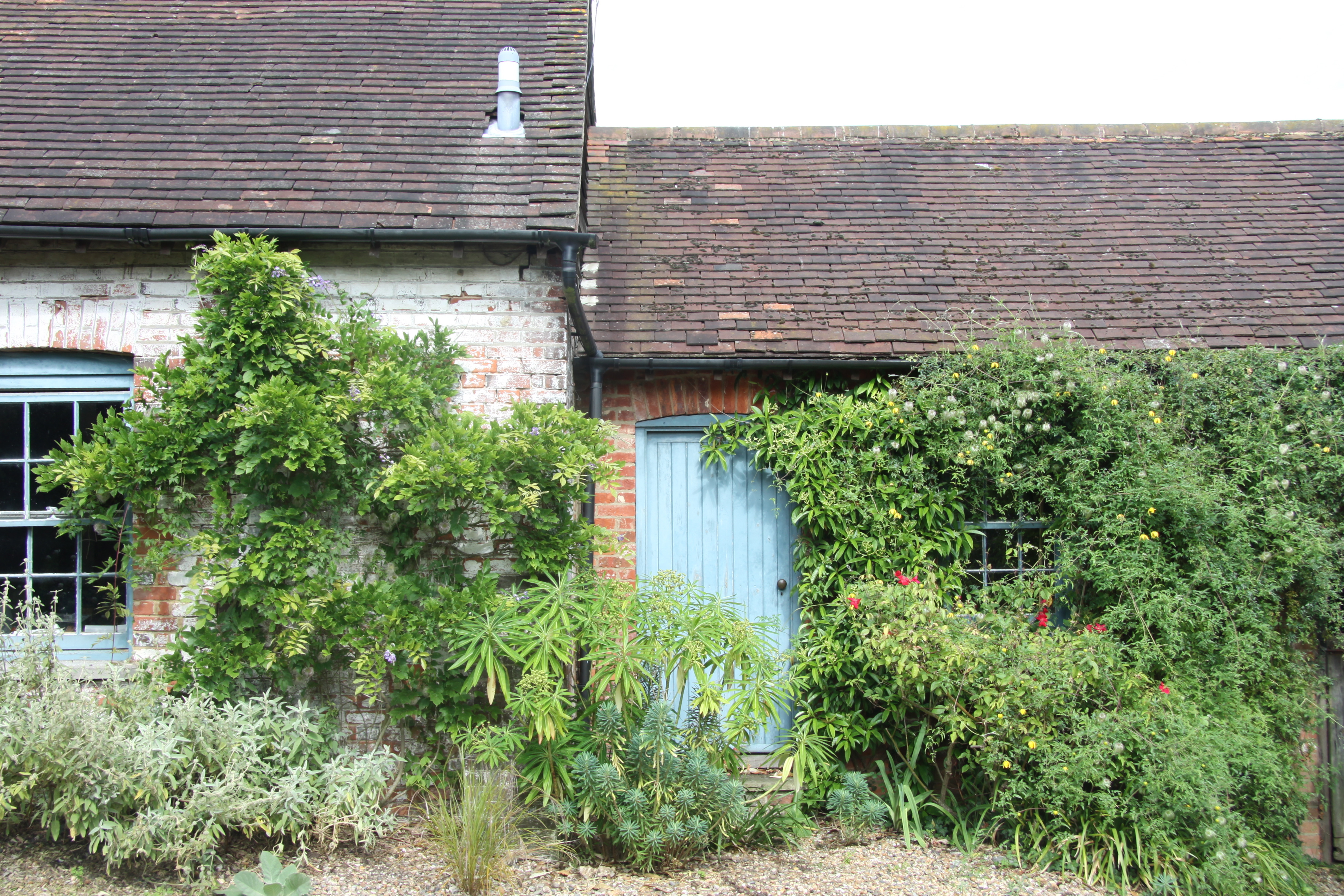
Sweetly clad outbuildings begin the sense of welcome and tip you, deliciously unsuspecting, into the different garden spaces beyond. IMG_5005

Outbuildings festooned with clematis and roses

Turning right, my breath is taken away by stretches of pale, delicate Echinacea pallida which float freely like exquisite jelly fish in the Prairie.

IMG_4853 (1)

Echinacea Pallida

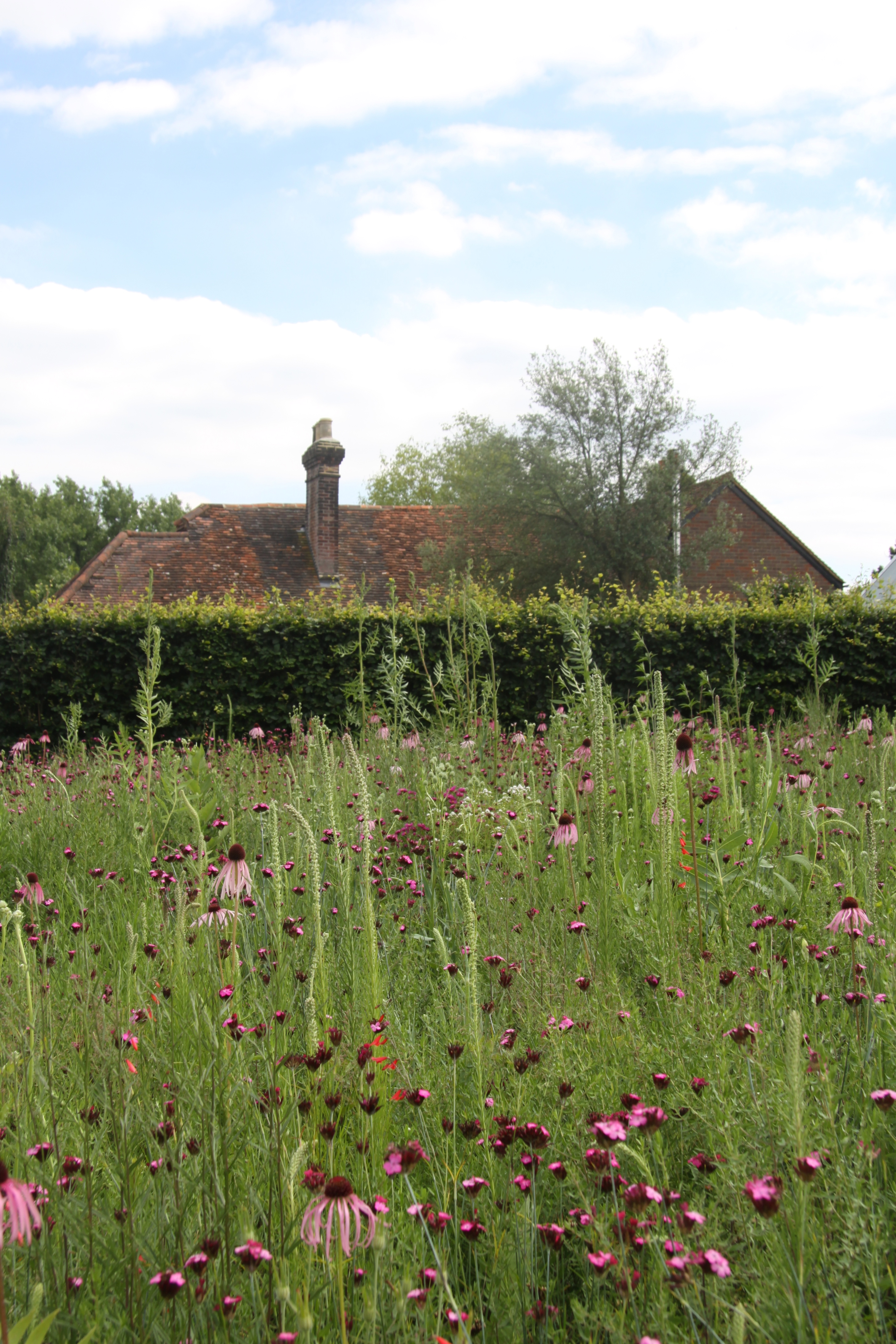
In this gorgeous area of of prairie planting Tom has created a dreamy place to experiment with broad sweeps of colour and form: as each plant comes into its own it casts a certain new intensity or contrast of texture on the scene. Here, fantastically generous quantities of Dianthus carthusianorum add both an earthy density and an almost luminous glow to the softly pastel, slightly shredded quality of the Echinacea.

pallida and carthusianorum

Dianthus carthusianorum and Echinacea pallida

The wonderful coral red Penstemmon barbatus coccineus is scattered gently through the planting to lift it away from the coolness of the pinks:

echinachea

Coral red Penstemmon barbatus coccineus amongst Echinacea and Dianthus carthusianorum

And there are – almost hidden –  dashes of a really wild orange from the native American milkweed, Asclepias tuberose

dianthus pentstemon and orange one

Asclepias tuberose with Dianthus carthusianorum

The whole scene is naturally masterfully framed – here by handsome hedges and rusty roof tiles:roof and meadow

Here by the simple pale blue-grey of the corrugated iron building designed by Ptolemy Dean:corrugated roof and the tall onesThe towering forms of Silphium laciniatum – another native American prairie plant, the Compass plant – seem to herald a leitmotive throughout the garden, as if Tom Stuart-Smith is keen to ensure that there are tall elegant shadows of his tall elegant self just in case he is not personally there to greet you.

the tall ones

Silphium laciniatum against the sky

Through a simple oak gate into a classic, scented kitchen garden:

IMG_4901

It is at this point that the visitors – who are here to support the NGS and The Garden Museum – begin to find the whole thing highly covetable and start to put down their own roots.  The Prairie has been a surprising and ethereal adventure but here, there is a manageable, settled feel with that brilliant combination of productive order and sense of overspilling colour that you get from the happiest kitchen gardens:

verbena kitchen

Verbena bonariensis and Allium sphaerocephalon amongst beans in the kitchen gardenkitchen garden sans ladiesView through to the Pelargonium and tomato-filled greenhouse

kitchen garden door

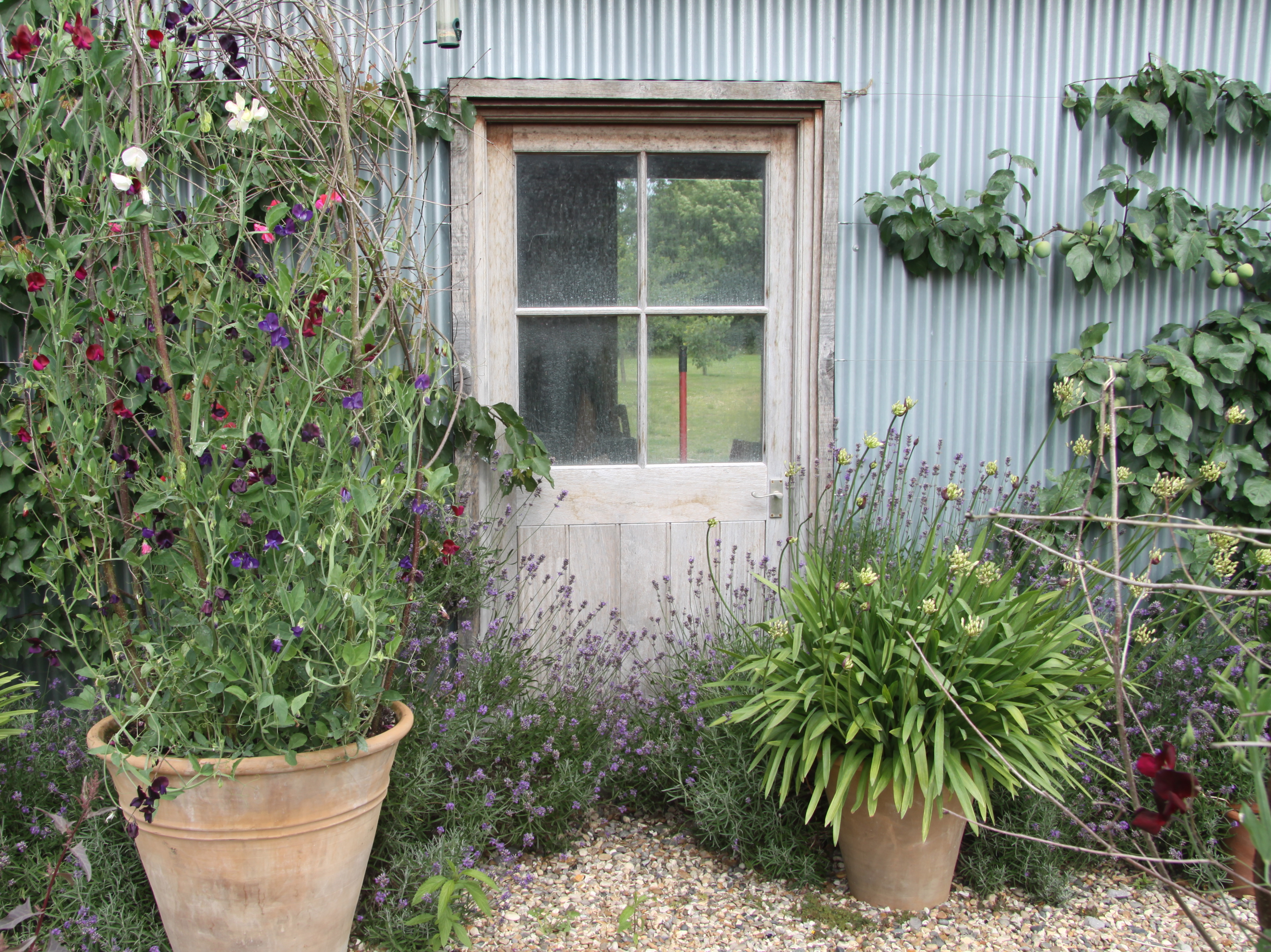
 The blue-grey corrugated iron and bleached wooden door of the kitchen garden ‘shed’ a subtle backdrop to pots of scented sweet peas, white agapanthus, espaliered fruit trees and lavender.

tulbaghia against cabbageIMG_4905

Tulbaghia violacea a brilliantly perky edging to a bed of moody blue-green cabbage

Back out of the kitchen garden and into the calm of meadow and hedge:

IMG_4919

A further rounded, shaggy yew hedge forms a protective embrace around the main family garden:soft protection of yew

Beyond the hedge I find myself in a rich terracotta, green and fading mauve haven of comfort and softness.  This a National Garden Scheme version of the Marie Celeste – the table and chairs are set out and ready to go, an embroidered cinnamon coloured shawl is draped casually over a bench the doors to the house are breezily ajar. But there are no Stuart-Smiths about and again the visitors find themselves settling down at the table, moving on only with difficulty:terracota barnThrough the barn windows framed by a voluptuous draped vine, there is an intoxicating glimpse of rich yellow from the Mount Etna Broom beyond:IMG_4924Palest yellow hollyhocks provide a serene offbeat echo to the riot of yellow through the archway:yellow holly hock

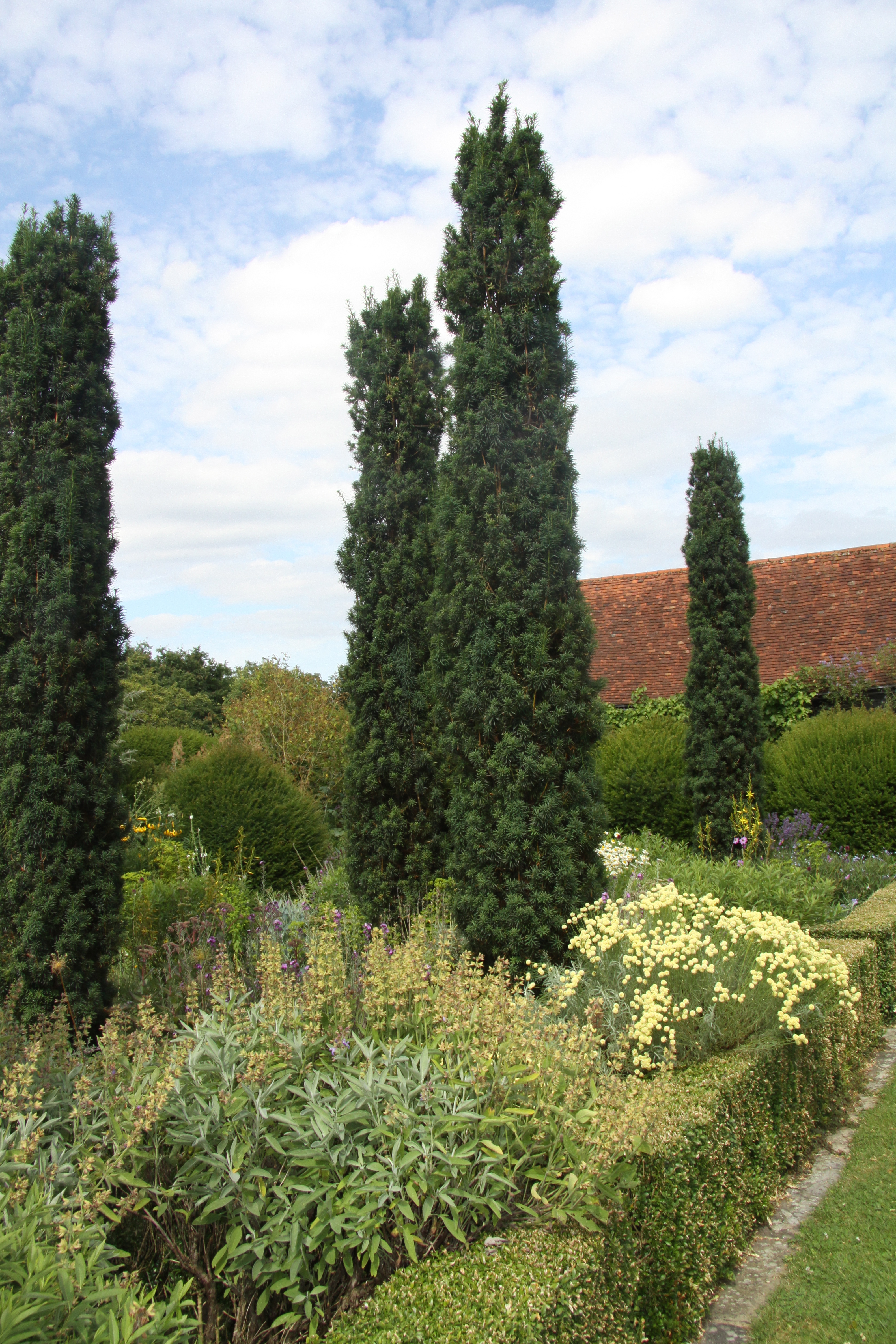
As you pull away from the house you reach a potentially formal area of clipped box hedges and sky-scratching yew columns (that Tom Stuart-Smith leitmotiv again) but in fact the topiary shapes serve more as a happy, forgiving foil to overspilling herbaceous planting.

yew columns terracotta roofThe topiary shapes are used as a happy, forgiving foil to overspilling herbacious planting:yew columnsStately white Epilobium dances in the space between the yew columns

phlomis and stipa lightStipa gigantea and Phlomis russeliana catch the light

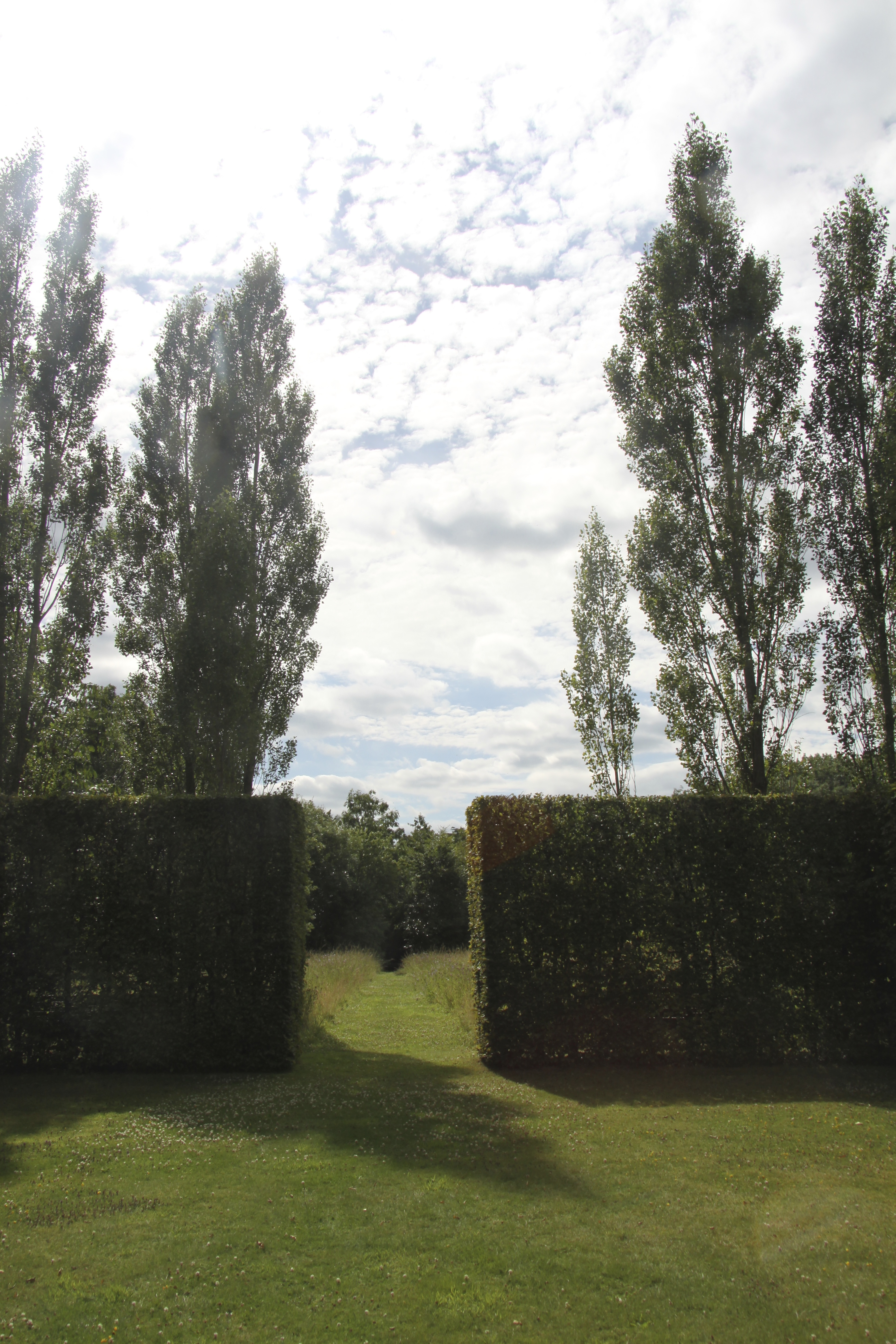
There is a moment of elegant calm with neatly clipped hedges and a troupe of slender, lacy poplars (the need for something tall and slim again):IMG_4948

Poplars and clipped hedges agains the sky

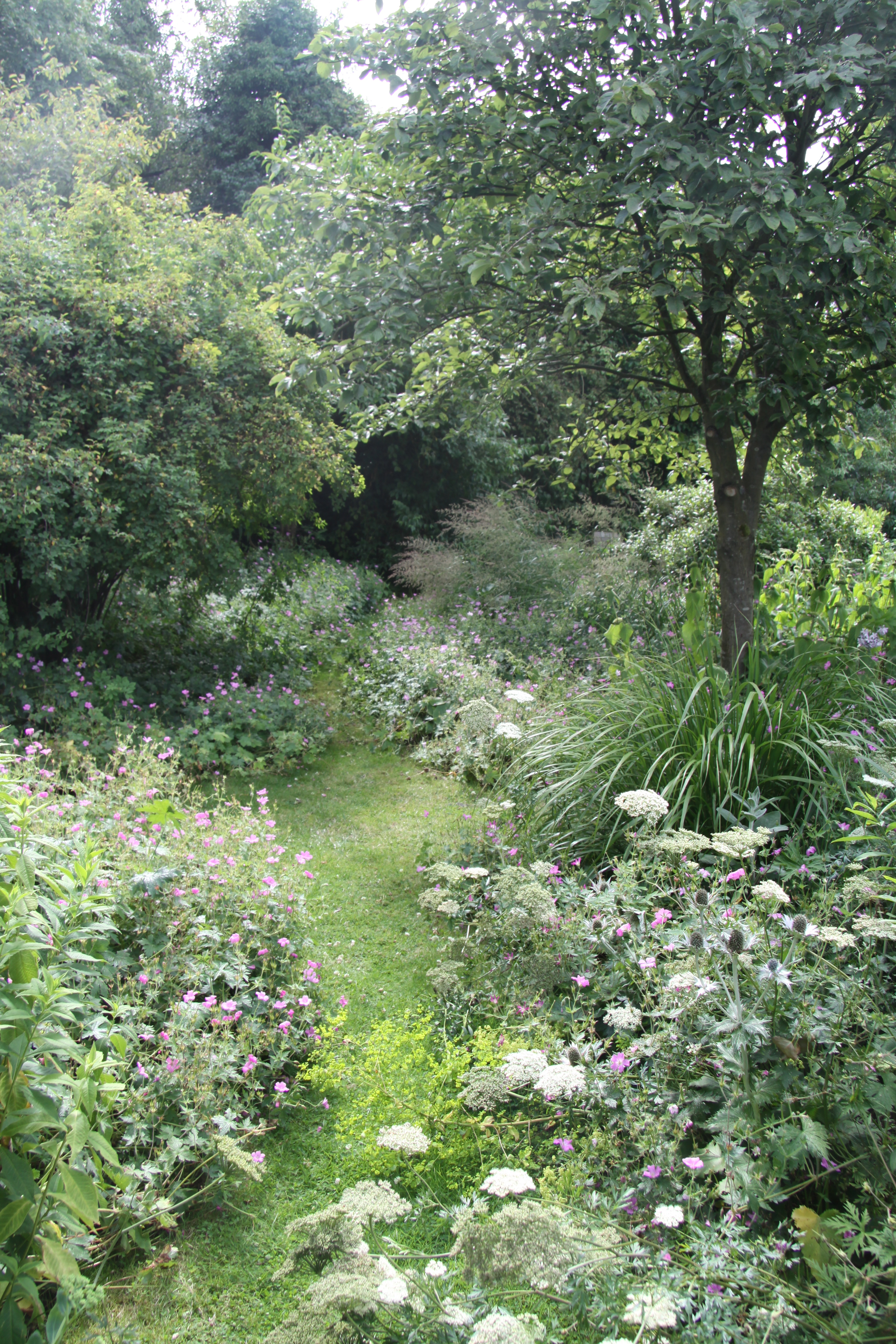
And then the chance to meander along gently shaded wooded areas: shady walk

The planting combinations are simple, and always brilliantly thoughtful – here a blue geranium is illuminated by the tiny rice like flowers of the arching grass,  Mellica altissima ‘Alba’ :

melica and blue geraniumMelica altissima ‘Alba’ and a blue geranium

Here a rusty coloured Helenium and a dark red Dahlia have the glaucous foliage of Macleaya cordata as a backdrop and the signature brilliant green underplanting of Hakonechloa macra:

dahlia , machalya, helenium and hakenacloadahlia etc + maclaya to skyA wooden bench is almost hidden by the surrounding planting (again I watch as visitors make their way almost competitively over to this so that for a few precious moments the bench can be their own).snuggly bench

And then I am back to the sweet outbuildings again, almost forgetting that my tour is not yet over:

IMG_5005But beyond a papery constellation of white Romneya coulteri is a compelling sunken garden the star of which on this mid July day is without a doubt three brilliant Genista aetnensis – or Mount Etna Broom, known for the scrubby volcano edge habitat on which it grows wild.

IMG_4986LOVELEY ETNA AND CHIMNEY

One of my favourite Mount Etna Broom’s stands as sort of celebratory sentry – like an attractive, slightly bonkers festival-going uncle – outside the gates of Great Dixter in East Sussex

DIXTER BROOMGenista aetnensis outside the front gate at Great Dixter

For a few weeks in July the tree tirelessly waves its relaxed limbs of cheery brightness and can be spotted mid-dance over hedge and meadow:DIXTER BROOM OVER HEDGE

Here at Serge Hill, Tom Stuart-Smith has used its airy extravagance to lighten and brighten a sophisticated courtyard garden with  Corten steel pools and panels, flemish brickwork and slender hardwood decking recycled from his RHS Chelsea Flower Show garden of 2006:COLOUR SCHEME WITH STIP 2006

Stuart-Smith’s Chelsea 2006 garden

HARDWOOD DECKING 2006

slender hardwood decking from Tom Stuart-Smith’s Chelsea 2006 garden

CORTEN POOLS 2006

Square corten steel pools and flemish brick path from Tom Stuart-Smith’s 2006 Chelsea garden

The palette of the courtyard garden in 2014 is subtle and properly lived in.  I love the broken streak of steel blue Eryngium amongst the bright greens yellows and mauves:IMG_4983

sea holly broom gardenSteel blue Eryngium amongst the acid yellow of Euphorbia and soft grasses

Purple-black sedum adds depth to the bold architectural foliage and pea-like seedheads of Euphorbia mellifera:

the tapestry

Grasses additonal layers of hazy rhythm:

broom and grassesThe richness of the velvety Chelsea Irises has been replaced by much gentler buttons of Astrantia ASTRANTIA AND CORTEN

and the corten steel itself has become softer and satisfyingly dull.LUSH PLANTING AROUND TRADEMARK POOL

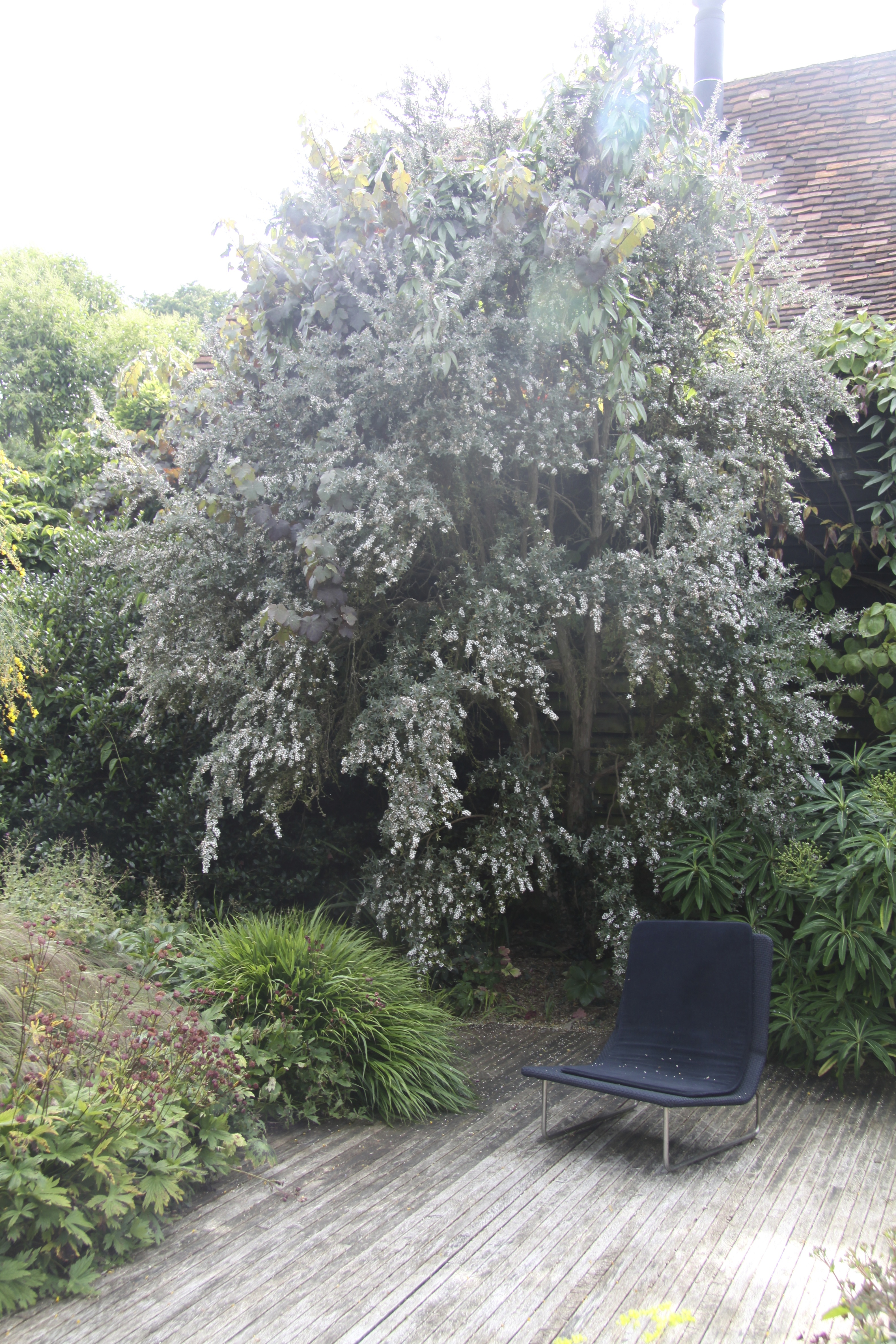
The decking is now silvery and tempting underfoot. The simplicity of this low chair at the base of an outstanding cloud burst of the fragrant Myrtus luma is intensely seductive.CHILEAN MURTLESo seductive in fact that pairs of women in white linen and couples with plump princely babies hover and perch and try to stay just that bit longer.  


I am imagine staying too and my start wondering what would be the perfect thing to eat or drink in this refined, colourful haven.  What should one bring to eat in this garden if one were ever invited as a guest?


I have been relishing Frances Bissell’s book, The Scented KitchenIMGI have loved every minute of her learned, uplifting text: I have learnt how ‘In America, day lily buds are deep-fried and served as one would okra’ or, on the subject of flower oils I have been imagining ” a lobster brushed with jasmine oil prior to being roasted, or perhaps rose or carnation oil brushed on scallops before you grill them”. There is an enchanting process called enfleurage which can be used for flower butters “all you do is wrap a piece of fresh unsalted butter in muslin, bury it in a bowl of petals, cover and leave it in a cool place for about 12 hours… this method works well with roses, jasmine, pinks and violets … delicious on toast or teatime scones”…


I am pretty sure that  ‘Taffety Tart’ would be surprising, sophisticated and deft enough to do the trick. Frances Bissell describes the tart as ‘an exquisite combination of lemon, rosewater and anis’  which was once a grand success when she cooked at the British Embassy in Cairo. It is a very light open apple tart with a layer of scented Pelargonium ‘Attar of Roses’  leaves between the pastry and the apple and sprinkled with sugar, softened butter, rosewater, lemon zest and anis or fennel seeds.

Option two would be Yotam Ottelenghi’s Apricot, Walnut and Lavender cake I have been wanting to make all year since it was published last summer in the Guardian.

Yotam Ottolenghi's apricot, walnut and lavender cake


Photograph: Colin Campbell for The Guardian


There is something enduring and seductive about Ottelenghi’s description of the recipe “it’s like Provence in a cake”.  The colours, rich orange with soft mauve and the texture dense with ground oily walnuts and lightened by lemon zest could be just the thing to savour as you hang on for a few last minutes in this loveliest of gardens.

Ehttps://thedahliapapers.com/wp-content/uploads/2014/07/corten-pools-2006.jpg

RETURN TO BRYAN’S GROUND

REVISITING A FAVOURITE ROMANTIC GARDEN IN MIDSUMMER  – HAVE WE MISSED THE LATE SPRING MAGIC?

APPLWE TREE AVENUWI have just returned from a works outing (well an end of project trip with my garden design partner, Helen ) to the Welsh Marches.   Top of our list of gardens to visit was a return to Bryan’s Ground near Presteigne in Herefordshire – three acres of intimate garden rooms and arboretum around a yellow painted 1912 Arts and Crafts House. The garden at Bryan’s Ground has been developed for the last twenty years by David Wheeler (publisher of the distinguished gardening quarterly, Hortus ) and artist and garden designer, Simon Dorrell.

The approach to Bryan’s Ground is elegant but initially subdued – a slightly after the party feeling.  The Amelanchier leading to the ‘Parking for Motors’ is in its most restrained phase – post blossom and bronze leaf and pre autumn fire:

Iamelanchier avenue

The Amelanchier lamarkii lined drive – in its quietest phase

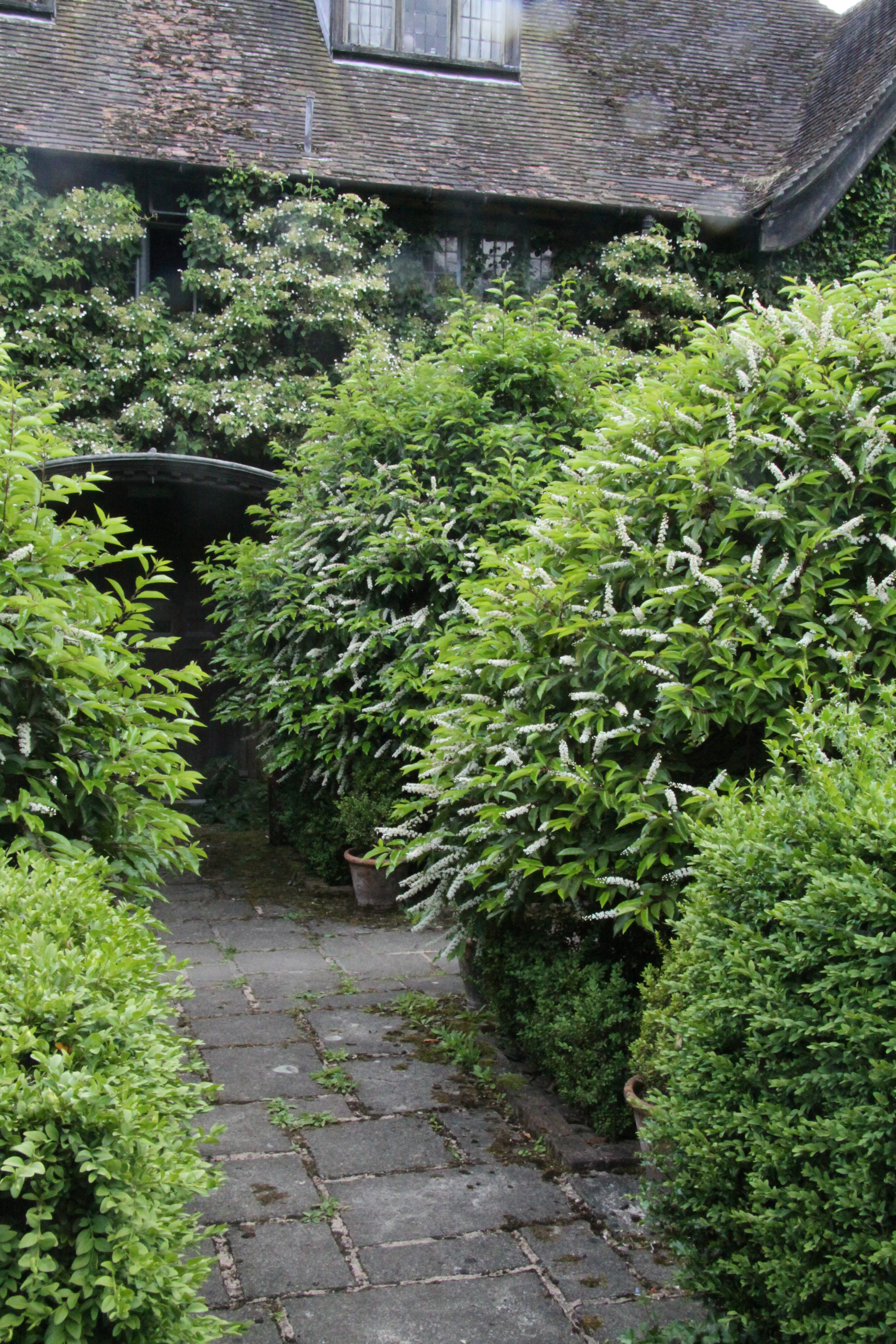
The front of the house, cloaked in Hydrangia petiolaris, and protected by solemn heavyweight sentries of giant, shaggy Prunus lusitanica, is looking shadowy and ripe almost for a the opening of a darker fairy tale:

LUSH LUSITANICA

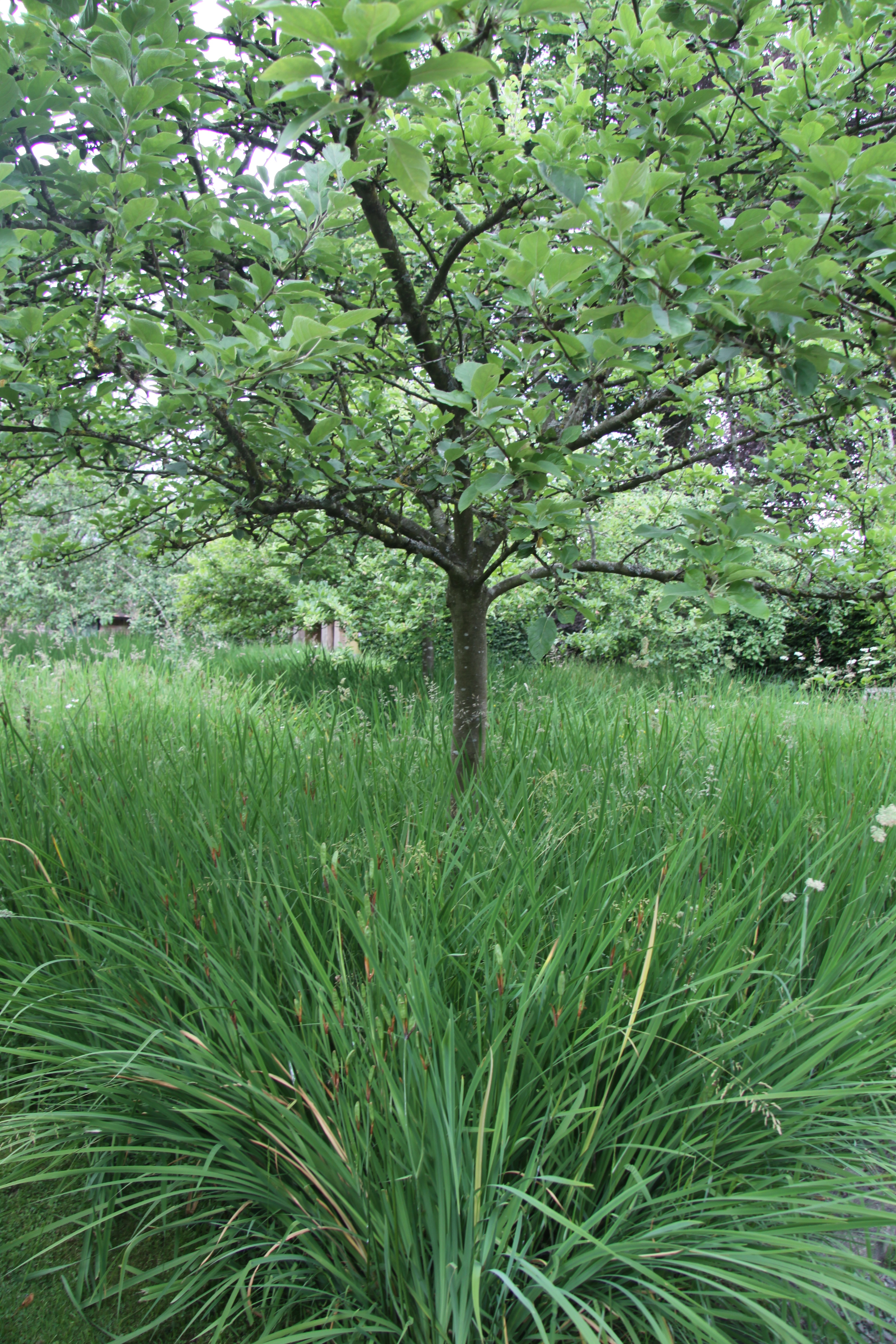
And the famous grid of 25 different apple tree which emerge from mown paths, each tree surrounded by a private sea of blue anemone, followed by Pheasant’s Eye narcissus, followed by  show-stoppingly dense planting of the slender, pale blue Iris sibirica ‘Perry’s Blue’  – is now quietly lush.

2011_05130047

Drifts of Iris sibirica ‘Papillon’ – image from patient gardener.wordpress.com

apple tee grassBut it does not take long to warm us up. Looking more closely, the planting around the apple trees is now laced with pale pink field geraniums and softly fluttering tall grasses are now taking over as quieter, paler stars amongst the stiffer stems of the flowered iris.

IMG_4387

There is a handsome new entrance archway to frame the arrival to the house via the orchard :IMG_4343

Entrance into the front garden at Bryan’s Ground

The archway has been built, beautifully, sturdily in the same handsome Dutch/Herefordshire vernacular as the ‘dovecote’ which lures you to enter the main part of the garden.

view sulking house

The Dovecote

The Dovecote has it all – which is when you remember why this is a garden of inspirational confidence and charm. It is a focal point from and axis into three sides of the garden  – each with its own flavour – and what is most covetable, perhaps, is that on the first floor there is a small dining room with idyllic views onto the Welsh Marches beyond.

The dovecote takes you through to a parade of formal topiary (albeit sweetly coexistng with leggy pink geraniums which lounge about freely throughout the garden) and acts as a handsome backdrop to the dense green of the yew and the softly planted steps – about to be set ablaze by Crocosmia

longer view side 2side two sulking houseThe steps here are about to be set ablaze by Crocosmia

And then you are finally let loose into the principal ‘Sunk Garden’

BEST TEASEL AND MAIN TERRACE

The Sunk Garden

For a moment I look back to see the dovecote nestling happily in stands of campanula and draped in roses.  No need to worry about missing the iris moment – which is brilliant and absolutely worth making a pilgrimage to see – the new midsummer fairy tale version of Bryan’s Ground is just unfolding.

side 3 sulking houseThe Dovecote with roses and Campanula

And I have two new loves in my life: the statuesque pointiness of fresh green teasel (Dipsacus fullonum):

IMG_4208

Self seeded teasel and foxgloves against topiary hawthorn

– and the endlessly forgiving romantic haze of quantities of green fennel:

sulking house in sea fennel

The Dovecote nestling in a haze of topiary and fennel

TEASEL LAVENDAR FENNEL

fennel, teasel and lavender

stchys daisy and fennelGreen Fennel, Stachys byzantina and daisies

The wild self-seeding generosity of these two plants works so well, of course, because of the the dark solidity of the topiary it is dancing between:

IMG_4217

Green fennel dancing between structural forms of hebe and yew

Every so often there are joyous rockets of super high foxgloves in the mix:

lightness of quicksilver

And throughout the garden the silvery, deliciously scented shrub Elaeagnus ‘Quicksilver’ is planted to add contrast and a shimmering brightness to the palette of greens:

IMG_4216

Elaeagnus ‘Quicksilver’

In one corner of the Sunk Garden there is a wonderful rather medieval monster-head wall of yew with a wonky sliver of an entrance to tempt you furhter in:

fab monster head opening

Above all this is the generous loggia where you can sit and eat spiced apple cake and idly imagine for a moment that this is your own. The path back to the Dovecote is splendidly narrow with overspilling plants:longer view side 3

 Or you might choose to have your tea under a voluptuous swoop of pineapple broom (Cytisus battandieri) whose vivid yellow flowers are almost intoxicatingly pineapple scented:

PINEAPPLE AND BENCH

Bench under gorgeous headily scented pineapple broom

And then the garden is calm again. Lime Alley on June 23rd 2014 is a shaded walk flanked by a quietly frothing carpet of Alchemilla mollis:

lime avenue

Lime Alley

In the spring, Lime Alley is singing with orange tulips, acid yellow Euphorbia polychrome and rich yellow azaleas but now it is calm and ordered, a perfectly judged break between the exhilarating Sunk Garden and the other midsummer rooms to come.

What really impresses me as I move around the garden is the simplicity of the planting – large quantities of astrantia and Geranium psilostemon:

IMG_4256

Geranium psilostemon and astrantia

IMG_4271knautia macedonica and pink geranium

There are lovely walks through shades of pink with classic columns of yew for structure:long view psilostemon yew

IMG_4272

–  And yet there is a constant supply of surprise and invention too.

There are sudden bursts of a new colour to keep you on your toes:SURPRISE BLUE AND CLARET

Aconitum and Cotinus amongst the pinks

IMG_4319

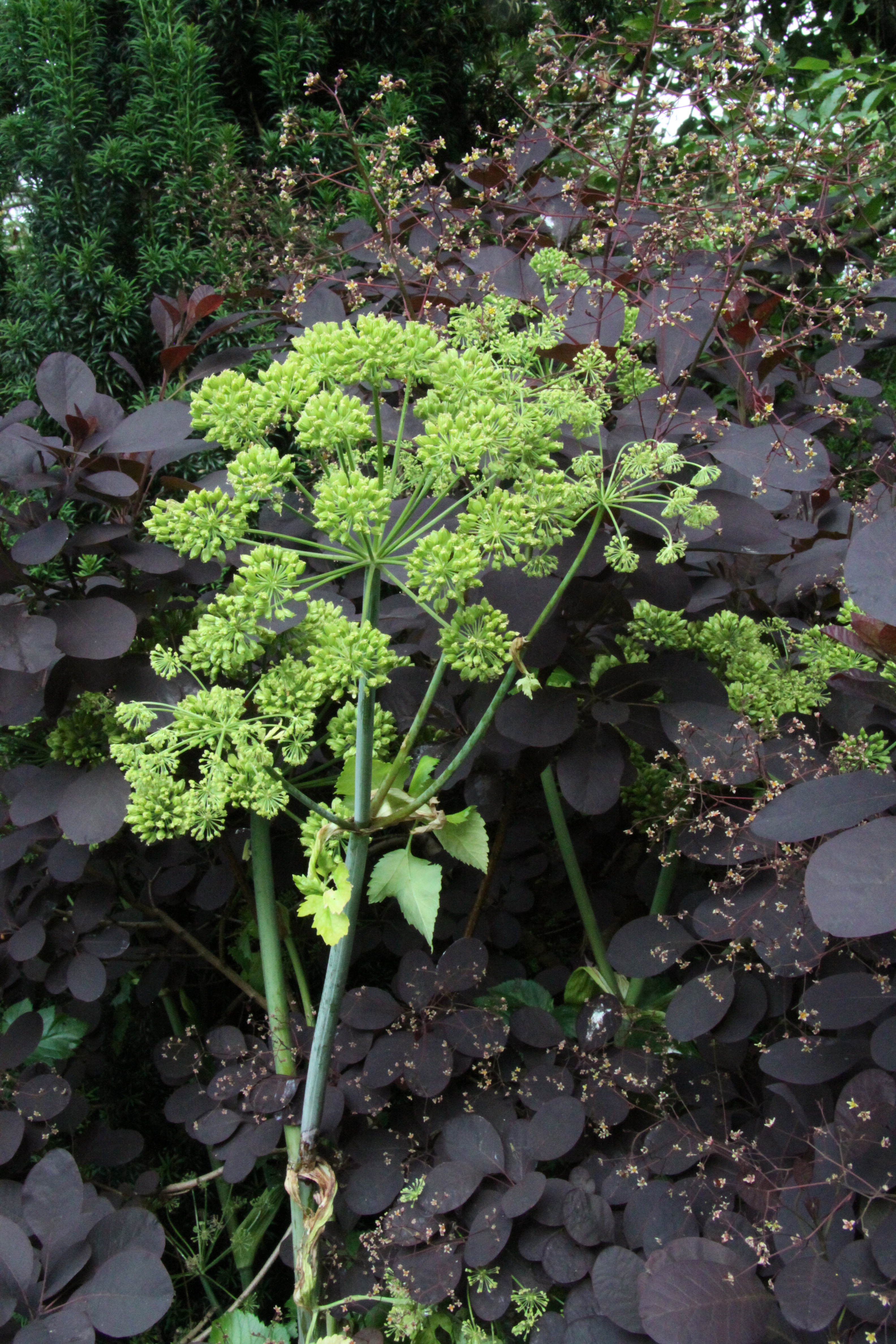
Angelica gigas and Cotinus

A gently shabby archway of recycled materials adds a layer of quirky grandeur to the cottage garden planting:

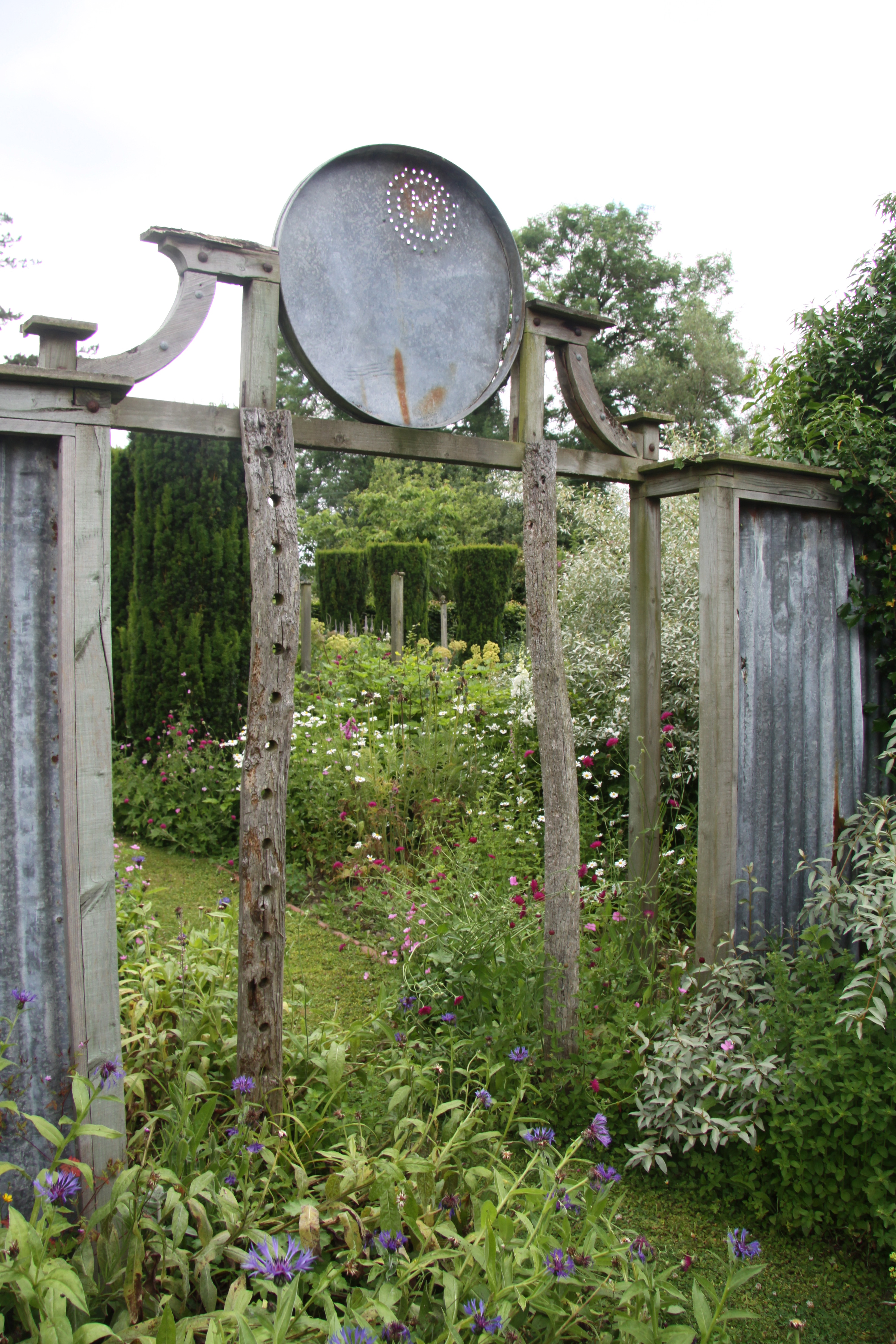
home made arch

Archway of recycled materials

And then as you turn the corner, the palette changes completely.  FIrst to rich dusky blues and purples:

ACANTHUS AND CLEMATIS

Acanthus and clematisIMG_4287

And round again to a corridor of pale yellows and silver
IMG_4295
Phlomis russeliana a key plant in this corridor of yellow and silver

There is the cool quiet of the Canal:
dog canalThe Canal

and the wonderful formal garden with pool – first glimpsed tantalisingly, of course, through an opening in a hedge:

ARCH TO POND

Pond glimpsed through hedge opening

Again we have missed the further swathes of Iris sibirica and what must have been a delicate knee-high forest of aquilegia in May. But the scene, here immaculately framed by a stilted hornbeam hedge and viewed from a perfectly place bench, is wonderfully restful.

POND THRU STILITSThe pond seen through the elegant limbs of a stilted hornbeam hedge

I love the license a plant has to self seed in this garden:

IMG_4311

carpet of Aquilegia seedlings under stilted hornbeam hedge

As we move away from the garden and enter the Cricket Wood – a still growing collection of specimen trees and shrubs started in 2000 – we are aware again of the intensity of a particular moment in an area of planting. In early spring there are hundreds of bulbs in the woodland, later scented walks of viburnums and the fragrant yellow azalea, Rhododendron luteum and many of the trees are specially selected for the strength of their autumn colour. But for now the palette is subtle and beginning to fade and bleach into high summer.

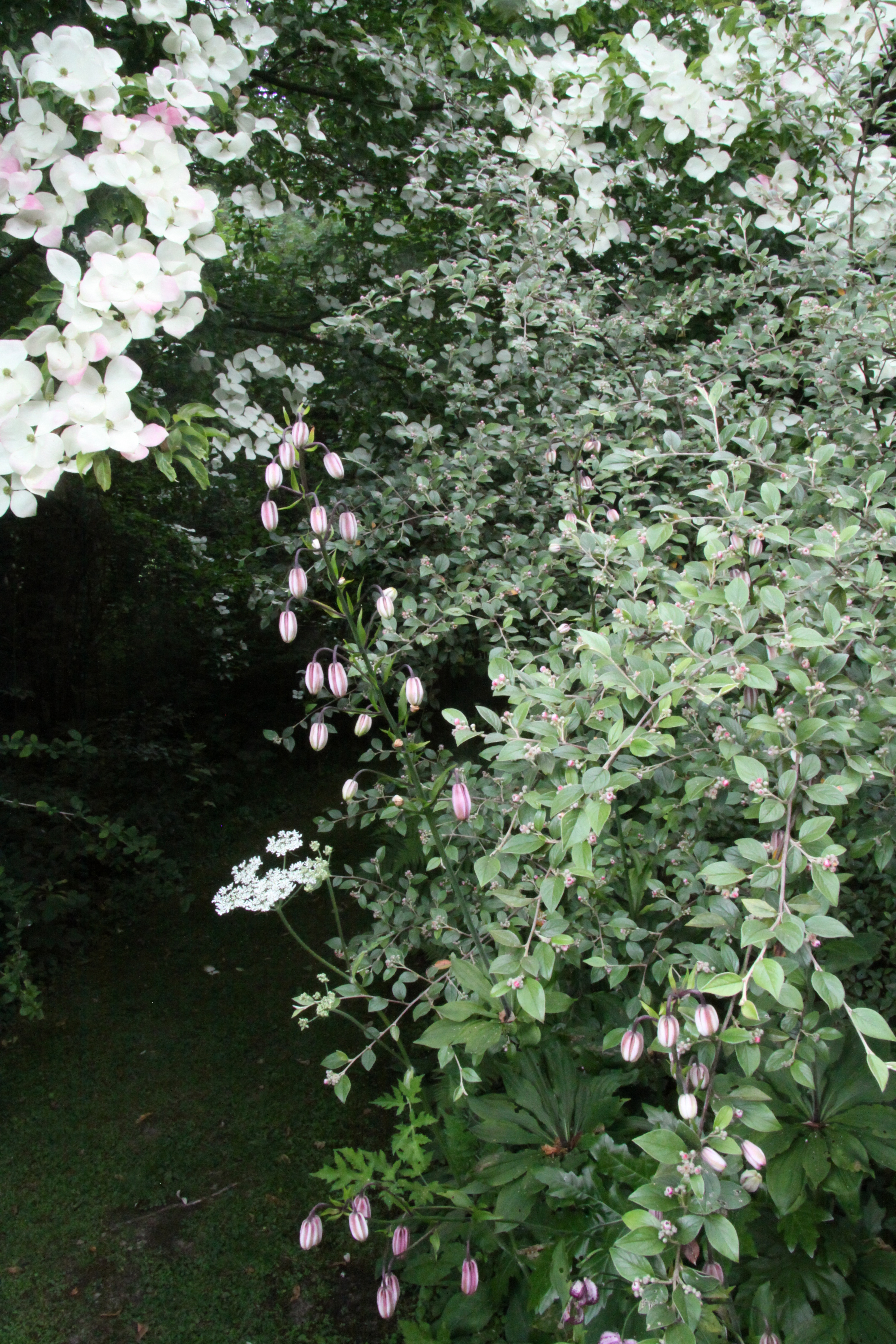
The transition from garden to woodland is marked by a lovely tree-fringed area dominated by a stunningly beautiful Cornus tree – I think it is ‘Norman Hadden – with pink tinged white bracts. The Cornus is underplanted with swathes of palest pink astrantia and dashes of richer pink Martagon lily:CLOSE UP MARTAGON COTONEASTER CORNUS CLOSE UP

Cornus – probably  ‘Norman Hadden’ HELENGenerous swathes of palest pink astrantia in dappled shade

CLOSE UP ASTRANTAIA MARTAGONAstrantia and Martagon Lily

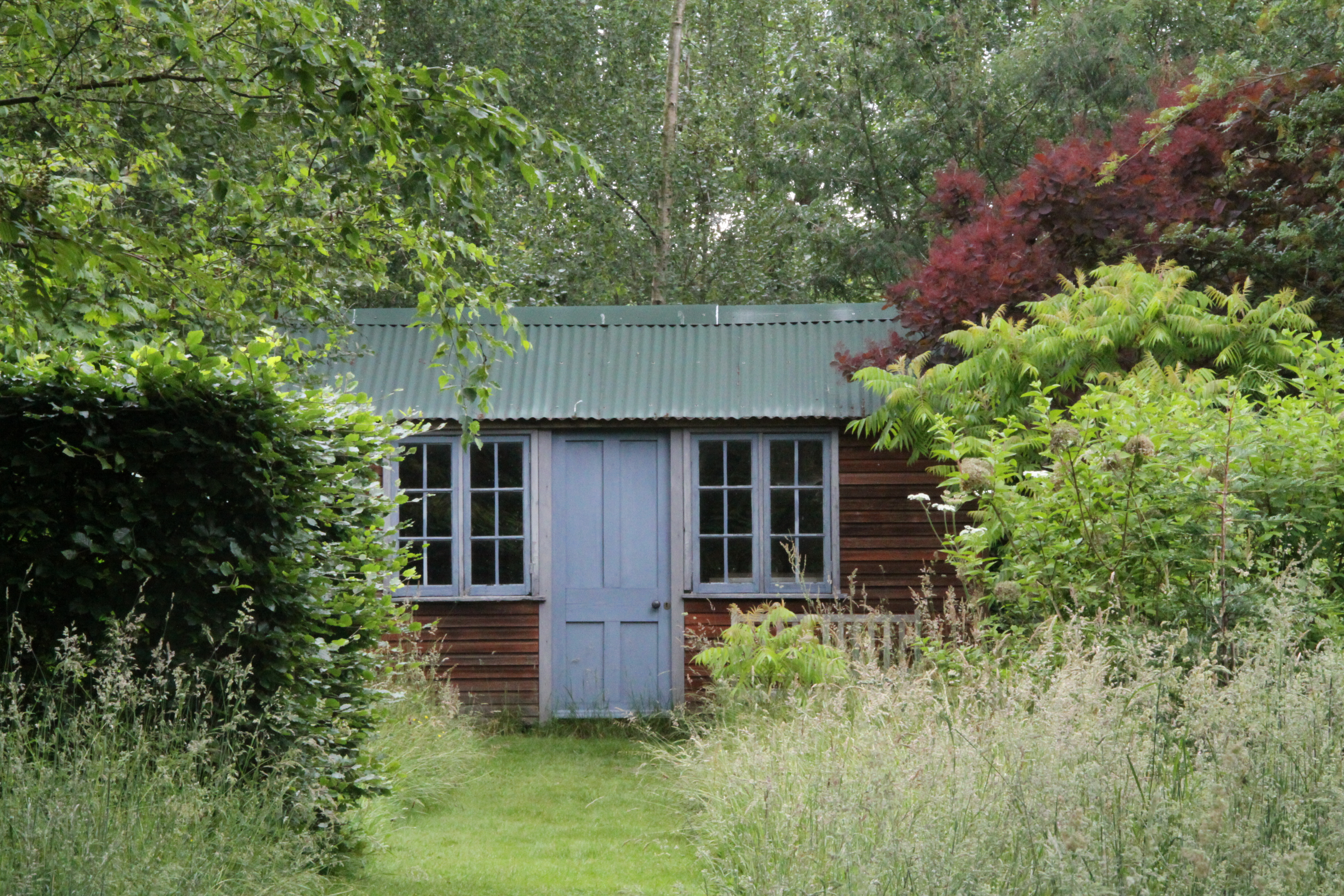
Within the wood itself there is a perfect tin-roofed house which looks increasingly fit for a fairytale the further you wander away from it and deeper into the woods:IMG_4414

IMG_4420

The long softly planted avenues will take you to treasures such as a fine crumple-leaved medlar:

IMG_4424

a gorgeous Cornus kousa var. chinensis:

IMG_4426

and a cloud of light-catching bronze cotinus amongst its towering silvery neighbours:

COTONEASTER IN WOOD

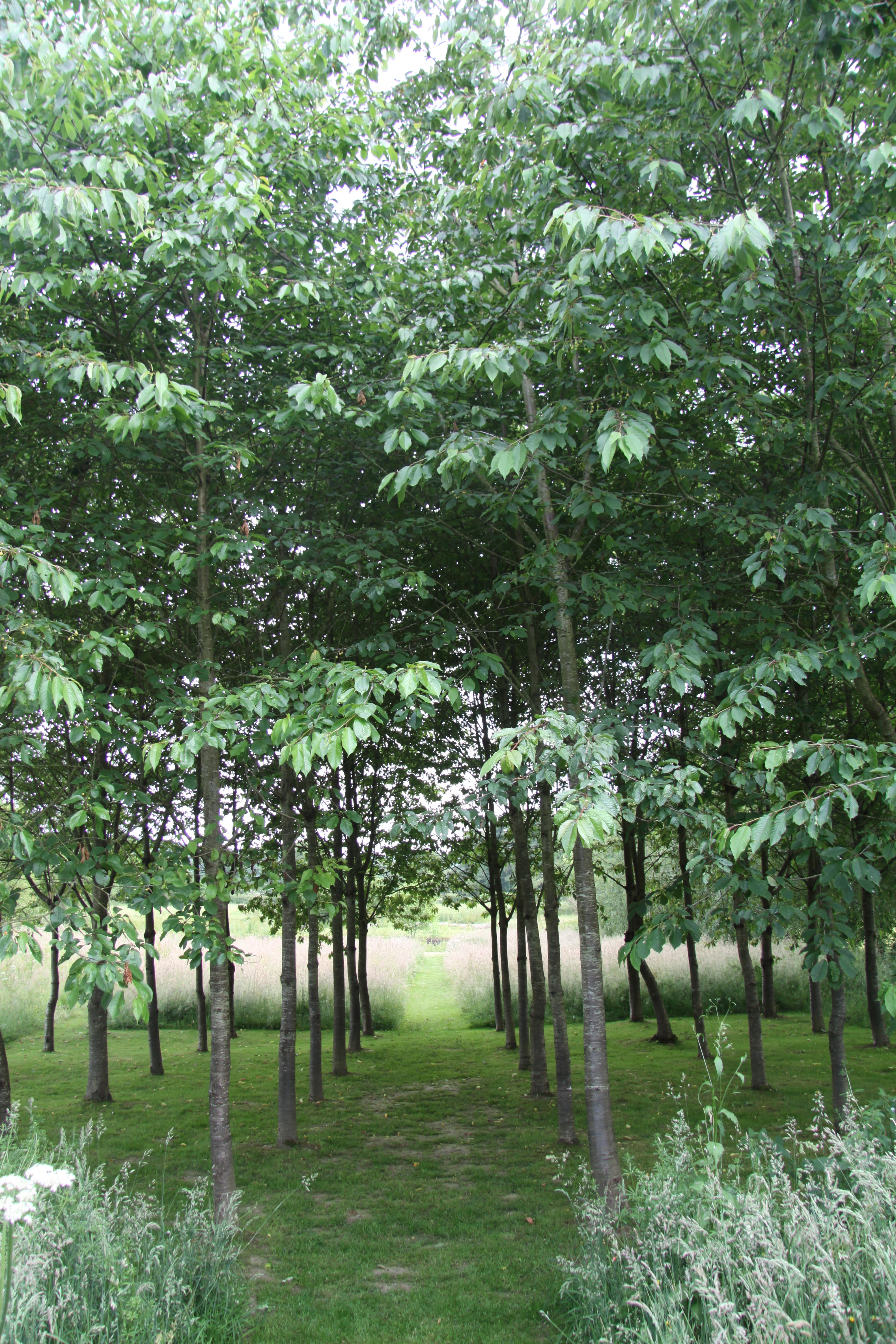
Much grown since the last time we visited is The Mezquita  – a grid of bird cherry trees (Prunus avium) inspired by the onyx and marble columns of the the Mezquita in Cordoba. This had looked rather stiff and organised when we visited a few years ago but it is now a wonderful sturdy forest of slim-trunked trees which frame the view in every direction and offers a delightful place to sit:

IMG_4427The Bird Cherry ‘Mezquita’

CLOSE UP CHERRIES

 ripening fruit of the Bird Cherry

IMG_4440An enchanting place to sit

The planting around Strongacre Pool at the edge of the Cricket Wood is particularly lovely.  Papery pale and delicate with a boathouse to add to your dreams.

BOAT HOUSE POND VIEW

The Cabin at Strongacre LakeSOFT PALETTE BY PNDThe delicate palette of plants at the water’s edge

As you walk away from the boat house the little building seems to be floating in a sea of dusky pink grass.

BOAT HOUSE

The Cabin at Strongacre Lake

I should not have worried for a moment that missing the irises would mean missing the magic of Bryan’s Ground.IMG_4433


THE LAND WHERE LICHENS GROW

IN SEARCH OF THE SCOTTISH PRIMROSE ON ORKNEY – WHILST DREAMING ABOUT THE STORY OF CITRUS IN ITALY

IMG

Gatwick airport, Thursday 15th May 2014.  I check the weather forecast for the weekend ahead on my iPhone.  Forecast for London over the weekend: a scorcher, rising to 28ºC.  Edinburgh (where we will spend the night): not bad, quite sunny today at least, temperatures may reach 18ºC.  Stromness, Mainland, Orkney – three hundred miles further north, where we are heading the next day – maximum daytime temperature 8ºC. Rain.

the tough sea

Coastline on Mainland Orkney – Sunday 17 May 2014

We have a lovely evening in Edinburgh and stroll around tamely in our shirt sleeves munching tiny hand baked oat cakes unpasteurised Orkney Cheddar from specialist cheese shop I.J Mellis.mellis

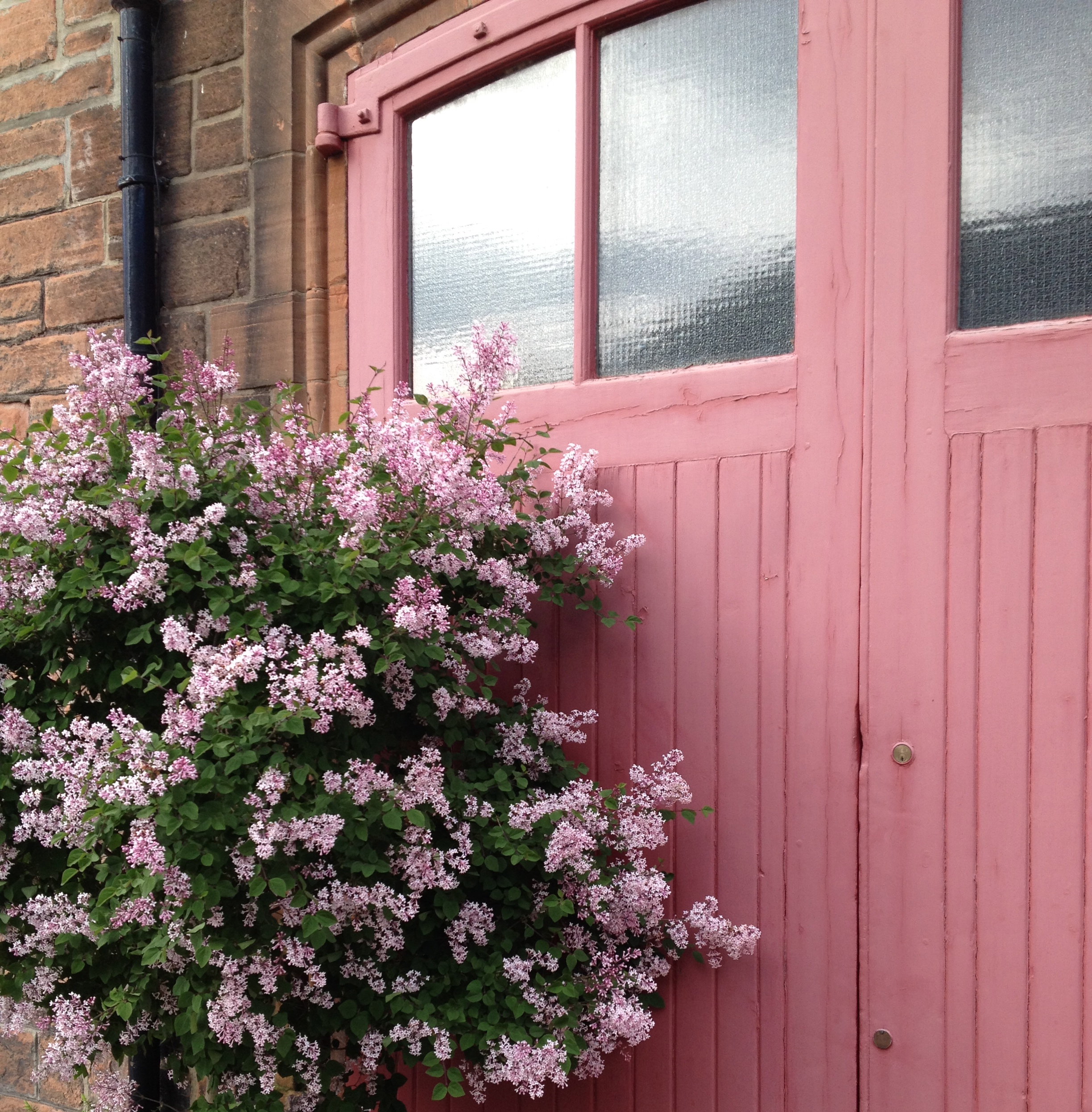
We admire the elegant lifestyle of an Edinburgh dweller in his idyllic Mews house with the fragrant Syringa meyeri ‘Palibin’ exactly matching the faded raspberry paint of his front door:

edinburgh lilacAs we settle down in the small plane for a weekend on Orkney I ignore the fact that the temperature gauge outside must be plummeting and sink back into Helena Attlee’s wonderful sensual and sun-filled account of the citrus in Italy, ‘The Land Where Lemons Grow’.

It is a brilliant, constantly surprising history of the impact of Citrus on  communities across Italy at different times.  But is arguably a dangerous choice for this particular trip.  “You only have to fly into Catania airport in Sicily in late spring to appreciate the raw power of zagara (citrus blossom) for, as the doors open, the scent will bludgeon its way onto the plane … green buds form like a haze all over the sour orange tree, opening into pure white, five-petalled stars around a clutch of yellow stakes.  Zagara fills the air with an invasive, migrant scent ….”

When we arrive at our hotel in Kirkwall things are a little grey and treeless but we are glad to note that the our hotel offers one potential – does the name ‘Highland Park’ mean anything to you? – way to cheer us up:

IMG_1035

Before I put on my bobble hat and waterproof trousers for the first major expedition of the weekend I sneak in a few more dreamy lines from Ms Attlee:

“Silence, heat, a scent of wild fennnel and a view across the great bowl of the Conca d’Oro to the blank blue sea beyond … a common orange, like the Navel or Valencia has a sugary, one-dimensional taste.  Eating a Sicilian blood orange is a much more complex experience.  Take the Tarocco: its meltingly soft flesh also has a high sugar content, but its sweetness is balanced by high acidity.  The result is a complicated, multi-dimensional flavour that unfolds slowly, subtly, beguilingly … wafer-thin discs of its marble flesh are combined with fennel, good olive oil, salt, a sprinkiling of choopped fennel leaves and black pepper, or used in pale pink risotto, bright red jelly and dark pink ice cream …”

IMG_0003

Detail of Botticelli’s ‘Spring’ in the inside cover of ‘The Land where Lemons Grow’

I am riveted by the history of the the complex art of creating perfume from the essential oil of the bergamot. In 1708, when he was only 23,  Giovanni Marina Farina invented a bergamot based perfume named Eau de Cologne after the city where he lived.  In a letter to his brother he described his invention as “the scent of a spring morning in Italy, of mountain narcissus and citrus blossom after rain”.

I read on – it is as if I have been personally rumbled: “for his northern European customers the perfume conveyed the exotic essence of everything they yearned for in the sunny south”. Eau de Cologne “became the perfume of the great houses and royal courts of the eighteenth century Europe” … Voltaire described is as a “fragrance that inspired the spirit” and if you visitied Goethe “you would have found him writing beside a box of rags soaked in the stuff”

Enough! (I may or may not have ordered a bottle of the original Farina 1709 cologne using the hotel wifi before going out and join the others on the bus.)

50mlnaturalspray

Farina 1709 Eau de Cologne

This afternoon, as the sky hangs thick and white-grey around us, we are in search of the Scottish Primrose.  It is a slightly crazy sight – forty or so conservation experts and environmentalists (plus the odd spouse)  spilling out onto an RSPB maritime heath reserve to search for this diminutive, scarce, plant.

2 blokes in search of a primrose

The heathland looks vast and unpromising but it is only here in Caithness and Sutherland – these days mostly in protected areas of wild habitat – and only in May and then again in July that we have a hope of finding this dark purple primrose, 4cm high and 8mm in diameter with five heart shaped petals ….

IMG_1037

Then at last!

girl photographinprimrose

Non is on the case

image.php

Primula Scotica – each flower less than a quarter of my finger nail

Tiny, rare, an incredible survivor. I am struck by how important it is for a jewel like this to get the chance to carry on.

By the next morning I am in a new phase and start falling for the incredible greens yellows and ochres that pervade Orkney.

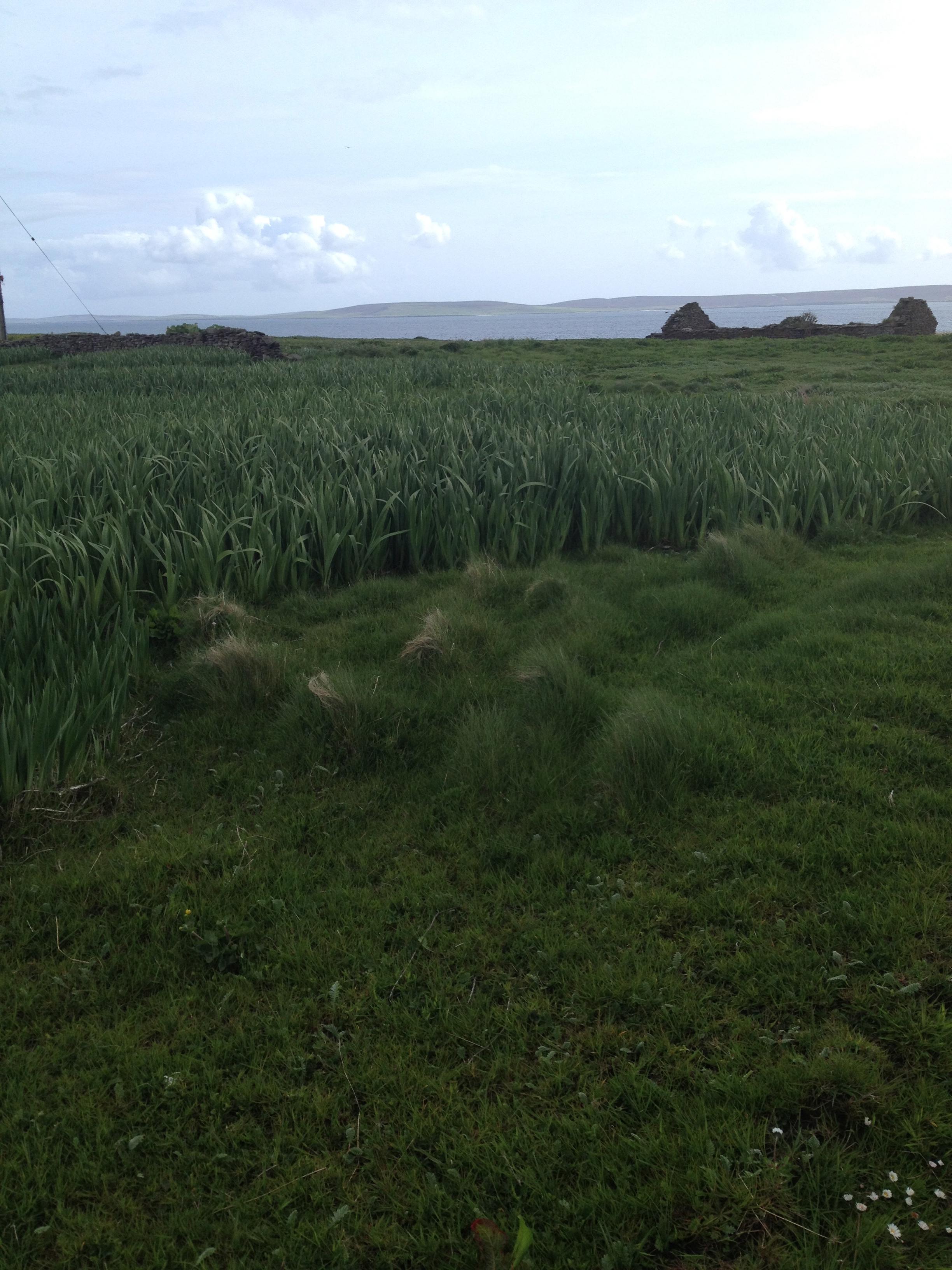
I love the unstoppable ranks of flag iris that march onwards towards the shore:iphone flag iris

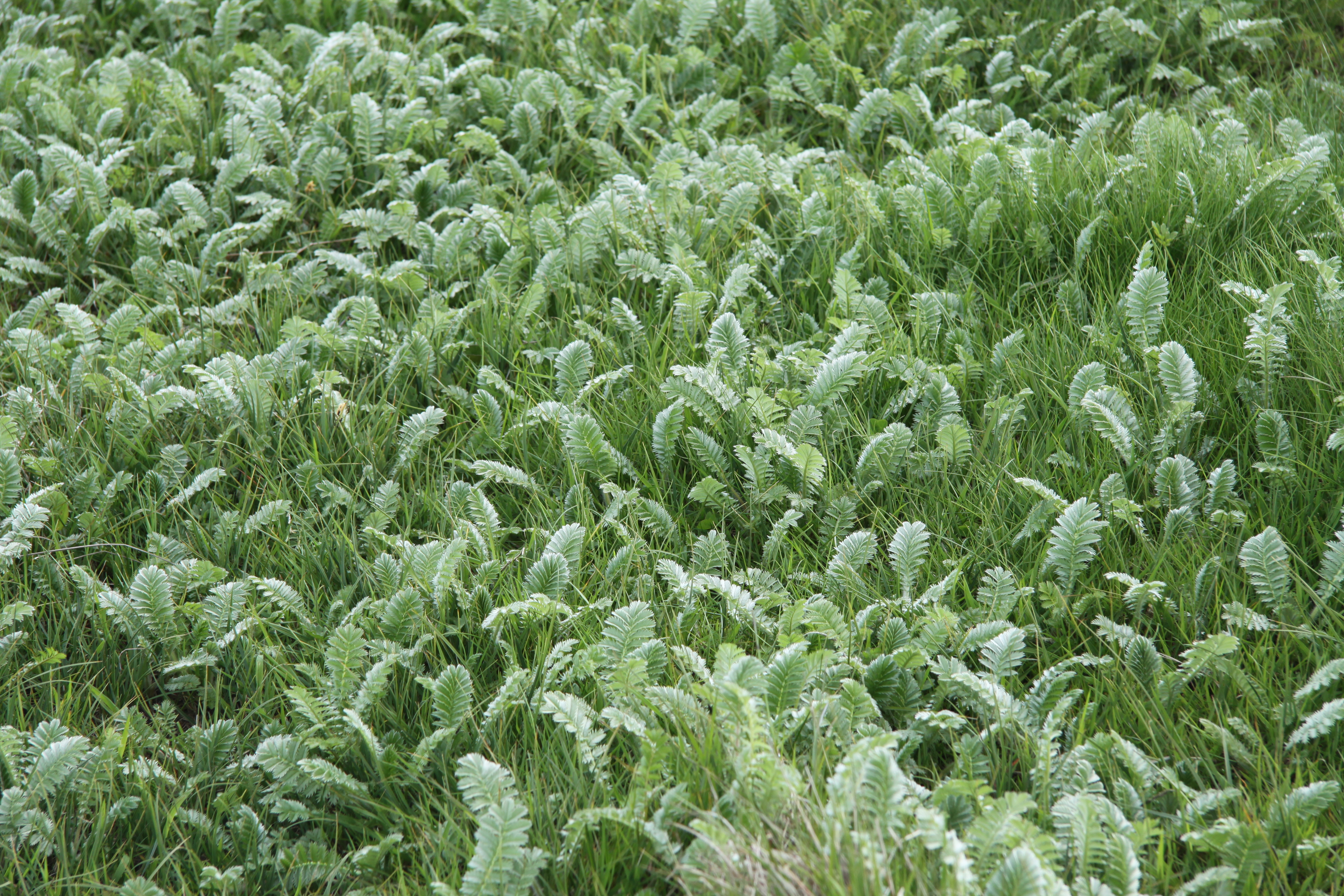
And the pale dancing leaves of Silverweed (Argentina anserina) amongst the turf:

silverweedSilverweed – Argentina anserina

I love the natural artfulness of  flag iris and marsh marigold planting itself deftly into the folds of a stream:

flag iris and calth iphone

Flag Iris (Iris pseudacorus) and Marsh Marigold (Caltha palustris)

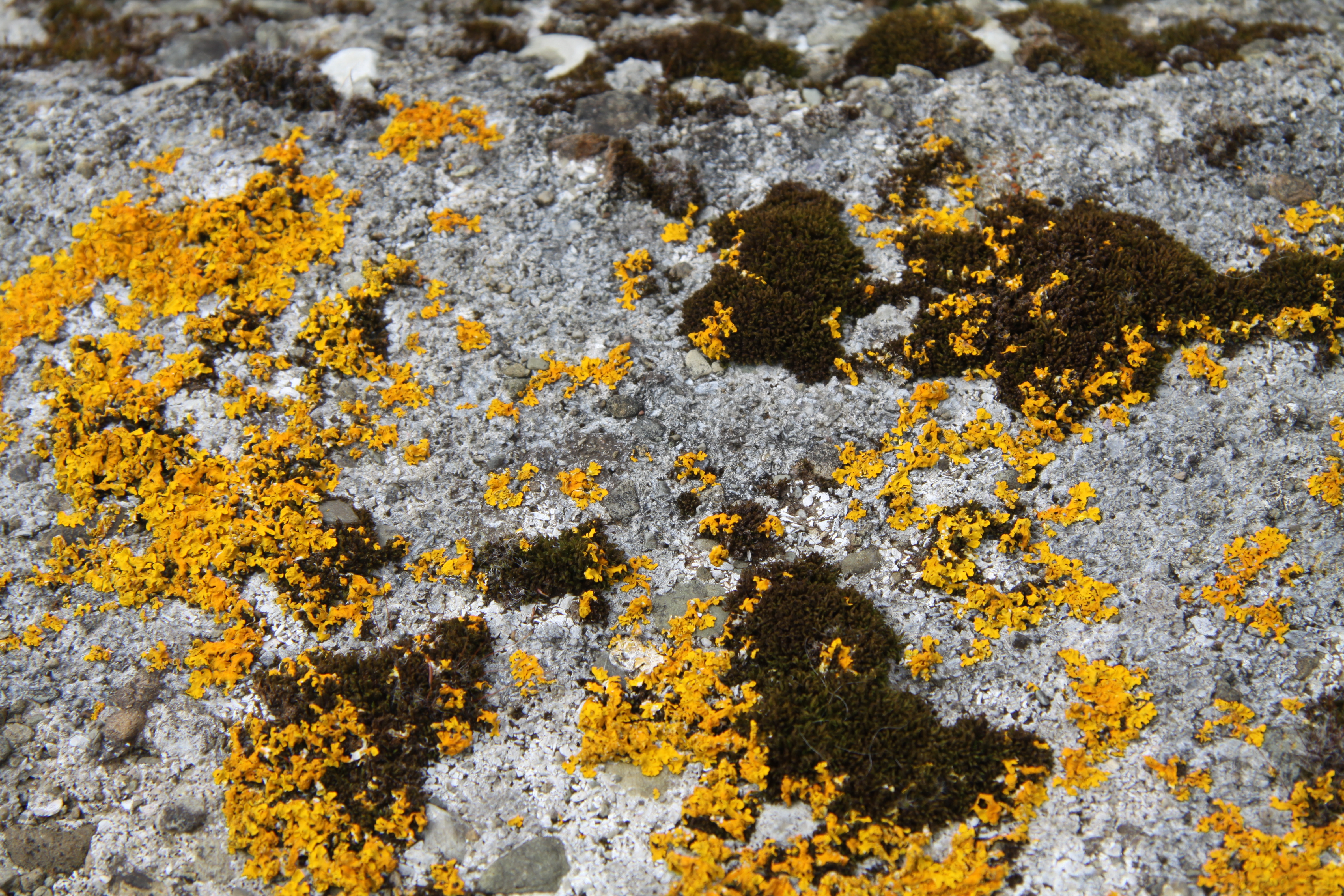
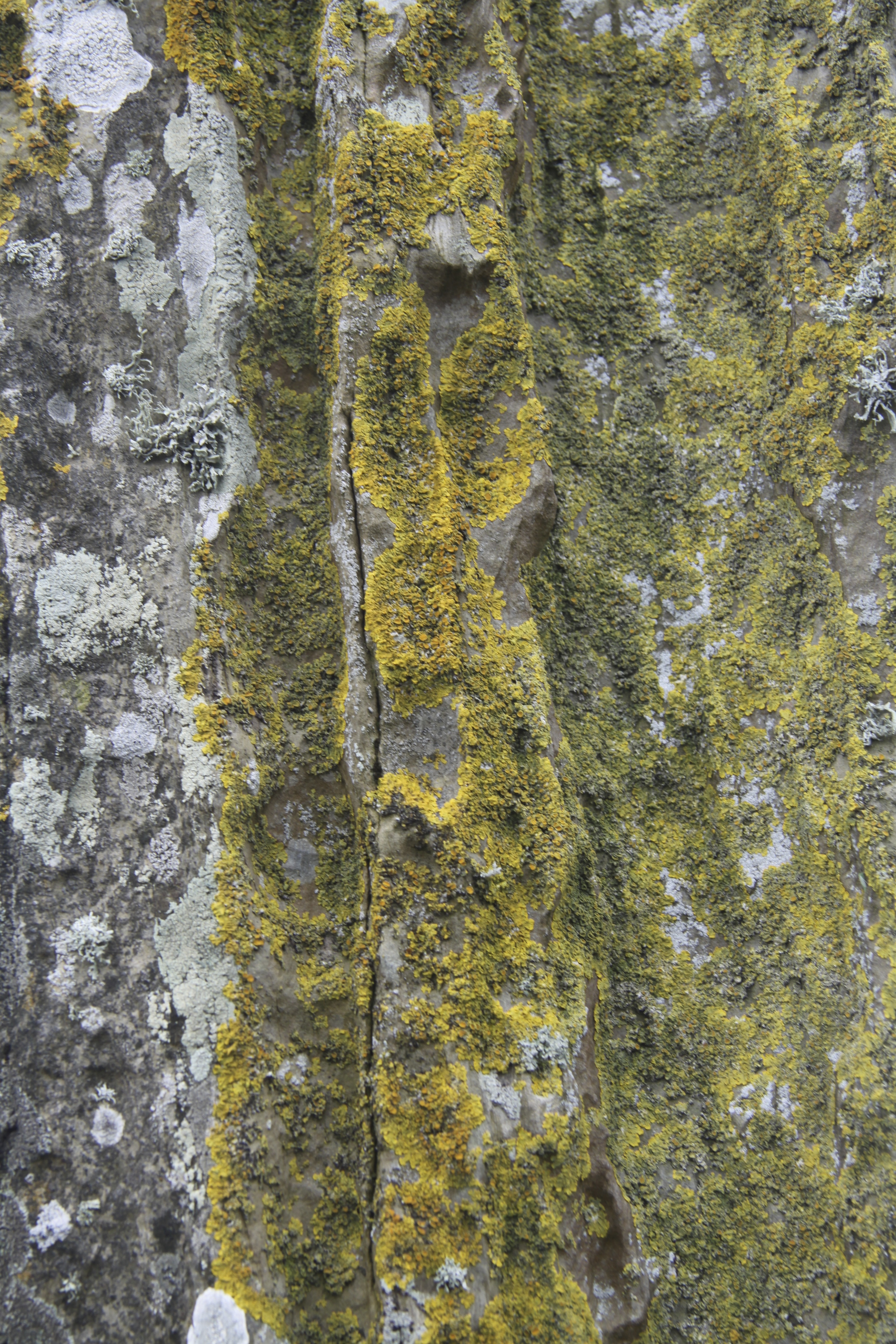
And then I get to see the lichen.  The walls of the sixteenth century St Magnus’ Church on the island of Birsay are enveloped in the most wonderful velvety camouflage of rich ochre. st magnus church

St Magnus’ Church, Birsay

st magnus close up 1

Lichen on dry stone walls surrounding St Magnus’ Church, Birsayst magnus gate post

Handsome rocket-shaped gate post, St Magnus’ Church, Birsay

st magnus dry stone stepsIngenious – lichen-laced – steps built into dry stone wall around St Magnus’ Church

st magnus close up 2

My particular favourite map-of-the-world lichen

The famous Ring of Brodgar – the beautiful neolithic henge and stone circle surrounded by sea, the cleanest air and wild flower meadows – provide even more addictive examples of lichen on stone.
ring brognar

Three standing stones from the Ring of Brodgar


brognar stone 2A powerful standing stone piercing the sky – incredible lichen

brognar lichen 1 Close up of white-on-grey lichen on a stone from The Ring of Brodgar

brognar lichen 2 Close up of paint-splash lichen on a stone from The Ring of Brodgar

broganr lichen 2 Velvety lichen on a stone from the RIng of Brodgar

Elsewhere the cliffs are gorgeously stepped and lightly coated with the same rich yellow:
drystone cliffs 2

We are in this spot for a long while – entranced by the swooping lines of Kittiwakes and gannets. Shocking to learn that the numbers of Kittiwakes alone have diminished by 87% in the last five years.  Sweet lacy clumps of ribwort plantain and bobbing pink thrift edge the cliff.IMG_3514

Thrift and Ribwort Plantain

Even the world under the clearest seawater shares the same gold against grey palette:IMG_3500

IMG_3502

We walk past a beautifully restored house with handsome crow-stepped gables. The house is in the ultimate position with a dry-stone walled garden that wanders loosely down to the shore.  There was obviously only one colour to paint it:

dreamhouse iphotoOchre house on Birsay, Orkney

As we look out of the bus window on the way home I realise that in this raw land of outstanding natural beauty I have found something new to dream about:
dream house thru bus window


View from bus window of sea, sky and ochre house on Birsay, Orkney

MATISSE: THE CUT OUTS AND THE GARDEN AT PETERSHAM

HENRI MATISSE AT TATE MODERN AND A JOYOUS LATE SPRING BORDER AT PETERSHAM HOUSE

le snip

Matisse in his studio working on his Cut-Outs – from Issue 31 Tate Etc Magazine.

What would you wear if you were a beautiful young woman, already living with Picasso, and about to be introduced to the older artist, Henri Matisse, who you regard as ‘God’?

IMG_0003

Françoise Gilot holding a red gladiolus, photographed by Gjon Mili, 1948.

There is a wonderful series of interviews in the latest edition of Tate Etc magazine which celebrates the uplifting Matisse: The Cut-Outs exhibition at Tate Modern. I loved discovering that the young woman in question, Françoise Gilot, decided on her outfit with knowing precision: “I remember very clearly that I dressed in almond silk trousers and a mauve silk top, because I knew he liked those colours”.

The choice hit the spot and during the course of their subsequent friendship Matisse drew and corresponded with Gilot, relishing the disconcerting impact his attention had on the the ten year junior, Picasso.   In the same interview Gillot gives a riveting description of watching Matisse make an abstract portrait of her in 1947.

IMG_0003

Henri Matisse’s gouache cut-out Abstract Portrait of Françoise Gilot (1947).

“He got hold of a sheet of paper, painted bright green and a piece of magenta paper and considered the shocking clash of these two colours and the sobering effect that would be achieved by the addition of a black shape”.  Initially Matisse was frustrated with the black shape he had made for the bottom right of the piece. “The whole composition looked too even, a bit dull …with his gigantic scissors he began to reduce it mercilessly until it became quite small and sharp edged.  All the prettiness had been eliminated but in the process of miniaturisation, the energy had been maximised … it was perfect”.

And so to gardens.  Even if they are never able to come near the perfection of one of these masterful works on paper or in glass – and the stability of a completed artwork will always elude the gardener – the best plantsmen are forever thinking deeply about the elements they work with. The challenge is constant: how best to balance shape and colour, form and texture and the impact of a small amount or large amount of one colour on a small amount or large amount of another.

establishing shot double border

The 150 foot long double border at Petersham House, Petersham.

The garden at Petersham House, reached via the delectable Petersham Nurseries, was open for the National Gardens Scheme one Sunday at the end of April and will be open again on June 1st as part of the Petersham Village Open Gardens, as well as on Sunday 20th July for the NGS. The double borders were originally designed by landscape architect Helen Dooley and have been gently adjusted over the years by the Head Gardener, Rosie Bines. They  are a wonderful example of exuberant spring planting and a skillful and inspiring approach to colour, form and texture.

The long borders at Petersham House lie beyond the slightly severe lawned garden with its handsome topiary chess piece like shapes emerging from columns of yew:

unfinished topiary

Unfinished topiary shape
finished topiary

and a complete topiary shape.

The shapes work best when viewed together with Petersham Church beyond – balancing its handsome curves and domes:
IMG_3139

Petersham Church and the garden of Petersham House.

For a moment I am distracted by piece after piece of covetable antique garden furniture which is beginning to feel at home amongst bowers of rambling roses and enclosures of clipped yew – and one cannot fail to be distracted of course by the watchful Anthony Gormley sculpture standing quietly on the grass.

gormley

Serpent bench in bower with Anthony Gormley sculpture.more gorgeous benchesone of a pair of covetable curvaceous dining benches in a yew enclosure.

But your heart really starts to race when you step through the gates beyond which the borders have been doggedly trying to catch your attention from the moment you arrive. The colours are rich and gorgeous against a classic framework of tightly clipped dark yew hedges and wonderful bold buttresses of rounded yew – and the balance changes constantly:

IMG_3208 (5)Fiery orange heads of Euphorbia grifitthii ‘Fireglow’ glow against the acid yellow of a different Euphorbia.

IMG_3196Dark tulips, pointed buds of Nectaroscordum siculum and subdued foliage of Macleaya Cordata.

Using yew as a dark background in a garden has the same ‘sobering effect’ on bright colours as black does for Matisse – it both subdues and energises:

thalictrum against yew

Fluffy, pale pink Thalictrum aquilegiifolium against yew.crocosima against yewSword shaped leaves of Crocosmia and Tellima grandiflora against yew.rheum characias yew

A spectacular combination of Rheum palmatum, bluebells, red tulips and Euphorbia against yew.

In another Tate Etc interview, Jacqueline Duhême, Matisse’s assistant from 1947-49, described how Matisse, worked on the design for the stained-glass windows for the Chapel of the Rosarie in Vence: he would lay down piece after piece of coloured paper until he had obtained the right “density that still let the light shine through.”

IMG_0003Jaqueline Duhême standing in front of designs for the Tree of Life stained-glass window for the Chapel of the Rosary, Vence.

imagesDisplay from ‘Henri Matisse: The Cut-Outs’ showing the range of colours Matisse was using.

Of course, working with plants, it is only in the more theatrical – and ultimately artificial – context of a flower show that this sort of immediate creation of an entire picture can take place. Visiting the RHS Chelsea Flower Show during the build stage last week, we chatted with wonderful plantswoman Chris Marchant of Orchard Dene Nursery about whether or not Cleve West would add a scattering of orange poppies to his already beautiful M&G garden.  A delicate sugar pink annual poppy was working brilliantly amongst the shimmering green-blond stems of Stipa gigantea, purple honesty and pale yellow evening primrose:

pink poppy

How would the richer note of the orange poppies, still in their trays at the side of the garden affect the whole picture?

I am finishing this blog after spending the day at Chelsea and the answer is that, in the end, the decision was to go for both pale pink and orange-red poppies.  The deep orange poppies offer a dash of fire which has a powerful, intensifying effect on the gentler tones of the surrounding plants.

orange poppy 2

Part of Cleve West’s M&G Garden, RHS Chelsea Flower Show 2014 – with orange-red poppies at the centre.

Away from the show garden most plant choices have to be made months or years before they will be required to work together. Here at Petersham the planning and weighing up of possibilities is bearing fantastic fruit.

The parallel idea of using a flash of crimson as a source of contrasting energy has worked brilliantly:

Tulip and RheumRed tulip against giant Rheum palmatum foliage.
the red tulipA single red tulip glows like a light bulb against blues and claret.

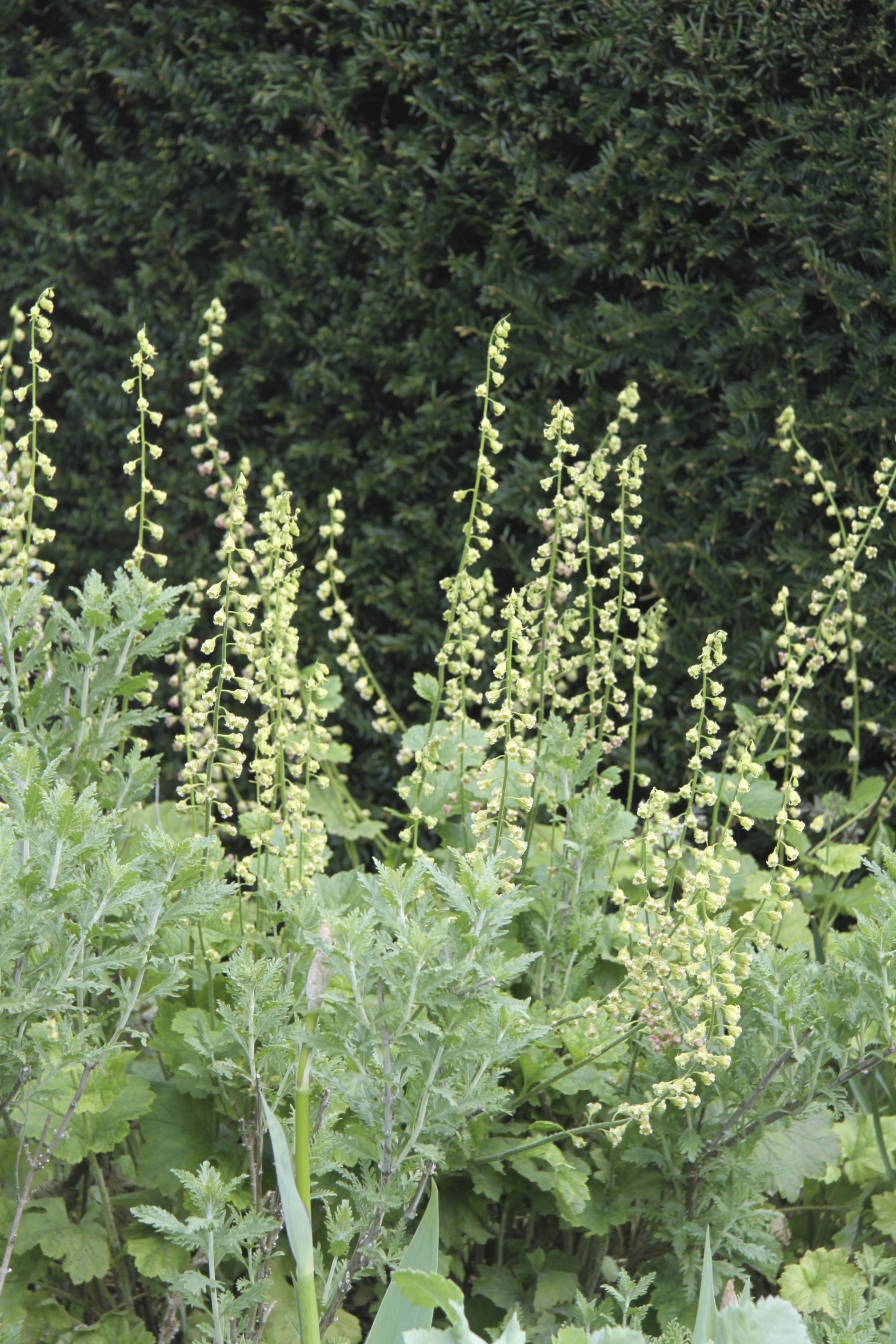
Elsewhere the pale green bell-like flowers of Tellima grandiflora add light and grace to the planting throughout the border.

IMG_3161 (2)

Tellima grandiflora 
tellima amongst camssaia
Tellima grandiflora adding a lightness to Camassia.

And the clever use of the diminutive rusty flowered Euphorbia dulcis ‘Chameleon’ adds depth and a deft subtlety to the planting:

dark euphorbia

Euphorbia dulcis  ‘Chameleon’ adding depth to lilac honesty and tulips.

The swathes of vivid blue Camassia have a surprisingly powerful effect on the surrounding colours – the coolness of the blue somehow makes the contrasting colours sing more loudly:

IMG_3232_2

I am reminded again of Jacqueline Duhême’s recollection of her time assisting Matisse: “there was always one colour that would make the others come to light and for Matisse it was usually blue that made the yellows, oranges and reds brighter”.

At Petersham this late spring border is full of signs of the way the garden is about to change. This rounded oriental poppy bud is on the verge of bursting open into a ball of colour:

IMG_3211_2 Bud of oriental poppy.

Torch-like shrubs of alternating claret and bright green Cotinus parade up the borders – their leaves growing daily and the pool of colour they provide getting bigger and having more influence day by day:torches of cotinusCotinus shrubs parade up the borders.

And the lush green leaves of Crambe cordfolia, which for now sit so demurely at the feet of the handsome yew acorns, will soon spin out into such huge airy clouds of white flower that for a while you will barely be able to squeeze past. The picture is about to change completely.
crambe

Crambe cordifolia leaves (left) at the base of a topiary yew acorn.

I make my way back from this private garden to the public Petersham Nurseries – back through a lovely ornamental potager with pale wigwams of papery silver birch:

kitchen garden 1Silver birch plant supports underplanted with herbs and narcissus.

I pass a wonderful small fleet of fat terracotta pots each housing a greedy artichoke plant.

IMG_3123
It is a delight to see a young chef darting around the kitchen garden collecting flowers of borage, thyme and chives to use in the cafe and restaurant:IMG_3257 And I love the way that tulips and cow parsley are growing together with the culinary herbs:IMG_3262Purple sage with tulips and cow parsley.

Next to the garden gate is a luscious patch of blousy peach coloured tulips, Tulipa ‘La Belle Epoque’. I absolutely want some of these to plant next September.

IMG_3122

Tulipa ‘La Belle Époque’

I chat on the way out to Rosie Bines.  I tell her how much I admire her work and she tells me that she likes my favourite, ancient, tomato-soup coloured gardening mac.  I am glad, obviously, that I had worn something that more or less suited the garden …

IMG_3561

My tomato-soup coloured gardening mac.

On the pin board above my desk I have a beautiful Matisse touchstone: a postcard of a black cut-out leaf against mint green from the Royal Academy Matisse exhibition of 2005:

matisse leaf

Next to it is a photograph of my idea of the ultimate swimming pool –  the pool at the hotel, La Colombe D’Or in St Paul de Vence in the South of France.  It is, of course, the perfect place to stay if you want to visit Matisse’s Vence Chapel in person.

Everything comes together: the blocky deep green of tightly clipped Cypress – sobering, balancing –  and the exuberant yellow of the mimosa which is made made more heady and electric by the richness of the blue sky.

pool

The swimming pool at La Colombe d’Or.


LILY OF THE VALLEY ON THE FIRST OF MAY

GRACE KELLY, PARIS IN THE SPRING TIME AND THE “WORST OF ALL DELICIOUS” WEEDS

IMG_3075

Convallaria majalis var. rosea after the rain

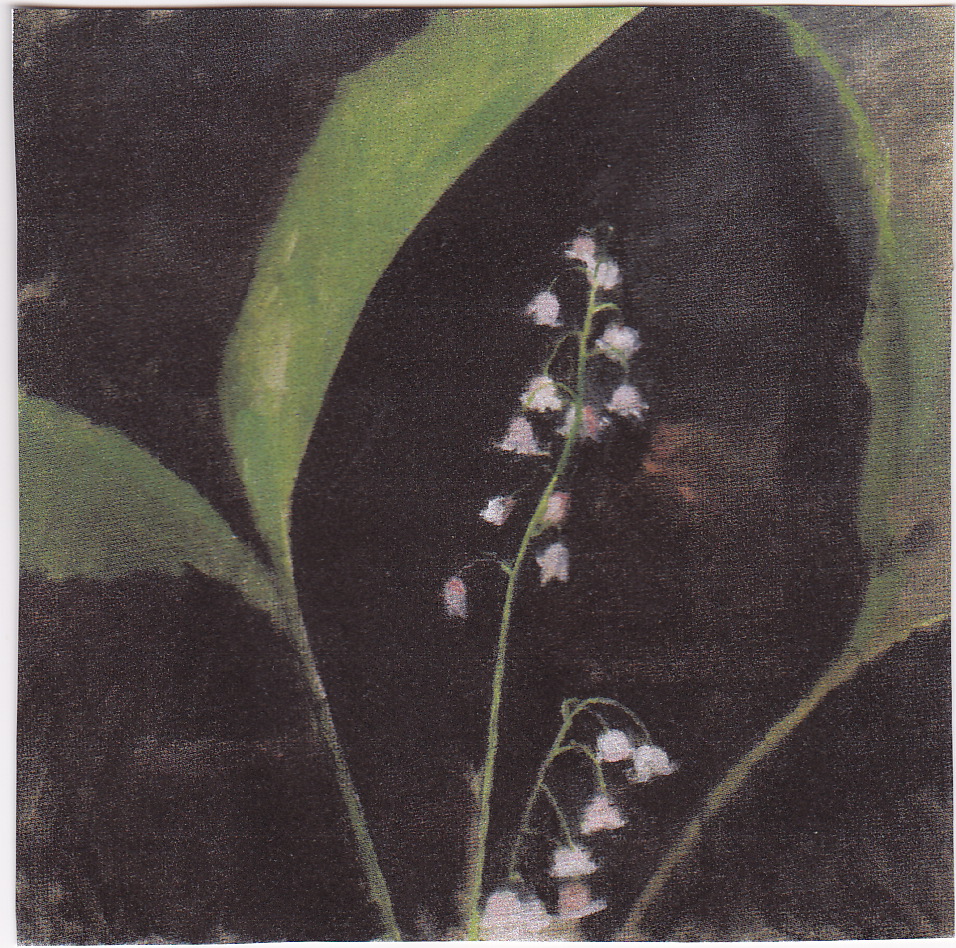
On the wooden table outside our kitchen door I have a terracotta pot of the most elegant pink lily of the valley, Convallaria majalis var. rosea.  The pot was given to me as a precious container of newly planted bulbs by my friend the painter, Charlotte Verity .  The gift was important as it was a memento of an extraordinary year Charlotte spent as Artist in Residence at The Garden Museum in London in 2010.  Here in the shadow of the ruddy castellated walls of neighbouring Lambeth Palace, Charlotte spent a year painting in Tradescant’s Garden – the knot garden created in 1981 by the Dowager Marchioness of Salisbury around the important tomb of the Seventeenth Century plant hunters.

majalis 3

Lily of the Valley 2009 – Charlotte Verity

Here amongst the formal framework of box with its spring halo of brilliant green, Charlotte’s observation of the garden’s plants was intimate and exquisite:

‘The medlar tree painting is taking a long time, the paint thickening and in danger of losing light.   Trying to get the direction of the branches the way they step back and forth, the silvery bark shining in the light and dark in the shadows” (extract from the wonderful diary she kept through the year and published by the Garden Museum).

I love the love lush fullness of her 2009 painting of white lily of the valley – in which the leaves almost battle for position.   Early twentieth Century plant hunter, Reginald Farrer describes lily of the valley as “the worst of all delicious weeds when it thrives” because of its  sometimes rampant tendency.  But as Beth Chatto writes in her nursery catalogue, conditions are not always easy to achieve and if one has “humus rich soil, among shrubs perhaps, where there is room for the wandering rhizomes … who would not plant lily of the valley for its heady scent in May and June and the chance to pick handfuls for the house”.

One of my favourite examples of the way lily of the valley can be grown to exploit this energetic tendency is the regimented mass of them in the walled kitchen gardens at West Dean College and Gardens in Sussex. Here amidst the covetable order of fruit tunnels, lined out vegetables and the ultimate gothic-gated apple house, lily of the valley grows in impressively deft order at the base of a beautiful flint wall.

apple store

The Apple Store in the Walled Kitchen Garden at West Dean

Lily of valley west deanLily of the Valley at the base of a flint wall at West Dean

Charlotte’s painting of the pink lily of the valley she encountered in the Tradescant Garden at the Garden Museum is one of my favourites.  I love the way she has captured the spare, framing curve of the strong leaves which form an arch around the pale, silvery pink of the flowers, and I am moved by the clarity of colour given to the Convallaria against the deep earthiness of the background.  
charlotte 2

Convallaria Rosea 2010 – Charlotte Verity

If you should have a problem with over zealous species lily of the valley, choosing this less vigourous pink form or one of the Saville-Row-handsome variegated forms would be a rewarding move for a shady spot in your garden:

IMG_3069

Convallaria majalis var rosea – a present from Charlotte in September 2013

IMG

Convallaria majalis ‘Variagata’

If you opt for the variegated route it is important to source your plants from a really good nursery. Beth Chatto is open about the trouble her nursery has had in the past with the handsome leaves of variegated lilies of the valley often reverting to plain green in a ‘disappointingly short time’.  The nursery now offers the seemingly steadfast  Convallaria majalis ‘Albostriata’ when it is available.

One of the really helpful characteristics of lily of the valley is that the foliage dies back after blooming which makes it a perfect subject for Great Dixter style intensive successional planting.  There is an excellent article by Gareth Richards about lily of the valley in the April 2014 edition of the RHS Garden Magazine.  Here, National Plant Collection holder, Brigitte Haugh recommends a rather brilliant sequence of snowdrops, followed by lily of the valley, followed by Turk’s cap lilies.  All three thrive in similar conditions and yet only one will be present in the same spot at any one time.

pcmuguet

Today, in France it is La Fête de Muguet or Lily of the Valley Day.  It is a national holiday (also Labour Day!) with a sweet tradition of giving fragrant bunches of lily of the valley to family and friends. This symbolic gift of flowers is said to date back to 1560 when King Charles IX was given a posy on the first of May as a token of good luck and prosperity for the coming year.  It became an annual tradition for the King to give members of his Court lily of the valley on May Day –  a tradition revived in around 1900, first as a romantic present and now a ubiquitous part of the holiday.

I remember seeing cellophane wrapped cones of rather giant lily of the valley on sale EVERYWHERE in Paris, (garages, department stores, pavements), when I spent a rather idyllic few months studying History of Art at the Sorbonne in my Gap Year.  It turns out rather satisfyingly that there is a particularly favoured chunky variety called ‘Géant de Fortins’. Despite the rather over commercialised reality of today’s version of the tradition there is a lingering fragrant romance to the very idea.

It is tied up with the freshness and the scent and all our romantic notions of Paris in the spring.  When the perfect Grace Kelly married Prince Rainier III of Monaco in late April 1956 she carried a demure, bouquet of tiny pearl-like lily of the valley and our hearts have been irrevocably caught ever since:

Grace Kelly 1

My own parents got married three years later during a very snowy January in Wales.  My mother is famous for worrying most that her cream satin dress would ‘look dirty’ against the white of the snow.  But she looked beautiful, of course, and I will always treasure this photograph with her own simple bouquet of lily of the valley nestling near the wedding cake.M&DI am about to plant my delicate pale pink lily of the valley in the ground and hope they will multiply with unseemly vigour.  Happy May 1st!

TWO WILD WELSH EASTER WALKS – AND A TAME ONE

 THE PEMBROKESHIRE COAST, A FOREST IN CEREDIGION AND THE PERFECTION OF ABERGLASNEY

It has been a dazzling April – except for today when I set off for a walk in my navy blue fur coat and return ridiculously soaked and bedraggled like a cartoon dog who has been up to no good.

Every morning I have been watching the sun creep over the back fence of our garden in South London and feeling as the day goes on that I can see the plants growing before my very eyes.
IMG_3058

We have just visited West Wales for three days and have enjoyed three perfect walks. The first walk was a whole day and a picnic along part of the Pembrokeshire coastal path:

IMG_2853Much of the way is lined with cow parsley – I love this moment when the cow parsley is still tight and yellow-green and you get that first-snatched taste of the lacy fullness to come.

IMG_2831Turn a corner as the sun comes out and you could think you are suddenly in the Aegean:

establish island

Dense cushions of thrift (Armeria maritima)  soften the path:

IMG_2859

The thrift’s bobbing pink heads cling astoundingly to the cliff edges:

IMG_0836

If you look closely amongst the floppy fringe of grasses in the plainest most exposed parts of the path, there are soft mauve sweet violets everywhere:

violet and pathThe expression ‘shrinking violet’ was first used to describe the violet’s modesty by Victorian essayist Leigh Hunt. It was quickly taken up as an expression to describe a quiet, even introverted personality.

On this walk I am fascinated at the way the flowers take such pains to lurk behind other foliage – and I cannot get the image of Dash’s gawky teenage sister hiding shyly behind a curtain of hair in the brilliant INCREDIBLES movie out of my head. Only when I get home and look her up am I reminded that the character is course perfectly named, Violet!

images

Violet from the wonderful Pixar Movie, The Incredibles, hiding behind her hair

violets

Sweet violets hiding behind lush Welsh grass

Other wild flowers on our route are the lovely sea campion (Silene uniflora) – bright white flowers held by a delicate, smokey pink calyx:

sea campion
Neat mounds of common scurvy grass (Cochlearia officinalis):

white flower tbc– its leaves full of Vitamin C, traditionally much valued by sailors as a protection against scurvy.

And there is the constant presence of blackthorn (Prunus spinosa) – its spikey white-splashed framework looking entirely gorgeous against the surprisingly rich blue of the water below:

IMG_2871

The pale grey frills of lichen are breathtaking close-up:

IMG_2876By the time I see this blocky, white-washed, cliffside farmhouse I am ready to move in and create a seaside garden of my own, planting it very simply but generously with the sort of plants that have we have just walked past.

IMG_2880

At the end of our walk stands the 1930’s chapel of St Non – a notice tells us that church services are no longer held here as when the rain beats against the chapel it can penetrate the two and a half feet walls in less than thirty minutes.

IMG_2886Inside there is the stained glass window of St Non by a follower of William Morris.  The clear royal blue and turquoise are surprisingly vibrant in the suddenly chilly low light at the end of the day:

IMG_2882

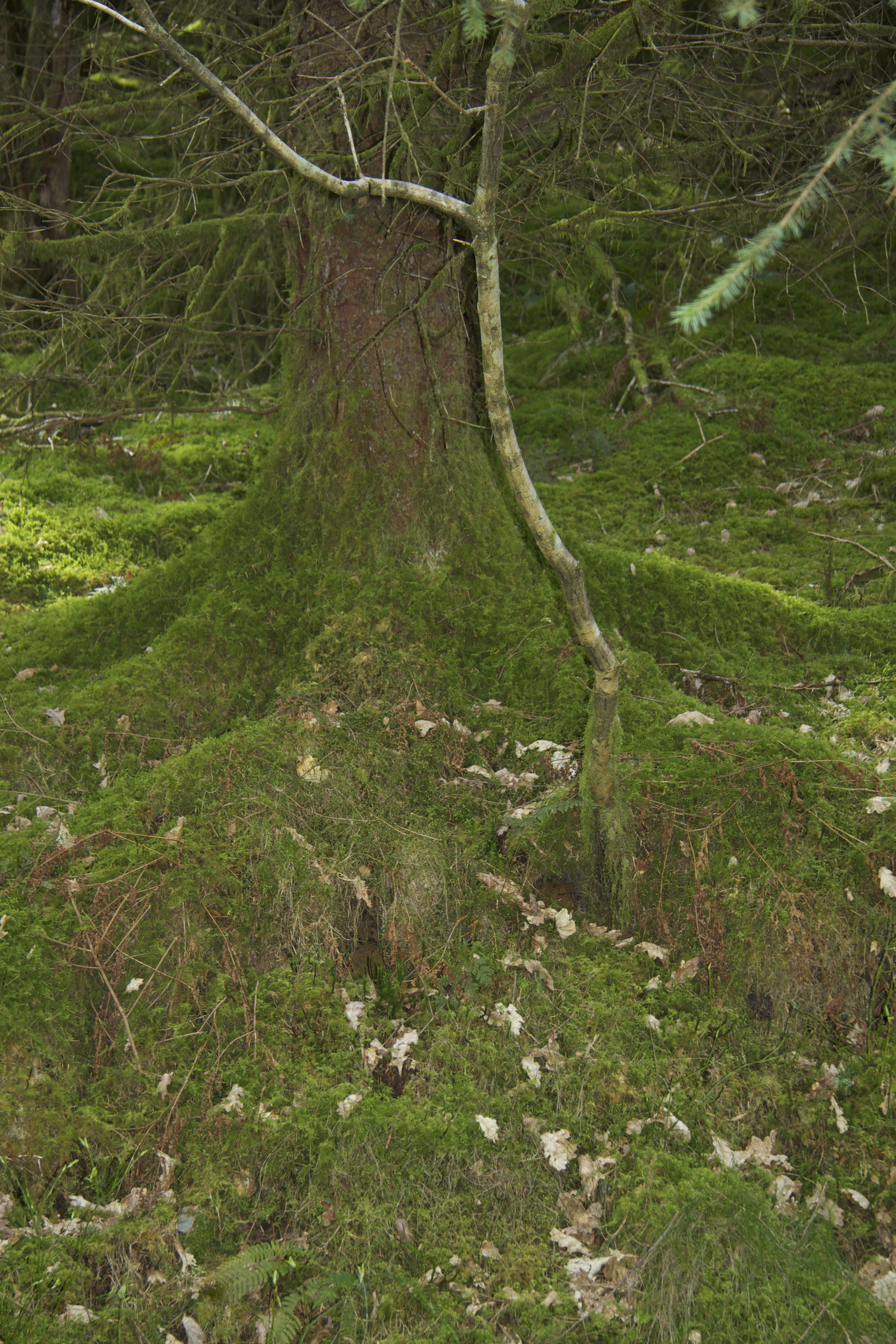
The next day I make sure to get a reassuring fix of timeless Welsh moss in a favourite stretch of forest near Brechfa in Carmarthenshire

Here the moss is everywhere – on the bare branches of deciduous trees:

moss branches

Clothing the base of trunks and catching fragments of available light:moss trunk Forming softly carpeting ripples:moss carpet

that make you want to stop and look closer:moss carpet closerand closer still.moss carpet closest

This is real Wales to me. We amble through the forest before lunch on Sunday and I feel rooted and cushioned by our visit.

On the way back to London, still in Carmarthenshire, we visit the restored medieval gardens of Aberglasney.  The perfection of the immaculately gardened grounds is occasionally overwhelming but there are some very beautiful elements and as always ideas to try to take away.

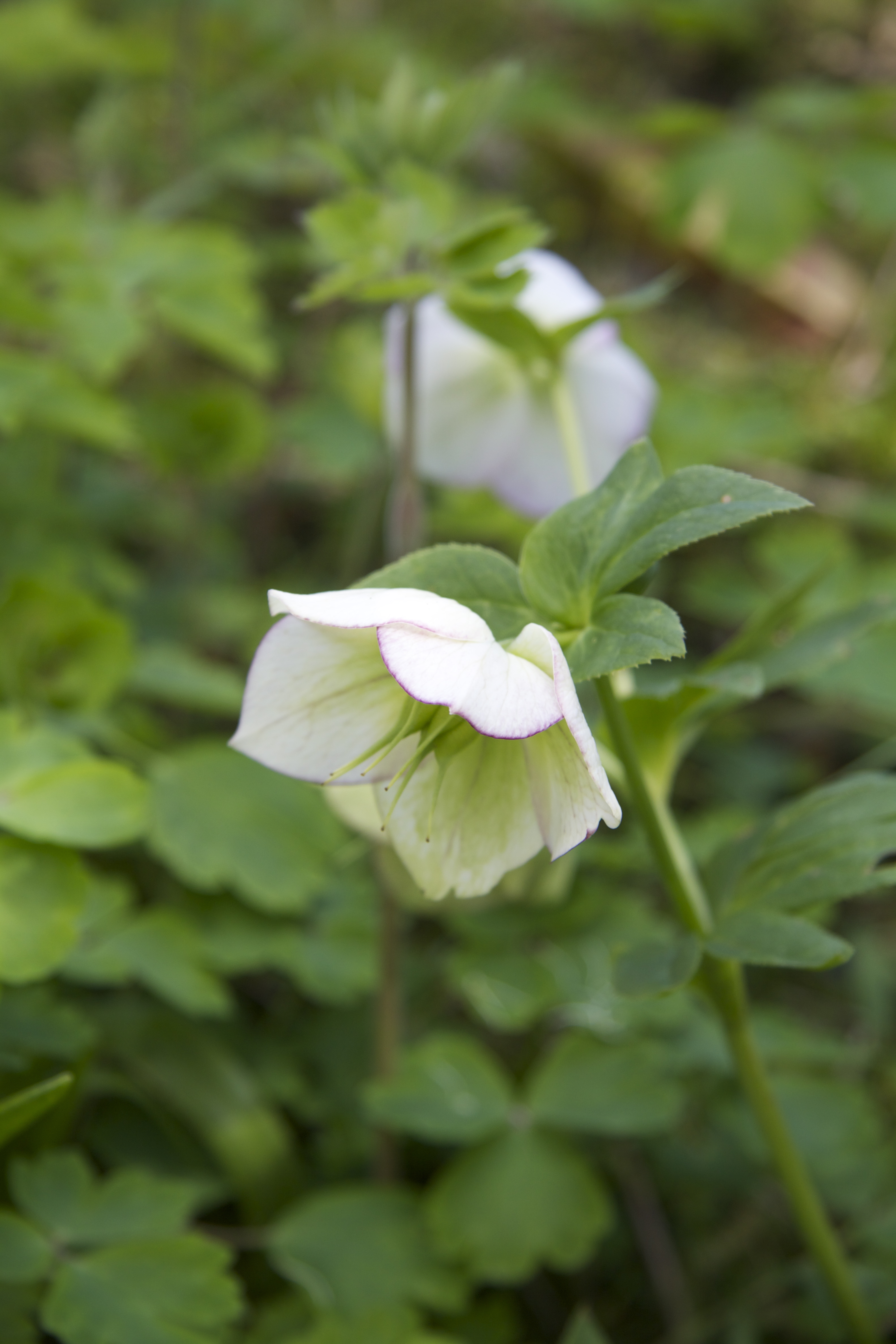
In the woodland garden we walk amongst competition quality examples of shade loving planting. There are still some perfect examples of the beautiful pink edged Helleborus orientalis ‘Harrington Double White Speckled’:

IMG_2937

and as the hellebores begin to fade a sea of pretty leaved Aquilegia foliage is rising up to take over – a perfect and practical example of successional planting:

IMG_2935 (1)

Paths are generously edged with my favourite dicentra – the glaucous leaved woodland dicentra, Dicentra formosa – lower growing and gentler in every way than its sometimes brash cousins:IMG_2943 IMG_2942Elsewhere the classic brilliant blue flowered Omphaloides cappadocica ‘Cherry Ingram’ is used again in large simple swathes:IMG_2938 IMG_2933And there are pools of the lovely pale blue grape hyacinth, Muscari Valerie Finnis – I have coveted this for a while now – time to put it definitively on my bulb order for September 2014IMG_2954 (1)I also made a luscious new discovery- Jeffersonia diphylla:

jeffersonia

This North American woodland plant has wonderful rounded bow-ties of bright green leaves and will bear bowl shaped anemone like white flowers later in the month – available to buy in the UK from Long Acre Plants, a great nursery which specializes in plants for shade.

And then there are the beautiful bones of the garden, old stone walls which are wonderfully exploited in different ways throughout.

Here the handsome crenellated wall provides a strong structural shape to balance the mature trees beyond and acts as a backdrop for the brightly coloured bedding in front.

IMG_3045

In some parts of the garden the walls are left plain – moments of plant-free calm

IMG_2970

Elsewhere they offer wonderfully framed openings onto new areas of the garden:

IMG_2968

Where the walls are clothed in plants the approach is simple and uncluttered. There is an entire wall of ivy leaved toadflax (Cymbalaria muralis) – a delicate trailing plant with tiny ivy-like leaves and lilac flowers ‘like tiny snapdragons’ ( turn to Chiltern Seeds if you would like to recreate the look) all summer.  This plant was introduced to the UK from Europe in the Seventeenth Century and is perfect for growing in crevices and on walls to create a soft atmosphere in a new wall.

IMG_2972

There are further crenellated walls elegantly laced with stems of Virginia creeper –  again I am moved by this moment in the year when you can almost see the new leaves growing, trying to cover the wall completely.

IMG_3008

And in the walled kitchen garden there is a magnificent stretch of perfect ‘Belgian Fence’ trained apples and pears:

IMG_2978

It’s fascinating to see how far behind the trained apples are on the left of the steps:IMG_2981compared to the trained pears:very close pear

There are also two handsome crab apple tunnels which I remember visiting years ago in late summer when they were heavy with tiny red fruit:

malus tunnel

The crab apple used here is the compact and particularly broad variety, Malus sargentii, which has a profusion of long-lasting neat cherry-like red fruit from August onwards. The neat pink buds will open to white and the tunnel should be in full flower by the end of April/beginning of May.

close up sargentiiMany parts of the garden are linked by immaculately cobbled and criss-cross patterned stone paths:

IMG_2966IMG_2965 (1)And through a final archway is a storybook perfect fritillary meadow bathed in sunshine:

IMG_2994IMG_2996

And so back to South London with a jolt but amazingly the blue skies continue.  When we stop for lunch even the wall in the pub car park is bursting into life:

IMG_0850

Back in our kitchen I look up at the glorious fig tree outside the back door.  There is the same buzz of excitement I felt witnessing the unfurling cow parsley in Pembrokeshire and the still separated leaves of the virginia creeper at Aberglasney –  again I am witnessing a plant which is growing towards the summer before my very eyes:

IMG_3053


Sea campion, moss and a Ninfarium – obviously – in the land of St Non


HOW TO GET AN A* FOR YOUR GARDEN

EASTER REVISION TIPS FROM THE GARDEN AT GRAVETYE MANORmag close up

Revision is heavily in the air at home in Camberwell – our identical twins working away for their A level exams in June.

IMG

(a somewhat inaccurate representation of the chaps you will find today stewing over the use of harmony and tonality in the 4th movement of Shostakovich’s 5th Symphony …)

Visiting one of my favourite gardens a few days ago,  I was reminded that we are never too old to get out our notebooks, really try to work out what makes a good garden great and try to put our learning into practice.

Gravetye Manor, in Sussex – the former home of Victorian writer and gardener, William Robinison, who pioneered the idea of creating an abundant natural atmosphere in a garden, – is now once again gardened with energy and and exciting flair by Head Gardener, Tom Coward.

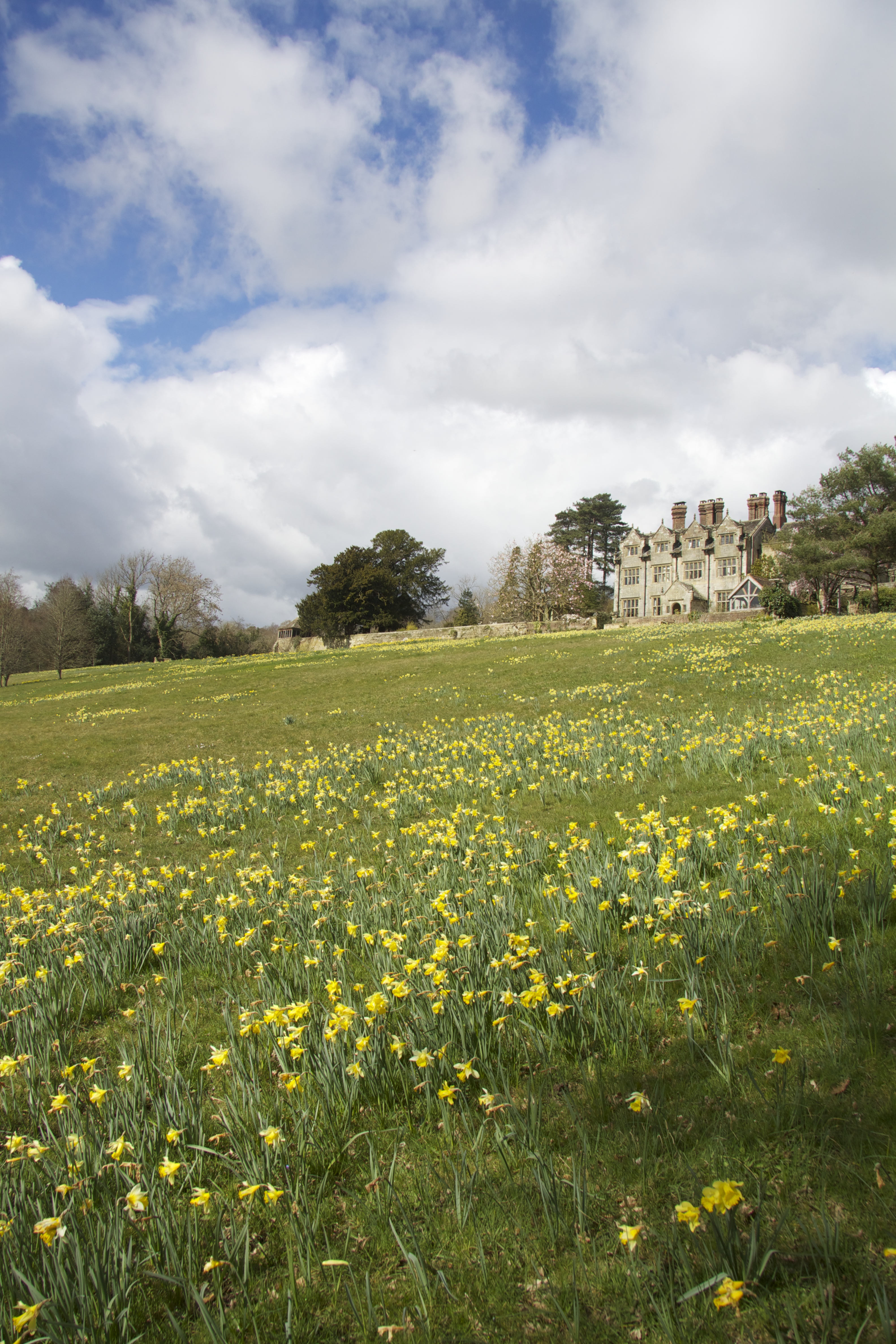
gravetye take 2For those without acres of land spilling down to their own private lake to fill with naturalised narcissus and wood anemone there are great ideas to be noted down and tried on a smaller scale.

luecojum close upLeucojum aestivum ‘Gravetye Giant’ AGM

Leucojum aestivum ‘Gravetye Giant’ is a particularly good selection of summer snowflake – made by William Robinson –  which contrary to its common name is in flower in late March to early April.  It is a strong bulb with tall stems holding nodding white flowers – brilliant planted generously as it is at Gravetye, wonderful to illuminate lightly shaded areas under trees and excellent value as the bulbs are reliably perennial.

light up take 2

framed leucojum take twoAs well as the abundant woodland drifts, Leucojum is used nearer the house to add a lower layer brightness to the planting.  Here the beautiful early flowering Stachyrus praecox is a wonderful choice for its position near the front door:

stachyrus and leucojumpg

I love the draped order of the neat tassels of pale greeny-yellow bells.

stachyrus closeup

It is a shrub that has its moment of real elegance only briefly before the arrival of its leaves – so here in a prominent position against the moss-softened stone of the house is an example of perfect positioning.
styrax against stone

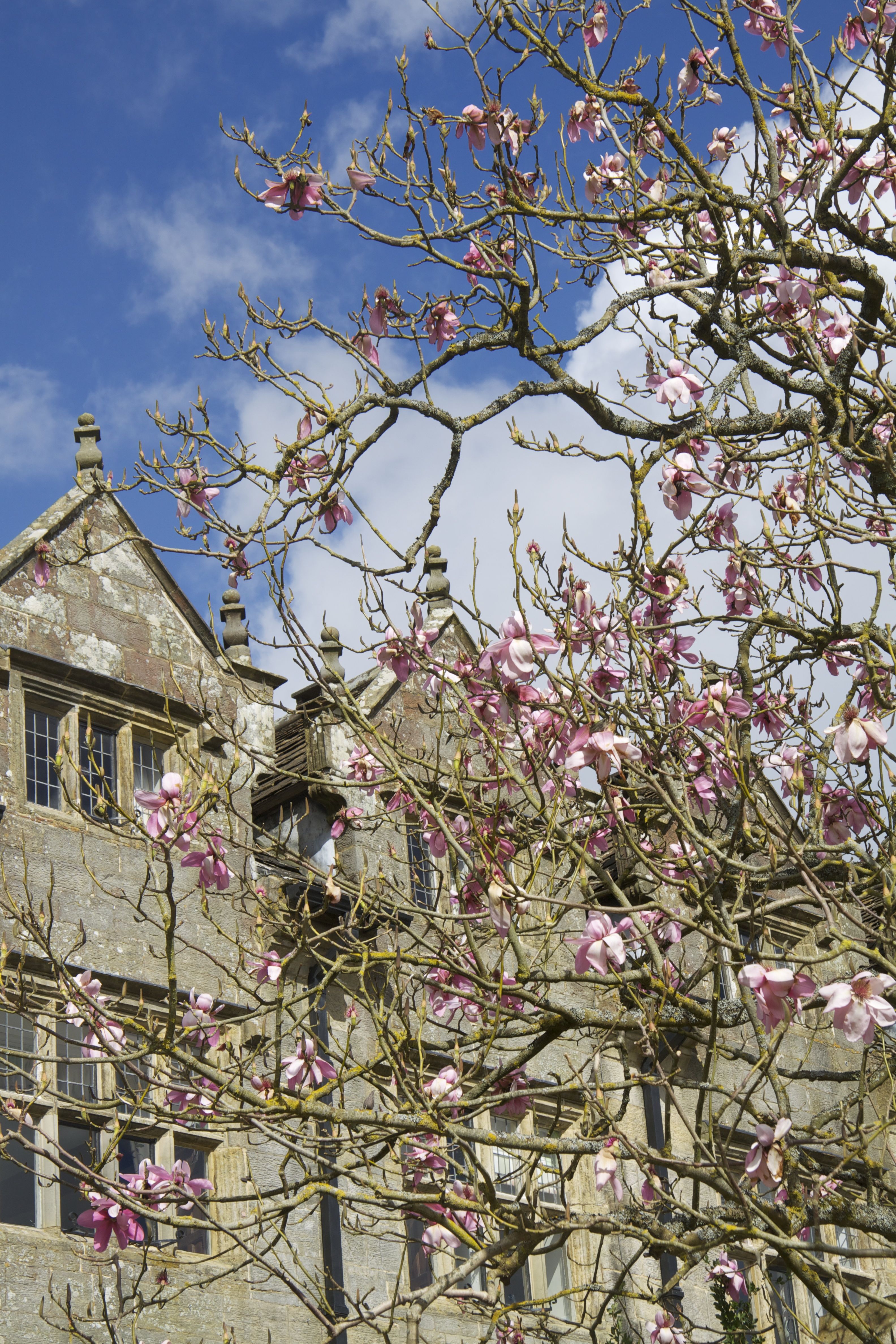
Another example of a brilliant pairing of architecture and planting is this monumental magnolia tree towering upwards against the sky and the hill top gabled roof of the manor house:

momumental mag

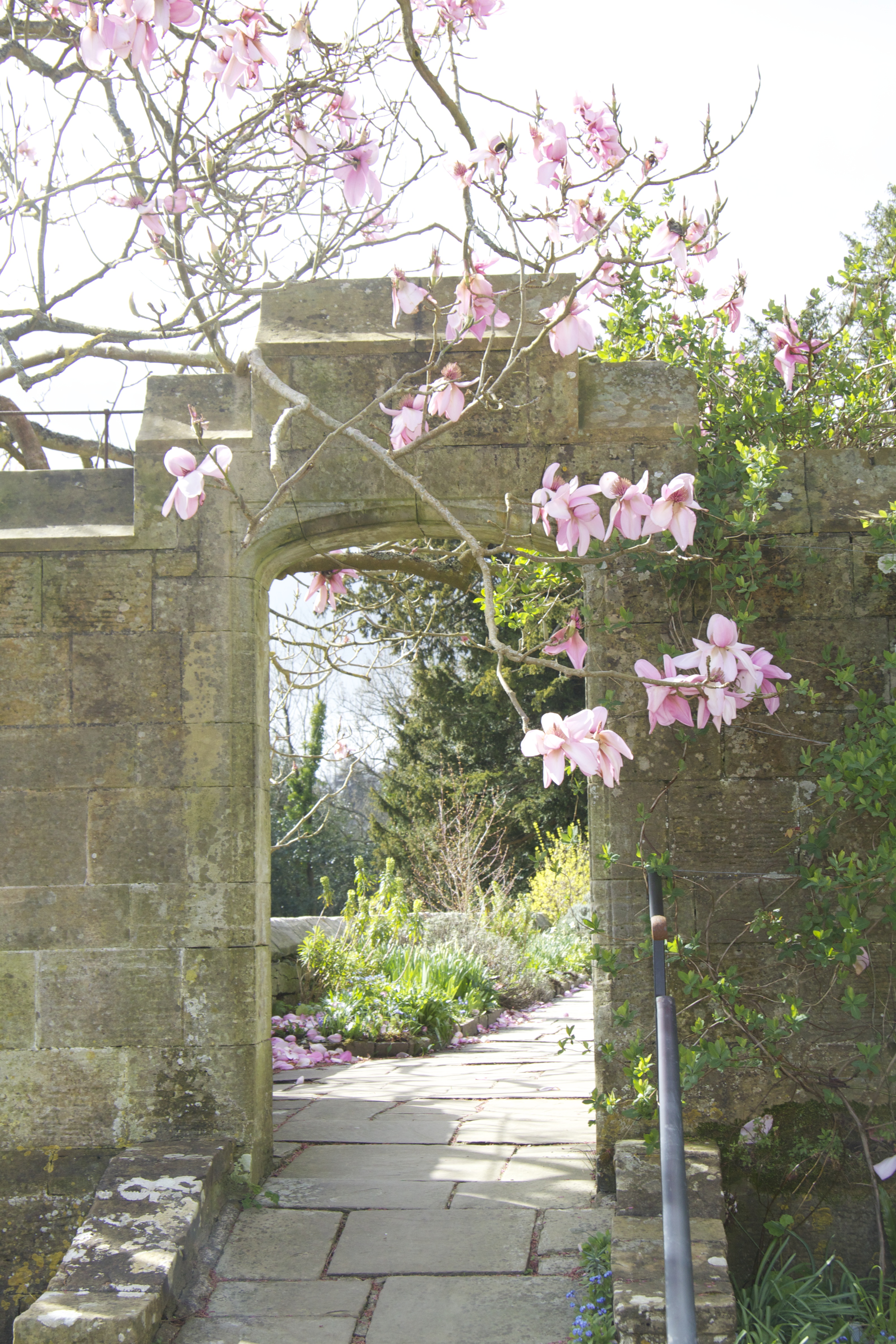
There is another sensational Magnolia planted so that its branches tumble invitingly at a gateway through to another section of the garden:

position mag gravetyeAgain this is an important idea worth remembering for any size of garden – as well as providing gorgeous decorative frame for the gateway, it means that the voluptuous flowers are brilliantly close to the eye.mag close up

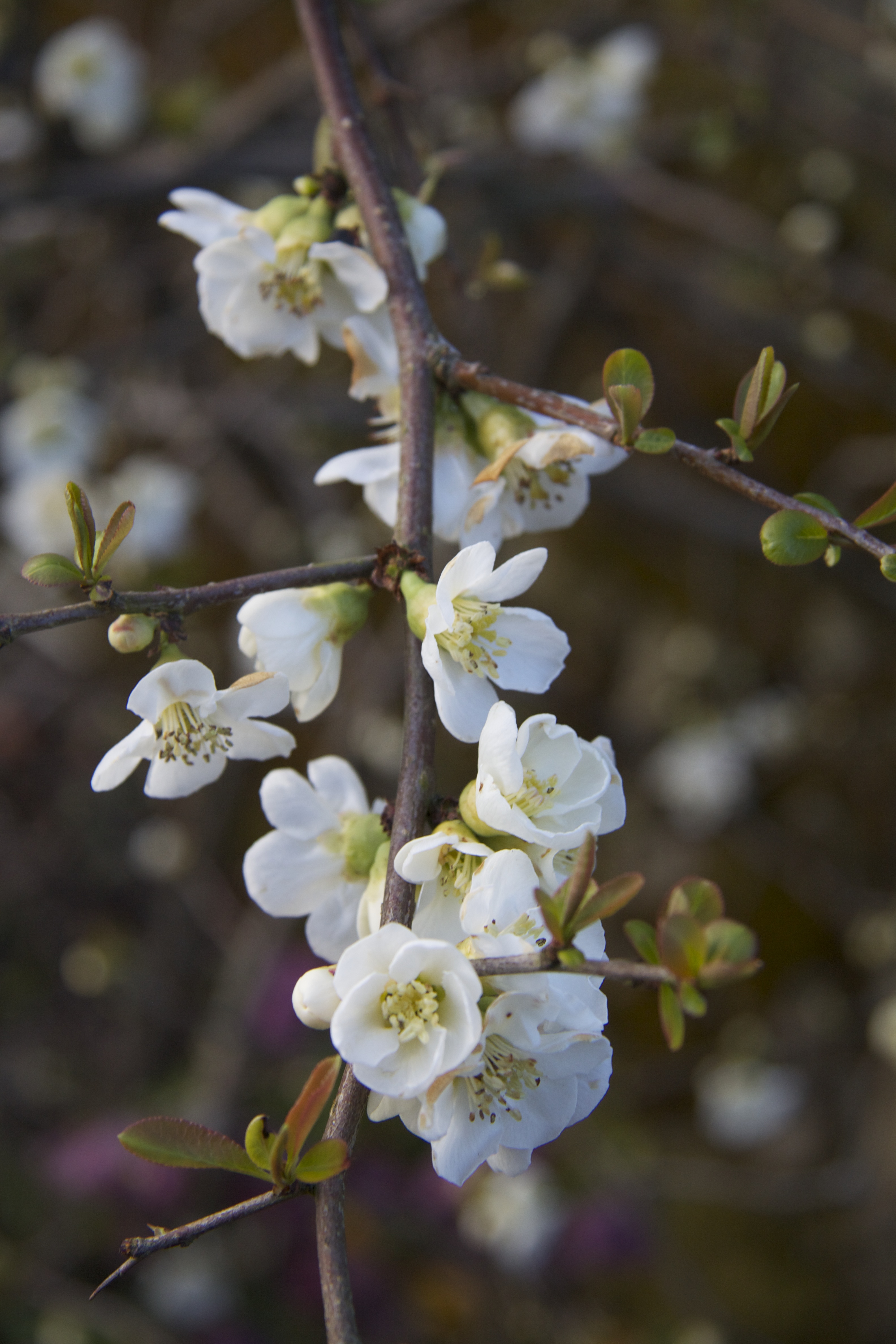
Another clever planting idea is to take a simple deciduous shrub and to repeat it throughout a  garden or a section of a garden. At Gravetye, a white ornamental quince – I think it is Chaenomeles speciosa ‘Nivalis’  – is planted several times along the drive to provide a cloud after cloud of white blossom .

quince take 2

This inexpensive, low growing, early flowering shrub has clear, single flowers with a restrained Japanese quality – again they look particularly elegant here against the soft hazy green of the moss covered walls:

close up chaenomeles

In the woodland garden a single brilliant orange-red coloured Chaenomeles – a similar quince would be Chaenomeles speciosa ‘Sargentii’ – is used in a completely different way, to add a intense splash of colour to a gentle underplanting of pale yellow narcissus:

ornamental quince use 1

At the entrance to the kitchen garden there is a great example of a how to maximize the potential of a tough, often underrated evergreen shrub, Viburnum davidii:

viburnum davidii

It is an excellent, resilient, structural plant which grows in a naturally soft mounding way – worth remembering to soften an entrance or help anchor a garden bench.

I was interested to see one of my favourite tough ground cover plants for wilder areas – Trachystemon orientalis – used to add a pool of bold lime green foliage under a tree in a comparatively formal area of the garden.  
trachestemon gravetye

Trachystemon orientalis is completely unfussy and provides bold, handsome foliage and starry blue flowers quickly and generously  – we have used it successfully to provide substantial coverage to the planting around a new lake in Sussex.  Here, I suppose, is an example of a rule which is there to be broken.  This bed at Gravetye is already coming alive with its vibrant colour.  It will be interesting to revisit at exam time in June to see if this has been a stroke of genius or a risky move …

trachestemon close up

The last of my revision notes from Gravetye is a photograph of this perfectly trained and pruned rose against a potting shed:

rose pruning

If you want an outbuilding roof to be romantically smothered in roses next summer this is the disciplined backbone required…

Gravetye Manor is now run as a Relais and Chateau Hotel. What is so rare about it, however, is that as well as being fantastically elegant and spoiling it manages to maintain the feel of a cherished home both inside and out.  My husband brought me here for the first night of our honeymoon and it has become our absolute favourite place for ‘end of term’ rewards – a day out together when our twins had just turned one, a special birthday weekend, a blissful 24 hours at the end of a particularly challenging few months.

moody woodland

We arrived on a brooding Saturday lunchtime and had lunch in front of the fire , a white table cloth on the small table in front of our sofa and the most delicious salad or roast jerusalem artichokes, artichoke puree, slices of apple, slivers of crispy fried onion and bitter leaves…

For me the garden is the thing and I love the way that even inside the hotel there are bowls of home grown flowers everywhere and the way the history and the future of the garden are being looked after in equal measure.

One last thought – if you really want to guarantee that A*, do make sure that when friends come to stay they open their curtains the next morning onto something like this:

IMG_0777


COPPICED WOOD – THE NON-HOBBIT WAY

INSPIRING ARCHITECTURAL USE OF COPPICED WOOD FROM BEIJING TO SUFFOLK

dezeen_Liyuan-Library-by-Li-Xiaodong-5                    Liyuan Library near Beijing by Li Xiaodong – Photograph courtesy of Dezeen

There is just a week left of the wonderful ‘Sensing Spaces, Architecture Re-imagined’ exhibition at the Royal Academy in London.  It is an uplifting, sensuous exhibition, featuring work by seven architectural practices from four different contintents. It does exactly what it sets out to do – delights and surprises the visitor and makes us think about thoughtful and innovative architecture in a way that feels personal and relevant to us.

My absolute favourite installation is by Chinese architect, Li Xiaodong – it is a darkened, straight-sided maze built of elegant panels constructed from immaculately ranked coppiced hazel and it is tantalisingly lit by an illuminated white path.

IMG_0772

For Owen Wainwright in The Guardian being in the space ‘feels like walking in a forest in the snow at night’. For me, one of the great pleasures of being in this magical wooded world is to stand still and watch the delight on visitors’ faces as they set off on an adventure to explore and find their way to the mirrored zen garden at the centre:IMG_0762

The hazel structures are very simple and very beautiful – the subtle, constantly varying, palette of silvered skins is central to their charm:

IMG_0774

And the moon-like lighting leaks through the gaps in the screens to create fine shadows:

IMG_0733

It was uplifting to discover that Li Xiaodong has already incorporated these fine natural screens into his brilliant design of the Liyuan Library near the small village of Huairou about two hours drive from Beijing:

dezeen_Liyuan-Library-by-Li-Xiaodong-4

Photo of Liyuan Library by Li Xiaodong courtesy of Dezeen

Here, the site for the library was deliberately chosen at the foot of the mountains, a five minute walk out of the village. The idea is that the conscious effort to head for the reading room amongst this beautiful, rugged landscape helps clear thoughts.

The building itself is made of glass and the hazel cladding was inspired by piles of locally sourced wooden sticks for firewood collected in piles outside the villagers’ houses:

dezeen_Liyuan-Library-by-Li-Xiaodong-9                    Photo by Li Xiaodong courtesy of Dezeen

Inside the library openings frame the view beyond and ‘the wooden sticks temper the bright light and spread it evenly through the space to provide for a perfect reading ambience’ (Li Xioadong).  I long to visit it.

dezeen_Liyuan-Library-by-Li-Xiaodong-2


Phto by Li Xiaodong courtesy of Dezeen

Back in the UK, I feel inspired to try at least to use coppiced wood in a more innovative, elegant way for gates, screening and garden buildings.

I touched on Patrice Taravella’s fantastically creative examples of working with coppiced chestnut in my December 2013 blog on  The Prieuré D’Orsan in central France and in my feature on the garden in February edition of Gardens Illustrated.

Here coppiced wood is used everywhere but always in a disciplined way – my horror is of the the Hobbit Movie ‘rustic’ use of coppiced wood to make supposedly charming curvy garden features which generally looked mismatched with everything else in the space.

Simple gates with hinges and handles made of recycled iron give this potentially very formal garden a soft, welcoming feel:

IMG_6449

IMG_6450IMG_6451

The gates vary gently throughout the garden and are designed to fit perfectly in each location:

IMG_6383coppice gateCoppiced chestnut is also used to build structures to give a romantic height and dreaminess to structural planting:

IMG_6432
structures giving structure

And to build garden rooms which look spare and basic in winter:

IMG_1304

But lush and cool in the summer:

IMG_6387

Arches and screens are ideas that could well be applied to a smaller garden:

IMG_1458IMG_6355

There are fantastic and highly skilled craftspeople to look to, all over the UK.  www.coppice-products.co.uk  is a great place to start to find someone in your area who could perhaps make make an a tunnel like this for a kitchen garden:

simple plant tunnel

or go for it and create something more monumental – I love this broad tunnel at WInterbourne Botanic Garden, Birmingham:3363577_277e2d70

Even simple wigwams as plant supports can be beautiful and strong if kept simple and unfussy:228

These plant supports are from Natural Fencing who already make a wide range of garden structures to commission.

Now in the swing of looking at structures made from coppiced wood with fresh eyes, I was struck by the new and very beautiful hurdle fence at Fullers Mill Garden in Suffolk which I visited this week.  The garden will open again on April 2nd.

This blonde, curving fence as beautiful as the wonderful old brick crinkle crankle walls in Suffolk villages such as Easton:

IMG_2639The fence was built in situ by master hurdle maker,  David Downie   Close up it has the same gorgeous subtlety of colour as the work of Li Xiaodong at the Royal Academy:

IMG_2647 It sits easily and comfortably in the naturally flowing context this wonderful plantsman’s garden in the middle of the King’s Forest and should last for about twenty years.

IMG_2651IMG_2648


THE CORNELIAN CHERRY – AND NORMAN STEVENS AT THE ROYAL ACADEMY

YELLOW AGAINST GREY IN A DULWICH GRAVEYARD AND AN EXHIBITION OF MAGICAL PRINTS OF PLANTS AND GARDENS 

cornelian plus gravesCornus mas – or the Cornelian Cherry – at the perfectly groomed Dulwich Old Burial Ground in South London.

stevens-levens-hall-garden-25113‘Levens Hall Garden’ screen print,  1985 Norman Stevens ARA

Friends who visit Dulwich Village from Islington perhaps or Kent are always amazed to find a small section of picture-perfect Connecticut in South London, ten minutes from Victoria station.  Saturday was a morning of glowering sunshine and the long dead inhabitants of the 400 year old cemetery were making earnest attempts to kick start the spring. The velvety day-glow green and yellow grass was erupting all over with silvery crocus buds and dense stooks of deep green narcissus foliage.

IMG_0715

I was in Dulwich to pay homage to my favourite specimen of Cornus mas – the Cornelian Cherry – which is the centrepiece of a beautifully groomed burial ground in the middle of the village. The burial ground is home to a dozen Grade II listed eighteenth and nineteenth century tombs of wealthy locals, the graves of 35 victims of the plague in 1665 and where Old Bridget the Queen of the Norwood Gypsies was buried in 1768.

Cornus mas is a densely branched, deciduous, large shrub or small tree with small umbels of brilliant yellow flowers in late February and early March.  It can be a rather unassuming tree but when given space – as it is here, the absolute queen amongst pale stone and open lawn – it can offer a sensational cloud of light and colour on the darkest of February days.

cornelian wholeclose up against white

The advantage of giving the tree this sort of space is that it will have a much greater impact later in the year too, when it is in leaf.  The potential for Cornus mas to be a really handsome specimen tree year round has now been realised by nurseries selling mature trees and if you have the room and the funds you could source a really handsome, spreading, semi mature “umbrella multi-stem’ from a nursery such as Deepdale Trees which supplies trees for many of the Chelsea Flower Show gardens.

Cornus-mas-4-5-6m

At the other end of the scale, a young Cornus mas can be a brilliant addition to a softer, more natural style of gardening too.  It was much favoured as a very tough, hardy tree by revolutionary Victorian gardener, William Robinson, and is currently lighting up a patch of open woodland in the Wild Garden at Gravetye Manor in Sussex,  see the Gravetye Garden Blog 

Tree and shrub specialists Bluebell Arboretum and Nursery recommend Cornus mas ‘Golden Glory’ AGM for its particular abundance of yellow flowers. After a hot summer,  ‘Golden Glory’ may produce a small crop of small, shiny, edible red cherry-like fruits in autumn. If, however, you’re after a jar of the elusive – and let’s face it, ultimate weekend gift –  homemade Cornelian Cherry Jam -the one to go for is Cornus mas ‘Jolico’ which the nursery describes as a ‘charming German form’ first selected to be used for commercial fruit production and which produces vivid red berries up to three times larger than those of a classic cornus mas.

3868599763_09c8859d20Shiny red fruit of Cornus mas – like miniature scarlet plums.

The fruits of the Cornelian cherry are always bitter and need vast amounts of sugar to make them palatable but the idea is very romantic. Try Almost Turkish Recipes for a reliable recipe.  Whilst waiting for your ‘Jolico’ to mature, maybe practise making the jam after a trip to the market on your next Mediterranean holiday?

In the meantime I am back in the UK on a stormy Saturday, on my way to the Royal Academy.  I have been seeing posters all over town for a small exhibition of prints by Norman Stevens. I can’t get the luminous, sculptural, bonnet-like image of the Topiary Gardens at Levens Hall – a gorgeous fourteenth Century Manor House in the Lake District  – out of my head.  There is something about the quality of the light and the rigid laciness of the foliage against the blue of the sky that makes me uncertain at first as to whether it is even a photograph or a print.

stevens-levens-hall-garden-25113

In Piccadilly, on my way to the exhibition, I am caught by the glinting, shadowy, greys and blacks of the windows of St James’s Church with the candle-like, palest pink, buds of just-about-to-open Magnolia in front of them.  This promise of voluptuous flower is my favourite moment in a Magnolia’s cycle:

IMG_0718St James’s Church, Piccadilly.

At the Norman Stevens exhibition the first print I encounter is an uncanny echo of the scene outside the church  – exquisite patterns of foliage against a building – shadows and highlights and shades of grey:

stevens-clapboard-house-25118

‘Clapboard House with Fronds and Architectural French Curve’, 1974, Etching and aquatint, Norman Stevens ARA

Norman Stevens (1937-88) studied painting at Bradford College of Art along with a particularly talented group of artists included David Hockney.  Originally a painter, he began printmaking in the early seventies and is now regarded as one of the foremost printmakers of his generation, revered for the way he always pushed boundaries with laboriously achieved effects of aquatint and mezzotint – and later screen prints -to create tone and texture,  soft grain effects and even the appearance of water colour washes.

There is a beautiful print called The Darkling Thrush made in 1976 to illustrate a volume of poems by Thomas Hardy.  A wonderful,  tunnel of a path formed from tangled scratchy black branches with grey-white blossom against a salmony, metallic-pink twilight sky. There is a Japanese quality of restraint and delicacy to this atmospheric work.

RF 080

‘The Darkling Thrush’, 1976, Norman Steven ARA Etching, aquatint

One of Norman Stevens’ latest prints is less comfortable but entirely memorable : the bright jauntiness of its colouring a poignant contrast to the sad subject matter – a pile of dismembered limbs of a favourite black walnut tree at Kew Gardens which fell in the storm of 1987.  Stevens’ eye for colour when working on a screenprint was legendary.  In the days before computer generated imagery he was brilliant at separating out the colours and predicting the results when they were printed one on top of the other – as fellow artist and print maker, Brad Faine writes in the exhibition catalogue ‘no mean feat when one uses ten to fifteen hand-made stencil separations.’

RF 089

‘Black Walnut Tree’ 1987, Norman Stevens ARA, Screenprint

But what I have really come for is Stevens’ etchings of topiary in great English country gardens – a dream world away from his crisp, California-inspired earlier work, with paintings and prints of white louvred windows, clapboard buildings and the foliage of tropical plants.

Porch 1971 by Norman Stevens 1937-1988

Porch, 1971, Norman Stevens ARA, aqua-tec on canvas, Tate

The Royal Academy exhibition features work inspired by the Victorian country house, Knightshayes Court in Devon, Painswick Rococo Garden in Gloucestershire and of course, Levenshall Topiary Gardens in Cumbria.

RF 077

‘Painswick, Moonlight’ 1979, Norman Stevens ARA, etching and aquatint

I am entranced by ‘Painswick Moonlight’  a finely worked, almost stippled, image of an impossibly perfect, dark, moonlit world of ranked monumental trees and mesmerisingly stripey shadows.

By Sunday evening I am walking through the cloisters of Canterbury Cathedral with one of my sons on the way to Evensong.  I love the way the freeform yew mound peers, monster-like over the finely carved decorative roof.  I think Norman Stevens would have enjoyed the rhythmic archctecture and the shadowy presence of plantlife.

IMG_0725enhancedCanterbury Cathedral cloisters, evening.